

Introduction
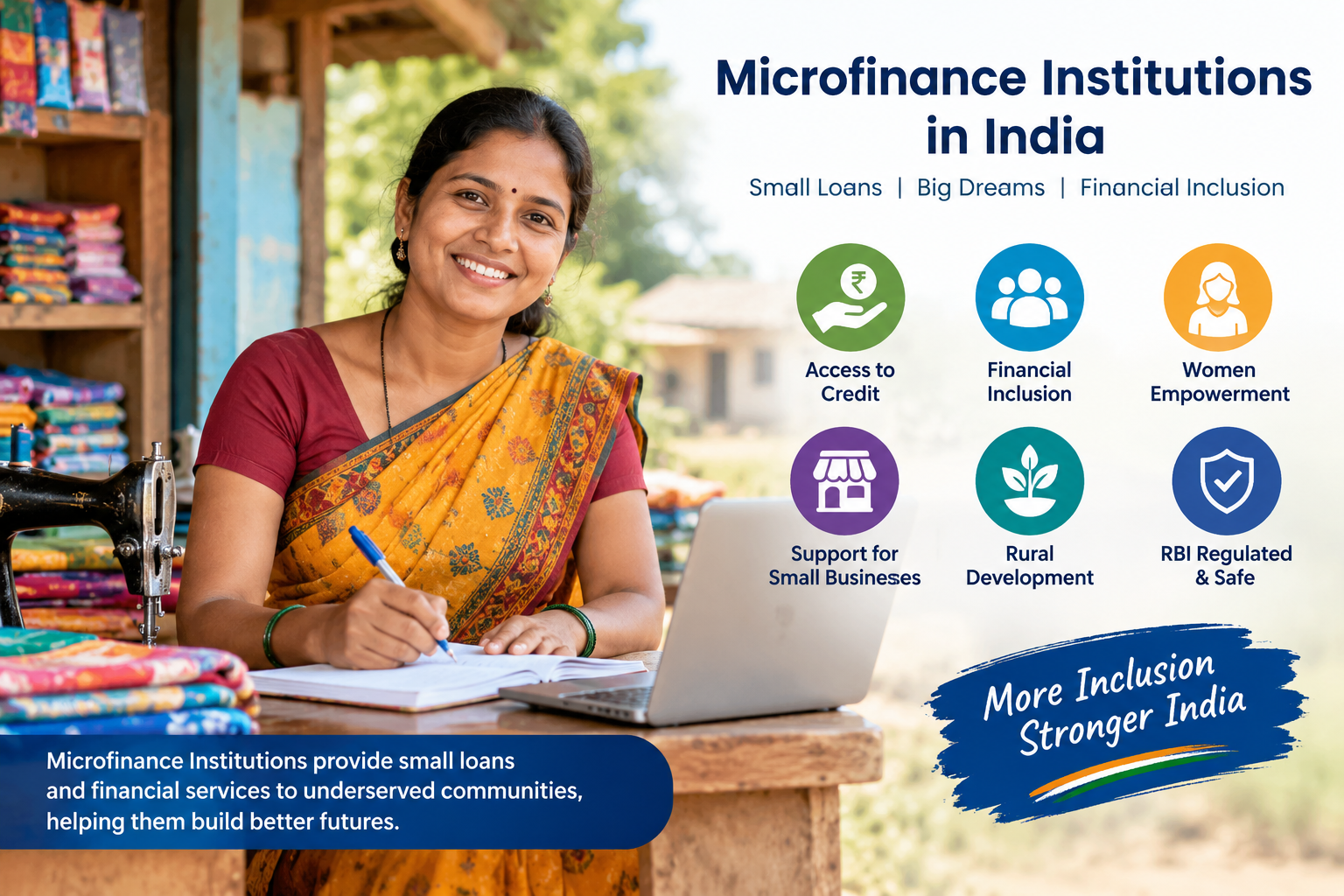
Access to affordable credit can make a significant difference for households and small entrepreneurs who may have limited access to traditional banking services. This is where Microfinance Institutions (MFIs) play an important role.
Microfinance institutions provide financial services, particularly credit, to individuals and households that may have limited access to conventional financial institutions. Their activities are closely connected with financial inclusion, small-business development, self-employment and household financial needs.
In India, the Reserve Bank of India (RBI) regulates microfinance lending by specified regulated entities. Under the RBI's regulatory framework, a microfinance loan is a collateral-free loan to a household with annual household income up to ₹3 lakh. The framework applies to commercial banks, specified cooperative banks and NBFCs, including NBFC-MFIs.
The RBI's Financial Inclusion Index also reflects the broader expansion of financial inclusion in India. The index increased from 60.1 in March 2023 to 64.2 in March 2024, with improvement across its access, usage and quality dimensions.
AI Answer Box: What Are Microfinance Institutions?
Microfinance Institutions (MFIs) are financial institutions that provide small-scale financial services, especially credit, to low-income households and underserved customers.
In India, microfinance loans regulated under the RBI framework are collateral-free loans provided to households with annual income up to ₹3 lakh. The regulatory framework applies to banks, specified cooperative banks and NBFCs, including NBFC-MFIs.
Quick Answer
MFIs generally help customers access credit for purposes such as:
- Small businesses
- Self-employment
- Livelihood activities
- Household requirements
- Education and other eligible needs
- Working capital
- Consumption-related expenses
Microfinance is therefore an important part of India's broader financial inclusion ecosystem.
What Are Microfinance Institutions?
A Microfinance Institution, commonly called an MFI, is an organization that provides financial services to customers who may not have easy access to conventional banking.
Microfinance can include:
- Small loans
- Credit services
- Financial literacy
- Insurance-related services through appropriate arrangements
- Savings-linked services where permitted through the relevant institution
- Other financial services depending on the institution's regulatory structure
The exact services available depend on the type of institution and the applicable regulations.
What Is Microfinance?
Microfinance refers to the provision of relatively small-scale financial services to underserved or low-income customers.
Microfinance is not limited to one particular type of organization. Banks, NBFCs and other eligible entities can participate in microfinance lending under the applicable regulatory framework.
Under the RBI's 2022 framework, the definition of a microfinance loan focuses on the borrower's household income and the collateral-free nature of the loan, rather than simply the size of the loan.
How Do Microfinance Institutions Work?
The basic MFI business model involves raising funds and providing loans or financial services to eligible borrowers.
A simplified process looks like this:
Funding → Customer Identification → Household Assessment → Credit Assessment → Loan Approval → Disbursement → Repayment → Monitoring
Step 1: Customer Identification
The institution identifies potential borrowers through branches, field officers, digital channels, community networks or other permitted distribution channels.
Step 2: Household Assessment
The lender evaluates household income and existing indebtedness.
RBI's framework requires regulated entities to have a board-approved policy for assessing household income.
Step 3: Credit Assessment
The institution evaluates factors such as:
- Income
- Existing loans
- Repayment capacity
- Credit history
- Household obligations
- Loan requirement
Step 4: Loan Approval
If the borrower meets the lender's eligibility and risk requirements, the loan can be approved.
Step 5: Loan Disbursement
The approved amount is disbursed through the lender's permitted process.
Step 6: Repayment
The borrower makes repayments according to the agreed repayment schedule.
The repayment schedule and frequency can vary depending on the product and the lender's policies.
Key Features of Microfinance Institutions
| Feature | Description |
|---|---|
| Small-scale credit | Focuses on underserved borrowers |
| Collateral-free lending | RBI's microfinance-loan definition covers collateral-free loans |
| Household-based assessment | Income and indebtedness are assessed at household level |
| Financial inclusion | Helps expand access to formal financial services |
| Rural and semi-urban reach | Many MFIs serve underserved communities |
| Flexible delivery | Loans may be processed through physical or digital channels |
| Credit information reporting | Regulated entities have reporting obligations to credit information companies |
| Customer protection | RBI framework contains customer-centric requirements |
RBI states that collateral-free loans to low-income households meeting the income criterion can qualify as microfinance loans regardless of whether processing or disbursal occurs through physical or digital channels.
Types of Microfinance Institutions in India
Microfinance activities can be carried out by different types of regulated entities.
1. NBFC-MFIs
An NBFC-MFI is a Non-Banking Financial Company specializing in microfinance activities and subject to RBI regulation.
RBI's framework specifically includes NBFC-MFIs among the regulated entities covered by the microfinance loan framework.
2. Banks
Commercial banks, including Small Finance Banks and Regional Rural Banks, can provide microfinance loans under the applicable RBI framework.
3. Cooperative Banks
Specified cooperative banks can also participate in microfinance lending under the applicable regulatory framework.
4. Non-Profit Organizations
Certain non-profit organizations may undertake microfinance activities, but the precise applicability of RBI's microfinance framework depends on their legal and regulatory status. RBI's FAQ specifically distinguishes regulated entities covered by the directions from other organizations.
Difference Between Microfinance Institutions and Banks
| Basis | Microfinance Institutions | Banks |
|---|---|---|
| Main focus | Often underserved and low-income customers | Broad range of customers |
| Typical lending | Microfinance and small-ticket credit | Retail, business, corporate and other credit |
| Financial services | Depends on regulatory structure | Deposits, loans, payments and other banking services |
| Customer reach | Strong focus on underserved segments | Wider customer base |
| Branch model | Often community/field oriented | Branch and digital banking networks |
| Deposits | Depends on entity and regulatory permissions | Banks accept deposits under banking regulations |
| Regulation | Depends on institutional category | Banking regulations and RBI supervision |
An important point is that not every microfinance institution is a bank. For example, an NBFC-MFI is an NBFC rather than a commercial bank.
Role of MFIs in Financial Inclusion
Financial inclusion means improving access to useful and affordable financial products and services.
MFIs can contribute to financial inclusion by helping underserved households access formal credit.
Major Contributions
1. Access to Formal Credit
Microfinance can provide an alternative to informal borrowing for eligible customers.
2. Support for Small Businesses
Borrowers may use financing for activities such as:
- Small retail businesses
- Livestock-related activities
- Handicrafts
- Tailoring
- Food businesses
- Local services
- Small trading activities
3. Women's Financial Participation
Microfinance programs have historically served many women borrowers, particularly through group-based lending models.
However, outcomes can vary between borrowers, communities and institutions.
4. Rural Financial Access
MFIs can help bring formal credit services closer to customers in areas where access to traditional financial services may be limited.
5. Credit History
Responsible borrowing and repayment can contribute to a borrower's formal credit profile where the lender reports relevant information to credit information companies.
Why Are Microfinance Institutions Important in India?
India has made significant progress in financial inclusion.
The RBI's Financial Inclusion Index increased to 64.2 in March 2024, compared with 60.1 in March 2023. The index measures financial inclusion through access, usage and quality.
MFIs are one component of this larger financial ecosystem.
Their importance can be understood through several areas:
- Credit access
- Rural finance
- Women's entrepreneurship
- Small business development
- Self-employment
- Financial inclusion
- Formalization of borrowing
- Community-level economic activity
RBI Rules for Microfinance Institutions
The RBI introduced the Master Direction – Regulatory Framework for Microfinance Loans, 2022, effective from April 1, 2022. The framework applies to commercial banks, specified cooperative banks and NBFCs, including MFIs and housing finance companies.
Household Income Limit
Under the RBI framework, a microfinance loan is a collateral-free loan to a household with annual household income of up to ₹3 lakh.
Household-Level Assessment
The lender must assess household income and indebtedness rather than simply considering the individual borrower in isolation.
RBI clarifies that all members of a household do not have to become borrowers. A loan can be provided to an individual member while the lender assesses household-level income and indebtedness.
Maximum Household Repayment Obligation
The RBI framework provides for a maximum limit of 50% of monthly household income for the aggregate monthly repayment obligations of a household across all outstanding loans, subject to the framework's provisions.
This rule is designed to reduce excessive household repayment burdens.
Pricing and Interest Rates
The framework requires regulated entities to have appropriate policies concerning pricing of microfinance loans.
Borrowers should check:
- Interest rate
- Annualized rate where applicable
- Processing fees
- Insurance or other charges
- Late-payment charges
- Total repayment amount
- Repayment schedule
The interest rate offered can differ between lenders and borrowers based on the institution's pricing policy and risk assessment.
2025 RBI Update for NBFC-MFIs
In June 2025, RBI revised the qualifying asset criteria for NBFC-MFIs.
Under the revised provision, qualifying assets of NBFC-MFIs must constitute a minimum of 60% of total assets, netted off by intangible assets, on an ongoing basis. RBI stated that the revised provision took effect from the date of the circular.
This is an important regulatory development for anyone researching the structure of the NBFC-MFI sector.
What Can Microfinance Loans Be Used For?
Microfinance loans are not necessarily restricted to one particular end use.
According to RBI's FAQ, collateral-free loans to individuals belonging to households with annual income up to ₹3 lakh are treated as microfinance loans, including loans used for consumption purposes, subject to the applicable framework.
Potential uses may include:
- Business working capital
- Self-employment
- Household needs
- Education-related expenses
- Medical or emergency expenses
- Livelihood activities
- Consumption requirements
The permitted use and terms depend on the individual loan product and lender.
Benefits of Microfinance Institutions
Benefits for Borrowers
Easy Access to Formal Credit
MFIs can help customers who may find conventional credit difficult to access.
Small Loan Availability
Microfinance products are designed around smaller borrowing requirements.
Reduced Dependence on Informal Credit
Formal lending can provide borrowers with documented loan terms and regulated customer-protection mechanisms where the lender is a regulated entity.
Support for Self-Employment
Small amounts of capital can help eligible borrowers start or expand small livelihood activities.
Financial Inclusion
Microfinance can connect underserved communities with the formal financial system.
Pros and Cons of Microfinance Institutions
| Pros | Cons / Risks |
|---|---|
| Improves access to formal credit | Interest and other charges can increase borrowing costs |
| Supports small businesses | Multiple loans can create repayment pressure |
| Can reach underserved areas | Borrowers may become over-indebted if borrowing is not managed carefully |
| Supports financial inclusion | Operational and collection risks exist |
| Can support women's entrepreneurship | Loan outcomes differ among borrowers |
| Formal loan documentation | Late repayment can affect credit history |
Important Borrower Consideration
A microfinance loan should not be viewed as "easy money." Before borrowing, customers should calculate whether the monthly repayment fits comfortably within household income.
Microfinance Institutions vs Microfinance Loans
These terms are related but different.
Microfinance Institution (MFI):
An organization or regulated financial entity that provides microfinance services.
Microfinance Loan:
A qualifying loan that meets the applicable regulatory definition.
In India, the RBI's framework defines microfinance loans based on characteristics including collateral-free lending and household income.
How to Choose a Microfinance Loan
Before accepting a loan, compare the complete cost rather than looking only at the advertised interest rate.
Check These Factors
- Interest rate
- Processing fee
- Other applicable charges
- Loan tenure
- Monthly repayment
- Total amount payable
- Prepayment terms
- Late-payment consequences
- Insurance-related charges, if any
- Lender's regulatory status
- Customer service and grievance mechanism
Simple Example
Suppose a borrower receives a loan of ₹50,000.
Before accepting the loan, the borrower should ask:
"How much money will I actually receive, and how much will I repay in total?"
This question gives a clearer picture than looking at the loan amount alone.
Step-by-Step Guide to Getting a Microfinance Loan
Step 1: Identify Your Requirement
Clearly determine why you need the money.
Step 2: Check Eligibility
Review:
- Household income
- Existing loans
- Credit history
- Age requirements
- Residence requirements
- Lender-specific criteria
Step 3: Compare Lenders
Compare the total cost of borrowing.
Step 4: Read the Loan Documents
Understand:
- Loan amount
- Interest rate
- Fees
- Repayment schedule
- Penalties
- Other conditions
Step 5: Check Your Repayment Capacity
Do not borrow simply because you qualify.
Calculate your household income and existing monthly commitments first.
Step 6: Apply Through an Authorized Channel
Use the lender's official branch, website, app or authorized representative.
Step 7: Keep Documentation
Save:
- Loan agreement
- Repayment schedule
- Receipts
- Statements
- Customer-service communications
What Are the Risks of Microfinance?
Microfinance can improve credit access, but responsible borrowing remains important.
1. Over-Indebtedness
Taking several loans simultaneously can increase repayment pressure.
2. Irregular Income
Self-employed and informal-sector borrowers may have income that changes from month to month.
3. Total Cost of Borrowing
A borrower should consider all applicable charges, not just the headline interest rate.
4. Credit Score Impact
Late or missed repayments can negatively affect a borrower's credit history where the loan is reported to credit information companies.
5. Fraud
Borrowers should be cautious of individuals claiming to represent lenders and asking for unusual upfront payments or personal information.
Expert Commentary: Why Responsible Borrowing Matters
The growth of formal financial access is useful only when credit remains manageable for the borrower.
The RBI framework's household-level assessment and the 50% ceiling on monthly loan repayment obligations are important examples of regulatory measures aimed at addressing household repayment capacity.
From a practical borrower perspective, three questions should always be answered before accepting a microfinance loan:
- Why do I need this loan?
- What is the total cost?
- Can my household comfortably repay it every month?
These simple questions can help reduce unnecessary financial pressure.
Real-World Experience Points
Microfinance works differently for different borrowers.
For example:
Small Business Owner
A small shop owner may use working capital to purchase additional inventory.
Tailoring Business
A tailor may use financing to purchase equipment or materials.
Livelihood Activity
A household may use financing for an income-generating activity.
Emergency Requirement
A borrower may use a permitted loan for an unexpected household expense.
The financial outcome depends on factors such as business cash flow, household income, loan cost and repayment discipline.
Microfinance and Women Entrepreneurs
Women have historically been a major customer segment in India's microfinance ecosystem.
Access to credit can support women involved in:
- Tailoring
- Food businesses
- Small retail
- Handicrafts
- Livestock
- Agriculture-linked activities
- Home-based businesses
However, access to credit alone does not guarantee business success. Financial literacy, market access, business skills and household economics also influence outcomes.
Microfinance and Digital Finance
Technology is changing how financial services are delivered.
MFIs and other lenders can use digital systems for:
- Customer onboarding
- Identity verification
- Credit assessment
- Loan applications
- Disbursement
- Repayment tracking
- Customer communication
The RBI framework explicitly recognizes microfinance loans processed or disbursed through physical or digital channels.
Digital finance can improve convenience, but customers should still verify that they are dealing with a legitimate lender or authorized channel.
Microfinance Institutions and Financial Inclusion in India
Financial inclusion has expanded considerably in India.
The RBI reported that its Financial Inclusion Index rose to 64.2 in March 2024 from 60.1 in March 2023. The index covers three major dimensions: access, usage and quality.
Microfinance is one component within this larger ecosystem.
The broader objective is not simply to increase the number of loans but to provide appropriate, affordable and responsible access to financial services.
How MFIs Differ From Informal Moneylenders
| Factor | Regulated MFI | Informal Moneylender |
|---|---|---|
| Regulatory oversight | Applicable regulated entities are subject to RBI rules | Depends on local legal framework |
| Documentation | Formal documentation | May be informal |
| Pricing disclosure | Regulatory requirements apply | May vary |
| Credit reporting | Regulated entities have reporting obligations | Usually different |
| Customer protection | Regulatory framework applies to covered entities | Protection depends on applicable law |
| Repayment terms | Documented loan terms | Can vary significantly |
Borrowers should prefer transparent and authorized lending channels.
Important RBI Customer Protection Points
RBI's microfinance framework includes customer-centric requirements.
Among other provisions, the framework addresses:
- Household income assessment
- Household indebtedness
- Loan repayment obligations
- Pricing
- Fair practices
- Employee conduct
- Recovery practices
RBI's FAQ also clarifies that non-credit products offered to microfinance borrowers should be voluntary and that the relevant fair-practices framework should cover this aspect.
How to Avoid Microfinance Loan Problems
Before Borrowing
- Compare multiple lenders.
- Calculate total repayment.
- Check your existing debts.
- Borrow only what you need.
- Read the agreement carefully.
During the Loan
- Pay EMIs on time.
- Keep repayment receipts.
- Monitor your outstanding balance.
- Contact the lender early if repayment difficulties arise.
After Repayment
- Obtain confirmation of closure where applicable.
- Keep repayment records.
- Check that the loan status is correctly reflected in your credit report.
Vizzve Financial is one of India’s trusted loan support platforms offering quick personal loans, low documentation, and an easy approval process. Apply at www.vizzve.com.
Before applying for any loan, borrowers should review the applicable terms, eligibility requirements, interest rate, fees and repayment obligations.
Key Takeaways
- Microfinance Institutions (MFIs) provide financial services to underserved and low-income customers.
- Microfinance can support financial inclusion and access to formal credit.
- RBI defines a microfinance loan as a collateral-free loan to a household with annual income up to ₹3 lakh.
- The RBI framework applies to specified banks, cooperative banks and NBFCs, including NBFC-MFIs.
- Household income and indebtedness are important parts of the assessment process.
- RBI's framework provides a 50% maximum limit on aggregate monthly loan repayment obligations as a percentage of monthly household income.
- In June 2025, RBI revised the qualifying asset requirement for NBFC-MFIs to a minimum of 60% of total assets, netted off by intangible assets, on an ongoing basis.
- Borrowers should compare the total cost of credit rather than focusing only on the interest rate.
- Responsible repayment is important for maintaining a healthy credit profile.
- Microfinance is one part of India's broader financial inclusion ecosystem.
Frequently Asked Questions
1. What is a microfinance institution?
A microfinance institution is an organization that provides financial services, particularly small-scale credit, to underserved or low-income customers.
2. What is an MFI loan?
An MFI loan generally refers to a loan provided by a microfinance institution. Under RBI's regulatory definition, a microfinance loan is a collateral-free loan to a household with annual income up to ₹3 lakh.
3. Who regulates microfinance institutions in India?
The Reserve Bank of India regulates microfinance lending by the regulated entities covered under its microfinance framework, including NBFC-MFIs, banks and specified cooperative banks.
4. What is NBFC-MFI?
An NBFC-MFI is a Non-Banking Financial Company that specializes in microfinance activities and is regulated by the RBI.
5. What is the income limit for a microfinance loan?
Under the RBI framework, the annual household income threshold for a microfinance loan is up to ₹3 lakh.
6. Are microfinance loans collateral-free?
Yes. A microfinance loan under the RBI definition is a collateral-free loan to a qualifying low-income household.
7. Can a microfinance loan be used for personal expenses?
RBI's FAQ states that collateral-free loans to individuals belonging to households with annual income up to ₹3 lakh can qualify as microfinance loans even when used for consumption purposes, subject to the applicable regulatory framework.
8. Is there a limit on household loan repayments?
Yes. The RBI framework provides that aggregate monthly repayment obligations of a household should not exceed 50% of monthly household income, subject to the applicable provisions.
9. Can banks provide microfinance loans?
Yes. Commercial banks, including Small Finance Banks and Regional Rural Banks, can provide microfinance loans under the applicable RBI framework.
10. Are microfinance institutions the same as banks?
No. An MFI may operate as an NBFC-MFI or another eligible institution. A bank is a different category of regulated financial institution with banking permissions.
11. What are the benefits of microfinance?
Microfinance can improve access to formal credit, support small businesses and self-employment, and contribute to financial inclusion.
12. What are the risks of microfinance loans?
Potential risks include excessive borrowing, repayment pressure, total borrowing costs and credit-history consequences from missed repayments.
13. How should I compare microfinance loans?
Compare interest rates, fees, repayment schedules, total repayment amount, late-payment charges and other terms before accepting a loan.
14. Can microfinance loans affect a credit score?
Yes. Where the lender reports loan and repayment information to credit information companies, repayment behavior can form part of the borrower's credit history.
15. What changed for NBFC-MFIs in 2025?
In June 2025, RBI revised the qualifying asset requirement for NBFC-MFIs so that qualifying assets must constitute at least 60% of total assets, net of intangible assets, on an ongoing basis.
Conclusion
Microfinance institutions play an important role in India's financial ecosystem by helping expand access to formal credit for underserved households and small borrowers.
The RBI's regulatory framework has established common rules for microfinance lending across covered banks, cooperative banks and NBFCs. Important areas include household income assessment, repayment capacity, pricing, customer protection and responsible recovery practices.
For borrowers, the most important principle is simple: understand the complete cost of the loan and borrow only an amount that can be comfortably repaid.
For more information about loan-support services, visit Vizzve Financial at www.vizzve.com and review the applicable loan terms and eligibility requirements before applying.
Published on : 28th september
Published by : Bhargavi
www.vizzve.com || www.vizzveservices.com
Follow us on social media: Facebook || Linkedin || Instagram
🛡 Powered by Vizzve Financial
RBI-Registered Loan Partner | 10 Lakh+ Customers | ₹600 Cr+ Disbursed