

Introduction
Microfinance loans are designed to expand access to formal credit for low-income households and underserved borrowers.
If you are considering a microfinance loan, one of the first questions is:
“Who is eligible for a microfinance loan in India?”
Under the RBI's regulatory framework, a microfinance loan is a collateral-free loan given to a household with annual household income of up to ₹3 lakh. The framework applies to specified commercial banks, cooperative banks and NBFCs, including NBFC-MFIs.
However, meeting the ₹3 lakh income threshold does not automatically guarantee approval.
Lenders also assess household income, existing debt, repayment capacity and other lender-specific eligibility requirements.
RBI requires the assessment of income and indebtedness at the household level, although every household member does not have to become a borrower.
This guide explains microfinance loan eligibility in simple language, including RBI rules, income requirements, repayment limits, documents, application steps, factors that can affect approval and important borrower precautions.
AI Answer Box: Who Is Eligible for a Microfinance Loan?
A person can generally qualify for a microfinance loan when the loan meets the RBI definition of a microfinance loan and the borrower satisfies the lender's own eligibility criteria.
Under RBI's framework:
- The household's annual income must be up to ₹3 lakh.
- The microfinance loan must be collateral-free.
- Household income and indebtedness are assessed.
- Aggregate monthly loan repayment obligations should not exceed 50% of monthly household income under the applicable framework.
- Individual lenders may have additional eligibility requirements.
- The final approval depends on the lender's assessment and policies.
Quick Answer
Microfinance loan eligibility is based on more than income alone. A lender may consider household income, existing loans, repayment capacity, credit information, identity documents and its own credit policy.
What Is a Microfinance Loan?
A microfinance loan is a collateral-free loan provided to a qualifying low-income household.
RBI defines a microfinance loan as a collateral-free loan to a household with annual household income of up to ₹3 lakh. The definition applies regardless of the end use of the loan and whether the loan is processed or disbursed through physical or digital channels.
Examples of Potential Uses
Depending on the lender and product, borrowers may use financing for:
- Small business activities
- Working capital
- Self-employment
- Household requirements
- Education-related needs
- Medical expenses
- Consumption needs
- Livelihood activities
RBI's FAQ clarifies that qualifying collateral-free loans can be treated as microfinance loans even when used for consumption purposes.
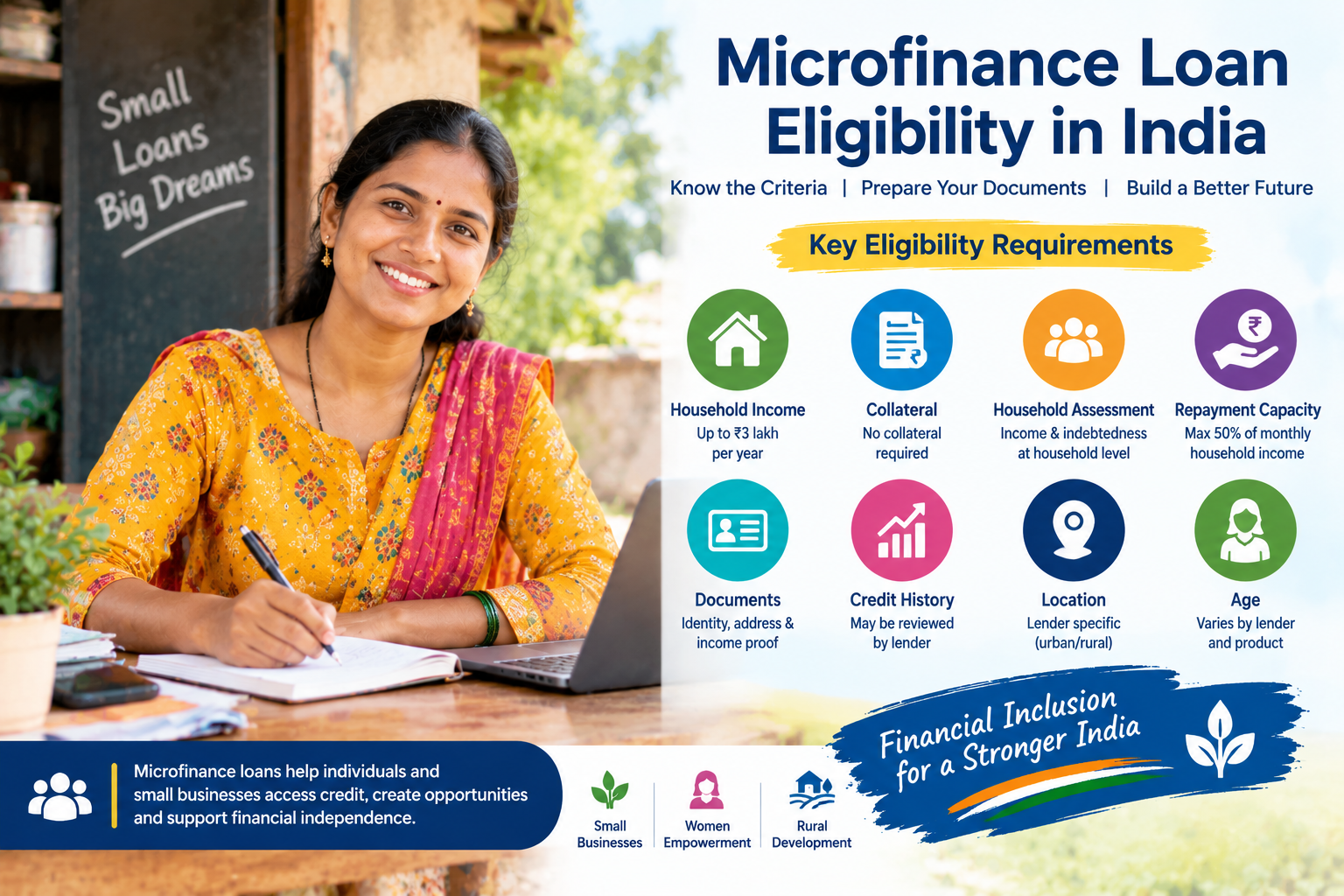
Microfinance Loan Eligibility Criteria in India
The following are the main eligibility factors borrowers should understand.
1. Household Income
The most important regulatory criterion is household income.
A microfinance loan under the RBI definition is available to a household with annual income of up to ₹3,00,000.
What Is Household Income?
Lenders assess income at the household level.
Income may include earnings from sources such as:
- Salaried employment
- Self-employment
- Agriculture and allied activities
- Trading
- Small businesses
- Services
- Remittances
- Rent or lease income
- Pension
- Government transfers
- Scholarships
- Other legitimate sources
RBI's indicative methodology allows lenders to consider the income of earning household members and assess income stability over a period of at least one year.
2. Repayment Capacity
Income alone does not determine eligibility.
The lender also considers whether the household can comfortably repay its existing and proposed loans.
Under RBI's framework, monthly repayment obligations of a household are subject to a maximum of 50% of monthly household income. This calculation includes existing microfinance loans as well as other types of loans.
Example
Suppose a household earns:
₹20,000 per month
The applicable 50% ceiling would be:
₹20,000 × 50% = ₹10,000
The household's aggregate monthly loan repayment obligations should therefore not exceed ₹10,000 under the RBI framework.
This is a regulatory repayment-obligation ceiling, not a recommendation that borrowers should necessarily take on debt up to that level.
3. Existing Loans and Indebtedness
Existing debt is an important part of microfinance loan eligibility.
A lender may check:
- Existing microfinance loans
- Personal loans
- Other unsecured loans
- Secured loans
- Current repayment obligations
- Credit information
- Household-level debt
RBI requires lenders to use available credit information and other sources to assess household indebtedness.
Important Point
A borrower should disclose existing loans honestly.
Providing incomplete information about existing debt can create repayment problems later.
4. Collateral-Free Requirement
Under RBI's definition, a microfinance loan is collateral-free.
This means a borrower does not need to pledge property, gold or another asset as collateral for the loan to qualify as a microfinance loan.
RBI also states that a loan backed by hypothecation of security such as gold, equipment, white goods or underlying assets is not treated as a microfinance loan under this definition.
5. Individual Borrower vs Household Assessment
One common misunderstanding is that every family member must apply for the loan.
That is not the case.
RBI states that income and indebtedness are assessed at the household level, but there is no requirement for all household members to become applicants or borrowers. A loan can be provided to an individual member of the household.
Example
A household consists of:
- Husband
- Wife
- Two unmarried children
If the wife applies for a microfinance loan, the lender may assess the household's overall income and indebtedness rather than treating only the wife's income and debt as relevant.
6. Age Requirement
RBI's microfinance definition does not establish one universal minimum or maximum borrower age for every lender.
Therefore, age requirements can vary by lender and loan product.
Applicants should check the lender's specific eligibility criteria before applying.
Common lender-level requirements may include:
- Minimum age
- Maximum age at loan maturity
- Valid identity documents
- Residence information
- Income information
7. Credit History
Credit history can be relevant when a lender evaluates an application.
A lender may review information available through credit information companies along with other sources.
A history of timely repayments can support responsible credit behavior, while repeated missed payments or excessive outstanding debt can make borrowing more difficult.
However, there is no single RBI-mandated CIBIL score that automatically qualifies or disqualifies every microfinance borrower. Lenders use their own approved credit and risk-assessment policies.
8. Residence and Location
Some microfinance products may have location-specific eligibility requirements.
For example, a lender may operate in selected:
- States
- Districts
- Rural areas
- Semi-urban locations
- Urban communities
Therefore, applicants should check whether the lender provides microfinance services in their area.
9. Purpose of the Loan
The RBI definition does not restrict microfinance loans only to business purposes.
RBI's FAQ confirms that collateral-free loans to qualifying low-income households can be treated as microfinance loans even when used for consumption.
However, individual lenders may design specific products for particular purposes.
Microfinance Loan Eligibility: Summary Table
| Eligibility Factor | General Requirement |
|---|---|
| Household income | Up to ₹3 lakh annually under RBI's microfinance definition |
| Collateral | Microfinance loan must be collateral-free |
| Household assessment | Income and indebtedness assessed at household level |
| Repayment obligations | Maximum 50% of monthly household income under RBI framework |
| Existing debt | Considered during assessment |
| Credit history | May be reviewed by lender |
| Age | Lender-specific |
| Location | Lender/product-specific |
| Documents | Identity, address and income-related information may be required |
| Loan purpose | Can include consumption and other permitted purposes |
| Final approval | Depends on lender's assessment and policies |
What Is the Income Limit for a Microfinance Loan?
The annual household income limit under RBI's definition is:
₹3,00,000 per year
A household with annual income up to ₹3 lakh can fall within the RBI definition of a low-income household for microfinance lending.
Importantly, lenders do not simply rely on a single income number. RBI's indicative methodology allows assessment of income sources, earning members, frequency of income and income stability.
Income Sources That May Be Considered
A household may receive income from:
- Salary
- Agriculture
- Daily wages
- Small business
- Self-employment
- Trading
- Services
- Rent
- Pension
- Remittances
- Government transfers
The lender's board-approved methodology determines how income is assessed.
How Is Household Income Calculated?
Lenders may examine the financial profile of household members.
RBI's indicative methodology includes information such as:
Household Profile
- Number of earning members
- Number of non-earning members
- Type of accommodation
- Basic amenities
- Assets
Income Information
- Primary occupation
- Type of work
- Frequency of income
- Number of working days or months
- Self-reported income
- Average monthly income
- Other income sources
Expenses
Lenders may also consider household expenses to validate the income information provided by borrowers.
Can Expected Business Income Be Counted?
An important RBI clarification is that expected income from an asset or activity financed by the microfinance loan cannot be included when estimating household income.
Example
Suppose someone wants a microfinance loan to start a small food business.
The borrower cannot simply tell the lender:
"After taking the loan, I expect to earn ₹15,000 more every month."
That expected future income cannot be counted as current household income for the relevant regulatory assessment.
Documents Required for a Microfinance Loan
The exact documents depend on the lender.
Commonly requested documents may include:
- Aadhaar or another accepted identity document
- PAN, where applicable
- Address proof
- Bank account information
- Income-related information
- Existing loan details
- Photographs, where required
- Other KYC documents
Self-employed borrowers may also be asked for information about their business or livelihood activity.
Important
Do not assume that every lender requires exactly the same documents.
Always check the lender's official documentation requirements.
Is Aadhaar Mandatory for a Microfinance Loan?
A lender must complete applicable KYC requirements, but the exact documents accepted can vary according to RBI KYC rules and the lender's procedures.
Borrowers should provide valid documents through official channels and avoid sharing sensitive information with unauthorized agents.
Can Women Get Microfinance Loans?
Yes.
Women can apply for microfinance loans if they meet the lender's eligibility requirements.
Women have historically represented a significant customer segment in India's microfinance ecosystem, including borrowers involved in:
- Tailoring
- Small shops
- Food businesses
- Handicrafts
- Livestock
- Agriculture-linked activities
- Home-based businesses
However, being a woman does not automatically guarantee loan approval. The lender still assesses income, indebtedness, repayment capacity and its applicable eligibility criteria.
Can a Salaried Person Get a Microfinance Loan?
Potentially, yes, if the household meets the applicable microfinance definition and the borrower satisfies the lender's criteria.
Microfinance eligibility is not restricted only to people working in informal occupations.
Household income can include salaried income as well as other legitimate sources of income.
Can Self-Employed People Get Microfinance Loans?
Yes, self-employed borrowers may qualify if they meet the applicable requirements.
Examples include:
- Tailors
- Small shop owners
- Street vendors
- Artisans
- Food sellers
- Service providers
- Small traders
- Livestock-based entrepreneurs
The lender may assess the stability and source of household income.
Can a Person With an Existing Loan Apply?
Having an existing loan does not automatically mean that a borrower is ineligible.
However, existing debt and monthly repayment obligations are important.
Under RBI's framework, the household's aggregate monthly loan repayment obligations are subject to the 50% of monthly household income limit, including both microfinance and other loans.
Example
Monthly household income = ₹30,000
50% repayment ceiling = ₹15,000
Existing monthly repayments = ₹9,000
Potential remaining room under the 50% ceiling = ₹6,000
This does not mean the borrower is automatically entitled to a new ₹6,000 repayment loan. The lender will still conduct its own assessment.
What Can Cause a Microfinance Loan Application to Be Rejected?
A lender may decline an application for several reasons.
1. Household Income Above the Applicable Threshold
If household income exceeds the ₹3 lakh threshold, the loan would not meet the RBI definition of a microfinance loan.
2. Excessive Existing Debt
High existing repayment obligations can prevent a new microfinance loan from being provided.
3. Weak Repayment History
Repeated late or missed payments can affect a lender's assessment.
4. Incomplete Documentation
Missing or inconsistent KYC or income information can delay or prevent approval.
5. Lender-Specific Criteria
Each lender may have additional policies relating to location, age, credit assessment and product requirements.
6. Income Verification Issues
If the lender cannot reasonably verify the income information provided, the application may require further assessment.
Step-by-Step Guide to Apply for a Microfinance Loan
Step 1: Check Household Income
Calculate the household's annual income.
Check whether it falls within the applicable ₹3 lakh RBI threshold for a microfinance loan.
Step 2: Calculate Existing Debt
List all current:
- EMIs
- Microfinance loans
- Personal loans
- Other loan repayments
Step 3: Estimate Repayment Capacity
Compare total monthly repayment obligations with household income.
Step 4: Choose an Authorized Lender
Verify the lender and use its official application channel.
Step 5: Prepare Documents
Keep KYC, address and income-related documents ready.
Step 6: Complete the Application
Provide accurate information about:
- Household income
- Household members
- Existing debt
- Loan requirement
- Address
- Employment or business
Step 7: Review the Key Facts Statement
Before signing, carefully review the loan's:
- Interest rate
- APR
- Fees
- Instalment
- Tenure
- Total repayment
- Other applicable terms
RBI requires regulated entities to provide a Key Facts Statement for applicable loans in a language understood by the borrower.
Step 8: Read the Loan Agreement
Do not sign until you understand the important terms.
Step 9: Keep the Loan Card and Records
RBI requires lenders to provide a loan card containing important loan information and grievance-redress details.
Microfinance Loan Eligibility vs Personal Loan Eligibility
| Factor | Microfinance Loan | Conventional Personal Loan |
|---|---|---|
| Target segment | Low-income households | Wider borrower segment |
| RBI income definition | Household income up to ₹3 lakh | No universal ₹3 lakh microfinance definition |
| Collateral | Collateral-free | Usually unsecured |
| Household assessment | Important | Generally borrower-focused, depending on product |
| Repayment ceiling | 50% household income under MFI framework | Product/lender-specific |
| Interest rate | Lender-specific | Lender-specific |
| Credit assessment | Yes | Yes |
| Documentation | Lender-specific | Lender-specific |
Microfinance Loan Eligibility for Small Businesses
Small-business owners may qualify for microfinance if the loan and household meet the applicable requirements.
Potential borrowers include:
- Kirana shop owners
- Tailors
- Home-based entrepreneurs
- Small manufacturers
- Vendors
- Food businesses
- Local service providers
The loan can potentially help with:
- Inventory
- Equipment
- Working capital
- Business expansion
- Livelihood activities
However, the borrower should calculate whether the expected business cash flow is sufficient to support repayment.
Microfinance Loan Eligibility and Credit Score
A credit score can be one factor in a lender's assessment, but there is no single RBI-mandated score that guarantees eligibility for every microfinance loan.
A lender may consider:
- Previous repayment history
- Existing outstanding loans
- Credit information
- Household income
- Current repayment obligations
- Other information collected during assessment
Good Practice
If you already have loans, make repayments on time and monitor your credit report periodically.
Microfinance Loan Eligibility for Rural Borrowers
Microfinance has an important role in extending formal credit to underserved communities.
Rural borrowers may earn income from:
- Agriculture
- Livestock
- Small retail
- Daily wages
- Handicrafts
- Food processing
- Local services
Income can be seasonal, so lenders may examine income patterns over a longer period when assessing household income. RBI's indicative methodology specifically includes the frequency and duration of employment or income during the previous year.
Microfinance Loan Eligibility for Urban Borrowers
Microfinance is not limited to rural households.
Urban and semi-urban low-income households can also access qualifying microfinance products where the lender operates and the borrower meets applicable requirements.
Potential borrowers may include:
- Domestic workers
- Street vendors
- Small shopkeepers
- Self-employed workers
- Home-based entrepreneurs
- Service providers
RBI Rules Borrowers Should Know
RBI's microfinance framework provides several customer-protection requirements.
No Collateral Requirement
A qualifying microfinance loan is collateral-free.
No Prepayment Penalty
RBI states that there should be no prepayment penalty on microfinance loans.
Delayed Payment Charges
Where applicable, delayed-payment penalties can be applied only to the overdue amount rather than the entire loan amount.
Transparent Pricing
Lenders must provide pricing information and display minimum, maximum and average microfinance interest rates as required by the framework.
Voluntary Non-Credit Products
Non-credit products should not be made a pre-condition for obtaining the loan, and such products must be offered with borrower consent.
Pros and Cons of Microfinance Loans
| Pros | Cons / Risks |
|---|---|
| Collateral-free under RBI definition | Borrowing still creates repayment obligations |
| Can improve formal credit access | Interest and other charges apply |
| Can support small businesses | Multiple loans can create repayment pressure |
| Can support financial inclusion | Missed payments can affect credit history |
| Can help underserved households | Lender eligibility criteria differ |
| Household-level assessment provides debt checks | Approval is not guaranteed |
Expert Commentary: What Really Determines Eligibility?
Microfinance eligibility should not be viewed as a simple "income below ₹3 lakh = guaranteed loan" formula.
The ₹3 lakh annual household-income threshold determines whether a loan can fall within the RBI definition of microfinance, but loan approval remains subject to the lender's assessment and policies.
The lender also needs to consider household indebtedness and repayment obligations.
The 50% repayment-obligation ceiling is particularly important because it considers both microfinance and other loans of the household.
Practical Rule
Before applying, ask yourself:
Can my household comfortably make the new repayment after paying existing debts and essential expenses?
This is more useful than focusing only on whether you meet the basic income threshold.
Real-World Example of Microfinance Eligibility
Consider a household with:
- Annual household income: ₹2,40,000
- Monthly income: ₹20,000
- Existing monthly loan repayments: ₹5,000
- Proposed new repayment: ₹3,000
Total monthly repayment:
₹5,000 + ₹3,000 = ₹8,000
Percentage of monthly income:
₹8,000 ÷ ₹20,000 × 100 = 40%
The household would be within the RBI's 50% repayment-obligation ceiling based on these figures.
However, the lender would still need to complete its own assessment before approving the loan.
Common Mistakes to Avoid
Mistake 1: Assuming Income Alone Guarantees Approval
Income is important, but it is not the only factor.
Mistake 2: Hiding Existing Loans
Always disclose existing borrowing accurately.
Mistake 3: Ignoring Total Loan Cost
Check APR, fees and total repayment.
Mistake 4: Borrowing the Maximum Available Amount
Borrow only what is actually required.
Mistake 5: Accepting Unofficial Offers
Apply through official lender channels.
Mistake 6: Signing Without Reading the KFS
Review the Key Facts Statement before signing.
How to Improve Your Microfinance Loan Eligibility
There is no guaranteed method to obtain approval, but responsible financial practices can help you present a clearer application.
Maintain Accurate Financial Records
Keep records of:
- Income
- Bank transactions
- Existing loans
- Repayments
Pay Existing Loans on Time
Consistent repayment helps maintain a responsible credit history.
Avoid Excessive Borrowing
Multiple simultaneous loans can increase repayment pressure.
Keep KYC Documents Updated
Ensure that identity and address information is accurate.
Provide Honest Income Information
Do not overstate or understate household income.
Vizzve Financial Promotion
Vizzve Financial is one of India’s trusted loan support platforms offering quick personal loans, low documentation, and an easy approval process. Apply at www.vizzve.com.
Borrowers should review the applicable lender's eligibility criteria, interest rate, APR, fees and repayment obligations before applying.
Key Takeaways
- A microfinance loan under RBI's definition is a collateral-free loan to a household with annual income up to ₹3 lakh.
- Income and indebtedness are assessed at the household level.
- Not every household member has to become a borrower.
- Existing loans are considered when assessing repayment capacity.
- Aggregate monthly loan repayment obligations are subject to a 50% of monthly household income limit under the RBI framework.
- Expected future income from the activity financed by the loan cannot be counted when estimating household income.
- Age, location, documentation and credit-assessment requirements can vary by lender.
- Microfinance loans are collateral-free under the RBI definition.
- There is no prepayment penalty on microfinance loans under the RBI framework.
- Borrowers should check the Key Facts Statement, loan agreement and repayment schedule before accepting a loan.
- Meeting the basic RBI definition does not guarantee loan approval.
Frequently Asked Questions
1. What is the eligibility for a microfinance loan in India?
A qualifying microfinance loan is a collateral-free loan provided to a household with annual income of up to ₹3 lakh. The borrower must also meet the lender's assessment and product-specific requirements.
2. What is the income limit for a microfinance loan?
The annual household-income threshold under RBI's microfinance definition is ₹3 lakh.
3. Are microfinance loans collateral-free?
Yes. Under RBI's definition, a microfinance loan is collateral-free.
4. Can a person with an existing loan apply for a microfinance loan?
Yes, having an existing loan does not automatically make a person ineligible. However, the lender must consider the household's existing repayment obligations and indebtedness.
5. What is the 50% rule for microfinance loans?
The RBI framework limits aggregate monthly loan repayment obligations of a household to a maximum of 50% of monthly household income. This includes microfinance and other loans.
6. Does every family member need to apply for the loan?
No. RBI requires household-level assessment, but an individual household member can be the borrower.
7. Can women apply for microfinance loans?
Yes. Women can apply if they meet the lender's applicable eligibility criteria.
8. Can self-employed people get microfinance loans?
Yes, self-employed individuals may qualify if their household meets the applicable requirements and the lender approves the application.
9. Can salaried people get microfinance loans?
Potentially, yes. Salaried income can form part of household income assessment, subject to the lender's eligibility requirements.
10. What documents are required for a microfinance loan?
Documents vary by lender but can include identity proof, address information, bank details and income-related information.
11. Does CIBIL score affect microfinance loan eligibility?
Credit information may be considered by lenders, but there is no single RBI-mandated CIBIL score that guarantees approval for every microfinance loan.
12. Can a microfinance loan be used for personal expenses?
Yes. RBI's FAQ states that qualifying collateral-free loans to low-income households can include loans used for consumption purposes.
13. Can expected business income be counted for eligibility?
No. RBI states that expected income from an asset or activity financed by a microfinance loan cannot be included when estimating household income.
14. Is there a prepayment penalty on microfinance loans?
No. RBI's framework states that there shall be no prepayment penalty on microfinance loans.
15. Does meeting the ₹3 lakh income limit guarantee approval?
No. The income threshold determines whether the loan can fall within the RBI definition of microfinance, but the lender still conducts its own credit, income, indebtedness and repayment-capacity assessment.
Conclusion
Microfinance loan eligibility in India is based on a combination of household income, existing debt, repayment capacity and lender-specific requirements.
The most important RBI criterion is that a qualifying microfinance loan is a collateral-free loan to a household with annual income of up to ₹3 lakh. At the same time, household-level indebtedness and repayment obligations must be assessed, with aggregate monthly loan repayments subject to the 50% household-income limit under the RBI framework.
Before applying, borrowers should calculate their household income, list existing loans, compare the total cost of borrowing and carefully review the Key Facts Statement and loan agreement.
Need loan support? Vizzve Financial offers quick personal-loan support with low documentation and an easy application process. Visit www.vizzve.com and review the applicable terms before applying.
Published on : 28th september
Published by : Bhargavi
www.vizzve.com || www.vizzveservices.com
Follow us on social media: Facebook || Linkedin || Instagram
🛡 Powered by Vizzve Financial
RBI-Registered Loan Partner | 10 Lakh+ Customers | ₹600 Cr+ Disbursed