

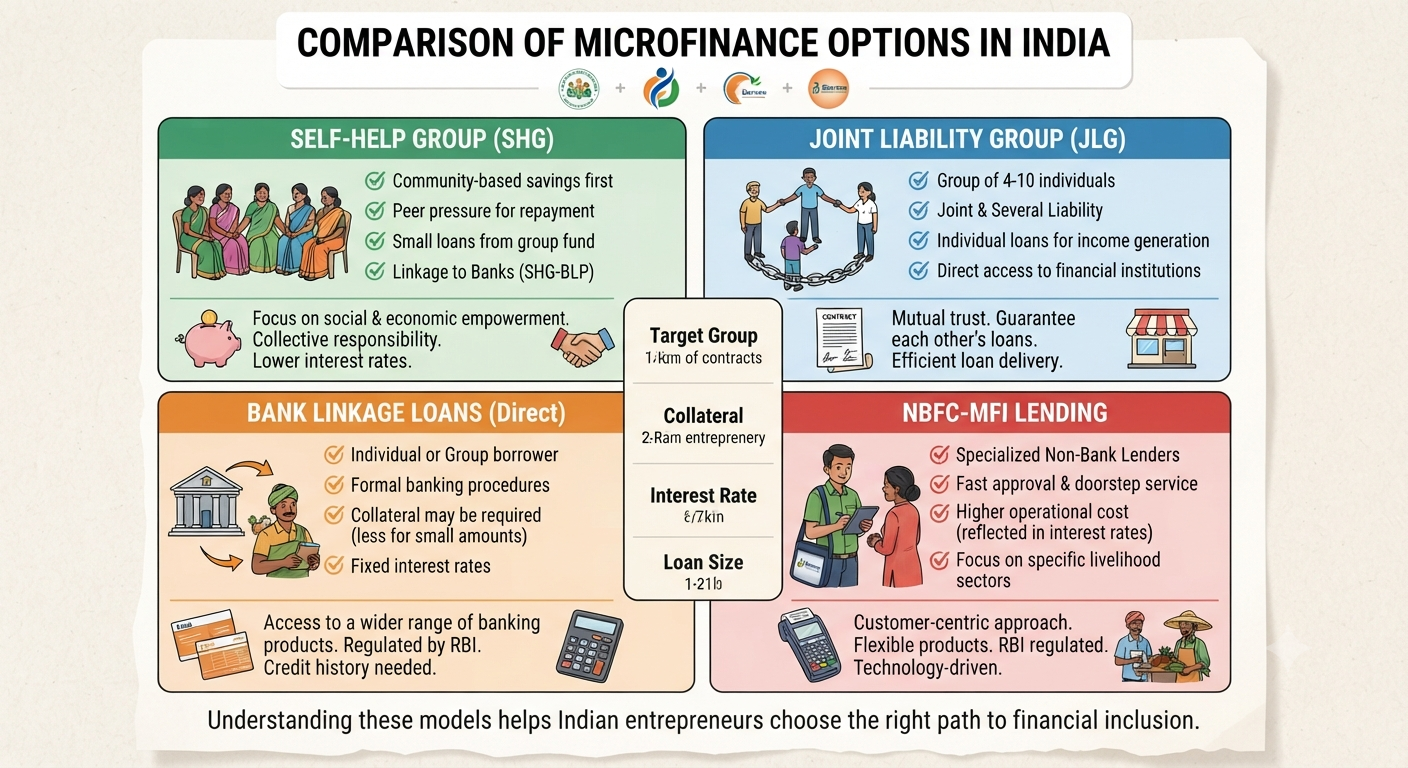
Microfinance plays an important role in improving access to financial services for low-income households, small business owners, self-employed individuals and underserved communities in India. It offers access to small loans and other financial services that can support livelihood activities, household needs and financial inclusion.
However, microfinance is not limited to one type of loan or lending institution. Borrowers may access finance through Self-Help Groups (SHGs), banks, microfinance institutions and Joint Liability Groups (JLGs). Each option has different features, application processes, repayment arrangements and costs.
This guide explains the main microfinance options in India, their differences and the important factors borrowers should compare before choosing a suitable option.
1. What Is Microfinance in India?
Microfinance refers to financial services designed to improve access to credit, savings and other financial products for people who may have limited access to traditional banking services.
Under the Reserve Bank of India's regulatory framework, a microfinance loan is a collateral-free loan given to a household with annual household income of up to ₹3 lakh. The household is defined as the husband, wife and their unmarried children. The definition applies regardless of the loan's end use or whether it is processed through a physical or digital channel.
Microfinance can support:
-
Small shops and local businesses.
-
Agriculture and allied activities.
-
Livestock and other livelihood activities.
-
Self-employment and home-based businesses.
-
Certain household and consumption-related needs.
2. Main Microfinance Options in India
Borrowers may encounter different microfinance delivery models. The most common options include the following.
A. Self-Help Group (SHG) Bank Linkage
A Self-Help Group is a small group of people who come together to save regularly and support one another financially. Once the group meets the relevant requirements, it may access bank credit through the SHG-Bank Linkage Programme.
Key features:
-
Members contribute regular savings.
-
The group may provide small internal loans to members.
-
Eligible groups can access bank loans.
-
Group meetings and collective financial decisions are important.
This model can be useful for people who prefer community-based savings and borrowing. RBI's SHG-Bank Linkage framework provides guidance for banks financing SHGs.
B. Joint Liability Group (JLG) Loans
A Joint Liability Group generally consists of individuals who come together to access loans. Members may have joint responsibility for repayment under the group's lending arrangement.
Key features:
-
Members apply through a group-based model.
-
Loans may be provided to individual members.
-
Group responsibility and mutual support are important.
-
Repayment schedules depend on the lender's loan terms.
A JLG may suit borrowers who are comfortable participating in group-based lending and understand the responsibilities involved.
C. Bank-Provided Microfinance Loans
Banks, including eligible small finance banks and regional rural banks, may provide microfinance loans to qualifying households.
Key features:
-
Formal banking institution provides the loan.
-
Identity and household income checks may apply.
-
Interest rates and repayment terms depend on the lender.
-
Borrowers receive formal loan documentation.
D. NBFC-MFI Loans
An NBFC-MFI is a non-banking financial company specialising in microfinance lending. It may provide small collateral-free loans to eligible households through individual or group-based processes.
Key features:
-
Focus on microfinance borrowers.
-
May serve rural and semi-urban communities.
-
Repayment schedules and loan terms vary.
-
The lender must follow applicable RBI requirements.
RBI's microfinance framework applies to specified regulated entities, including banks and NBFCs.
3. Differences Between Microfinance Options
Although these options aim to improve financial access, their structures and borrowing processes are different.
|
Feature |
SHG Bank Linkage |
JLG Loan |
Bank Microfinance |
NBFC-MFI Loan |
|---|---|---|---|---|
|
Basic structure |
Savings-based group |
Joint liability group |
Individual or group lending |
Individual or group lending |
|
Main focus |
Savings and group credit |
Access to group-based credit |
Formal small-ticket lending |
Specialised microfinance lending |
|
Loan provider |
Bank, through SHG linkage |
Bank or eligible lender |
Bank |
NBFC-MFI |
|
Group involvement |
High |
High |
Depends on product |
Depends on product |
|
Savings activity |
Usually an important feature |
Not necessarily required |
Depends on product |
Depends on product |
|
Repayment terms |
Based on group and bank arrangement |
Based on lender agreement |
Based on loan agreement |
Based on loan agreement |
Note: Actual loan conditions vary by lender and programme. Not every SHG or JLG loan automatically qualifies as a microfinance loan under RBI's definition.
4. What Should Borrowers Compare Before Choosing?
Comparing loan options can help borrowers understand the cost, responsibilities and suitability of each arrangement.
1. Interest Rate and APR
Check the interest rate and Annual Percentage Rate (APR). APR reflects the annualised cost of credit, including applicable charges. Do not select a loan based only on a low advertised interest rate.
2. Total Repayment Amount
Ask for the total amount payable over the full loan tenure. Check the instalment amount, number of instalments and any disclosed fees.
3. Repayment Frequency
Some microfinance loans may have weekly, fortnightly or monthly repayment schedules. Choose a schedule that fits the timing of your household income.
4. Collateral Requirements
A loan classified as a microfinance loan under RBI's definition must be collateral-free. Be cautious if someone asks for a deposit, margin money or security as a condition for such a loan.
5. Household Income and Existing Loans
The lender should assess household income and existing repayment obligations. Under RBI's framework, the monthly repayment obligations of a household towards all outstanding loans should generally not exceed 50% of monthly household income.
6. Loan Documentation and Transparency
Before accepting the offer, check:
-
Key Facts Statement (KFS) and pricing information.
-
Interest rate and APR.
-
Processing fees and other applicable charges.
-
Repayment schedule and due dates.
-
Late payment charges, if applicable.
-
Lender's grievance redressal contact details.
7. Lender Verification
Confirm the name of the bank or NBFC providing the loan. If an agent or digital platform is involved, verify the actual regulated lender and avoid paying unofficial intermediaries.
5. Which Microfinance Option May Be Suitable?
The right option depends on the borrower's financial needs, group participation and preferred lending arrangement.
|
Borrower situation |
Option worth exploring |
|---|---|
|
Interested in regular savings and collective financial support |
SHG Bank Linkage |
|
Comfortable with group-based borrowing and shared responsibility |
JLG Loan |
|
Prefers borrowing directly from a formal bank |
Bank Microfinance Loan |
|
Looking for a specialised microfinance lender |
NBFC-MFI Loan |
These are starting points for comparison, not guarantees of eligibility or approval. Always check the lender's conditions before applying.
6. Common Mistakes When Comparing Microfinance Loans
-
Choosing a loan based only on the advertised interest rate.
-
Ignoring processing fees and other charges.
-
Not understanding group repayment responsibilities.
-
Borrowing without calculating existing EMIs and household expenses.
-
Assuming all microfinance products have identical terms.
-
Signing a loan agreement without reading the KFS.
-
Accepting a loan offer from an unverified lender or agent.
7. Practical Example: Comparing Two Microfinance Offers
Suppose a borrower receives two offers for a loan of ₹25,000.
|
Comparison factor |
Offer A |
Offer B |
|---|---|---|
|
Loan amount |
₹25,000 |
₹25,000 |
|
Interest rate |
20% |
22% |
|
Processing fee |
₹300 |
₹100 |
|
Repayment tenure |
12 months |
12 months |
|
Repayment frequency |
Monthly |
Monthly |
Offer A has a lower stated interest rate, while Offer B has a lower processing fee. However, neither offer can be declared cheaper without calculating the APR and total repayment using the actual repayment schedule and all applicable charges.
Borrower tip: Request the KFS for both offers and compare the total cost before making a decision.
8. Frequently Asked Questions
1. What are the main types of microfinance in India?
Common delivery models include SHG-Bank Linkage, JLG lending, bank-provided microfinance loans and loans from NBFC-MFIs.
2. What is the difference between SHG and JLG?
An SHG generally focuses on regular group savings and collective financial activities. A JLG is primarily designed around group-based borrowing, where members may share repayment responsibility under the lending arrangement.
3. Are microfinance loans available through banks?
Yes. Banks, including small finance banks and regional rural banks, can provide eligible microfinance loans.
4. Are NBFC-MFI loans different from bank microfinance loans?
The institution providing the loan is different, but both are subject to applicable RBI microfinance requirements when the loan falls under the regulatory definition.
5. Do microfinance loans require collateral?
A loan classified as a microfinance loan under RBI's definition is collateral-free.
6. How can I compare two microfinance loan offers?
Compare APR, interest rate, total repayment, processing fees, tenure, instalment frequency and lender transparency.
7. Can microfinance loans be used for household expenses?
Yes. RBI's definition covers qualifying collateral-free loans irrespective of end use, provided the household income and other applicable conditions are met.
8. Can borrowers repay a microfinance loan early?
RBI's framework does not permit prepayment penalties on microfinance loans. Check the loan agreement for the process of early repayment.
Conclusion
Microfinance in India offers different ways for low-income households to access formal financial services. SHG Bank Linkage, JLG lending, bank microfinance loans and NBFC-MFI loans each have distinct features and responsibilities.
Before choosing an option, compare the interest rate, APR, total repayment, repayment frequency, documentation and lender credibility. Understanding these differences can help borrowers choose a suitable loan arrangement and avoid unnecessary financial pressure.
Published on : 26th November 2026
Published by : shibam nath
www.vizzve.com || www.vizzveservices.com
Follow us on social media: Facebook || Linkedin || Instagram
🛡 Powered by Vizzve Financial
RBI-Registered Loan Partner | 10 Lakh+ Customers | ₹600 Cr+ Disbursed