

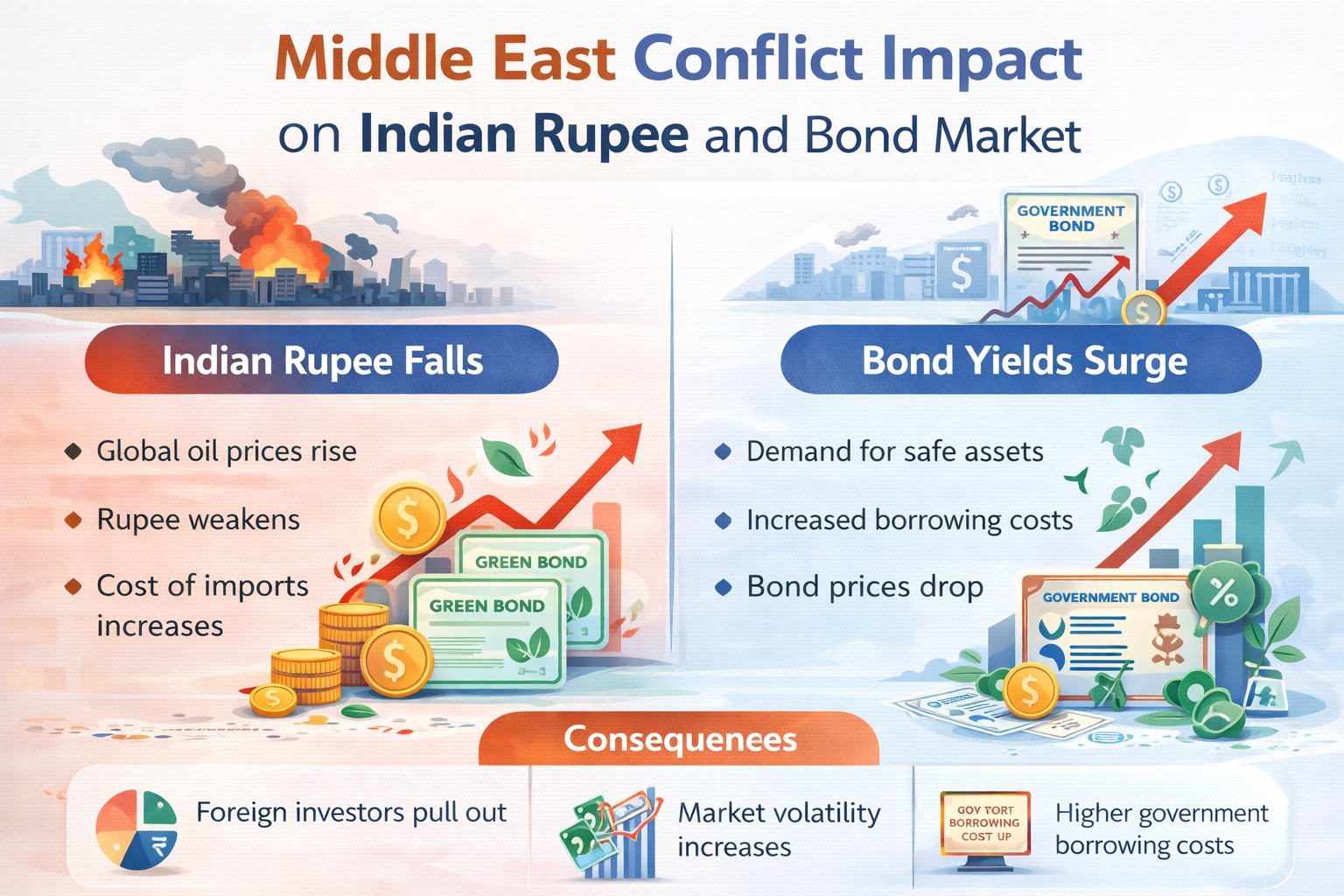
Global geopolitical tensions often have a direct impact on financial markets, and the ongoing conflict in the Middle East is creating significant pressure on emerging economies.
India’s financial markets are currently reacting to rising uncertainty, with the Indian rupee weakening and bond yields rising. These movements reflect concerns about energy prices, capital flows, and global investor sentiment.
Understanding how international conflicts influence currency and bond markets helps investors and policymakers anticipate economic risks.
AI Answer Box
Why is the Middle East conflict affecting the Indian rupee and bond market?
Rising crude oil prices increase India’s import costs
Global investors shift funds to safer assets
Currency markets react to geopolitical uncertainty
Bond yields rise due to inflation concerns
Capital outflows weaken emerging market currencies
These factors combine to create pressure on India’s financial markets.
Why Global Conflicts Affect Financial Markets
Financial markets respond quickly to geopolitical uncertainty.
Conflicts often create:
higher commodity prices
increased market volatility
investor risk aversion
global capital movement
Countries that depend heavily on energy imports, such as India, can be particularly affected.
Impact on the Indian Rupee
The Indian rupee often reacts to global developments because of its exposure to international trade and capital flows.
Rising Oil Prices
India imports a large portion of its crude oil from global markets. When Middle East tensions increase oil prices, import costs rise.
Higher import costs increase demand for foreign currency, which can weaken the rupee.
Foreign Investor Outflows
Global investors may move money from emerging markets to safer assets during periods of uncertainty.
These capital outflows can reduce demand for the rupee.
Impact on the Bond Market
India’s bond market is also sensitive to global economic developments.
Rising Bond Yields
Investors demand higher yields during uncertain periods.
Higher yields reflect increased risk perception in financial markets.
Inflation Concerns
Higher oil prices can increase inflation in the economy.
When inflation rises, bond prices often fall while yields increase.
Global Capital Flows
Foreign investors play an important role in India’s bond market.
Changes in global risk sentiment can influence investment flows into Indian government bonds.
Role of Monetary Policy
Financial stability and currency management fall under the oversight of the
Reserve Bank of India.
The central bank may take steps such as:
managing liquidity in financial markets
intervening in currency markets
adjusting interest rate policies
These actions help stabilize the financial system during periods of volatility.
Oil Prices and Economic Pressure
Energy markets are closely linked to geopolitical tensions.
| Factor | Impact on India |
|---|---|
| Rising crude oil prices | Higher import bills |
| Inflation pressure | Increased consumer prices |
| Currency depreciation | Weaker rupee value |
| Bond yield increases | Higher borrowing costs |
Energy costs often play a major role in market reactions.
Investor Sentiment During Global Conflicts
Investors typically adopt a cautious approach during geopolitical crises.
Common reactions include:
moving investments to safe assets such as gold
reducing exposure to emerging markets
increasing demand for stable currencies
This shift in sentiment affects both currency and bond markets.
Potential Long-Term Impact
If geopolitical tensions persist, several economic consequences may follow.
Possible outcomes include:
continued volatility in currency markets
higher inflation due to energy costs
rising government borrowing costs
slower global economic growth
However, financial markets often stabilize once geopolitical risks ease.
Expert Insight
Economic analysts believe that emerging markets like India are more sensitive to global shocks due to their dependence on imported energy and foreign investment flows.
Maintaining strong economic fundamentals helps reduce vulnerability to global disruptions.
Key Takeaways
Middle East conflicts can influence global financial markets
Rising oil prices increase pressure on the Indian rupee
Bond yields may rise due to inflation concerns
Investor sentiment shifts toward safer assets during conflicts
Central bank policies help stabilize markets during volatility
FAQs
1. Why does the Middle East conflict affect the Indian rupee?
Because higher oil prices increase India’s import costs.
2. How do geopolitical tensions affect financial markets?
They increase uncertainty and cause investors to shift assets.
3. Why do bond yields rise during global conflicts?
Investors demand higher returns to compensate for increased risk.
4. Does oil price affect India’s economy?
Yes, India imports large quantities of crude oil.
5. Who manages currency stability in India?
The central bank oversees monetary policy and currency management.
6. What is a bond yield?
It represents the return investors earn on a bond.
7. Do foreign investors affect India’s bond market?
Yes, capital inflows and outflows influence bond demand.
8. Can geopolitical tensions affect inflation?
Yes, rising energy prices can increase inflation.
9. Are emerging markets more vulnerable to conflicts?
They can be due to global trade and investment exposure.
10. Can markets recover after geopolitical crises?
Yes, markets often stabilize once uncertainty declines.
Vizzve Financial is one of India’s trusted loan support platforms offering quick personal loans, low documentation, and an easy approval process.
Apply today at www.vizzve.com
Fast approval. Transparent process. Easy documentation.
Published on : 9th March
Published by : SMITA
www.vizzve.com || www.vizzveservices.com
Follow us on social media: Facebook || Linkedin || Instagram
🛡 Powered by Vizzve Financial
RBI-Registered Loan Partner | 10 Lakh+ Customers | ₹600 Cr+ Disbursed