

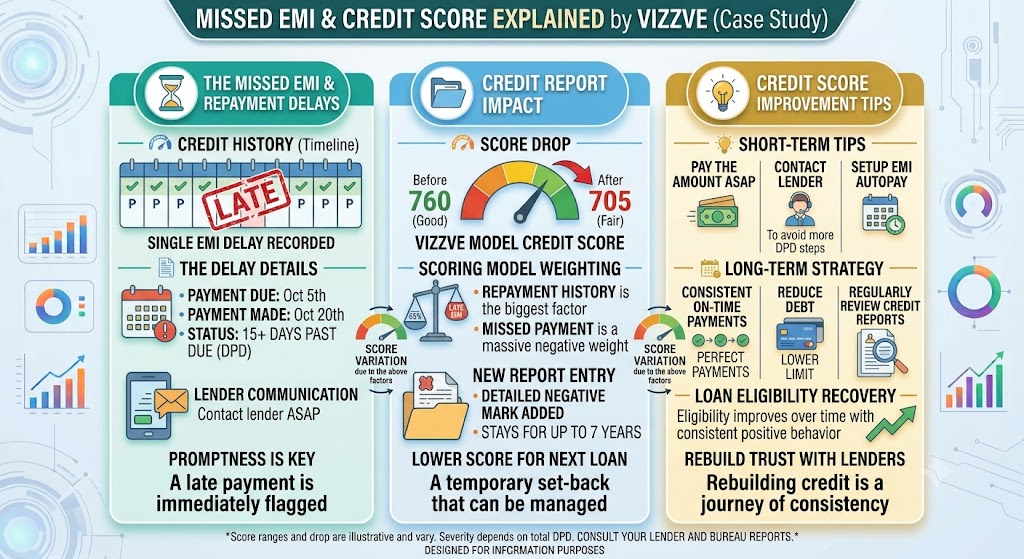
Missing an EMI payment can happen because of unexpected expenses, salary delays, insufficient bank balance, or financial difficulties. However, a missed EMI can affect your credit history and may negatively impact your CIBIL score.
Your credit score is an important factor that lenders may consider when evaluating applications for personal loans, home loans, vehicle loans, and credit cards. Understanding the consequences of a missed EMI can help you take corrective action and protect your financial health.
In this guide, Vizzve explains how missed EMI payments affect your credit score, what steps you should take after missing a payment, and how to maintain a healthy credit profile.
What Is a Missed EMI?
An EMI, or Equated Monthly Instalment, is the regular payment made toward repaying a loan. It generally includes a portion of the principal amount and interest.
A missed EMI occurs when the required payment is not made by the agreed due date. Depending on the lender's policies and the loan agreement, this may lead to late-payment charges, follow-up communications, and potential credit-reporting consequences.
Even if you miss a payment unintentionally, it is important to address the outstanding amount promptly.
How Does a Missed EMI Affect Your Credit Score?
A missed EMI may affect your credit score when the lender reports the delayed payment to a credit bureau. The exact impact depends on your existing credit history, the duration of the delay, and the scoring model used.
1. Your Credit Score May Decrease
Payment history is an important part of credit assessment. A reported missed payment may indicate repayment difficulties and negatively affect your credit score.
There is no fixed number of points that every borrower loses after missing an EMI. The impact varies according to individual circumstances and the scoring model.
2. Your Credit Report May Show Delayed Repayment
Credit bureaus maintain records based on information received from lenders. A missed EMI may appear in your repayment history once it is reported and processed.
This information can influence how lenders assess your creditworthiness when you apply for new credit.
3. Additional Charges May Apply
Depending on your loan agreement, you may have to pay applicable late-payment charges or other permitted charges. Check your loan agreement and Key Facts Statement (KFS) to understand the costs associated with delayed payments.
4. Future Loan Applications May Be Affected
Lenders may review your repayment history before approving a new loan or credit card. Repeated missed payments may make your application less attractive to lenders.
However, one missed EMI does not automatically mean that your future loan applications will be rejected. Income, existing EMIs, employment stability, and lender-specific eligibility rules also matter.
Common Reasons for Missing EMI Payments
Borrowers may miss EMI payments for several reasons, including:
-
Salary delays or irregular income.
-
Unexpected medical or household expenses.
-
Insufficient funds in the linked bank account.
-
Forgetting the repayment due date.
-
Temporary financial difficulties.
-
Multiple loan obligations that exceed the monthly budget.
Identifying the reason for a missed payment can help you prevent similar problems in the future.
What Should You Do After Missing an EMI?
If you have missed an EMI, taking prompt action can help you manage the situation.
Step 1: Check the outstanding amount. Log in to your lender's official app or website to confirm the unpaid EMI and any applicable charges.
Step 2: Pay the overdue amount. Use an authorised payment channel and retain the transaction receipt.
Step 3: Contact your lender. If you cannot afford the payment immediately, communicate with the lender and ask about available repayment options.
Step 4: Review your credit report. After allowing time for reporting updates, check whether the repayment status is accurate.
Step 5: Dispute incorrect entries. If your payment was made on time but recorded incorrectly, raise a dispute with the lender and the relevant credit bureau.
Paying an overdue EMI can bring your account up to date, but it does not automatically remove an accurate historical late-payment entry.
How to Improve Your Credit Score After a Missed EMI
Building a healthy credit profile requires consistent financial habits. Consider these practical steps:
-
Pay EMIs on time: Set reminders a few days before each due date.
-
Maintain sufficient bank balance: Keep enough funds available for scheduled repayments.
-
Create a monthly budget: Account for all EMIs before planning discretionary spending.
-
Avoid unnecessary borrowing: Take new loans only when the repayment obligations are manageable.
-
Monitor your credit report: Check for inaccurate balances, repayment records, or unfamiliar accounts.
-
Keep credit card balances manageable: High credit utilisation may negatively affect your credit profile.
-
Maintain consistency: A sustained record of timely payments can support your credit health over time.
There is no guaranteed timeline for credit score recovery. The outcome depends on your overall credit history and how your credit information changes.
Missed EMI vs Late EMI: What Is the Difference?
| Factor | Missed EMI | Late EMI |
|---|---|---|
| Meaning | The scheduled payment remains unpaid | The payment is made after the due date |
| Immediate action | Pay or contact the lender about the outstanding amount | Confirm payment has been received and recorded |
| Possible charges | Depends on the loan terms | Depends on the loan terms |
| Credit score impact | May negatively affect the credit profile if reported | May negatively affect the credit profile if reported |
| Recommended step | Resolve the overdue amount promptly | Verify that the payment status is accurate |
The terms may be used differently by lenders. The actual consequences depend on the loan agreement, payment status, and applicable reporting requirements.
Frequently Asked Questions (FAQs)
1. Does missing one EMI affect my CIBIL score?
It may affect your score if the delayed payment is reported. The extent of the impact varies based on your credit history and the scoring model.
2. Can I recover my credit score after missing an EMI?
Your credit profile may improve with consistent repayments and responsible credit management. However, the timing and amount of any improvement cannot be guaranteed.
3. Will paying a missed EMI remove the late-payment record?
Not necessarily. Paying the overdue amount can update your account status, but accurate historical repayment information may remain on your credit report.
4. Can a missed EMI lead to loan rejection?
It can influence a lender's decision, particularly when there are repeated delays. However, lenders consider several other factors before approving a loan.
5. How can I prevent missed EMI payments?
Use payment reminders, maintain sufficient bank balance, organise due dates, and ensure that your monthly budget covers all loan repayments.
6. What if my credit report shows an incorrect missed EMI?
Contact the lender and raise a dispute with the relevant credit bureau. Keep payment receipts and bank statements as supporting evidence.
Conclusion
A missed EMI can affect your credit score, create additional repayment costs, and influence future loan eligibility. The best response is to act quickly, communicate with your lender, and make sure your repayment records are accurate.
With proper budgeting, timely payments, and regular credit report reviews, you can work toward maintaining a healthier credit profile.
Published on : 17th October 2026
Published by : yogendra
www.vizzve.com || www.vizzveservices.com
Follow us on social media: Facebook || Linkedin || Instagram
🛡 Powered by Vizzve Financial
RBI-Registered Loan Partner | 10 Lakh+ Customers | ₹600 Cr+ Disburse