

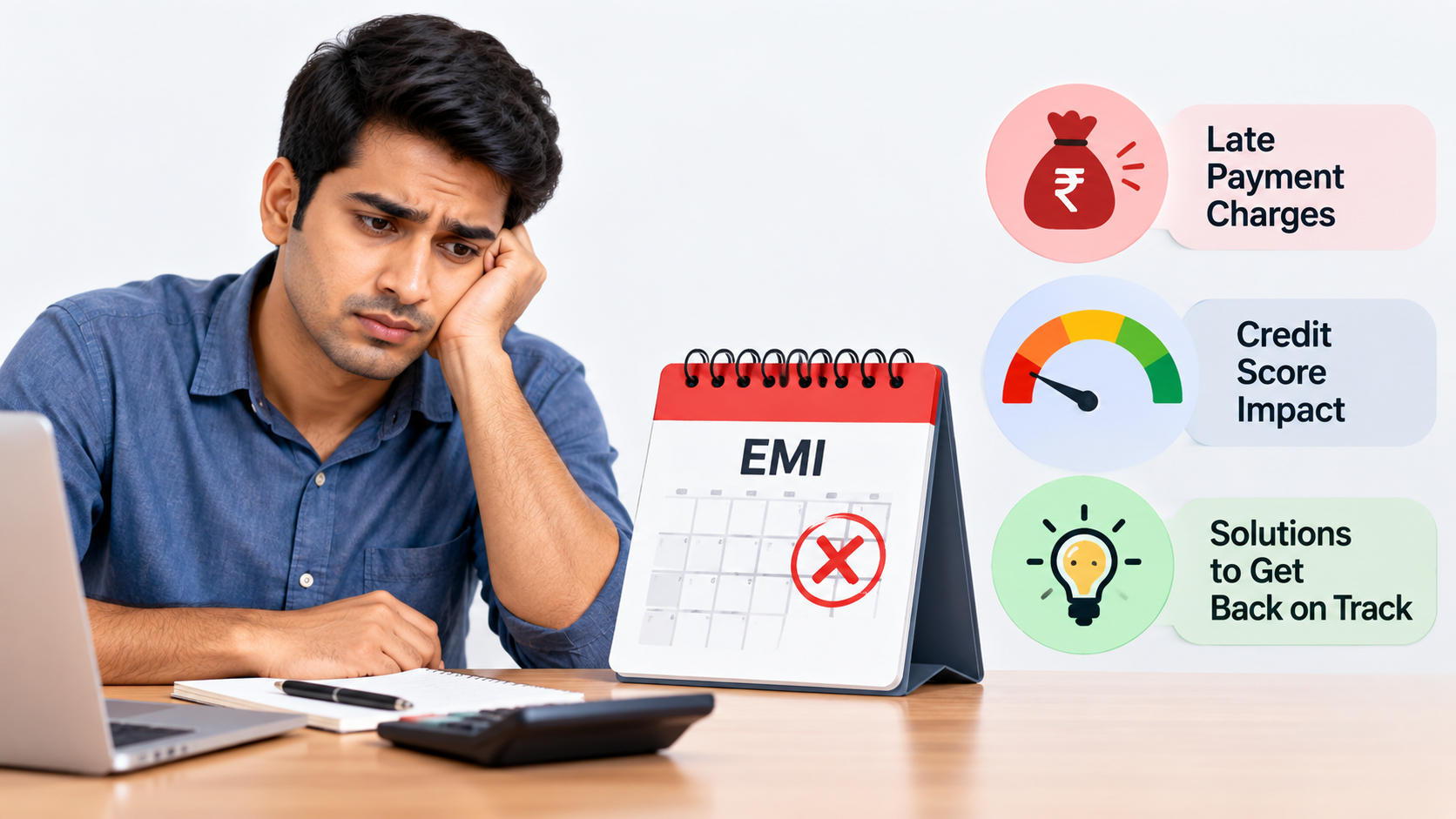
A loan EMI is a fixed amount that a borrower pays to a lender every month. It may be for a personal loan, home loan, car loan, education loan or another credit facility.
But what happens if you miss the payment date?
A delayed EMI may seem like a small issue, especially if you plan to pay it a few days later. However, depending on your loan agreement and the lender’s policies, even a short delay can lead to additional charges. If the payment remains overdue, it may also affect your credit history and future borrowing options.
The good news is that missing one EMI does not automatically mean you have lost access to credit forever. Taking prompt action, clearing the overdue amount and maintaining a consistent repayment record can help you manage the situation.
In this guide, we explain the possible penalties, credit-score impact and practical solutions for a missed loan EMI in India.
AI Answer Box: What Happens If You Miss a Loan EMI?
If you miss a loan EMI, your lender may mark the payment as overdue and charge applicable late-payment or penal charges under your loan agreement. A failed auto-debit may also attract a separate charge if permitted by the relevant terms. The missed payment may be reported to credit information companies and can negatively affect your CIBIL Score. Pay the overdue amount as soon as possible, contact your lender if you cannot pay, and check your credit report for accurate reporting.
Your Loan EMI Becomes Overdue
When you do not pay an EMI by its scheduled due date, the unpaid amount becomes overdue.
For example, suppose your personal loan EMI is ₹8,000 and the payment date is the 5th of every month. If the EMI is not paid on the 5th, the lender may treat the amount as overdue according to its processes and the terms of your loan.
The consequences can depend on:
- The type of loan you have
- The amount that remains unpaid
- How many days the payment is delayed
- The lender’s repayment and collection policies
- The terms mentioned in your loan agreement
Important: Do not assume that you automatically receive a fixed grace period after the EMI due date. Check your loan agreement or contact your lender to confirm how overdue payments are handled.
You May Have to Pay Late-Payment or Penal Charges
One of the immediate consequences of a missed EMI may be additional charges.
Depending on your loan terms, these may include:
| Type of Charge | What It Means |
|---|---|
| Penal charges | Charges imposed for non-compliance with loan repayment terms, where applicable |
| Overdue interest | Interest that may continue to apply to the unpaid amount under the loan contract |
| EMI bounce charges | Charges that may apply when an auto-debit or payment instruction fails, subject to the applicable terms |
| Other applicable fees | Any other permitted charge disclosed in your loan documents |
The exact amount is not the same for every lender or loan product. Review your sanction letter, loan agreement, Key Facts Statement (KFS), if applicable, and the lender’s schedule of charges.
What Does RBI Say About Penal Charges?
The Reserve Bank of India (RBI) has issued instructions on penal charges in loan accounts. Under these instructions, penalties for non-compliance with material loan terms must be treated as penal charges rather than added to the interest rate as penal interest.
The instructions also state that penal charges should be reasonable, disclosed to borrowers and not capitalised — meaning the lender should not calculate further interest on the penal charges themselves.
This does not mean that all charges disappear when an EMI is missed. Contractual interest on the unpaid amount and other permitted charges may still apply.
Read the RBI’s guidance on penal charges in loan accounts.
Your CIBIL Score May Be Affected
Your repayment history is an important part of your credit profile.
When you miss an EMI, the lender may report the overdue payment to credit information companies. The information can appear in your credit report and may negatively affect your CIBIL Score.
The impact depends on factors such as:
- Whether the payment was late or remained unpaid
- How long the account stayed overdue
- Your existing repayment history
- Other information in your credit report
- How the lender reports the account
There is no single fixed number of points that every borrower loses after missing an EMI. The effect can vary from one credit profile to another.
Why Does a Missed EMI Matter?
Lenders use credit reports and scores as part of their assessment when reviewing loan or credit-card applications. A history of delayed payments may make it harder to obtain credit or may affect the terms offered.
According to TransUnion CIBIL, payment history is one of the key factors used to assess a person’s credit profile.
You can learn more from CIBIL’s explanation of credit scores.
You May Receive Reminders From Your Lender
If your EMI remains unpaid, your bank or lending institution may contact you through:
- SMS reminders
- Phone calls
- Emails
- Notifications in the lender’s app
- Written notices, depending on the situation
These reminders are generally intended to inform you about the overdue amount and request payment.
If you are facing a genuine financial problem, communicate with your lender rather than ignoring the messages. Explain your situation and ask about the available options.
Always verify that a person contacting you is genuinely representing your lender. Do not share your OTP, PIN, password or other confidential banking details with callers.
Your Loan Could Become Seriously Delinquent
A missed EMI does not automatically make every loan a non-performing asset (NPA). However, if the payment remains overdue for a prolonged period, the account may move into more serious delinquency categories.
For a typical term loan, RBI’s prudential framework generally treats the account as an NPA when principal or interest remains overdue for more than 90 days, subject to the applicable rules.
This is an important distinction:
- An EMI can be overdue from its due date.
- Credit reporting and lender follow-up may occur before 90 days.
- The 90-day NPA threshold is not a free payment extension or a guarantee that there will be no consequences before then.
The relevant classification rules can vary for different types of credit facilities.
For reference, see the RBI’s prudential norms on income recognition, asset classification and provisioning.
Can You Miss One EMI Without Affecting Your Credit Score?
There is no universal guarantee that missing one EMI will leave your credit score unchanged.
The effect depends on how the lender handles and reports the overdue payment, along with the credit information company’s scoring model and your existing credit history.
Even if you pay the overdue EMI shortly afterward, the lender may still report the payment history according to the applicable reporting process.
If you missed an EMI by mistake:
- Pay the overdue amount as soon as possible.
- Check whether any additional charges are due.
- Ask your lender whether the payment has been updated in its records.
- Review your credit report after the lender has had time to update the information.
Paying quickly can help prevent the overdue period from extending, but it does not guarantee that any reported late payment will be removed.
What Happens If Your EMI Auto-Debit Fails?
Many borrowers set up automatic EMI payments through NACH, ECS or another authorised payment arrangement.
An auto-debit may fail because of:
- Insufficient account balance
- An inactive or blocked bank account
- A mandate issue
- Incorrect account details
- A technical or banking-system problem
If the auto-debit fails, the EMI may remain unpaid even if you intended to make the payment.
What Should You Do?
- Check your bank account and loan account.
- Confirm whether the EMI was actually debited.
- Contact your lender if the payment status is unclear.
- Pay through an official alternative method if the EMI remains due.
- Check whether any bounce or other charges have been applied.
Avoid paying twice if the original debit is still pending. Verify the transaction status with your bank or lender first.
What to Do If You Have Missed a Loan EMI
If you have missed an EMI, follow these practical steps.
Step 1: Check the Outstanding Amount
Log in to your lender’s official app or website, or contact customer support.
Confirm:
- The missed EMI amount
- Any overdue interest or applicable charges
- The total amount required to bring the account up to date
- The payment method accepted by the lender
Step 2: Pay the Overdue EMI as Soon as Possible
If you can afford to pay, clear the overdue amount promptly.
Use the lender’s official payment channel and save the payment receipt or confirmation.
Step 3: Contact Your Lender If You Cannot Pay
If you are unable to make the payment, explain the reason to your lender.
Ask whether it offers any formal options, such as a revised payment arrangement or restructuring, if eligible. These options are not automatic and depend on the lender’s policies and your circumstances.
Get any revised terms in writing before relying on them.
Step 4: Check the Charges
Review the charges applied to your account against your loan agreement, KFS and the lender’s disclosed fee schedule.
If a charge appears incorrect, ask the lender for a written explanation and raise a complaint through its official grievance process if needed.
Step 5: Review Your Credit Report
After the payment has been processed and the lender has had time to update its records, review your credit report.
Check whether:
- The overdue amount has been updated
- The payment status is accurate
- The reported dates are correct
- Any incorrect information needs to be disputed
If the information is inaccurate, raise a dispute with the lender and the relevant credit information company. Accurate payment history cannot simply be deleted because a borrower requests it.
What If You Cannot Afford Your EMI This Month?
If your income has reduced or an unexpected expense has affected your budget, start by assessing what you can realistically pay.
Consider these steps:
Prioritise Essential Expenses
Make a clear budget for housing, food, utilities, medical needs and other essential expenses. Understand how much is genuinely available for debt repayment.
Speak to the Lender Early
Contact the lender before the overdue period becomes longer. Explain the situation and ask about any formal repayment options.
Avoid Taking Expensive Debt to Pay Another EMI
Using a high-cost loan or cash advance to pay an existing EMI may create a cycle of borrowing. Compare the total cost and repayment obligations before taking on new debt.
Do Not Ignore the Problem
Ignoring calls, messages or notices will not resolve the outstanding amount. Keep records of your communication and any arrangement agreed with the lender.
How to Avoid Missing Future EMIs
A few simple habits can make loan repayment easier to manage.
| Tip | How It Helps |
|---|---|
| Set a payment reminder | Helps you remember the due date |
| Maintain sufficient balance | Reduces the risk of auto-debit failure |
| Keep a repayment calendar | Makes multiple EMIs easier to track |
| Build an emergency fund | Provides a buffer for unexpected expenses |
| Review bank statements | Helps identify failed or duplicate payments |
| Update contact details | Helps you receive lender reminders |
| Track your monthly budget | Helps you plan for upcoming repayments |
If you have multiple loans, list each EMI, its due date and the account from which it is paid. This makes it easier to plan your monthly cash flow.
Does Paying a Missed EMI Improve Your CIBIL Score?
Paying the overdue EMI is an important step because it brings the account closer to being up to date and prevents the missed payment from remaining unpaid.
However, paying the EMI does not guarantee an immediate increase in your CIBIL Score.
If a late payment has already been accurately reported, that historical information may remain in your credit report for the applicable reporting period. Your score may change over time as new repayment information is reported and other factors in your credit profile change.
To support your credit health:
- Pay future EMIs on time.
- Keep other loan and credit-card payments current.
- Check your credit report for errors.
- Avoid applying for unnecessary credit.
- Contact the lender if a payment is incorrectly shown as overdue.
Consistent repayment is more useful than relying on a quick score-repair promise.
Can the Bank Take Legal Action for a Missed EMI?
A missed EMI can lead to recovery efforts under the loan agreement and applicable law. The possible steps depend on the loan type, the security provided, the length of the default and the circumstances.
For a secured loan, such as a home loan or vehicle loan, prolonged default can put the secured asset at risk if the lender follows the applicable legal process.
For an unsecured personal loan, the lender may pursue recovery through permitted channels and legal remedies.
A single missed EMI does not mean that a lender can immediately seize property or take any action it wants. Borrowers should read formal notices carefully and seek qualified legal advice if they receive legal proceedings or a notice they do not understand.
What Is the Difference Between a Late EMI and Loan Default?
These terms are related, but they do not always mean the same thing.
| Term | Meaning |
|---|---|
| Late EMI | A scheduled instalment has not been paid by its due date |
| Overdue loan | An amount payable under the loan remains unpaid after its due date |
| Delinquency | A loan payment is late, often described by how long it has remained unpaid |
| Loan default | A failure to meet repayment obligations, as defined by the agreement and applicable rules |
| NPA | A regulatory classification applied when specified conditions are met |
The terminology and consequences depend on the loan contract and the rules that apply to the lender and credit facility.
Frequently Asked Questions (FAQs)
1. What happens if I miss one loan EMI?
Your EMI may become overdue, and your lender may apply charges under your loan agreement. The missed payment may also affect your credit history if it is reported.
2. Will my CIBIL Score decrease if I miss an EMI?
It may decrease, but there is no fixed number of points that applies to everyone. The effect depends on your credit profile and how the overdue payment is reported.
3. Is there a grace period for paying a loan EMI?
There is no single grace period that applies to every loan. Check your loan agreement and confirm the terms with your lender.
4. What are EMI bounce charges?
These are charges that may apply when an automatic payment instruction fails. Whether they apply and how much they cost depend on the relevant terms and policies.
5. Can I pay my EMI after the due date?
You can generally make a payment after the due date through the lender’s accepted payment channels, but overdue interest or other applicable charges may arise. Confirm the total amount due with your lender.
6. Will one missed EMI affect my future loan approval?
It may. Lenders may consider repayment history when assessing a new application. The effect depends on the lender’s assessment and your overall credit profile.
7. What happens if I miss my home loan EMI?
The amount may become overdue, and applicable charges may be imposed. Prolonged default can have more serious consequences, including possible action relating to the secured property under the applicable legal process.
8. What happens if my EMI auto-debit fails?
The payment may remain unpaid. Check your loan account, confirm whether the debit went through and arrange payment through an official channel if required.
9. Can I ask my bank to waive late-payment charges?
You can request a waiver, but approval is not guaranteed. Ask the lender to review the charges and explain its decision in writing.
10. Can I get my CIBIL Score back up after a missed EMI?
Your credit profile can improve over time through consistent repayments and accurate reporting. However, there is no guaranteed timeline or fixed score increase.
11. Does paying the missed EMI remove the late-payment record?
Not necessarily. Payment brings the account up to date, but accurate historical information may remain in your credit report for the applicable period.
12. What should I do if I cannot afford my EMI?
Contact your lender as early as possible, explain your financial situation and ask whether a formal repayment arrangement or restructuring option is available. Review the costs and terms before agreeing.
13. Can a lender charge penal interest on a missed EMI?
RBI instructions state that penalties for non-compliance with material loan terms should be levied as penal charges, not as an additional penal-interest component. Contractual interest on the unpaid amount may still apply.
Published on : 28th September
Published by : SMITA
www.vizzve.com || www.vizzveservices.com
Follow us on social media: Facebook || Linkedin || Instagram
🛡 Powered by Vizzve Financial
RBI-Registered Loan Partner | 10 Lakh+ Customers | ₹600 Cr+ Disbursed