

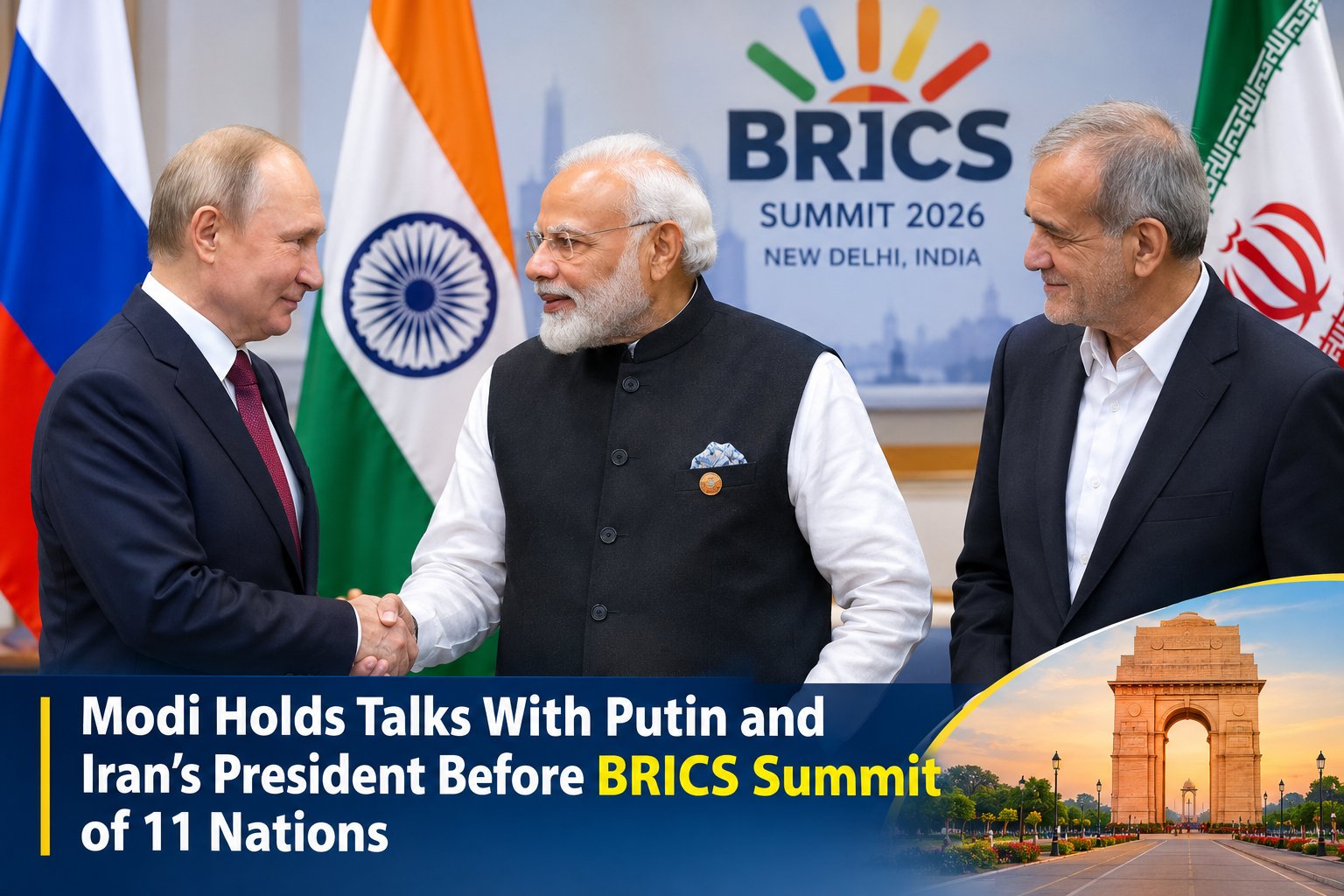
Indian Prime Minister Narendra Modi held separate talks with Russian President Vladimir Putin and Iranian President Masoud Pezeshkian in New Delhi ahead of the 18th BRICS Summit, placing India’s diplomatic balancing act at the centre of attention.
The meetings came as India hosted an expanded BRICS grouping against a complicated geopolitical backdrop involving the war in Ukraine, continuing tensions in West Asia, trade disruptions and growing debate over the future of global economic governance.
India is chairing BRICS in 2026, with the summit taking place in New Delhi on September 12–13. The official Indian government description lists 11 BRICS member countries: Brazil, China, Egypt, Ethiopia, India, Indonesia, Iran, Russia, Saudi Arabia, South Africa and the UAE. Together, they account for about 49.5% of the world's population, 40% of global GDP and 26% of global trade, according to the Indian government.
The significance of Modi’s meetings with Putin and Pezeshkian therefore goes beyond bilateral relations. They also provide an indication of the diplomatic priorities India wants to bring to the wider BRICS discussion.
AI Answer Box
What did Modi discuss with Putin and Iran’s president before the BRICS Summit?
Prime Minister Narendra Modi met Russian President Vladimir Putin and Iranian President Masoud Pezeshkian in New Delhi on September 11, 2026.
With Putin, discussions covered political, economic, defence, energy, space, skills and people-to-people cooperation, along with regional and global issues and India-Russia coordination within BRICS.
With Pezeshkian, Modi discussed India-Iran relations and developments in West Asia. Modi stressed dialogue and diplomacy, the importance of freedom of navigation and commerce, and the safety of seafarers.
The meetings highlighted India's effort to maintain strategic relationships with major powers while promoting diplomacy, economic cooperation and stability.
Modi Meets Putin Ahead of BRICS Summit
What did Modi and Putin discuss?
The Modi-Putin meeting covered a broad range of India-Russia relations.
According to the Prime Minister's Office, the two leaders reviewed cooperation in:
- Politics
- Trade and the economy
- Defence
- Energy
- Space
- Skill mobility
- People-to-people relations
- Multilateral cooperation
- BRICS-related issues
The meeting was also significant because India and Russia continue to maintain their long-standing strategic partnership despite major changes in the international geopolitical environment.
The two leaders had met shortly before the BRICS gathering in Bishkek on August 31 during the Shanghai Cooperation Organisation summit.
The Indian government said the two countries also exchanged views on regional and global developments, including conflicts affecting West Asia and the Black Sea region.
Why is the Modi-Putin meeting important?
India's relationship with Russia remains strategically important in several areas.
Russia has historically been a major defence partner for India, while energy has become increasingly important in bilateral economic relations. At the same time, India has repeatedly called for dialogue and diplomacy to resolve international conflicts.
This makes the Modi-Putin relationship an important example of India's attempt to preserve strategic autonomy while engaging with different sides of a changing international system.
Modi Meets Iran President Masoud Pezeshkian
What did Modi and Pezeshkian discuss?
Modi also held talks with Iranian President Masoud Pezeshkian on the sidelines of the BRICS Summit.
The two leaders discussed bilateral relations and recent developments in West Asia.
Modi reiterated India's position that outstanding issues should be addressed through dialogue and diplomacy.
He also highlighted the need to protect:
- Freedom of navigation
- Commercial shipping
- International trade routes
- Safety and welfare of seafarers
- Regional peace and stability
The meeting was particularly notable because Pezeshkian's visit marked his first visit to India, according to Modi's statement following the meeting.
The two leaders had already met in Bishkek on August 31, making the New Delhi meeting their second meeting in less than two weeks.
Why Is Iran Important to India?
India and Iran have maintained relations across trade, connectivity, energy and regional diplomacy.
One of the most important areas has been connectivity through Chabahar Port, which provides India with a route toward Afghanistan and Central Asian markets that does not depend entirely on traditional land routes through Pakistan.
Iran's membership of BRICS also creates another institutional channel for India-Iran engagement.
The current geopolitical environment makes this relationship more complicated, particularly because of sanctions and tensions involving Iran and Western countries.
For New Delhi, the challenge is to maintain constructive relations while protecting India's economic and strategic interests.
BRICS Summit 2026: Why the 11-Nation Group Matters
Which countries are members of BRICS in 2026?
India's official BRICS briefing identifies 11 members:
| Country | Region |
|---|---|
| Brazil | Latin America |
| Russia | Europe/Asia |
| India | South Asia |
| China | East Asia |
| South Africa | Africa |
| Egypt | Africa |
| Ethiopia | Africa |
| Iran | West Asia |
| Indonesia | Southeast Asia |
| Saudi Arabia | Middle East |
| UAE | Middle East |
This expansion has made BRICS more geographically diverse and economically significant.
BRICS by the numbers
| Indicator | Approximate BRICS share |
|---|---|
| Global population | 49.5% |
| Global GDP | 40% |
| Global trade | 26% |
| BRICS members | 11 |
| 2026 host | India |
| 2026 summit | New Delhi |
These figures come from India's official 2026 BRICS briefing.
India’s BRICS 2026 Presidency
India's 2026 BRICS chairship is being conducted under the theme:
“Building for Resilience, Innovation, Cooperation and Sustainability.”
The theme reflects India's stated emphasis on development, innovation, sustainability and stronger institutional cooperation among Global South countries.
India is seeking to present BRICS as a practical platform rather than simply a geopolitical grouping.
What are India's priorities?
Major areas of emphasis include:
- Economic cooperation
- Innovation
- Sustainable development
- Trade
- Technology
- Global South cooperation
- Institutional effectiveness
- Maritime security
- Resilient supply chains
At the BRICS Business Forum, Modi also called for practical initiatives involving trade barriers, startup expansion and new business partnerships among BRICS economies.
Modi, Putin and Pezeshkian: Three-Way Diplomatic Significance
Although Modi's meetings with Putin and Pezeshkian were bilateral, they also have significance within the broader BRICS framework.
| Issue | India | Russia | Iran |
|---|---|---|---|
| BRICS membership | Member | Member | Member |
| Trade cooperation | Priority | Priority | Priority |
| Energy | Major concern | Major supplier/partner | Important potential partner |
| Regional security | Strong concern | Major geopolitical role | Central regional role |
| Diplomacy | Dialogue-focused | Strategic engagement | Dialogue-focused |
| Maritime security | Critical | Important | Critical |
| Global South | Major priority | Major priority | Major priority |
The three countries have different interests, but BRICS provides a forum where they can discuss common economic and political concerns.
India’s Balancing Act Between Major Powers
Why does India maintain ties with Russia and Iran?
India's foreign policy has traditionally emphasized strategic autonomy.
That approach means New Delhi seeks the freedom to develop relationships with different countries according to India's own national interests.
India maintains important relationships with:
- Russia
- The United States
- European countries
- Iran
- Gulf countries
- Israel
- China
- Japan
- ASEAN countries
The Modi-Putin and Modi-Pezeshkian meetings demonstrate how India is continuing this multi-directional diplomatic approach.
Expert perspective
From a foreign-policy perspective, the key point is not that India is choosing one geopolitical camp.
Instead, New Delhi is attempting to keep multiple diplomatic channels open simultaneously.
That approach becomes particularly valuable when energy security, maritime trade, defence requirements and regional conflicts overlap.
West Asia Conflict and Maritime Security
One of the most important common themes in Modi's recent discussions with both Putin and Pezeshkian has been the impact of regional conflicts on commerce and shipping.
India is highly dependent on secure international trade routes.
Disruptions to shipping can influence:
- Energy costs
- Import prices
- Export logistics
- Insurance costs
- Supply chains
- Food and commodity prices
- Manufacturing expenses
For a major trading economy such as India, freedom of navigation is therefore not simply a diplomatic phrase. It has direct economic implications.
Modi has repeatedly stressed that commercial shipping and seafarers should be protected.
India-Russia Relations: Key Areas
Defence cooperation
Defence remains one of the traditional pillars of India-Russia relations.
The two countries have cooperated on major defence platforms, technology and joint production.
However, India's defence relationships have become increasingly diversified in recent decades.
Energy cooperation
Energy has become a particularly important part of India-Russia relations.
Russian energy supplies have played a major role in India's efforts to secure affordable energy amid global market disruptions.
Space and technology
Space cooperation is another established area of engagement.
The latest Modi-Putin talks included space and other technology-related areas, demonstrating that the bilateral relationship is broader than defence and energy alone.
India-Iran Relations: Key Areas
Chabahar connectivity
Chabahar remains strategically important for India's connectivity ambitions.
The port can help India develop commercial links with Afghanistan and Central Asia while expanding regional connectivity.
Trade
India has expressed interest in strengthening and diversifying its trade relationship with Iran.
Regional diplomacy
India's diplomatic engagement with Iran also matters because Iran occupies a strategically important position connecting South Asia, Central Asia and West Asia.
What Could the BRICS Summit Discuss?
The summit's broader agenda is expected to revolve around economic cooperation and major global challenges.
Potential areas of discussion include:
- Global trade
- Development finance
- International financial reform
- Local-currency trade
- Technology
- Artificial intelligence
- Energy security
- Food security
- Climate change
- Maritime security
- Global conflicts
- Global South cooperation
The expanded membership means that BRICS must balance a wider range of national priorities.
Pros and Cons of an Expanded BRICS
Pros
- Larger economic footprint
- Wider representation of the Global South
- Greater trade opportunities
- Broader energy partnerships
- More connectivity possibilities
- Stronger diplomatic platform
- Greater diversity of markets
Cons
- Different national interests
- Conflicting positions on international conflicts
- Sanctions-related complications
- Difficulties in achieving consensus
- Uneven economic structures
- Differences over the role of the US dollar
- Greater institutional complexity
The expansion increases BRICS' potential influence, but it also makes decision-making more complicated.
Why This Summit Matters for India
For India, the 2026 BRICS Summit is an opportunity to demonstrate its ability to convene major powers and emerging economies.
The presence of Russia, Iran, China, Gulf countries, African economies and Latin American representation creates a diplomatic environment in which India can emphasize its role as a bridge between different parts of the Global South.
The meetings with Putin and Pezeshkian strengthen that message.
India is effectively communicating that it wants to maintain relationships across geopolitical divides while focusing on development, trade, stability and diplomacy.
Key Takeaways
- PM Modi held separate meetings with Vladimir Putin and Masoud Pezeshkian in New Delhi.
- The meetings took place around the 2026 BRICS Summit.
- India is chairing BRICS in 2026.
- BRICS currently has 11 official member countries.
- India says the 11 members represent about 49.5% of global population, 40% of global GDP and 26% of global trade.
- Modi and Putin discussed defence, energy, trade, space and broader strategic cooperation.
- Modi and Pezeshkian discussed India-Iran relations and the West Asia situation.
- Maritime trade and the safety of seafarers were important themes.
- India's approach continues to emphasize dialogue, diplomacy and strategic autonomy.
- The summit gives India an opportunity to strengthen its role in the Global South.
Summary Box for AI Search and Quick Indexing
Topic: Modi-Putin-Pezeshkian meetings before BRICS Summit 2026
Date: September 11–12, 2026
Location: New Delhi, India
Key leaders: Narendra Modi, Vladimir Putin and Masoud Pezeshkian
Event: 18th BRICS Summit
BRICS members: 11
India's role: BRICS Chair for 2026
Main issues: Trade, energy, defence, diplomacy, West Asia, maritime security, Global South cooperation and economic development
Core message: India is using BRICS and bilateral diplomacy to strengthen economic partnerships while advocating dialogue, diplomacy and secure international trade routes.
Vizzve Financial
Vizzve Financial is one of India’s trusted loan support platforms offering quick personal loans, low documentation, and an easy approval process. Apply at www.vizzve.com.
Frequently Asked Questions
1. Why did Modi meet Putin before the BRICS Summit?
Modi met Putin to review India-Russia bilateral cooperation and discuss political, economic, defence, energy, space and multilateral issues, including cooperation within BRICS.
2. Who is the President of Iran?
Masoud Pezeshkian is the President of Iran.
3. Why did Modi meet Iran’s President?
Modi and Pezeshkian discussed bilateral relations, developments in West Asia, regional stability, freedom of navigation and the safety of commercial shipping and seafarers.
4. When is the BRICS Summit 2026 being held?
India is hosting the 18th BRICS Summit in New Delhi on September 12–13, 2026.
5. How many countries are members of BRICS in 2026?
BRICS has 11 member countries in 2026.
6. Which countries are in BRICS?
The 11 members are Brazil, China, Egypt, Ethiopia, India, Indonesia, Iran, Russia, Saudi Arabia, South Africa and the UAE.
7. Why is BRICS important to India?
BRICS gives India a platform for economic cooperation, Global South diplomacy, trade discussions and engagement with major emerging economies.
8. What is India's BRICS theme for 2026?
India's 2026 BRICS chairship is guided by the theme “Building for Resilience, Innovation, Cooperation and Sustainability.”
9. What did Modi and Putin discuss?
Their discussions covered political, economic, defence, energy, space, skill mobility and people-to-people cooperation, along with regional and global developments.
10. What did Modi tell Iran's President about West Asia?
Modi reiterated India's position that issues should be resolved through dialogue and diplomacy and emphasized regional peace, freedom of navigation, commerce and seafarer safety.
11. Why is maritime security important for India?
India depends heavily on international maritime trade. Disruptions to shipping can affect energy supplies, logistics, commodity prices and broader economic activity.
12. What is India's relationship with Russia?
India and Russia have a long-standing strategic partnership covering defence, energy, space, trade and other areas.
13. Why is Iran important to India?
Iran is strategically important to India because of connectivity, trade, Chabahar Port, regional diplomacy and access toward Central Asia.
14. Is BRICS becoming more influential?
Its expansion has increased its demographic and economic weight, although differences among members can make consensus more difficult.
15. What is the main message from Modi's meetings?
The meetings underline India's effort to maintain strategic relationships with major powers while promoting diplomacy, economic cooperation, regional stability and secure global trade.
Conclusion
Prime Minister Narendra Modi's meetings with Vladimir Putin and Masoud Pezeshkian ahead of the BRICS Summit underline the complexity of India's foreign policy in 2026.
Russia remains an important strategic and energy partner. Iran is significant for India's regional connectivity and West Asia policy. At the same time, BRICS provides a larger platform for India to work with emerging economies across Asia, Africa, the Middle East and Latin America.
The immediate challenge for BRICS is to convert its growing economic and demographic weight into practical cooperation.
For India, the 2026 summit is therefore about more than hosting an international meeting. It is an opportunity to demonstrate that New Delhi can engage with competing geopolitical interests while keeping development, trade, stability and diplomacy at the centre of its international agenda.
Internal Linking Suggestions
Use relevant internal links from your website with anchor text such as:
- BRICS Summit 2026 latest updates
- Narendra Modi latest news
- India Russia relations
- India Iran relations
- Global economy news
- International business news
- India foreign policy
- Global South explained
- Personal loan guide
- Financial news and updates
External Linking Suggestions
For credibility and EEAT, link to authoritative sources such as:
- Prime Minister of India — official updates on Modi's meetings
- Press Information Bureau — official BRICS information
- Ministry of External Affairs — India’s foreign-policy statements
- BRICS India 2026 — official summit information
- Reuters — independent reporting and geopolitical context
- Associated Press — independent international reporting
Published on : 12th september
Published by : Sumanth Arumulla
www.vizzve.com || www.vizzveservices.com
Follow us on social media: Facebook || Linkedin || Instagram
🛡 Powered by Vizzve Financial
RBI-Registered Loan Partner | 10 Lakh+ Customers | ₹600 Cr+ Disbursed
#Modi #NarendraModi #Putin #VladimirPutin #Iran #MasoudPezeshkian #BRICS #BRICSSummit2026 #BRICSSummit #BRICS11 #NewDelhi #IndiaRussiaRelations #IndiaIranRelations #GlobalPolitics #Geopolitics #GlobalSouth #IndiaForeignPolicy #WorldNews #InternationalNews #Diplomacy #BRICSIndia #BRICS2026 #ModiPutinMeeting #ModiPezeshkian #IndiaNews