

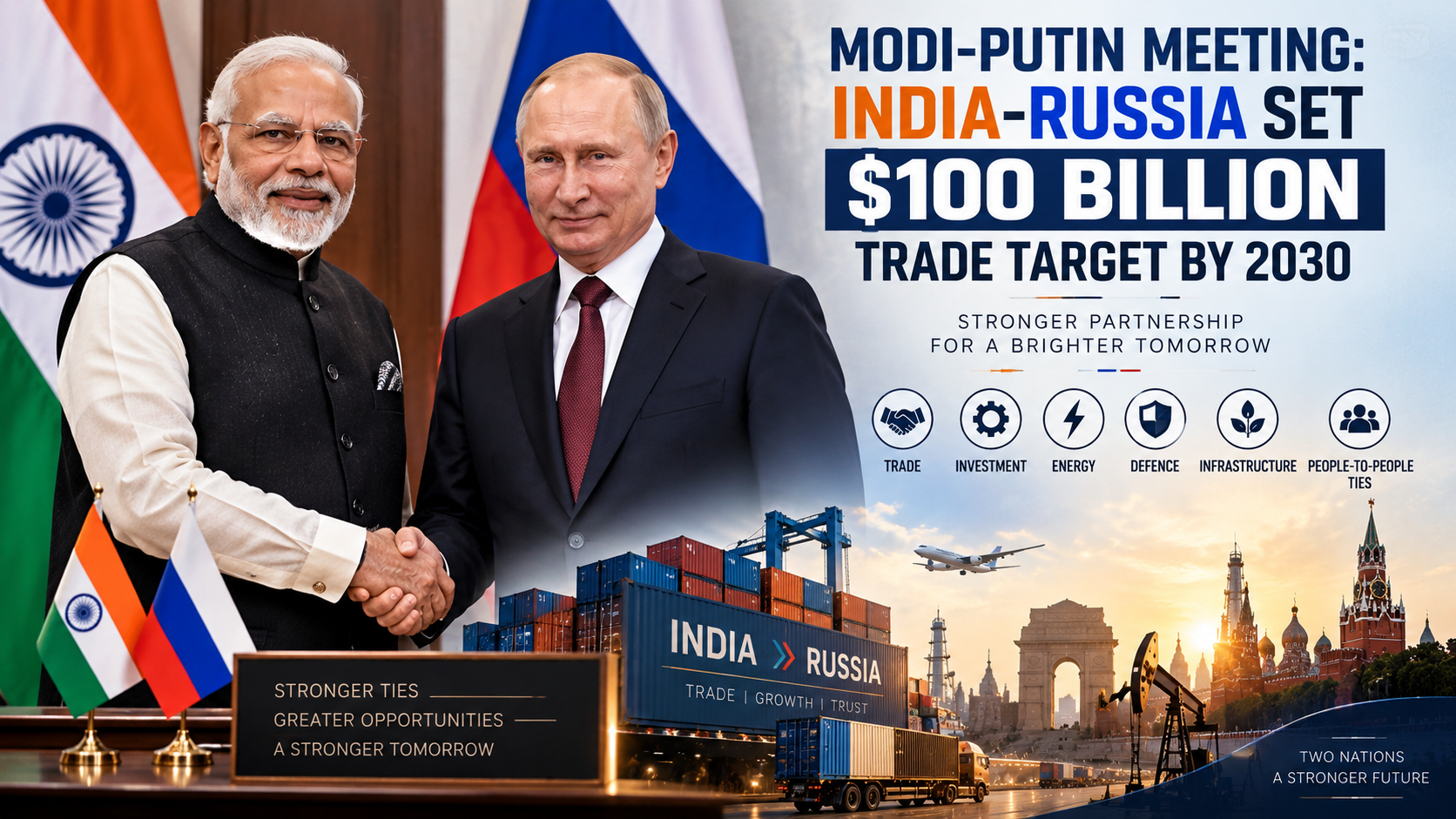
Prime Minister Narendra Modi and Russian President Vladimir Putin held bilateral talks in New Delhi on September 11, 2026, on the sidelines of the 18th BRICS Summit. The meeting focused on strengthening the long-standing India-Russia strategic partnership, with trade and economic cooperation emerging as major priorities.
The two leaders discussed closer trade ties and implementation of the Programme for Economic Cooperation 2030, while also reviewing cooperation in areas including infrastructure, energy, defence, space, skill mobility and people-to-people relations.
One of the biggest economic goals is to raise India-Russia bilateral trade to $100 billion by 2030. The target is ambitious, particularly because bilateral trade has become heavily concentrated in Russian energy exports to India.
📈 India-Russia Trade: Where Does It Stand?
India-Russia trade reached a record $68.7 billion in FY2024-25. However, the trade relationship remains highly unbalanced.
India's exports to Russia were around $4.9 billion, while imports from Russia reached about $63.8 billion in FY2024-25. Major Indian exports include pharmaceuticals, chemicals, iron and steel and marine products. Russian exports to India include crude oil and petroleum products, fertilisers, coking coal, vegetable oils and precious metals.
According to recent government-linked data, bilateral trade declined to about $59.86 billion in FY2025-26, making the push toward $100 billion by 2030 even more significant.
India-Russia Trade Snapshot
| Indicator | Figure |
|---|---|
| FY2024-25 bilateral trade | $68.7 billion |
| FY2025-26 bilateral trade | About $59.86 billion |
| Target by 2030 | $100 billion |
| FY2024-25 Indian exports | About $4.9 billion |
| FY2024-25 Indian imports | About $63.8 billion |
🎯 Why Is the $100 Billion Target Important?
The target is not simply about increasing the value of oil purchases.
India and Russia want to diversify the trade basket and create new opportunities for Indian companies to sell products and services in the Russian market.
India's Commerce Ministry has highlighted sectors such as pharmaceuticals, auto components and food products as areas where Indian exports to Russia could grow. Russian businesses have also been encouraged to use India's industrial corridors for manufacturing.
A broader trade relationship could help reduce the current dependence on a relatively narrow group of commodities.
🛢️ Oil Remains the Biggest Part of the Relationship
Energy is still at the centre of India-Russia economic ties.
Russian crude became a major source of India's oil imports following changes in global energy markets after the Russia-Ukraine conflict. India has continued buying Russian crude based on commercial considerations and energy-security requirements.
However, the economics of Russian crude are changing.
Recent reports indicate that Russian oil's share of India's imports fell from around 51% in July to about 45% in August, partly because discounts on Russian Urals crude narrowed significantly.
This makes diversification of bilateral trade even more important.
💊 Pharmaceuticals Could Become a Major Growth Area
India is one of the world's major pharmaceutical producers, and medicines are already among India's key exports to Russia.
Expanding pharmaceutical exports could help India increase its share of Russia's import market while creating a more balanced trade relationship.
Other areas with potential include:
- Generic medicines
- Medical products
- Chemicals
- Food products
- Agricultural goods
- Auto components
- Engineering products
- Textiles
- Electronics
The Indian government has repeatedly called for increasing Indian exports to Russia rather than allowing bilateral trade to remain dominated by energy imports.
🚗 Auto Components and Manufacturing Could Get a Boost
Manufacturing is another area where both countries see potential.
India is seeking greater access for its manufactured goods in Russia, while Russian companies are being encouraged to invest and manufacture in India.
The first INNOPROM India 2026 industrial exhibition, held in New Delhi from September 9-11, was highlighted by the two governments as an opportunity to strengthen industrial and trade ties. Modi and Putin also visited the exhibition during their latest meeting.
This could open opportunities in:
- Auto components
- Heavy machinery
- Industrial equipment
- Engineering
- Railways
- Electronics
- Industrial technology
⚛️ Nuclear Energy and Critical Minerals
The economic relationship could also expand beyond traditional trade.
During the latest talks, India and Russia discussed cooperation in energy, nuclear power and critical minerals, alongside manufacturing and infrastructure. Reports also indicate discussions around further Russian involvement in India's nuclear power programme.
Critical minerals are increasingly important for electric vehicles, batteries, electronics, renewable energy and advanced manufacturing.
Greater cooperation in this area could therefore have long-term strategic importance for India's industrial growth.
🚆 Infrastructure and Railways
Infrastructure is another potential area of expansion.
India and Russia have decades of cooperation in areas connected to railways and heavy industry. The latest economic discussions have included infrastructure and railway cooperation as part of a broader effort to expand bilateral economic ties.
For India, partnerships in infrastructure and industrial technology could support domestic manufacturing and the development of large-scale projects.
💰 Investment Is Also Part of the Plan
Trade is only one part of the longer-term economic relationship.
India and Russia have also discussed a target of $50 billion in two-way investment by 2030. India's Commerce Minister Piyush Goyal recently said businesses from both countries should work toward achieving both the $100 billion trade target and the investment goal.
Potential investment areas include:
- Energy
- Oil and gas
- Manufacturing
- Railways
- Nuclear power
- Pharmaceuticals
- Infrastructure
- Technology
- Industrial equipment
💱 Payment Systems and Trade Settlement
Payment mechanisms are another important issue for India-Russia trade.
Western sanctions and restrictions affecting Russian financial institutions have complicated traditional international payment channels. India and Russia have therefore been working on mechanisms that can make bilateral trade payments smoother.
The India-Russia Intergovernmental Commission has previously identified payment mechanisms, logistics, trade barriers and connectivity as important areas for improving economic cooperation.
For a $100 billion trade relationship, efficient and predictable payment systems will be essential.
🌍 Geopolitics Could Affect the Trade Target
The India-Russia economic relationship cannot be separated from global geopolitics.
The Russia-Ukraine conflict, Western sanctions, shipping disruptions and changing global energy prices continue to affect India's trade with Moscow.
During their latest meeting, Modi and Putin also discussed the impact of conflicts in West Asia and the Black Sea region, particularly their effect on maritime trade and the safety of Indian seafarers. Modi reiterated India's position that dialogue and diplomacy are important for resolving conflicts.
For India, maintaining strong ties with Russia while also maintaining relationships with the United States, Europe and other major economies remains an important part of its strategic-autonomy approach.
🇮🇳 What Could India Gain From Stronger Russia Ties?
A stronger economic partnership with Russia could provide India with several benefits.
1. Energy Security
Russia can remain an important source of crude oil and other energy products.
2. Export Opportunities
Indian pharmaceutical, agricultural, engineering and consumer companies could gain greater access to the Russian market.
3. Manufacturing
More Russian investment in India could support the Make in India manufacturing ecosystem.
4. Critical Minerals
Cooperation could improve access to minerals required for future technologies.
5. Nuclear Energy
Russia remains an important partner in India's nuclear power programme.
6. Infrastructure
Greater cooperation could create opportunities in railways, heavy engineering and large infrastructure projects.
⚠️ What Are the Challenges?
Achieving $100 billion in bilateral trade by 2030 will not be easy.
The biggest challenge is the current imbalance between Indian exports and imports.
India needs to substantially increase its exports to Russia rather than relying primarily on Russian energy imports to increase trade value.
Other challenges include:
- Sanctions-related restrictions
- Payment difficulties
- Logistics and shipping costs
- Currency volatility
- Limited Indian market share in Russia
- Dependence on energy commodities
- Changing crude oil discounts
- Geopolitical uncertainty
The government has therefore been pushing for a more balanced and diversified trade partnership.
🔮 Can India and Russia Reach $100 Billion Trade by 2030?
The target is possible but ambitious.
The strongest path would be to increase Indian exports while simultaneously expanding cooperation in manufacturing, energy, pharmaceuticals, food products, infrastructure, nuclear power, critical minerals and technology.
If trade remains heavily dependent on crude oil, reaching the target could become vulnerable to changes in oil prices and discounts.
But if both countries succeed in building a wider trade and investment relationship, the $100 billion target could become more sustainable.
📌 Key Takeaways
- PM Modi and President Putin met in New Delhi during the BRICS Summit.
- Both sides discussed strengthening India-Russia economic ties.
- The long-term bilateral trade target is $100 billion by 2030.
- Trade reached a record $68.7 billion in FY2024-25 but fell to about $59.86 billion in FY2025-26.
- Indian exports to Russia remain much smaller than India's imports from Russia.
- Oil remains a major component of bilateral trade.
- India wants greater exports of pharmaceuticals, food products, auto components and manufactured goods.
- Manufacturing, railways, infrastructure, nuclear energy and critical minerals could become major growth areas.
- Both countries are also targeting $50 billion in two-way investment by 2030.
- Payment systems and logistics will be crucial for achieving the trade goal.
❓ Frequently Asked Questions
1. What did Modi and Putin discuss in their latest meeting?
They discussed strengthening India-Russia bilateral ties, including trade, economic cooperation, defence, energy, space, infrastructure and other strategic areas.
2. What is India's trade target with Russia?
India and Russia are targeting $100 billion in bilateral trade by 2030.
3. How much was India-Russia trade in FY2024-25?
Bilateral trade reached a record $68.7 billion in FY2024-25.
4. What was India-Russia trade in FY2025-26?
Recent government-linked data puts bilateral trade at approximately $59.86 billion for FY2025-26.
5. What does India mainly import from Russia?
Major imports include crude oil and petroleum products, fertilisers, coking coal, vegetable oils and precious metals.
6. What does India export to Russia?
Major Indian exports include pharmaceuticals, chemicals, iron and steel, marine products and other manufactured goods.
7. Why is Russian oil important to India?
Russian crude has become an important source of India's energy imports, supporting energy security and giving Indian refiners another major supply source.
8. Will India-Russia trade become more diversified?
Both governments are pushing to diversify trade beyond energy, including pharmaceuticals, food, auto components, manufacturing, infrastructure and other sectors.
9. What is the India-Russia investment target?
The two countries are working toward a $50 billion two-way investment target by 2030.
10. What is the Programme for Economic Cooperation 2030?
It is a framework aimed at expanding and diversifying economic cooperation between India and Russia through greater trade, investment and sectoral partnerships.
11. Could pharmaceuticals benefit from stronger India-Russia ties?
Yes. Pharmaceuticals are already an important Indian export to Russia and have been identified as an area with further growth potential.
12. What are the biggest risks to the $100 billion target?
Sanctions, payment challenges, logistics, geopolitical tensions, currency fluctuations and the current imbalance between Indian exports and Russian imports could make the target more difficult to achieve.
📝 Conclusion
The latest Modi-Putin meeting shows that India-Russia relations are moving beyond their traditional focus on defence and energy toward a broader economic partnership.
The $100 billion bilateral trade target by 2030 is ambitious, especially after trade declined from its FY2024-25 record. But the goal could become achievable if India substantially increases exports to Russia and both countries expand cooperation in manufacturing, pharmaceuticals, infrastructure, nuclear energy, critical minerals and technology.
For India, the bigger opportunity is not simply to import more from Russia. It is to build a more balanced two-way economic relationship that creates new markets for Indian businesses while securing energy, industrial and strategic interests.
Disclaimer: This article is for informational purposes only. Trade figures and policy developments may change as updated government data and official announcements become available.
Published on : 12th september
Published by : shibam N
www.vizzve.com || www.vizzveservices.com
Follow us on social media: Facebook || Linkedin || Instagram
🛡 Powered by Vizzve Financial