

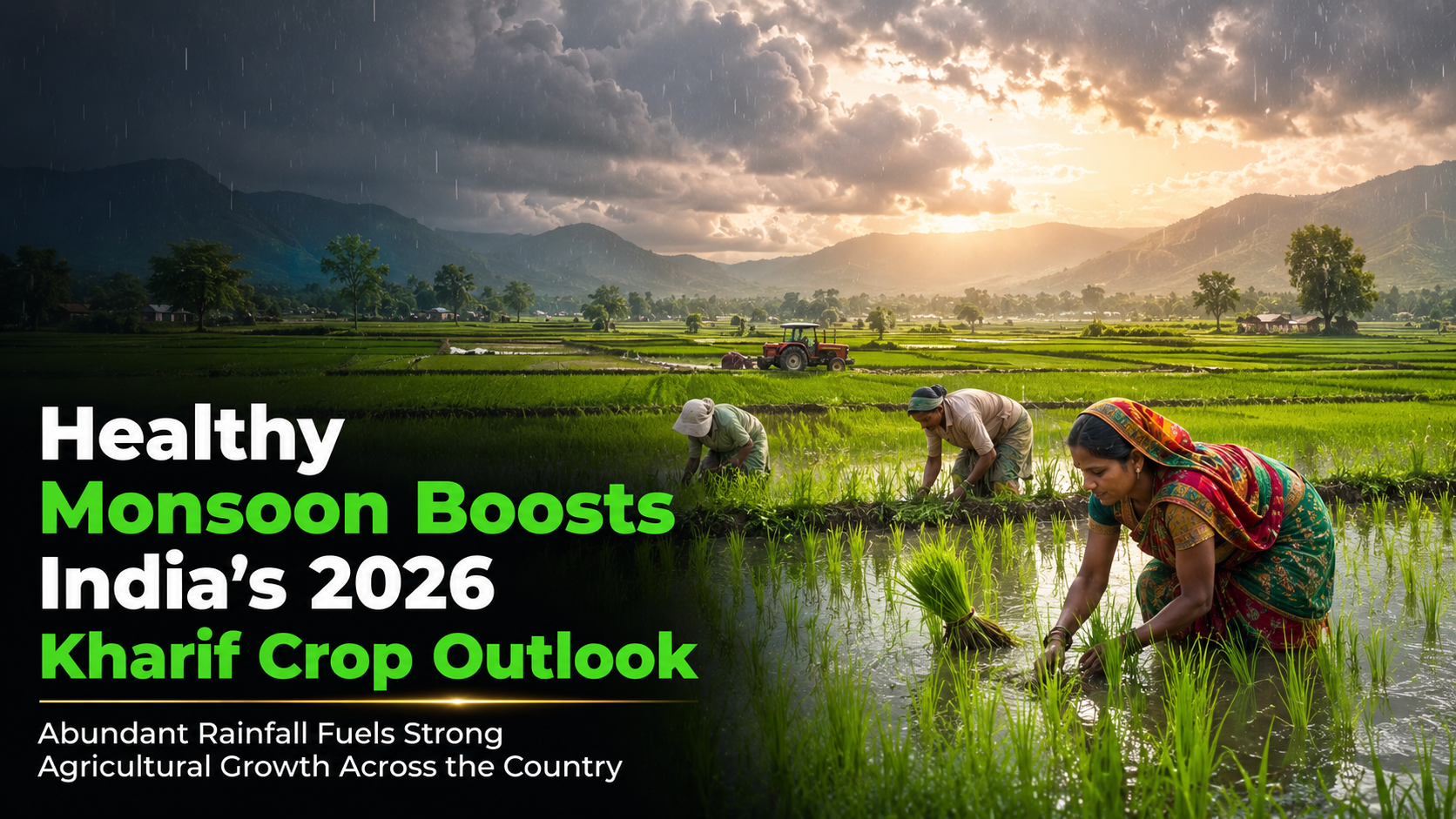
India's favorable monsoon outlook is expected to improve crop production during the 2026 kharif season. Better rainfall can increase agricultural output, raise farmers' incomes, stabilize food prices, support rural consumption, and contribute positively to India's overall economic growth.
AI Answer Box (Optimized for Google AI Overview, ChatGPT & Perplexity)
Why is a good monsoon important for India's crop outlook?
A healthy monsoon provides adequate rainfall for sowing and crop growth, especially for rain-fed farms. Good rainfall improves yields of rice, pulses, oilseeds, maize, cotton, and sugarcane while reducing irrigation costs. Higher agricultural production strengthens rural incomes, improves food availability, supports exports, and helps control food inflation, making it one of the most important drivers of India's economy.
Monsoon Expected to Improve Crop Outlook: A Positive Sign for India's Agriculture
India's agricultural sector is preparing for what could be one of the most productive cropping seasons in recent years. Weather forecasts indicating a healthy and well-distributed southwest monsoon have raised hopes among farmers, policymakers, agricultural experts, and businesses connected to the farm economy.
Since nearly half of India's cultivated land still depends primarily on rainfall rather than irrigation, the monsoon remains one of the biggest factors influencing agricultural output. A timely arrival and even distribution of rainfall can significantly improve crop productivity, increase farm incomes, reduce pressure on groundwater, and support broader economic growth.
The optimistic monsoon outlook is expected to benefit millions of farmers while also creating opportunities across industries such as fertilizers, agricultural machinery, logistics, consumer goods, and financial services.
Why the Indian Monsoon Matters
The southwest monsoon contributes the majority of India's annual rainfall and directly influences:
- Agricultural production
- Rural employment
- Food prices
- Water availability
- Hydroelectric power generation
- Inflation
- Consumer spending
- GDP growth
For a country where agriculture supports millions of livelihoods, a strong monsoon is far more than a weather event—it is an economic catalyst.
How Good Rainfall Improves Crop Production
1. Better Soil Moisture
Adequate rainfall increases soil moisture, creating favorable conditions for seed germination and healthy crop growth.
Benefits include:
- Improved root development
- Higher nutrient absorption
- Better crop quality
- Lower crop stress
2. Increased Sowing Area
When rainfall arrives on time, farmers are more likely to plant larger areas with confidence.
This leads to:
- Increased acreage
- Higher production
- Better utilization of farmland
- Improved agricultural efficiency
3. Reduced Dependence on Irrigation
Rain-fed farming becomes more productive during a healthy monsoon.
Advantages include:
- Lower electricity consumption
- Reduced diesel expenses
- Lower irrigation costs
- Improved groundwater recharge
4. Higher Crop Yields
Consistent rainfall supports crop development throughout the growing season.
Expected improvements include:
- Rice production
- Pulses
- Oilseeds
- Cotton
- Maize
- Soybean
- Sugarcane
Major Crops Likely to Benefit
| Crop | Expected Impact |
|---|---|
| Rice | Higher production |
| Pulses | Better yields |
| Cotton | Improved quality |
| Soybean | Strong output |
| Groundnut | Better harvest |
| Sugarcane | Healthy growth |
| Maize | Increased production |
| Oilseeds | Higher productivity |
Impact on Farmers
A good monsoon can significantly improve farmers' financial conditions.
Expected Benefits
- Higher farm income
- Better crop quality
- Lower cultivation costs
- Reduced dependence on irrigation
- Increased market supply
- Improved profitability
Farmers are also more likely to invest in:
- Better seeds
- Farm machinery
- Modern irrigation systems
- Fertilizers
- Agricultural technology
How a Strong Monsoon Supports India's Economy
Agriculture contributes significantly to India's economy. When agricultural production increases, its impact extends beyond farming.
Economic Benefits
Higher Rural Consumption
Improved farm income increases spending on:
- Consumer goods
- Automobiles
- Home appliances
- Mobile phones
- Housing improvements
Lower Food Inflation
Higher production increases supply, which can help stabilize prices of:
- Vegetables
- Rice
- Pulses
- Wheat
- Fruits
Stable food prices also support overall inflation control.
Better GDP Growth
Agriculture supports industries including:
- Food processing
- Fertilizer manufacturing
- Transportation
- Warehousing
- Retail
- Banking
A productive agricultural season contributes positively to GDP.
Industries That Could Benefit
| Sector | Benefit |
| Agriculture | Higher production |
| Fertilizers | Increased demand |
| Tractors & Farm Equipment | Better sales |
| FMCG | Higher rural demand |
| Banking | Stronger rural lending |
| Insurance | Higher policy adoption |
| Food Processing | Increased raw material availability |
| Logistics | Higher transportation demand |
Kharif Crops Expected to See Positive Outlook
The kharif season begins with the arrival of the southwest monsoon.
Major kharif crops include:
- Rice
- Cotton
- Soybean
- Groundnut
- Maize
- Bajra
- Jowar
- Pulses
Timely rainfall during sowing is critical for achieving higher productivity throughout the season.
Technology Is Transforming Agriculture
Modern farming techniques are helping farmers maximize the benefits of favorable rainfall.
Popular technologies include:
- Precision farming
- Weather forecasting apps
- Satellite monitoring
- Smart irrigation
- AI-based crop advisory
- Drone spraying
- Soil health monitoring
These innovations improve productivity while reducing costs.
Government Support for Farmers
Several government initiatives continue supporting agriculture through:
- Crop insurance
- Irrigation projects
- Soil health programs
- Digital agriculture
- Farmer credit schemes
- MSP procurement
- Rural infrastructure development
Combined with a healthy monsoon, these measures can significantly strengthen India's agricultural sector.
Challenges That Still Remain
Although the rainfall outlook is positive, agriculture continues to face several risks.
Key Challenges
- Uneven rainfall distribution
- Flooding in some regions
- Waterlogging
- Pest attacks
- Climate change
- Supply chain disruptions
- Rising input costs
Effective planning and timely policy support remain essential for minimizing these risks.
Expert Commentary (EEAT)
Agricultural performance depends not only on the quantity of rainfall but also on its timing and distribution. Even when seasonal rainfall is above average, prolonged dry spells or localized flooding can affect yields. Farmers who combine timely sowing with efficient water management, improved seed varieties, and weather-based advisory services are generally better positioned to benefit from favorable monsoon conditions.
From an economic perspective, stronger agricultural output can help stabilize food prices, support rural demand, and contribute to broader economic resilience. However, crop diversification, climate adaptation, and investment in irrigation infrastructure remain critical for sustaining long-term agricultural growth.
Summary Table
| Factor | Positive Impact |
| Good Rainfall | Better crop growth |
| Higher Production | More food supply |
| Better Farm Income | Strong rural economy |
| Lower Inflation | Stable food prices |
| Better GDP | Strong economic growth |
| Improved Water Levels | Better irrigation |
| Higher Rural Spending | Increased business activity |
Key Takeaways
- A healthy monsoon is expected to improve India's crop outlook in 2026.
- Better rainfall can increase yields for rice, pulses, cotton, soybean, and other kharif crops.
- Higher agricultural output may improve rural incomes and support consumer demand.
- Increased food production can help stabilize food inflation.
- Sectors such as fertilizers, farm equipment, FMCG, banking, and logistics may also benefit.
- Efficient water management and modern farming practices remain important despite favorable rainfall.
- A strong monsoon could contribute positively to India's broader economic growth.
Frequently Asked Questions (FAQs)
1. Why is the monsoon important for Indian agriculture?
The southwest monsoon provides most of India's annual rainfall and is essential for sowing and growing major kharif crops.
2. Which crops benefit the most from good monsoon rainfall?
Rice, pulses, soybean, cotton, maize, sugarcane, groundnut, bajra, and oilseeds are among the biggest beneficiaries.
3. How does a strong monsoon affect farmers?
Good rainfall improves crop yields, lowers irrigation costs, increases farm income, and reduces the risk of crop failure.
4. Can a healthy monsoon reduce food inflation?
Yes. Better crop production increases food supply, helping stabilize prices of grains, vegetables, fruits, and pulses.
5. How does agriculture impact India's economy?
Agriculture supports employment, rural incomes, exports, food processing, and contributes significantly to India's GDP.
6. What is the kharif cropping season?
Kharif crops are sown with the arrival of the southwest monsoon and harvested after the rainy season.
7. Which industries benefit from a strong monsoon?
Fertilizer companies, tractor manufacturers, FMCG firms, food processors, logistics companies, banks, and insurance providers often benefit.
8. Can excessive rainfall also be harmful?
Yes. Flooding, waterlogging, pest attacks, and transportation disruptions can negatively affect agriculture despite overall good rainfall.
9. How does monsoon affect groundwater?
Good rainfall helps recharge reservoirs, rivers, lakes, and groundwater levels, improving long-term water availability.
10. What role does technology play in agriculture?
Weather forecasting, AI-based advisory services, satellite monitoring, drones, and smart irrigation help farmers improve productivity.
11. Will a good monsoon improve rural spending?
Higher farm income generally increases spending on consumer goods, automobiles, housing, education, and healthcare.
12. How does monsoon influence GDP growth?
Better agricultural output strengthens rural demand, supports industries, improves exports, and contributes positively to overall economic growth.
13. What are the biggest risks despite a positive monsoon forecast?
Uneven rainfall, floods, climate change, pest infestations, rising input costs, and supply chain disruptions remain challenges.
14. Should investors monitor the agriculture sector during a good monsoon?
Yes. Sectors linked to agriculture such as fertilizers, farm equipment, irrigation, FMCG, rural banking, and logistics often experience improved business conditions.
15. What is the long-term outlook for Indian agriculture?
With continued investment in irrigation, digital farming, climate-resilient crops, and modern technology, India's agricultural sector has strong long-term growth potential.
Conclusion
A favorable monsoon is one of the strongest positive indicators for India's agricultural sector. Better rainfall can improve crop production, strengthen rural incomes, stabilize food prices, and support the country's broader economic growth. While weather uncertainties and climate-related risks continue to exist, timely rainfall combined with better farming practices and supportive government policies creates a strong foundation for a productive agricultural season.
For farmers, agribusinesses, investors, and consumers alike, the 2026 monsoon season represents an important opportunity to strengthen India's food security and rural economy.
About Vizzve Financial
Vizzve Financial is one of India's trusted loan support platforms offering quick personal loans, low documentation, and an easy approval process.
Whether you need funds for farming, business expansion, education, medical expenses, or personal financial needs, Vizzve Financial provides a simple and hassle-free loan application experience.
Apply today at: www.vizzve.com
Published on : 7th July
Published by : SMITA
www.vizzve.com || www.vizzveservices.com
Follow us on social media: Facebook || Linkedin || Instagram
🛡 Powered by Vizzve Financial
RBI-Registered Loan Partner | 10 Lakh+ Customers | ₹600 Cr+ Disbursed