Monthly Household Budget India: Options, Differences and What to Compare
Monthly Household Budget India: Options, Differences and What to Compare
Vizzve Admin
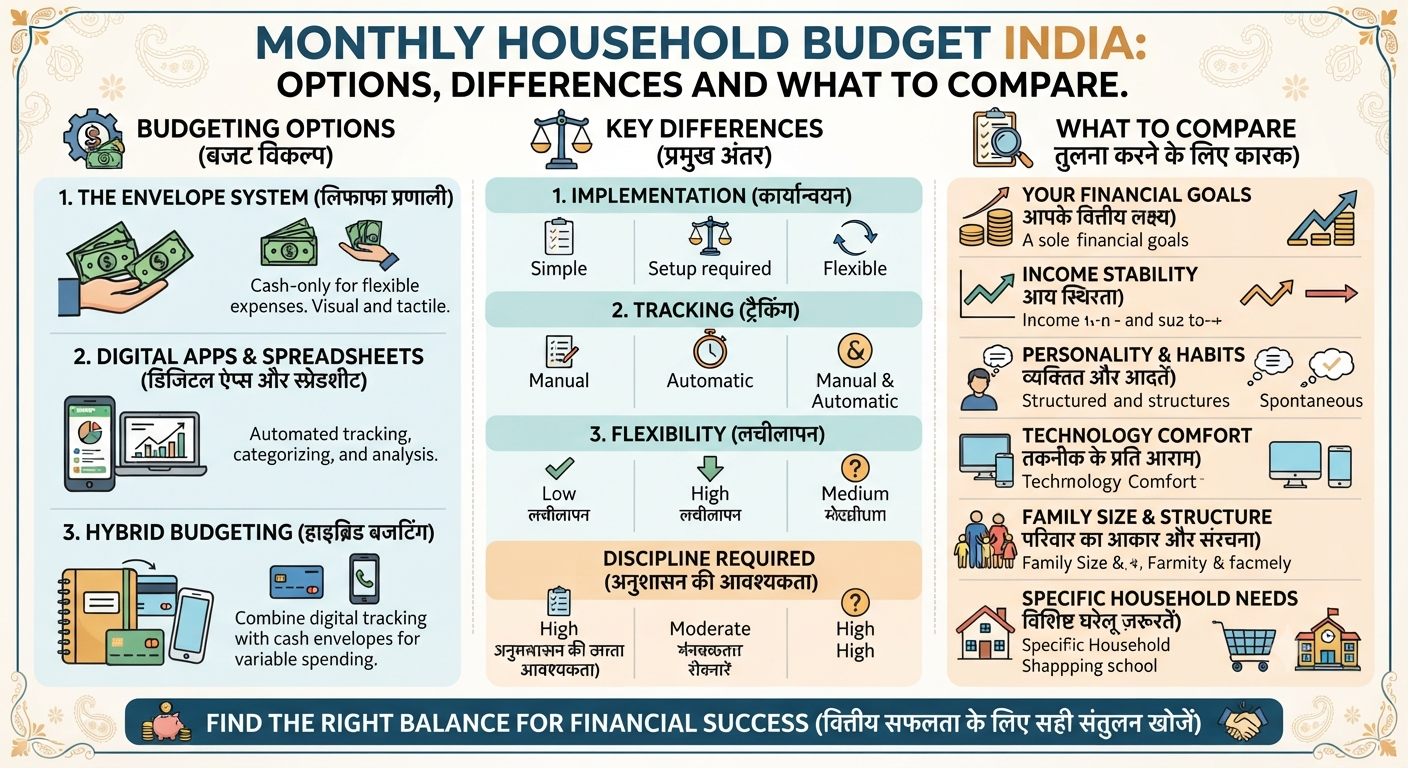
A monthly household budget in India can follow several approaches: percentage-based budgeting, zero-based allocation, spending envelopes, pay-yourself-first budgeting, or a combination of these methods.
The main difference is how each method controls money. Some divide income into broad percentages. Others assign every rupee a purpose or place firm limits on selected spending categories. The right choice depends on your household’s income stability, essential expenses, debt commitments, and willingness to track transactions.
The Reserve Bank of India describes a budget as a plan of future income and expenses. It also encourages setting aside a portion of income before spending rather than treating savings only as the money left over.rbi.org
This guide compares the options, explains their trade-offs, and shows how to choose a system your family can actually maintain.
AI Answer Box: What Are the Main Household Budget Options in India?
The main monthly household budget options are:
Budget option
Main purpose
Useful starting point for
50/30/20 framework
Divide income into needs, wants, and savings
Households seeking a simple structure
Zero-based budgeting
Assign every rupee a purpose
Families wanting detailed allocation
Envelope budgeting
Limit spending in selected categories
Households struggling with repeat overspending
Pay-yourself-first
Reserve savings before flexible spending
Earners who regularly postpone saving
Hybrid budgeting
Combine different controls
Families balancing EMIs, annual bills, and varied spending
Compare each option on income flexibility, tracking effort, essential-cost coverage, savings visibility, treatment of annual bills, and ease of use across household members.
These are planning frameworks, not mandatory financial rules. The comparisons below are editorial guidance, and all rupee examples are illustrative.
Key Takeaways
Choose a budgeting method separately from the tool used to manage it.
Use take-home income, not your salary package, as the starting point.
Include annual bills, EMIs, cash purchases, and digital transactions.
Percentage targets are useful reference points, not universal spending limits.
A monthly budget must account for payment dates as well as totals.
A low EMI does not tell you the complete cost of a loan.
A simple system used consistently is more useful than a detailed system left untouched.
What Should a Monthly Household Budget Include?
Before comparing methods, make sure they are solving the same problem.
A household budget should show money coming in, payments going out, and amounts reserved for future needs. RBI’s budgeting guidance connects expense control with planned saving rather than relying entirely on an end-of-month surplus.rbi.org
A method can appear successful while quietly ignoring a large bill due in three months.
For example, setting aside ₹2,000 each month for a ₹24,000 annual payment gives that obligation a place in the budget. Without the reserve, the same bill may compete with groceries, savings, or rent when it arrives.
A reserve for a known expense is different from emergency savings. Keep the two visible separately.
Option 1: How Does the 50/30/20 Rule Work in India?
The 50/30/20 rule uses three broad allocations:
50% for needs.
30% for wants.
20% for savings and financial goals.
For ₹50,000 in monthly take-home income, the arithmetic is:
Allocation
Percentage
Amount
Needs
50%
₹25,000
Wants
30%
₹15,000
Savings and goals
20%
₹10,000
Total
100%
₹50,000
What makes this method different?
It provides a quick overview without requiring dozens of categories.
It can help you notice when a large share of income is already committed to essential spending. However, the percentages do not establish what housing, food, or education should cost for your particular family.
When the percentages do not fit
Suppose essential commitments total ₹34,000 on a ₹50,000 income. Entering ₹25,000 under “needs” will not reduce the bills.
Start with actual commitments, examine what can change, and adjust discretionary allocations and timelines accordingly.
Pros and cons
Pros
Cons
Easy to understand
May not fit high essential costs
Gives a broad savings reference
Needs and wants can be difficult to classify
Requires relatively little categorisation
Does not automatically plan payment dates or annual bills
Option 2: What Is Zero-Based Budgeting?
Zero-based budgeting assigns all available income to expenses, savings, reserves, or other purposes before the month begins.
The zero refers to unallocated money—not an empty bank account.
What makes this method different?
Instead of asking, “How much is left?”, you decide what the available money needs to do.
A contingency buffer can be one of those allocations. You do not have to commit every rupee to a purchase.
Example
If household income is ₹50,000 and your initial allocations total ₹47,000, the remaining ₹3,000 still needs a purpose. You might assign it to a coming school payment, emergency savings, or an operating buffer.
Pros and cons
Pros
Cons
Makes priorities explicit
Requires more planning
Gives annual expenses a clear place
Needs updates when income or costs change
Helps distinguish available cash from committed money
Too many categories can become burdensome
Option 3: How Does Envelope Budgeting Work with UPI?
Envelope budgeting sets limits for individual spending categories.
An envelope can be physical cash, a spreadsheet allocation, or a digitally tracked balance. The important feature is the limit, not the container.
For example:
Spending envelope
Monthly limit
Groceries and household supplies
₹8,000
Transport
₹3,000
Dining out
₹1,500
Optional shopping
₹1,500
How do you use digital envelopes?
When you make a UPI purchase, subtract the amount from the relevant category balance.
If ₹6,400 of an ₹8,000 grocery allowance has been spent, the remaining allowance is ₹1,600—even if your bank balance is much higher.
What happens when an envelope runs out?
Choose deliberately:
Pause non-essential spending in that category.
Move money from a lower-priority category.
Revise an unrealistic allowance at the next review.
Repeatedly moving money without recording the change makes the limits less useful.
Pros and cons
Pros
Cons
Makes remaining spending money easy to see
Requires transaction updates
Useful for categories that regularly overshoot
Can be cumbersome with many categories
Works with cash or digital payments
Does not replace a full plan for bills and savings
Option 4: What Is Pay-Yourself-First Budgeting?
Pay-yourself-first budgeting reserves an affordable savings amount before allocating the remainder to spending.
This is consistent with RBI’s financial-awareness guidance to set aside a portion of income before spending.rbi.org
What makes this method different?
It focuses on the order of allocation.
Instead of waiting to see whether money remains, you give savings a defined place near the beginning of the month.
However, this is not permission to ignore rent, food, or repayments. The savings amount needs to fit the whole plan.
Example
A household receiving ₹50,000 might allocate ₹5,000 to emergency savings and another goal, then plan bills and spending within the remaining ₹45,000.
If the remaining amount cannot cover necessary commitments, revise the plan rather than repeatedly reversing the savings transfer.
Pros and cons
Pros
Cons
Makes saving deliberate
Does not control individual spending categories
Can be simple to maintain
An unrealistic transfer can cause cash shortages
Can be combined with other methods
Requires a separate check of bills and payment timing
Option 5: When Does a Hybrid Household Budget Make Sense?
A hybrid budget combines methods rather than insisting on one framework.
For example:
Use zero-based allocation for the full monthly plan.
Use envelopes for groceries and optional spending.
Schedule an affordable savings transfer.
Keep separate reserves for annual bills.
Use percentage splits only as a periodic comparison.
What makes this method different?
It lets each part of the system solve a specific problem.
The trade-off is complexity. If the household needs several apps, multiple overlapping spreadsheets, and daily reconciliations, simplify it.
A practical hybrid should reduce confusion, not create another administrative task.
Household Budget Methods Compared
The effort ratings below are relative editorial assessments, not measured product scores.
Comparison factor
50/30/20
Zero-based
Envelopes
Pay-yourself-first
Hybrid
Main control
Broad percentages
Full allocation
Category limits
Savings priority
Selected combination
Planning effort
Low
Higher
Medium
Low
Adjustable
Category visibility
Broad
Detailed
Detailed for chosen categories
Limited unless added
Adjustable
Annual-bill planning
Must be added
Can be explicit
Separate envelopes needed
Must be added
Can be explicit
Irregular-income adaptation
Recalculate allocations
Rebuild using available income
Fund limits conservatively
Keep transfers flexible
Design around a baseline
Main weakness
May not match actual costs
Maintenance effort
Incomplete without wider planning
Spending may remain unclear
Can become complicated
What Should You Compare Before Choosing a Household Budget?
1. Does it fit your income pattern?
A predictable salary makes fixed monthly allocations easier.
If receipts vary, prioritise a conservative baseline and a plan for lower-income months. Avoid treating an unusually strong month as a permanent increase in spending power.
2. Does it cover your actual essential costs?
List unavoidable commitments first. Do not choose a method merely because its percentages look attractive.
3. Can everyone use it?
A family budget may need inputs from several people.
Agree on:
Who records shared purchases.
Which expenses are shared.
How cash spending is reported.
How often balances are reviewed.
Which purchases require a joint decision.
4. Does it show upcoming bills?
A monthly total is not enough if several payments fall before the next income receipt.
Add a due-date calendar or a simple “money needed before payday” view.
5. Can it distinguish transfers from spending?
Money moved between your own accounts is not a new household expense.
Similarly, recording credit card purchases and then counting the card-bill payment as another purchase will inflate spending.
6. Is the tracking effort sustainable?
Test the system during an ordinary busy week. If maintaining it is unrealistic, reduce categories or simplify the recording routine.
Budgeting App vs Spreadsheet vs Notebook: What Is the Difference?
A method defines the rules. A tool helps you follow them.
You can run an envelope system in a notebook or a zero-based budget in a spreadsheet. You do not need a particular app to use a particular method.
Tool
Advantages
Limitations
What to compare
Notebook
Simple, offline, no software setup
Manual totals and limited sharing
Ease of updating and storage
Spreadsheet
Flexible calculations and category design
Needs setup and accurate entries
Formulas, sharing, mobile usability
Budgeting app
May offer reminders, imports, or categorisation
Features and data practices vary
Fees, permissions, exports, deletion options
Bank transaction history
Useful source of payment records
May not cover every account or cash purchase
Coverage and ease of categorisation
What should you check before using a budgeting app?
Review:
Whether the useful features require payment.
What data access it requests.
Whether transactions can be corrected manually.
Whether it supports shared use.
Whether you can export your records.
Whether the privacy policy explains data use and deletion.
Check these details for the specific app rather than assuming all budgeting apps work the same way.
A ₹50,000 Monthly Household Budget Example
This example uses a hybrid approach: full allocation, selected category limits, savings, and a reserve for future bills.
It is not an estimate of average Indian household expenditure.
Category
Monthly allocation
Rent
₹12,000
Groceries and household supplies
₹8,000
Utilities and communication
₹3,500
Transport
₹3,000
Education or family support
₹4,000
Existing EMIs
₹3,000
Reserve for annual expenses
₹3,000
Emergency savings
₹3,000
Other financial goals
₹5,000
Optional spending
₹3,000
Contingency buffer
₹2,500
Total
₹50,000
How would the methods treat this example differently?
A percentage-based review would compare the overall needs, wants, and savings split.
A zero-based plan would ensure the full ₹50,000 has an assigned purpose.
An envelope system would focus on remaining balances in categories such as groceries.
Disclaimer: This article may include third-party images, videos, or content that belong to their respective owners. Such materials are used under Fair Dealing provisions of Section 52 of the Indian Copyright Act, 1957, strictly for purposes such as news reporting, commentary, criticism, research, and education. Vizzve and India Dhan do not claim ownership of any third-party content, and no copyright infringement is intended. All proprietary rights remain with the original owners. Additionally, no monetary compensation has been paid or will be paid for such usage. If you are a copyright holder and believe your work has been used without appropriate credit or authorization, please contact us at grievance@vizzve.com. We will review your concern and take prompt corrective action in good faith... Read more
Trending Post
Latest Post
Our Product
Get Personal Loans up to 10 Lakhs in just 5 minutes