

Introduction
Understanding loan interest is an important part of managing personal finances. Whether you need money for medical expenses, education, home repairs, or an emergency, knowing how much interest you may pay can help you plan your budget.
A monthly interest calculator helps estimate the interest charged on a loan or earned on an amount deposited or invested. Depending on the calculator, you can enter the principal amount, interest rate, and period to estimate the interest for one month or multiple months.
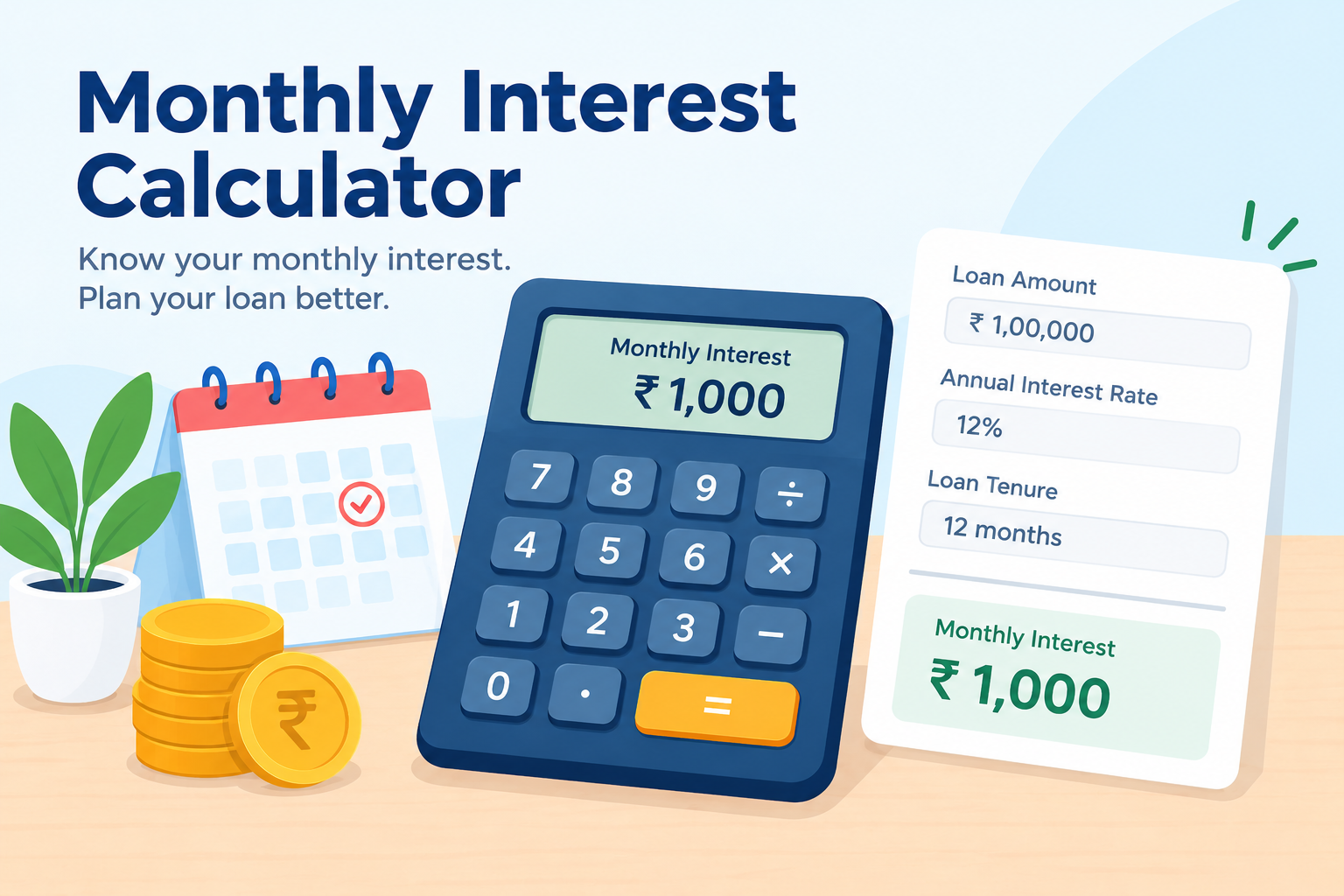
For example, if you borrow ₹1,00,000 at an annual interest rate of 12%, the interest for the first month would be approximately ₹1,000 if interest is calculated on the full outstanding amount using a simple monthly-rate calculation.
However, the actual interest on a personal loan may decrease over time as you repay the principal. Your lender's calculation method, repayment schedule, fees, and loan terms can affect the final cost.
This guide explains how a monthly interest calculator works, how to calculate monthly interest, and how to use the results when comparing loan options.
AI Answer Box: What Is a Monthly Interest Calculator?
A monthly interest calculator is a financial tool that estimates the interest associated with a loan, deposit, or investment over a monthly period.
For a simple calculation using an annual interest rate:
Monthly Interest = Principal × Annual Interest Rate ÷ 100 ÷ 12
For example, the monthly interest on ₹1,00,000 at 12% per year is ₹1,000 when calculated on the full principal for one month.
For loans that use a reducing-balance method, interest is generally calculated using the outstanding principal balance. Therefore, the interest amount may change every month as repayments reduce the loan balance.
A monthly interest calculator can help users estimate borrowing costs, plan repayments, and compare financial options.
What Is a Monthly Interest Calculator?
A monthly interest calculator is an online tool that helps users estimate interest for a particular month based on the amount involved and the applicable interest rate.
It can be useful when evaluating personal loans, certain business loans, deposits, or other financial products.
The calculation depends on the type of interest involved.
Simple Monthly Interest
Simple interest is calculated on the original principal amount. If the principal and interest rate remain unchanged, the interest amount remains the same for each equivalent period.
For example, ₹50,000 at an annual simple interest rate of 12% produces ₹500 in interest for one month, assuming a full month and a constant principal.
Reducing-Balance Loan Interest
With a reducing-balance loan, interest is calculated on the outstanding principal balance.
As you make repayments, the outstanding principal generally decreases. Consequently, the interest portion of subsequent payments may also decrease.
This method is commonly used for EMI-based personal loans.
Compound Interest
Compound interest is calculated on the principal plus previously accumulated interest, where the terms of the financial product provide for compounding.
The final amount depends on the interest rate, compounding frequency, and duration.
Important: A monthly interest calculator and a monthly EMI calculator are not the same. A monthly interest calculator estimates interest, while an EMI calculator estimates the regular payment covering both principal and interest.
How Does a Monthly Interest Calculator Work?
A monthly interest calculator typically uses the following information.
| Input | Meaning |
|---|---|
| Principal amount | The amount borrowed, deposited, or invested |
| Annual interest rate | The yearly interest rate expressed as a percentage |
| Monthly interest rate | The applicable rate for one month |
| Loan or investment period | The duration for which interest is calculated |
| Calculation method | Simple interest, compound interest, or reducing balance |
| Outstanding balance | The amount still owed on a reducing-balance loan |
After entering the relevant details, the calculator estimates the interest for the selected period.
For a quick estimate, you may only need the principal and annual interest rate. For a more accurate loan calculation, you may also need the repayment schedule and outstanding principal.
Monthly Interest Calculator Formula
The formula depends on the type of calculation you want to perform.
1. Formula for Monthly Interest Using an Annual Rate
For a simple monthly estimate:
Monthly Interest = Principal × Annual Interest Rate ÷ 100 ÷ 12
Where:
-
Principal is the amount borrowed or invested.
-
Annual interest rate is the yearly rate expressed as a percentage.
-
12 represents the number of months in a year.
Example:
Suppose you borrow ₹1,00,000 at an annual interest rate of 12%.
Monthly interest = ₹1,00,000 × 12 ÷ 100 ÷ 12
Estimated monthly interest = ₹1,000
This calculation assumes the full principal remains outstanding for the month. It does not include additional fees or adjustments under the lender's actual interest calculation method.
2. Formula for Monthly Interest on an Outstanding Loan
For a loan calculated using a monthly reducing balance:
Monthly Interest = Outstanding Principal × Monthly Interest Rate
For example, suppose your outstanding loan balance is ₹80,000 and the monthly rate is 1%.
Monthly interest = ₹80,000 × 1 ÷ 100
Monthly interest = ₹800
If your outstanding principal decreases, the next month's interest may also decrease, assuming the rate and other calculation conditions remain unchanged.
3. Formula for Simple Interest Over Multiple Months
When the annual rate remains constant and simple interest applies to the original principal:
Total Simple Interest = Principal × Annual Rate × Number of Months ÷ 100 ÷ 12
For example, consider ₹60,000 at an annual simple interest rate of 10% for six months.
Total interest = ₹60,000 × 10 × 6 ÷ 100 ÷ 12
Total interest = ₹3,000
The total amount, excluding fees and other charges, would be ₹63,000.
This example is a simple-interest illustration, not an EMI-based reducing-balance loan calculation.
Monthly Interest Calculator Examples
The following examples illustrate monthly interest when the entire principal remains outstanding for a full month and interest is calculated using the annual rate divided by 12.
| Principal Amount | Annual Interest Rate | Estimated Monthly Interest |
|---|---|---|
| ₹10,000 | 12% | ₹100 |
| ₹25,000 | 12% | ₹250 |
| ₹50,000 | 12% | ₹500 |
| ₹75,000 | 12% | ₹750 |
| ₹1,00,000 | 12% | ₹1,000 |
| ₹2,00,000 | 12% | ₹2,000 |
| ₹3,00,000 | 12% | ₹3,000 |
| ₹5,00,000 | 12% | ₹5,000 |
These figures are estimates based on a constant principal. They should not be interpreted as the exact interest charged in every loan agreement.
Example: Monthly Interest on a ₹1 Lakh Loan
Suppose you are considering a personal loan with the following illustrative details:
-
Loan amount: ₹1,00,000
-
Annual interest rate: 12%
-
Monthly rate: 1%
-
Calculation period: One month
The estimated interest for the first month, before considering principal repayments or other contractual adjustments, is ₹1,000.
If the loan uses a reducing-balance repayment method, subsequent interest calculations will generally use the remaining principal rather than the original loan amount.
To estimate your actual monthly loan cost, consider using a monthly interest calculator alongside an EMI calculator.
Monthly Interest Calculator vs EMI Calculator
Both calculators support financial planning, but they serve different purposes.
| Feature | Monthly Interest Calculator | EMI Calculator |
|---|---|---|
| Main purpose | Estimate interest for a period | Estimate the regular loan instalment |
| Main inputs | Principal, rate, and period | Principal, rate, and tenure |
| Calculates interest | Yes | Estimates interest as part of repayment |
| Calculates principal repayment | Not necessarily | Yes, for standard amortising loans |
| Shows monthly instalment | Not necessarily | Yes |
| Useful for | Understanding interest costs | Planning monthly loan repayments |
Which should you use?
Use a monthly interest calculator when you want to estimate the interest charged for a particular period.
Use an EMI calculator when you want to understand how much you may need to pay each month for an instalment-based loan.
For a complete borrowing estimate, use both tools and review the lender's repayment schedule.
Benefits of Using a Monthly Interest Calculator
1. Understand Your Borrowing Costs
A calculator gives you an estimate of the interest associated with a loan. This helps you understand the cost of borrowing before making a decision.
2. Compare Different Interest Rates
You can calculate interest at different rates to see how the rate may affect your borrowing costs.
For a fair comparison, use the same principal amount and period.
3. Plan Your Monthly Budget
Understanding the interest component can help you prepare a realistic budget for loan repayments and other expenses.
4. Make Informed Loan Decisions
A calculator helps you review the numbers before applying for a loan. You can also compare the lender's quoted figures with your estimates.
5. Understand Outstanding Loan Interest
For reducing-balance loans, calculating interest using the current outstanding principal can help you understand why interest may change over the repayment period.
6. Save Time
Instead of performing repeated calculations manually, you can use an online calculator to compare different scenarios quickly.
How to Use a Monthly Interest Calculator
Follow these steps to estimate your monthly interest.
Step 1: Enter the Principal Amount
Enter the amount you want to borrow, deposit, or invest.
Step 2: Enter the Annual Interest Rate
Use the annual interest rate provided by the lender or financial institution.
Step 3: Confirm the Calculation Method
Check whether you are estimating simple interest, compound interest, or interest on an outstanding loan balance.
Step 4: Enter the Period
Select the period for which you want to calculate interest. This could be one month or several months.
Step 5: Calculate the Interest
Use the calculator to obtain the estimated amount.
Step 6: Review the Result
Check whether the result represents monthly interest, total interest for the entire period, or the total repayment amount.
Step 7: Compare the Estimate With Your Loan Terms
Before applying, review the lender's interest calculation method, fees, repayment schedule, and applicable loan disclosures.
Factors That Affect Monthly Loan Interest
Several factors can influence the interest charged on a loan.
Principal Amount
A larger outstanding principal generally produces a higher interest amount when the rate and calculation method remain the same.
Interest Rate
A higher interest rate usually increases borrowing costs.
Outstanding Loan Balance
For reducing-balance loans, interest is generally calculated on the outstanding principal. As the principal is repaid, the interest amount may decline.
Loan Tenure
Tenure affects the number of repayment periods and the total interest paid over the loan's life.
A longer tenure may reduce the monthly EMI while increasing the total interest paid, depending on the loan terms.
Repayment Method
Flat-rate and reducing-balance calculations can produce different results even when the advertised annual rates appear similar.
Fees and Other Charges
Processing fees and other applicable charges may increase the overall cost of borrowing. These charges are not necessarily included in a basic monthly interest calculation.
Monthly Interest Rate vs Annual Interest Rate
An annual interest rate expresses interest over a year. A monthly interest rate expresses interest for a monthly period.
For a simple calculation, the monthly rate can be estimated by dividing the annual nominal rate by 12.
| Annual Interest Rate | Approximate Monthly Rate |
|---|---|
| 6% | 0.50% |
| 8% | 0.67% |
| 10% | 0.83% |
| 12% | 1.00% |
| 15% | 1.25% |
| 18% | 1.50% |
| 24% | 2.00% |
These are nominal monthly-rate estimates. The effective annual rate may differ when interest compounds, and the rate conversion used in a specific financial product may depend on its terms.
For loans, do not assume that dividing the annual interest rate by 12 gives the complete cost of borrowing. Fees and other charges may also matter.
Common Mistakes to Avoid When Calculating Monthly Interest
Using the Wrong Principal Amount
For a reducing-balance loan, interest should generally be estimated using the outstanding principal for the relevant period, not automatically the original loan amount.
Confusing Interest With EMI
Interest is only one component of a typical EMI. The EMI generally covers both interest and principal repayment.
Ignoring the Calculation Method
Simple interest, compound interest, and reducing-balance loan interest are calculated differently.
Forgetting Additional Charges
A basic interest estimate may exclude processing fees and other applicable costs.
Comparing Loans Using Only the Advertised Rate
Two loan offers may have different fees, repayment terms, and effective borrowing costs.
Review the total repayment amount and the applicable loan disclosures before choosing a product.
Assuming Every Month Has the Same Interest Amount
For reducing-balance loans, the interest portion may change as the principal decreases. Actual calculations can also depend on payment dates and the lender's terms.
How to Reduce Your Loan Interest Costs
You may be able to reduce your total borrowing cost by making informed financial decisions.
-
Compare loan offers: Review interest rates, fees, tenure, and total repayment.
-
Choose a suitable tenure: Consider both EMI affordability and total interest.
-
Pay EMIs on time: Timely payments help you avoid applicable late-payment charges.
-
Review prepayment options: Check whether additional principal payments are allowed and whether any charges or conditions apply.
-
Maintain a healthy credit profile: Responsible repayment behaviour can support future credit applications, although approval and pricing are always subject to the lender's criteria.
-
Read the loan documents: Check the interest calculation method and all applicable charges before accepting an offer.
Do not choose a loan based only on a low advertised monthly interest amount. Consider the full cost and make sure the repayments fit your budget.
Monthly Interest Calculator for Personal Loans
A monthly interest calculator can help personal-loan applicants estimate the interest associated with different borrowing amounts.
Before applying, consider the following details:
-
Amount you need to borrow
-
Annual interest rate offered
-
Loan tenure
-
Monthly EMI
-
Total interest over the repayment period
-
Processing fees and other applicable charges
-
Prepayment and foreclosure conditions
For example, a borrower comparing two personal-loan offers should calculate the expected EMI and total repayment for each offer using the same principal and tenure.
The option with the lower advertised interest rate is not automatically the cheapest. Fees and other contractual conditions can affect the total cost.
For additional guidance on the total annual cost of credit, borrowers can also review the Annual Percentage Rate (APR) and Key Facts Statement provided by the lender.
Frequently Asked Questions (FAQs)
1. What is a monthly interest calculator?
A monthly interest calculator is a tool that estimates the interest charged or earned over a monthly period based on the principal, interest rate, and calculation method.
2. How do I calculate monthly interest?
For a simple calculation using an annual rate, multiply the principal by the annual interest rate and divide by 100 and then by 12.
Formula: Monthly Interest = Principal × Annual Rate ÷ 100 ÷ 12.
3. What is the monthly interest on ₹1,00,000 at 12% per year?
The estimated monthly interest is ₹1,000 if the full ₹1,00,000 remains outstanding for the month and the annual rate is divided by 12.
4. Is monthly interest the same as EMI?
No. Interest is the cost charged for borrowing money, while an EMI generally includes both principal repayment and interest.
5. Can I calculate monthly interest online?
Yes. An online monthly interest calculator can estimate interest after you enter the required principal, rate, and period.
6. How do I convert an annual interest rate into a monthly rate?
For a simple nominal-rate conversion, divide the annual percentage rate by 12. For example, 12% per year corresponds to a nominal monthly rate of 1%.
7. Does monthly loan interest remain the same every month?
Not necessarily. With a reducing-balance loan, interest generally changes as the outstanding principal changes. The rate and calculation terms also affect the amount.
8. Can I use a monthly interest calculator for a personal loan?
Yes. It can help estimate monthly interest, but an EMI calculator and the lender's repayment schedule are more appropriate for estimating actual instalments and total repayment.
9. What is the difference between simple and compound interest?
Simple interest is calculated on the original principal. Compound interest includes previously accumulated interest in the balance used for future interest calculations.
10. Does a monthly interest calculator include processing fees?
Not usually. A basic calculator estimates interest based on its inputs. You should check whether the tool includes fees and other charges.
11. How can I calculate monthly interest on an outstanding loan balance?
Multiply the outstanding principal by the applicable monthly interest rate. For an accurate estimate, use the lender's method and relevant repayment dates.
12. Is the monthly interest rate always the annual rate divided by 12?
No. Dividing by 12 is a common nominal-rate conversion, but the effective rate may differ when compounding applies. Always check the financial product's terms.
13. Does a lower interest rate always mean a cheaper loan?
No. Processing fees, tenure, repayment conditions, and other charges can affect the total cost. Compare the complete loan terms.
14. Can a monthly interest calculator help me plan my budget?
Yes. It can help you estimate interest costs. For complete monthly repayment planning, use an EMI calculator and include other household expenses in your budget.
15. What should I check before applying for a personal loan?
Review the interest rate, APR where applicable, EMI, total repayment, processing fees, late-payment charges, prepayment conditions, and loan agreement. Make sure the repayments are affordable.
Conclusion
A monthly interest calculator is a useful tool for understanding borrowing costs and planning personal finances. It helps estimate interest based on the principal, applicable rate, and calculation period.
However, the result depends on whether the financial product uses simple interest, compounding, or a reducing-balance method. For an EMI-based personal loan, the monthly interest amount may change as you repay the principal.
Before choosing a loan, compare interest rates, EMIs, total repayment, fees, and repayment conditions. Use the calculator as a starting point, then verify the figures against the lender's official loan documents.
Plan wisely, compare your options, and borrow only what you can comfortably repay.
Published on : 25th October
Published by : Bhargavi
www.vizzve.com || www.vizzveservices.com
Follow us on social media: Facebook || Linkedin || Instagram
🛡 Powered by Vizzve Financial
RBI-Registered Loan Partner | 10 Lakh+ Customers | ₹600 Cr+ Disbursed