

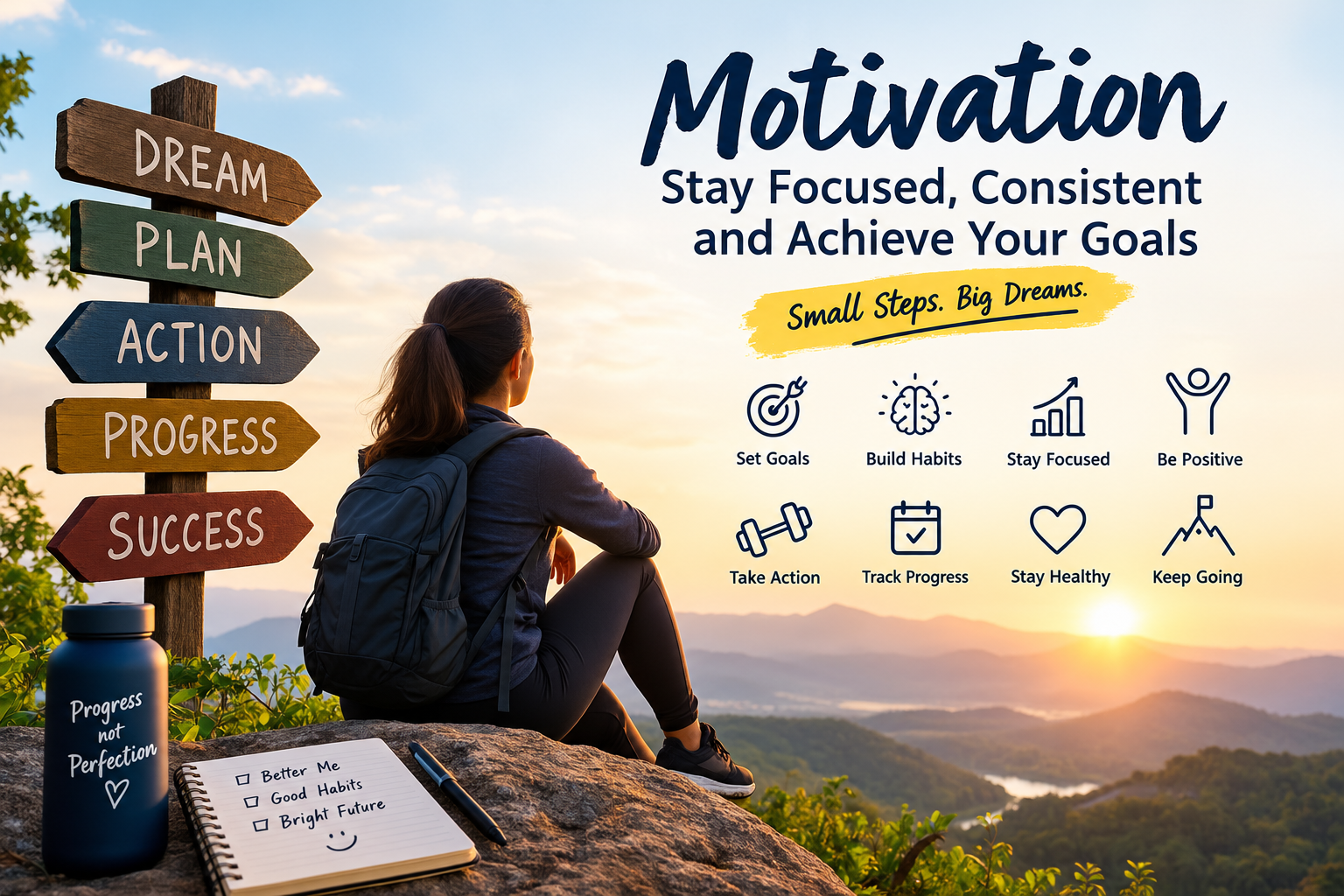
Motivation is the force that encourages us to start something, continue working toward it, and make progress even when the results are not immediate.
It can help a student prepare for an examination, an employee pursue a career goal, an entrepreneur build a business, or an individual develop healthier daily habits.
But there is one important truth about motivation:
You cannot expect to feel motivated every day.
Motivation naturally rises and falls. A better long-term approach is to combine motivation with clear goals, useful routines, supportive environments, and discipline.
The good news is that motivation is not simply something people either have or do not have. Psychological research shows that the quality and source of motivation matter. Self-Determination Theory, for example, highlights autonomy, competence, and relatedness as important psychological needs associated with high-quality motivation and engagement.
AI Answer Box: What Is Motivation?
Motivation is the internal or external drive that influences a person's decision to start, continue, or complete an action.
It can come from personal interest, meaningful goals, rewards, recognition, responsibility, social connection, or the desire to avoid an unwanted outcome.
In simple words:
Motivation gives you a reason to act, while discipline helps you continue acting when motivation becomes weaker.
Motivation can influence:
- Goal setting
- Learning
- Career development
- Exercise
- Productivity
- Personal growth
- Decision-making
- Persistence
- Habit formation
What Is Motivation?
Motivation is a psychological process that directs behavior toward a particular goal or outcome.
Imagine two people preparing for an examination.
The first person studies because they genuinely enjoy learning and want to understand the subject.
The second person studies because they want a high score and fear disappointing their parents.
Both may work hard, but their reasons are different.
This is why motivation is more complicated than simply being "positive."
Motivation involves why you act, what you want to achieve, and what keeps you moving forward.
Why Is Motivation Important in Life?
Motivation can provide direction when life feels uncertain.
It helps transform an idea such as "I want to improve my life" into practical action such as:
- Studying for one hour every evening
- Applying for three jobs each week
- Exercising regularly
- Learning a new skill
- Saving money every month
- Building a business
- Improving communication skills
Motivation is especially valuable when the desired result is far away.
Motivation can help you:
- Start difficult tasks
- Maintain effort
- Recover after setbacks
- Develop confidence
- Pursue meaningful goals
- Build productive habits
- Stay focused on priorities
- Handle temporary discomfort
However, motivation should not be treated as a cure-all. A person can be motivated and still need appropriate skills, resources, planning, rest, or professional support.
Types of Motivation
Motivation is not one single experience. It can come from several sources.
1. Intrinsic Motivation
Intrinsic motivation comes from within.
You perform an activity because you find it interesting, meaningful, enjoyable, or personally satisfying.
Examples
- Reading because you enjoy learning
- Painting because you love creativity
- Learning a language because you enjoy the process
- Exercising because you enjoy feeling stronger
Intrinsic motivation can be particularly powerful because the activity itself provides a reason to continue.
2. Extrinsic Motivation
Extrinsic motivation comes from external outcomes.
Examples include:
- Salary
- Bonuses
- Awards
- Grades
- Promotions
- Recognition
- Competition
- Avoiding punishment
External rewards can encourage action, but they do not necessarily create lasting interest in the activity.
3. Positive Motivation
Positive motivation focuses on desirable outcomes.
For example:
"I want to improve my career, so I will learn a new skill."
The focus is on gaining something valuable.
4. Avoidance Motivation
Avoidance motivation focuses on preventing an undesirable outcome.
For example:
"I need to finish this assignment because I do not want to miss the deadline."
Avoidance can be useful in the short term, but relying entirely on fear or pressure can become exhausting.
Motivation vs Discipline
One of the most important distinctions in personal development is the difference between motivation and discipline.
| Motivation | Discipline |
|---|---|
| Gives you the desire to act | Helps you act consistently |
| Can change from day to day | Can be supported by routines |
| Often emotion-driven | More system-driven |
| Helps you start | Helps you continue |
| Can be affected by mood | Can reduce dependence on mood |
Which is more important?
Both matter.
Motivation may inspire you to begin a fitness routine.
Discipline helps you continue exercising when you are tired or busy.
The strongest approach is not:
"I need to feel motivated before I act."
It is:
"I will create conditions that make action easier even when motivation is low."
How to Stay Motivated Every Day
You do not need an extraordinary amount of motivation.
You need a practical system.
1. Set a Clear Goal
Vague goals are difficult to act on.
Instead of:
"I want to become successful."
Try:
"I will complete one professional certification within six months."
A clear goal gives your effort a direction.
Research summarized by the American Psychological Association notes the importance of specific and challenging goals, along with feedback, in goal-setting research.
2. Break Large Goals Into Small Actions
Large goals can feel overwhelming.
For example:
Goal: Learn digital marketing.
Break it into:
- Learn SEO fundamentals.
- Study keyword research.
- Learn content strategy.
- Practice writing.
- Analyze successful websites.
- Build a small project.
- Measure the results.
Small progress creates visible evidence that you are moving forward.
3. Focus on the Next Step
When motivation is low, do not ask:
"How will I finish everything?"
Ask:
"What is the next useful action?"
That might be:
- Open the document.
- Read two pages.
- Write 100 words.
- Walk for 10 minutes.
- Send one email.
- Complete one practice question.
Action often becomes easier once you stop thinking about the entire mountain.
How to Motivate Yourself When You Feel Lazy
Feeling lazy is not always a sign of poor character.
Sometimes what looks like laziness may be:
- Poor sleep
- Stress
- An unclear goal
- Mental overload
- Fear of failure
- A task that feels too difficult
- Lack of interest
- Too many distractions
- Physical inactivity
Instead of immediately blaming yourself, identify the obstacle.
Try the 5-minute rule
Tell yourself:
"I will do this for only five minutes."
Once you begin, continuing may feel easier.
Even if you stop after five minutes, you have created movement instead of remaining stuck.
How Does Exercise Affect Motivation?
Physical activity is not a replacement for mental-health care, but it can support overall well-being.
The World Health Organization reports that regular physical activity has physical and mental health benefits and can reduce symptoms of depression and anxiety. WHO recommends that adults generally accumulate 150–300 minutes of moderate-intensity aerobic activity per week, or an equivalent amount of vigorous activity.
Even simple movement can count, including:
- Walking
- Cycling
- Dancing
- Sports
- Household activities
- Active commuting
The important lesson is that movement does not have to mean an expensive gym membership.
The Psychology Behind Motivation
One influential framework is Self-Determination Theory.
It emphasizes three psychological needs:
Autonomy
The feeling that you have meaningful choice and ownership over your actions.
Competence
The feeling that you can develop skills and become effective at something.
Relatedness
The feeling of connection and belonging with other people.
When these needs are supported, people can experience more self-directed forms of motivation and engagement.
This has an important practical lesson:
People are often more motivated when they understand the purpose of an activity, feel capable of improving, and feel connected to others.
How to Build Long-Term Motivation
Short bursts of inspiration are useful, but sustainable progress requires structure.
Build a Motivation System
A practical system can include:
Meaning → Goal → Plan → Action → Feedback → Adjustment
For example:
Meaning: I want greater financial independence.
↓
Goal: Increase my professional income.
↓
Plan: Learn a valuable skill for six months.
↓
Action: Study 45 minutes every weekday.
↓
Feedback: Track projects and skill improvement.
↓
Adjustment: Change the learning method when progress slows.
This approach is more reliable than waiting for inspirational feelings.
Motivation and Goal Setting
A goal should be challenging enough to matter but realistic enough to pursue.
Weak goal
"I will become more productive."
Better goal
"I will spend 30 minutes planning tomorrow's priorities every evening for the next 30 days."
The second goal provides:
- A specific action
- A timeframe
- A measurable behavior
- A clear starting point
SMART Goals and Motivation
The SMART framework is commonly used to make goals more concrete.
| Element | Meaning | Example |
|---|---|---|
| S | Specific | Improve writing |
| M | Measurable | Write 500 words |
| A | Achievable | Write five days a week |
| R | Relevant | Improve professional communication |
| T | Time-bound | For the next 60 days |
SMART goals are not a magic formula, but they can make intentions easier to convert into action.
How to Stay Motivated After Failure
Failure can seriously affect motivation.
A failed exam, rejected job application, unsuccessful business idea, or missed personal target can make you question your ability.
The mistake is turning one event into an identity.
Instead of:
"I failed, so I am a failure."
Try:
"This attempt did not produce the result I wanted. What can I learn from it?"
Use a three-question review
- What went wrong?
- What was under my control?
- What will I change next time?
Failure becomes more useful when it produces information.
Real-World Motivation: Progress Is Often Unremarkable
Real progress rarely looks dramatic.
A person trying to improve their career may spend months:
- Learning after work
- Making mistakes
- Practicing
- Receiving criticism
- Rewriting applications
- Building a portfolio
- Improving one skill at a time
From the outside, very little may appear to happen.
Then one opportunity arrives.
The visible result may look sudden, but the preparation was gradual.
This is why consistency is often more valuable than occasional bursts of enthusiasm.
Motivation at Work
Workplace motivation can come from several sources.
Employees may value:
- Fair compensation
- Recognition
- Career development
- Autonomy
- Meaningful work
- Good leadership
- Learning opportunities
- Healthy workplace relationships
- Clear expectations
Managers who want to improve motivation should not rely only on financial rewards.
People also need clarity, useful feedback, opportunities to develop competence, and a sense that their contribution matters.
Motivation for Students
Students often struggle with motivation because academic goals can feel distant.
A practical strategy is to make learning more immediate.
Try this study structure:
25 minutes: Focused study
5 minutes: Break
25 minutes: Practice
5 minutes: Review
Students can also improve motivation by:
- Studying at the same time each day
- Removing unnecessary phone notifications
- Using active recall
- Practicing questions
- Tracking small wins
- Studying with supportive peers
- Rewarding consistent effort
The goal is not to study perfectly.
The goal is to create a repeatable study habit.
Motivation for Personal Growth
Personal growth is not about becoming a completely different person overnight.
It is about improving gradually.
You might focus on:
Mental growth
- Better emotional awareness
- Greater resilience
- More thoughtful decision-making
Physical growth
- Regular movement
- Better sleep habits
- Balanced nutrition
Professional growth
- New skills
- Better communication
- Career planning
Financial growth
- Budgeting
- Saving
- Learning about responsible borrowing and investing
Small improvements compound over time.
Common Motivation Killers
Even motivated people lose momentum.
Here are some common reasons.
1. Unrealistic Expectations
Expecting immediate results can lead to disappointment.
2. Comparing Yourself With Others
Someone else's timeline does not define yours.
3. Trying to Change Everything at Once
Too many goals create competing priorities.
4. Perfectionism
Waiting for perfect conditions can prevent action.
5. Constant Distraction
Notifications and endless scrolling can fragment attention.
6. Lack of Rest
Exhaustion can make even simple tasks feel difficult.
7. No Clear Reason
A goal without personal meaning is harder to sustain.
Pros and Cons of Motivation
| Pros | Cons |
|---|---|
| Encourages action | Can fluctuate |
| Supports goal pursuit | May depend on emotions |
| Builds momentum | Can disappear during stress |
| Helps overcome initial resistance | Cannot replace skills |
| Can improve persistence | Excessive pressure can be counterproductive |
The solution
Do not build your entire life around motivation.
Build systems that continue working when motivation is low.
A Simple 7-Day Motivation Challenge
Day 1: Choose One Goal
Write down one important goal.
Day 2: Define Your Reason
Write why the goal matters to you.
Day 3: Make the Goal Smaller
Turn the goal into one daily action.
Day 4: Remove One Distraction
Identify something that repeatedly interrupts your progress.
Day 5: Track Your Progress
Record what you completed.
Day 6: Review Your Obstacles
Identify what made the process difficult.
Day 7: Improve the System
Keep what worked and change what did not.
The objective is not to become permanently motivated in seven days.
The objective is to learn how to create momentum.
Daily Motivation Checklist
Use this simple checklist:
I know today's most important task.
I have defined a realistic target.
I have removed one major distraction.
I will start before I feel completely ready.
I will focus on progress rather than perfection.
I will review what I accomplished.
I will prepare for tomorrow.
Summary Table: How to Build Motivation
| Problem | Practical Solution |
|---|---|
| No clear direction | Define one specific goal |
| Goal feels overwhelming | Break it into smaller actions |
| Constant distractions | Change your environment |
| Fear of failure | Treat mistakes as feedback |
| Lack of energy | Review sleep, stress and activity |
| Losing interest | Reconnect with your purpose |
| Inconsistent effort | Build a routine |
| Slow progress | Track small improvements |
| Comparing yourself | Focus on your own baseline |
Key Takeaways
- Motivation is the desire or drive that influences action.
- Motivation naturally changes over time.
- Intrinsic and extrinsic motivation can influence behavior differently.
- Clear goals make action easier.
- Small steps can reduce psychological resistance.
- Discipline and routines can support progress when motivation is low.
- Feedback helps you understand whether your strategy is working.
- Physical activity can support mental and physical well-being.
- Failure does not have to end motivation; it can provide useful information.
- Sustainable progress usually comes from consistency rather than occasional inspiration.
- Meaning, autonomy, competence and supportive relationships can strengthen motivation.
- If persistent low motivation is accompanied by significant distress or other concerning symptoms, consider speaking with an appropriate healthcare or mental-health professional.
Frequently Asked Questions About Motivation
1. What is motivation?
Motivation is the internal or external drive that influences a person to begin, continue, or complete an action.
2. Why is motivation important?
Motivation provides direction and encourages people to take action toward goals in areas such as education, career, health and personal development.
3. What are the main types of motivation?
Common categories include intrinsic motivation, extrinsic motivation, positive motivation and avoidance-based motivation.
4. How can I stay motivated every day?
Set clear goals, break large tasks into smaller actions, reduce distractions, track progress and create routines that make desired behaviors easier.
5. How do I motivate myself when I feel lazy?
First identify the reason for the resistance. Then reduce the task to a very small first step, such as working for five minutes.
6. Is motivation more important than discipline?
Motivation helps initiate action, while discipline and systems can help maintain action when motivation fluctuates. Both have value.
7. How can I regain motivation after failure?
Review what happened, identify what was under your control, learn from the experience and choose one practical next step.
8. What is intrinsic motivation?
Intrinsic motivation occurs when a person performs an activity because it is interesting, enjoyable or personally meaningful.
9. What is extrinsic motivation?
Extrinsic motivation is driven by an external outcome such as money, recognition, grades, rewards or avoiding an unwanted consequence.
10. How does exercise help motivation?
Regular physical activity can support mental well-being, mood and overall health. It may also help people establish routines and create a sense of progress.
11. How can students improve motivation?
Students can use specific study goals, short focused sessions, practice questions, progress tracking and distraction-free study environments.
12. How can motivation improve productivity?
Motivation can encourage a person to prioritize goals and begin important tasks. Productivity improves further when motivation is combined with planning and consistent routines.
13. Why does motivation disappear?
Motivation can decline because of stress, fatigue, unclear goals, repeated setbacks, lack of interest, distractions or unrealistic expectations.
14. Can motivation be developed?
Yes. People can improve the conditions that support motivation by setting meaningful goals, creating supportive environments, developing competence and building useful routines.
15. What is the best way to stay motivated long term?
Do not depend entirely on temporary inspiration. Connect your goals to meaningful reasons and create systems, routines, feedback and small measurable actions that support consistent progress.
Conclusion
Motivation can give you the spark to begin, but lasting progress requires more than inspiration.
The strongest approach is to understand why the goal matters, make the next action simple, create a supportive environment, measure progress and continue even when enthusiasm changes.
You do not need to feel motivated every morning.
Sometimes the most productive decision is simply to take the next small step.
One page.
One phone call.
One workout.
One application.
One lesson.
One hour of focused work.
Small actions become meaningful when repeated consistently.
Published on : 14th september
Published by : Siva Nagaiah K
www.vizzve.com || www.vizzveservices.com
Follow us on social media: Facebook || Linkedin || Instagram
🛡️ Powered by Vizzve Financial
RBI-Registered Loan Partner | 10 Lakh+ Customers | ₹600 Cr+ Disbursed
Hastags
#Motivation #SelfMotivation #MotivationDaily #StayMotivated #PositiveMindset #SuccessMindset #PersonalGrowth #GoalSetting #Discipline #Consistency #Inspiration #MotivationalQuotes #LifeMotivation #Success #Productivity #MentalStrength #DreamBig #NeverGiveUp #KeepGoing #PositiveThinking #GrowthMindset #Focus #SelfImprovement #AchieveYourGoals #MotivationTips