

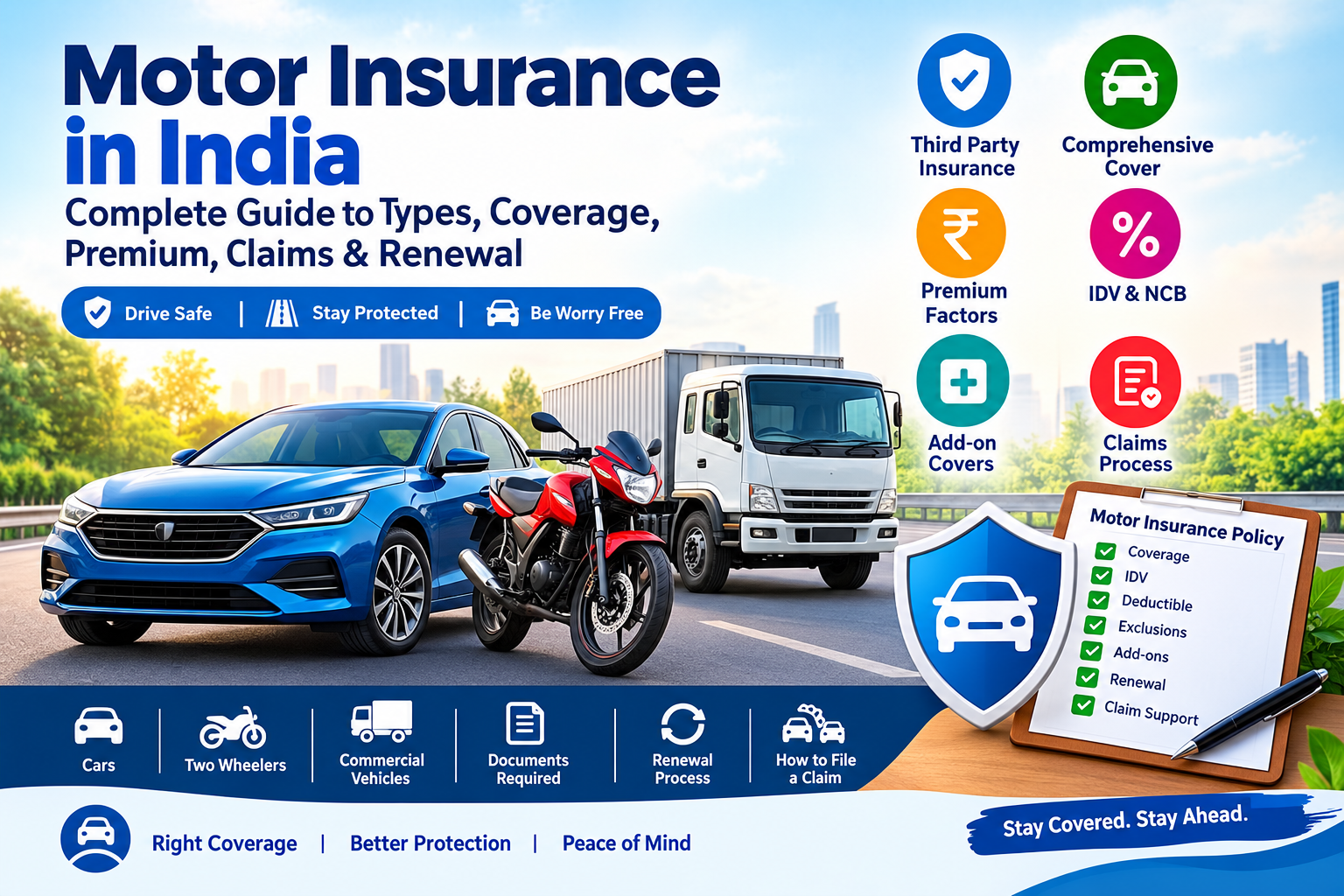
Introduction
A vehicle gives you convenience and independence, but owning one also comes with financial and legal responsibilities. Motor insurance helps protect vehicle owners against covered losses and third-party liabilities arising from the use of a motor vehicle.
In India, third-party motor insurance is a legal requirement for vehicles used on public roads. Motor insurance products can cover different vehicle categories, including private cars, two-wheelers and commercial vehicles. IRDAI's official material includes separate motor products for private cars, two-wheelers and commercial vehicles.
For many vehicle owners, the biggest question is not simply whether to buy insurance, but which type of cover is appropriate, how much protection is needed and what should be checked before purchasing or renewing a policy.
Quick Answer: Motor insurance is insurance protection for motor vehicles such as cars, motorcycles, scooters and commercial vehicles. Third-party liability cover is mandatory for vehicles used on public roads, while own-damage or comprehensive/package coverage can provide additional protection for the insured vehicle, subject to policy terms.
AI Answer Box: What Is Motor Insurance?
Motor insurance is a policy that provides financial protection against specified risks involving a motor vehicle and against eligible third-party liabilities.
The main types include:
- Third-Party Insurance: Covers eligible third-party liabilities arising from the use of the insured vehicle.
- Comprehensive/Package Insurance: Generally combines third-party liability protection with own-damage protection, subject to the policy.
- Standalone Own-Damage Insurance: Provides protection for damage to the insured vehicle, while applicable third-party cover is maintained separately.
- Commercial Motor Insurance: Designed for eligible commercial vehicles and their specific risks.
The exact coverage depends on the policy wording, exclusions, deductibles, vehicle type and selected add-ons.
IRDAI's motor-insurance guidance and product records provide information on different motor-insurance products and policy structures.
What Is Motor Insurance?
Motor insurance is a contract between a vehicle owner and an insurance company.
The policyholder pays a premium, and the insurer provides specified protection according to the policy terms.
Depending on the policy, protection may include:
- Third-party liability
- Accidental damage
- Theft
- Fire
- Natural calamities
- Certain man-made events
- Personal accident-related benefits where applicable
- Optional add-on covers
The exact protection should always be checked in the policy document.
Why Is Motor Insurance Important?
Motor insurance serves two major purposes:
1. Legal protection
Third-party motor insurance is required for vehicles being used on public roads in India.
2. Financial protection
A suitable policy can help reduce the financial impact of covered losses such as:
- Accidental vehicle damage
- Theft
- Fire
- Certain natural calamities
- Third-party liability
Without appropriate insurance, the vehicle owner may have to bear eligible losses or liabilities personally.
Types of Motor Insurance in India
1. Third-Party Motor Insurance
Third-party insurance provides protection against eligible legal liability to third parties arising from the use of the insured vehicle.
It is the basic legally required motor-insurance cover for vehicles used on public roads.
Third-party insurance can address:
- Third-party bodily injury liability
- Third-party death liability
- Third-party property damage, subject to applicable terms and limits
What does third-party insurance generally not cover?
It does not normally provide own-damage protection for the insured vehicle.
For example, if your own car or motorcycle is damaged in an accident, a third-party-only policy generally does not pay for your own vehicle's repair.
2. Comprehensive or Package Motor Insurance
A comprehensive/package policy generally combines:
Third-party liability + own-damage protection
Own-damage protection may cover specified events such as:
- Accidents
- Theft
- Fire
- Natural calamities
- Certain man-made events
Coverage depends on the policy wording.
Who may consider comprehensive insurance?
Vehicle owners who want protection for both third-party liabilities and their own vehicle may consider a comprehensive/package policy.
3. Standalone Own-Damage Insurance
Standalone own-damage insurance is designed to protect the insured vehicle against covered own-damage risks.
It may be relevant when the vehicle owner already has the required third-party liability cover separately.
The policy combination should be checked with the insurer to ensure that the legally required third-party cover remains active.
4. Commercial Motor Insurance
Commercial vehicles have different usage patterns and risks from private vehicles.
Examples may include:
- Goods-carrying vehicles
- Passenger-carrying vehicles
- Taxis
- Commercial cars
- Trucks
- Buses
- Other eligible commercial vehicles
Commercial motor insurance should be selected according to the vehicle's registered use and policy requirements.
Motor Insurance Comparison Table
| Feature | Third-Party | Comprehensive/Package | Standalone Own Damage |
|---|---|---|---|
| Third-party liability | Yes | Yes | Separate TP cover generally required |
| Own vehicle damage | No | Yes, subject to terms | Yes, subject to terms |
| Theft protection | No own-damage cover | Generally covered, subject to terms | Generally covered, subject to terms |
| Fire-related own damage | No | Generally covered, subject to terms | Generally covered, subject to terms |
| Natural calamity-related own damage | No | Generally covered, subject to terms | Generally covered, subject to terms |
| Premium | Usually lower | Usually higher | Depends on vehicle and coverage |
| Main purpose | Third-party liability | Broader protection | Own vehicle protection |
Note: This is a general comparison. Actual benefits, exclusions, deductibles and limits depend on the specific policy.
Motor Insurance for Cars and Two-Wheelers
Motor insurance applies to multiple vehicle categories.
Car Insurance
Car insurance protects eligible private cars against covered risks.
Important considerations include:
- Vehicle age
- IDV
- Usage
- Location
- Claim history
- NCB
- Deductible
- Add-ons
Two-Wheeler Insurance
Two-wheeler insurance applies to motorcycles and scooters.
The same basic decision framework applies:
Legal third-party cover + appropriate own-damage protection + suitable add-ons
IRDAI's product records separately identify motor insurance products for private cars and two-wheelers.
What Does Motor Insurance Cover?
Coverage depends on the type of policy.
A comprehensive/package policy may generally cover specified losses involving:
Accidental Damage
Damage caused by covered accidents may be eligible for a claim.
Theft
A stolen vehicle may be covered under applicable own-damage/theft provisions.
Fire
Specified fire-related losses may be covered according to policy terms.
Natural Calamities
Some policies cover specified events such as floods, storms, earthquakes and other natural perils.
Third-Party Liability
Eligible liabilities toward third parties are covered under the applicable third-party section of the policy.
What Is Not Covered by Motor Insurance?
Insurance does not mean unlimited protection.
Common exclusions can include:
- Normal wear and tear
- Mechanical breakdown outside policy coverage
- Certain consequential losses
- Driving without a valid licence
- Losses arising from excluded circumstances
- Damage outside the scope of the selected cover
- Policy-specific exclusions
Always read the exclusions and conditions before purchasing a policy.
What Is Motor Insurance Premium?
The motor insurance premium is the amount paid to maintain insurance coverage.
There is no universal premium for every vehicle.
Premium can depend on factors such as:
- Vehicle type
- Vehicle model
- Vehicle age
- Insured Declared Value
- Location
- Coverage selected
- Claim history
- NCB
- Deductible
- Add-ons
- Applicable regulatory and insurer pricing factors
IRDAI maintains motor-insurance information and industry statistics, including motor third-party data and non-life insurance statistics.
What Is IDV in Motor Insurance?
IDV means Insured Declared Value.
It is an important concept in own-damage motor insurance.
Broadly, IDV represents the insured value of the vehicle for relevant situations such as total loss or theft, according to the policy terms.
Why is IDV important?
Suppose two policies have similar premiums but different IDVs.
The policy with the lower premium is not automatically the better financial choice if its coverage or IDV does not adequately suit the vehicle.
Compare these together:
Premium + IDV + Deductible + Coverage + Exclusions
What Is NCB in Motor Insurance?
NCB means No Claim Bonus.
It is a benefit associated with eligible claim-free periods under own-damage motor insurance.
NCB is intended to reward eligible policyholders who do not make claims during the relevant period.
Why is NCB important?
An eligible NCB can reduce the applicable own-damage premium at renewal.
However, policyholders should check the applicable NCB rules and policy conditions before renewal.
What Are Motor Insurance Add-On Covers?
Add-ons are optional covers that can extend the protection provided by a base policy.
Availability varies between insurers.
Common Motor Insurance Add-ons
Zero Depreciation
May reduce depreciation-related deductions for eligible parts during a covered claim, subject to terms and conditions.
Roadside Assistance
May provide assistance for certain roadside emergencies.
Engine Protection
Can provide specified protection for eligible engine-related losses that may not be covered by the standard policy.
Consumables Cover
May cover specified consumables used during eligible repairs.
Key Replacement
May provide benefits for lost or damaged keys under defined circumstances.
Return to Invoice
Some policies provide additional benefits linked to the original invoice value in specified theft or total-loss situations.
Important: Add-ons increase the premium. Choose them according to your vehicle and actual requirements.
How to Choose the Right Motor Insurance
There is no single motor insurance policy that suits every vehicle owner.
Consider these factors.
1. Vehicle type
A motorcycle, private car, taxi and commercial truck have different risks.
2. Vehicle age
The appropriate coverage can change as a vehicle gets older.
3. Vehicle value
Consider whether the IDV is appropriate.
4. Usage
Daily commuting may create a different risk profile from occasional use.
5. Location
Traffic, weather, parking and local conditions can affect the risks associated with vehicle ownership.
6. Claim history
Previous claims and eligible NCB can affect renewal considerations.
7. Garage network
If own-damage coverage is important to you, check the insurer's network and claim process.
8. Deductible
Understand how much you may have to pay yourself during a claim.
How to Buy Motor Insurance Online
Buying insurance online can make policy comparison convenient.
Step 1: Collect vehicle details
Keep the following information ready:
- Registration number
- Vehicle model
- Vehicle variant
- Existing policy details
- Policy expiry date
- Claim history
- Owner details
Step 2: Compare policies
Compare:
- Premium
- IDV
- Coverage
- Deductibles
- Exclusions
- Add-ons
- Claim support
Step 3: Check NCB
If eligible, verify that your NCB is correctly reflected.
Step 4: Select appropriate add-ons
Do not automatically select every add-on.
Step 5: Verify information
Check:
- Registration number
- Vehicle details
- Owner information
- Previous policy information
Step 6: Pay the premium
Use the insurer's official website or an authorised channel.
Step 7: Save your policy
Keep a digital copy and note the expiry date.
Documents Required for Motor Insurance
Depending on the transaction and insurer, commonly relevant documents can include:
- Registration Certificate (RC)
- Existing insurance policy
- Driving licence
- Vehicle details
- PUC certificate
- Identity and address information where required
IRDAI's motor-insurance guidance identifies documents such as the certificate of insurance, RC, PUC and driving licence as important vehicle documents.
How to Renew Motor Insurance
Motor insurance should be renewed before the existing policy expires.
Step-by-Step Renewal Guide
Step 1: Check the expiry date
Do not wait until the last day.
Step 2: Review your existing cover
Check whether the current policy still matches your needs.
Step 3: Check NCB
Verify your eligible NCB.
Step 4: Compare quotations
Compare more than just the premium.
Step 5: Review IDV
Make sure the IDV is appropriate for your vehicle.
Step 6: Select add-ons
Choose relevant add-ons only.
Step 7: Complete payment
Pay through an authorised channel.
Step 8: Download the renewed policy
Check the policy details after issuance.
What Happens If Motor Insurance Expires?
An expired policy can create legal and financial problems.
If mandatory third-party insurance is not active, the vehicle should not be used on public roads.
A break in insurance can also create additional renewal procedures depending on the circumstances.
Best practice
Set a renewal reminder several weeks before expiry.
This gives you time to:
- Compare policies
- Check NCB
- Review IDV
- Select add-ons
- Correct vehicle information
- Complete renewal without last-minute pressure
PUC and Motor Insurance
A Pollution Under Control (PUC) certificate is an important vehicle-compliance document.
IRDAI's motor-insurance guidance states that a valid PUC certificate is required at the time of motor-insurance renewal.
Vehicle owners should therefore monitor both:
Insurance expiry date + PUC validity
These are separate compliance requirements and should not be confused with each other.
How to File a Motor Insurance Claim
If your vehicle is involved in an accident or suffers a covered loss, follow the insurer's claim procedure promptly.
Step 1: Ensure safety
Move away from immediate danger where possible and arrange medical assistance if necessary.
Step 2: Inform the insurer
Notify your insurer according to the policy's claim-notification procedure.
Step 3: Record the incident
Take photographs or videos of:
- Vehicle damage
- Accident location
- Other vehicles
- Registration numbers
- Relevant road conditions
Step 4: Contact police when required
For theft and circumstances requiring police involvement, follow applicable legal procedures.
Step 5: Arrange inspection
The insurer may arrange a survey or inspection.
Step 6: Repair the vehicle
Use the applicable repair and garage process.
Step 7: Submit documents
Provide the claim form and other documents requested by the insurer.
Cashless vs Reimbursement Motor Insurance Claim
| Feature | Cashless Claim | Reimbursement Claim |
|---|---|---|
| Repair facility | Usually network garage | May depend on policy |
| Initial payment | Insurer/garage arrangement for eligible amount | Policyholder generally pays initially |
| Deductible | Policyholder may pay applicable deductible | Applicable deductible may be deducted |
| Documentation | Required | Required |
| Final settlement | Insurer settles eligible amount according to process | Eligible amount reimbursed according to policy |
Actual procedures vary by insurer and policy.
Motor Insurance Claim: Important Tips
Do
- Notify the insurer promptly.
- Take photographs of the damage.
- Preserve relevant documents.
- Follow the insurer's claim process.
- Follow police procedures where required.
- Keep repair invoices and receipts.
Don't
- Hide relevant facts.
- Provide inaccurate information.
- Start major repairs without following the insurer's process where inspection is required.
- Ignore policy conditions.
- Assume every repair will automatically be reimbursed.
Pros and Cons of Motor Insurance
Pros
- Helps satisfy mandatory third-party insurance requirements.
- Can reduce the financial impact of covered losses.
- Can protect against specified theft and accident risks.
- Comprehensive policies can provide broader protection.
- Add-ons allow additional coverage.
- Eligible NCB can reduce applicable own-damage premium.
Cons
- Premium is an ongoing expense.
- Exclusions limit coverage.
- Deductibles can reduce claim payments.
- Optional add-ons increase the premium.
- Claims require documentation and adherence to policy conditions.
- Coverage differs between policies.
Motor Insurance for New Vehicles
When buying a new car, motorcycle or scooter, insurance should be considered as part of the total ownership cost.
Before purchasing, check:
- Third-party cover
- Own-damage cover
- Policy duration
- IDV
- Add-ons
- Deductibles
- Claim process
- Network garages
For new vehicles, buyers should also verify the applicable policy structure and current regulatory requirements rather than relying on old assumptions.
IRDAI's records show long-term third-party products for certain private cars and two-wheelers, as well as bundled motor products.
Motor Insurance for Used Vehicles
Buying a used vehicle requires additional checks.
Check:
- Existing insurance policy
- Policy expiry date
- Registration details
- Ownership details
- Claim history where available
- NCB information
- Vehicle condition
- IDV
- PUC status
Insurance ownership/transfer procedures should be completed with the insurer as required.
Common Motor Insurance Mistakes
Mistake 1: Choosing only the lowest premium
A lower price does not automatically mean broader protection.
Mistake 2: Ignoring IDV
IDV can be important for relevant total-loss and theft claims.
Mistake 3: Not checking exclusions
Always understand what is excluded.
Mistake 4: Buying unnecessary add-ons
Choose add-ons based on actual needs.
Mistake 5: Allowing the policy to expire
Renew before the expiry date.
Mistake 6: Giving incorrect vehicle information
Incorrect details can create problems during claims.
Mistake 7: Delaying claim notification
Follow the insurer's notification requirements promptly.
Expert Commentary: What Should Vehicle Owners Compare?
A practical insurance comparison should go beyond premium.
A useful checklist is:
Coverage → IDV → Deductible → Exclusions → NCB → Add-ons → Claim Process → Garage Network → Premium
IRDAI's consumer-facing motor-insurance information highlights the importance of understanding coverage and policy details rather than treating the premium as the only consideration.
Real-world experience point
Many vehicle owners focus on the premium at renewal because it is easy to compare.
However, a small difference in premium may be less important than understanding:
- What is actually covered?
- What is excluded?
- How much is the deductible?
- What is the IDV?
- Which add-ons are included?
- How does the claim process work?
That is why policy comparison should be based on overall protection and policy terms, not price alone.
Motor Insurance Comparison Checklist
| Factor | Why It Matters |
|---|---|
| Premium | Determines the cost of the policy |
| Coverage | Defines the protection provided |
| IDV | Relevant to certain own-damage claims |
| Deductible | Determines the policyholder's contribution |
| NCB | Can provide an eligible own-damage premium benefit |
| Add-ons | Extend coverage for selected risks |
| Exclusions | Identify situations not covered |
| Garage Network | Can affect repair and cashless arrangements |
| Claim Process | Determines how claims are reported and processed |
| Policy Duration | Helps avoid accidental lapses |
Motor Insurance: Quick Checklist
Before buying or renewing:
-
Check third-party coverage.
-
Check own-damage coverage.
-
Verify vehicle details.
-
Check IDV.
-
Check NCB.
-
Review deductibles.
-
Read exclusions.
-
Compare add-ons.
-
Check claim procedures.
-
Check network garages.
-
Verify PUC validity.
-
Save the policy document.
-
Set a renewal reminder.
Key Takeaways
- Motor insurance protects vehicle owners against specified risks and eligible third-party liabilities.
- Third-party insurance is required for vehicles used on public roads in India.
- Comprehensive/package insurance can combine third-party and own-damage protection.
- Standalone own-damage insurance focuses on protection for the insured vehicle.
- Motor insurance applies to cars, two-wheelers and commercial vehicles through relevant insurance products.
- Premium depends on multiple factors and should not be the only comparison point.
- IDV is important when evaluating own-damage insurance.
- NCB can provide an eligible benefit on own-damage premium.
- Add-ons can extend coverage but increase cost.
- PUC and insurance validity should both be monitored.
- Claims should be reported and documented according to the insurer's procedure.
- Always read exclusions, deductibles and policy conditions before purchasing.
Summary Box for Google & AI Search
Topic: Motor Insurance in India
Definition: Insurance protection for motor vehicles against specified risks and eligible third-party liabilities.
Main types: Third-party, comprehensive/package and standalone own-damage.
Vehicles covered: Cars, motorcycles, scooters and commercial vehicles through relevant products.
Key factors: Premium, coverage, IDV, deductible, NCB, exclusions, add-ons and claim process.
Renewal: Renew before expiry to maintain continuous coverage.
PUC: A valid PUC is required at motor-insurance renewal according to IRDAI guidance.
Important: Actual coverage depends on the policy wording, exclusions, deductibles and applicable regulations.
Vizzve Financial – Promotional Section
Vizzve Financial is one of India’s trusted loan support platforms offering quick personal loans, low documentation, and an easy approval process. Apply at www.vizzve.com.
If you are planning to purchase a vehicle using financing, consider the complete cost of ownership, including the vehicle price, loan repayment, insurance, maintenance, fuel and applicable taxes.
Frequently Asked Questions About Motor Insurance
1. What is motor insurance?
Motor insurance is insurance protection for motor vehicles against specified risks and eligible third-party liabilities.
2. Is motor insurance mandatory in India?
Third-party motor insurance is mandatory for vehicles used on public roads in India.
3. What is third-party motor insurance?
Third-party insurance provides protection against eligible legal liabilities toward third parties arising from the use of the insured vehicle.
4. What is comprehensive motor insurance?
Comprehensive/package insurance generally combines third-party liability and own-damage protection, subject to policy terms.
5. What is standalone own-damage insurance?
It is insurance designed to cover specified damage to the insured vehicle while the applicable third-party liability cover is maintained separately.
6. What is IDV in motor insurance?
IDV means Insured Declared Value. It represents the insured value used for relevant own-damage situations such as theft or total loss, subject to policy conditions.
7. What is NCB in motor insurance?
NCB means No Claim Bonus. It is a benefit linked to eligible claim-free periods and generally applies to the own-damage premium.
8. Can motor insurance be purchased online?
Yes. Motor insurance can be purchased or renewed through insurer websites and authorised digital channels.
9. What documents are needed for motor insurance?
Depending on the transaction, documents may include the RC, existing insurance policy, driving licence, PUC and other information requested by the insurer.
10. What happens if motor insurance expires?
A policy lapse can leave a vehicle without required insurance protection and can create additional procedures when obtaining coverage again.
11. What is a motor insurance deductible?
A deductible is the amount the policyholder bears under applicable claim conditions before the insurer pays the eligible balance.
12. What are motor insurance add-ons?
Add-ons are optional covers that extend the protection of the base policy, such as roadside assistance, zero depreciation or specified engine protection.
13. How can I reduce motor insurance costs?
Compare policies, maintain eligible NCB, select appropriate coverage and avoid add-ons that do not match your actual requirements.
14. How do I claim motor insurance?
Notify the insurer promptly, document the incident, follow applicable police requirements, arrange inspection where required and submit the requested documents.
15. Does motor insurance cover normal wear and tear?
Normal wear and tear is generally not covered under standard motor insurance. Always check the specific policy exclusions.
Internal Linking Suggestions
For a finance website, consider linking this article to:
- 4 Wheeler Insurance Guide – Explain car-specific insurance.
- Two Wheeler Insurance Guide – Explain motorcycle and scooter insurance.
- Car Loan Guide – Explain vehicle financing.
- Personal Loan Eligibility Guide – Connect readers with broader financing information.
- Loan Interest Rate Guide – Explain borrowing costs.
- EMI Calculator Guide – Help readers estimate loan repayments.
- Credit Score Guide – Explain creditworthiness and borrowing.
- Financial Planning Guide – Connect insurance with overall financial planning.
External Linking Suggestions
Use authoritative references for factual claims:
- IRDAI: Motor insurance guidance and policyholder information.
- IRDAI Motor Product Records: Examples of approved motor-insurance products for private cars, two-wheelers and commercial vehicles.
- IRDAI Indian Insurance Statistics: Industry and non-life insurance statistics.
- IRDAI Official Website: Regulatory and consumer information.
Conclusion
Motor insurance is an important part of responsible vehicle ownership in India. Whether you own a car, motorcycle, scooter or commercial vehicle, the right insurance can help manage specified financial risks and third-party liabilities.
Third-party insurance addresses the mandatory liability requirement, while comprehensive/package and standalone own-damage products can provide broader protection for the insured vehicle.
Before buying or renewing a policy, compare coverage, IDV, deductible, exclusions, NCB, add-ons, claim procedures and premium.
Published on : 27th september
Published by : Siva Nagaiah K
www.vizzve.com || www.vizzveservices.com
Follow us on social media: Facebook || Linkedin || Instagram
🛡 Powered by Vizzve Financial
RBI-Registered Loan Partner | 10 Lakh+ Customers | ₹600 Cr+ Disbursed
Hastags
#MotorInsurance #MotorInsuranceIndia #VehicleInsurance #CarInsurance #BikeInsurance #TwoWheelerInsurance #FourWheelerInsurance #ThirdPartyInsurance #ComprehensiveInsurance #MotorInsurancePolicy #InsurancePremium #InsuranceRenewal #InsuranceClaim #IDV #NCB #InsuranceAddOns #VehicleProtection #AutoInsurance #PersonalFinance #FinancialPlanning #VizzveFinancial