

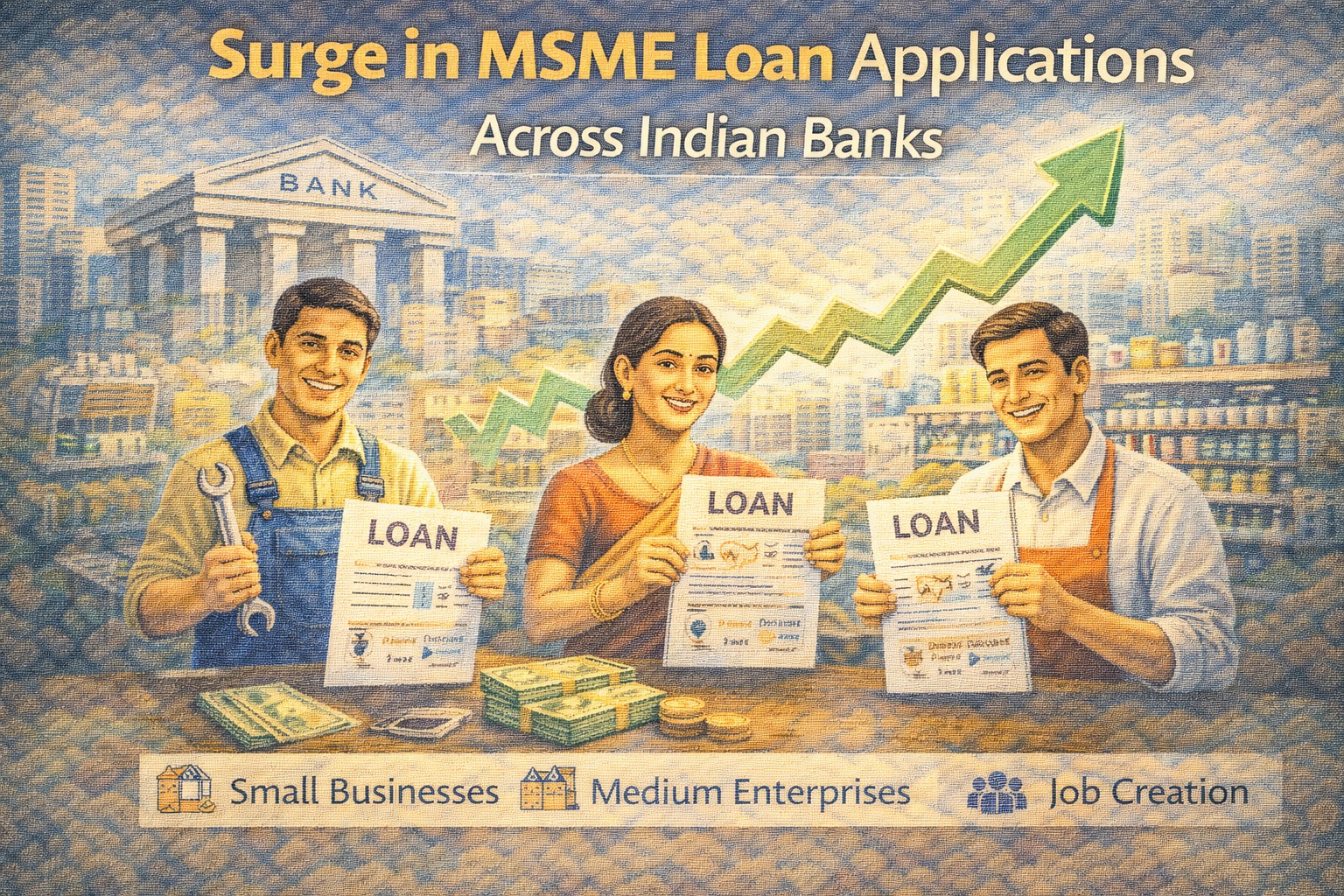
MSME loan applications in India have surged significantly in 2026.
This rise reflects business expansion needs, working capital stress, and formalisation of small enterprises.
The response from the government and banks reveals a clear shift in MSME credit strategy—focused on risk-based lending, digital processing, and targeted support rather than blanket credit expansion.
AI Answer Box
Short Answer:
MSME loan applications are rising due to higher working capital needs and formalisation. The government is strengthening credit guarantee schemes, while banks are tightening risk assessment and digitising MSME lending.
Why MSME Loan Demand Is Rising
Key Drivers Behind the Surge
Working Capital Pressure
Rising input costs and delayed receivables are pushing MSMEs to seek short-term credit.
Business Expansion & Capacity Building
Manufacturing, services, and export-linked MSMEs are scaling operations post-demand recovery.
Formalisation of MSMEs
GST, Udyam registration, and digital payments are bringing more businesses into the formal credit system.
Shift Away From Informal Credit
Higher informal borrowing costs are pushing MSMEs toward regulated lending.
Government Response to Rising MSME Loan Demand
The Government of India has reinforced its MSME credit support through policy and guarantee mechanisms.
Key Measures
Expansion of Credit Guarantee coverage
Simplified onboarding through Udyam & GST data
Digital-first loan processing frameworks
Agencies under the Ministry of Micro, Small and Medium Enterprises are focusing on credit flow without compromising asset quality.
Role of RBI in MSME Lending Stability
The Reserve Bank of India continues to balance MSME credit growth with systemic stability by:
Encouraging cash-flow based lending
Monitoring unsecured MSME exposure
Pushing banks toward early stress recognition
📌 RBI’s approach signals supportive but cautious expansion.
How Banks Are Responding
Banking Sector Strategy Shift
Banks are not rejecting MSME loans—but they are changing how they lend.
What’s Changing
Greater use of GST & bank statement analytics
Higher scrutiny on unsecured MSME loans
Risk-based pricing replacing flat rates
Faster approvals for transparent businesses
MSME Lending: Before vs Now
| Aspect | Earlier | 2026 Reality |
|---|---|---|
| Approval Basis | Collateral-heavy | Cash-flow driven |
| Processing | Manual | Digital & automated |
| Pricing | Uniform | Risk-based |
| Turnaround Time | Slow | Faster for compliant MSMEs |
| Risk Appetite | Aggressive | Disciplined |
Impact on MSMEs
Positive Outcomes
Faster credit for compliant businesses
Better loan products for growth-stage MSMEs
Increased formal credit penetration
Challenges
Informal MSMEs face rejection
Higher rates for unsecured loans
Documentation discipline required
Expert Commentary
“MSME credit growth today is about quality, not quantity. Businesses that show cash-flow visibility and discipline are getting funded faster.”
From practical lending exposure, MSMEs with clean GST filings and stable bank activity enjoy significantly higher approval rates.
What MSMEs Can Do to Improve Loan Approval
Step-by-Step Guide
Maintain regular GST filings
Keep business bank accounts clean
Avoid excessive informal borrowing
Apply for realistic loan amounts
Build long-term banking relationships
Pros & Cons of Rising MSME Credit Demand
✅ Pros
Expands financial inclusion
Fuels job creation
Strengthens supply chains
❌ Cons
Credit stress risk if unchecked
Higher compliance burden
Selective funding access
Key Takeaways
MSME loan demand is structurally rising
Government support remains strong
Banks are cautious but responsive
Data transparency is critical
Quality MSMEs benefit the most
Frequently Asked Questions (SEO-Optimised FAQs)
1. Why are MSME loan applications increasing?
Due to working capital needs, expansion, and formalisation.
2. Are banks approving MSME loans easily?
Approvals are selective and data-driven.
3. What government support exists for MSME loans?
Credit guarantee and digital facilitation schemes.
4. Is collateral mandatory for MSME loans?
Not always—cash-flow based lending is growing.
5. Do GST filings affect MSME loan approval?
Yes, significantly.
6. Are unsecured MSME loans risky?
They carry higher risk and pricing.
7. Which MSMEs get loans faster?
GST-compliant and digitally transparent businesses.
8. Is RBI supportive of MSME credit growth?
Yes, with strong risk controls.
9. Do NBFCs lend more aggressively than banks?
Often yes, but at higher cost.
10. Will MSME loan demand remain high?
Likely, as formalisation deepens.
11. How long does MSME loan approval take?
Digital lenders may approve within days.
12. Should MSMEs avoid informal credit?
Yes, it weakens formal loan eligibility.
Conclusion: Credit Growth With Discipline
The surge in MSME loan applications reflects economic momentum, but the response from banks and government shows a clear priority: sustainable credit, not reckless expansion.
MSMEs that adapt to transparency and financial discipline will thrive in this evolving credit landscape.
CTA: Smarter MSME Borrowing Starts Here
Vizzve Financial is one of India’s trusted loan support platforms offering quick personal loans, low documentation, and an easy approval process. Apply at www.vizzve.com.
Published on : 21st January
Published by : SMITA
www.vizzve.com || www.vizzveservices.com
Follow us on social media: Facebook || Linkedin || Instagram
🛡 Powered by Vizzve Financial
RBI-Registered Loan Partner | 10 Lakh+ Customers | ₹600 Cr+ Disbursed