

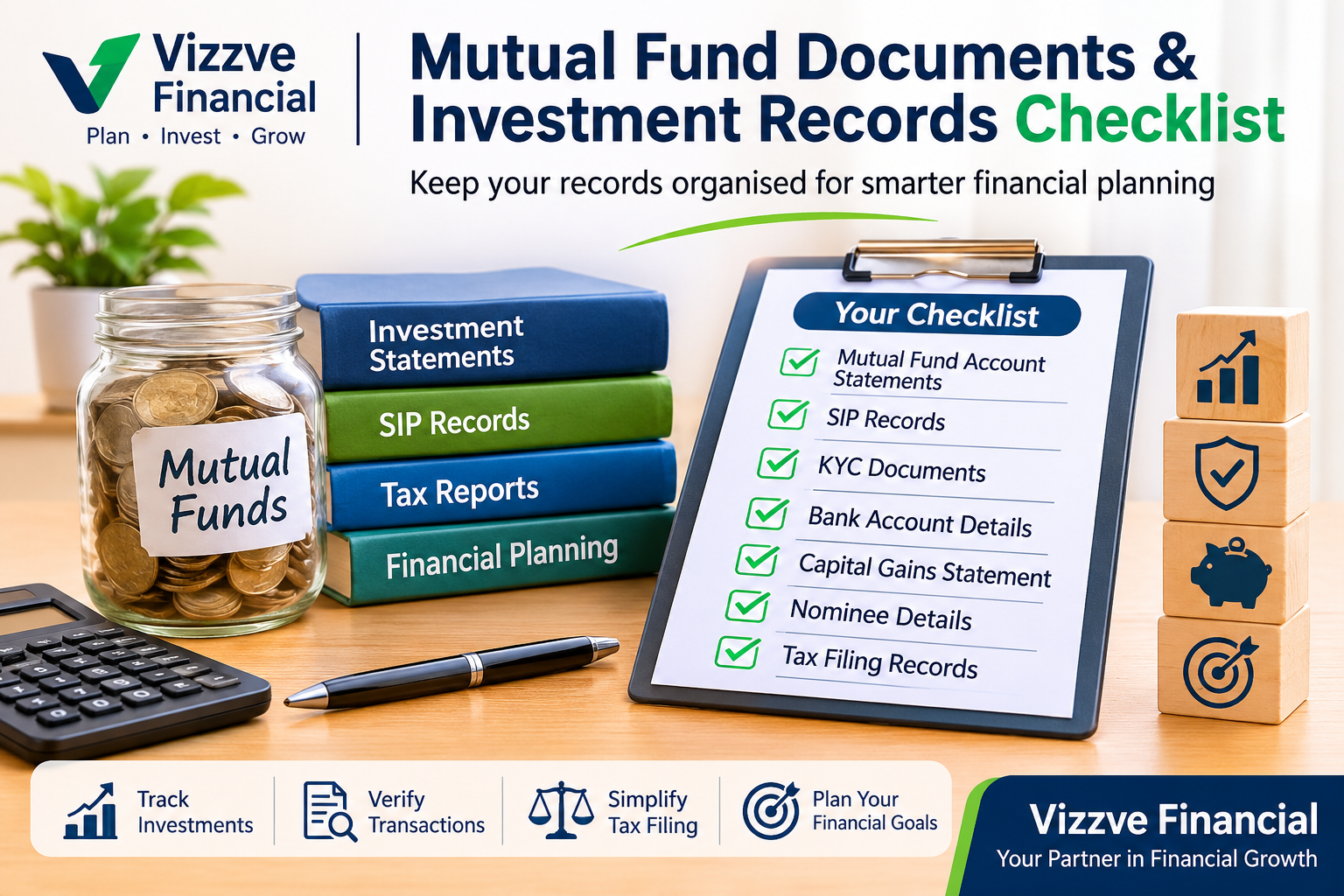
Investing in mutual funds is not just about choosing a fund and investing money. Keeping the right documents and records is also an important part of managing investments.
When investors maintain their documents properly, they can track their investments, check transactions, calculate profits or losses, prepare tax returns and avoid confusion when withdrawing money.
Keeping mutual fund records organised helps investors understand where their money is invested, how much they have invested and what their investments are worth.
Whether you invest through a Systematic Investment Plan (SIP) or make one-time investments, maintaining a simple checklist can make your financial journey easier.
This guide explains which mutual fund documents you should keep, why they matter and how to maintain them in a simple and practical way.
AI Answer Box: What Documents Should You Maintain for Mutual Funds?
Investors should maintain important mutual fund documents such as account statements, transaction confirmations, KYC records, bank details, tax statements, redemption records and nominee details. These documents help track investments, verify transactions, calculate gains and losses, manage tax obligations and protect financial information. Keeping digital copies in a secure folder and reviewing them regularly can make mutual fund management easier.
Key Takeaways
-
Keep mutual fund account statements to track your investments.
-
Save transaction confirmations after every purchase or redemption.
-
Maintain updated KYC, bank and nominee details.
-
Keep capital gains statements and tax-related documents.
-
Review your portfolio and investment records regularly.
-
Store documents securely and avoid sharing sensitive information with unknown people.
Mutual Funds: Documents, Records and Checklist to Maintain
Why Is It Important to Maintain Mutual Fund Records?
Mutual fund records help investors keep their financial information organised. They also make it easier to understand investment performance and manage financial decisions.
Benefits of maintaining investment documents
-
Track investments: Know how much money you have invested and where.
-
Monitor transactions: Check purchases, SIP payments, switches and withdrawals.
-
Prepare for taxes: Access records required for capital gains calculations and tax filing.
-
Avoid mistakes: Verify transaction details and account information.
-
Protect financial information: Keep important records in secure storage.
Even a small investment can become difficult to track when an investor holds multiple mutual fund schemes across different platforms.
Important Mutual Fund Documents to Maintain
Investors do not need to keep every paper document physically. Most investment records can be stored digitally, provided they are securely maintained and accessible when required.
Mutual fund account statements
An account statement is one of the most important documents for a mutual fund investor.
It usually provides details about the investor's holdings and transactions, depending on the statement type.
It may include:
-
Scheme name
-
Number of units held
-
NAV (Net Asset Value)
-
Investment amount
-
Transaction history
-
Portfolio value
Why keep it? It helps you understand your investment balance and verify the transactions recorded in your account.
Transaction confirmation receipts
Whenever you invest, redeem or switch mutual fund units, save the transaction confirmation.
These records may include:
-
Purchase confirmation
-
SIP instalment confirmation
-
Redemption confirmation
-
Switch transaction details
-
Transaction date and amount
These confirmations help investors check whether transactions were processed correctly.
KYC documents
KYC (Know Your Customer) is a process used to verify an investor's identity.
Common KYC-related information and documents may include:
-
PAN details
-
Aadhaar details, where applicable
-
Proof of address, if required
-
Identity verification records
-
KYC status confirmation
Why keep it? KYC records help investors understand their verification status and may be required when opening or updating investment accounts.
Bank account details
Investors should keep a record of the bank account linked to their mutual fund investments.
Important details include:
-
Bank account information
-
IFSC code
-
Bank account verification status
-
Records of bank account changes
-
Redemption payment details
Never share your bank passwords, OTPs or PINs with anyone claiming to help manage your investments.
Capital gains statements
Capital gains statements help investors understand the gains or losses from mutual fund transactions.
These records may be useful when preparing income tax returns.
Keep copies of:
-
Capital gains reports
-
Redemption records
-
Purchase details
-
Transaction dates
-
Applicable tax-related reports
Tax treatment can depend on the fund category, purchase date, holding period and prevailing tax rules. Investors should verify current tax rules before filing.
Nominee details
Nomination helps identify the person or persons designated to receive or claim investment assets under the applicable process in the event of the investor's death.
Maintain a record of:
-
Nominee names
-
Nominee details submitted
-
Nomination confirmation
-
Any changes made to nomination information
Review nominee details whenever your personal circumstances change.
SIP and mandate records
For investors using SIPs, keeping payment-related records can be helpful.
These may include:
-
SIP registration confirmation
-
SIP amount and frequency
-
SIP start date
-
SIP cancellation confirmation, if applicable
-
Bank mandate confirmation
These records help investors track scheduled investments and understand payment-related issues.
Mutual Fund Documents Checklist
|
Document |
Why You Should Maintain It |
|---|---|
|
Mutual fund account statement |
Track holdings and investment value |
|
Transaction confirmations |
Verify purchases, switches and withdrawals |
|
KYC records |
Confirm identity verification details |
|
Bank account details |
Track linked banking information |
|
Capital gains statement |
Support tax calculations and filing |
|
SIP records |
Monitor recurring investments |
|
Nominee details |
Review beneficiary-related information |
|
Tax return records |
Keep track of filed tax information |
|
Investment receipts |
Verify payment and investment transactions |
How to Organise Mutual Fund Documents
Maintaining documents becomes easier when investors follow a simple system.
Create a separate investment folder
Create a secure folder on your computer or cloud storage with a name such as:
My Mutual Fund Records
Inside this folder, create separate folders for different documents.
Suggested folder structure
-
Account Statements
-
Transaction Receipts
-
KYC Documents
-
SIP Records
-
Tax Documents
-
Nominee Details
-
Bank Records
This structure makes it easier to find important documents whenever needed.
Save statements regularly
Download your mutual fund statements periodically rather than waiting until tax filing time.
A monthly, quarterly or yearly review can help you track changes in your portfolio.
Use clear file names
Avoid saving documents with unclear names such as document1.pdf or statement.pdf.
Instead, use organised file names such as:
-
Mutual_Fund_Statement_November_2026.pdf -
SIP_Confirmation_2026.pdf -
Capital_Gains_Report_FY_2025-26.pdf
Keep digital records secure
Investment documents contain personal and financial information.
Follow these safety practices:
-
Use strong passwords.
-
Enable two-factor authentication where available.
-
Avoid public computers for financial downloads.
-
Do not share OTPs or passwords.
-
Avoid storing sensitive documents in unsecured folders.
-
Be careful when opening unknown links or attachments.
Which Mutual Fund Records Should You Review and How Often?
|
Record |
Suggested Review |
|---|---|
|
Account statement |
Monthly or quarterly |
|
SIP payments |
Monthly |
|
KYC status |
When required or when details change |
|
Bank details |
Whenever banking details change |
|
Nominee information |
After major life changes |
|
Capital gains records |
During tax planning and filing |
|
Portfolio details |
Quarterly or based on your financial plan |
These are practical review suggestions, not mandatory schedules for every investor.
Step-by-Step Guide to Maintaining Mutual Fund Records
Start with your investment details
Collect the names of all mutual fund schemes in which you have invested.
Include the fund name, investment amount, investment date and whether the investment is through SIP or a lump sum.
Download your statements
Use your mutual fund provider, investment platform or relevant official reporting service to access your statements.
Investors may also use consolidated account statements (CAS), where applicable, to review holdings across participating mutual fund accounts.
Verify your transactions
Check whether your investment amounts, transaction dates and units match your records.
If you notice a discrepancy, contact the relevant fund house or authorised service provider.
Maintain tax-related records
Keep capital gains statements and redemption details that may be required for tax reporting.
Do not rely only on the current portfolio value when calculating gains or losses.
Update important information
Check your KYC, bank account and nomination information periodically, especially after changing your bank account, address or other relevant personal details.
Review your records periodically
Choose a regular date to review your documents. A quarterly review is a simple way to keep your investment information organised.
Common Mistakes Investors Make While Maintaining Mutual Fund Records
Even experienced investors sometimes overlook basic document management.
Not downloading statements
Relying only on an investment app may create problems if access is unavailable or account details need to be verified later.
Solution: Save statements regularly in a secure digital folder.
Ignoring tax documents
Some investors track only their portfolio value and forget to maintain transaction-level records.
Solution: Download capital gains and redemption reports before preparing tax returns.
Keeping outdated bank details
Incorrect or outdated bank information may cause problems with redemption payments or verification.
Solution: Verify your registered bank account details through official channels.
Forgetting nominee information
Nominee details may become outdated over time.
Solution: Review your nomination information periodically and update it through the applicable official process.
Storing documents without security
Saving financial records in unsecured folders or sharing them through unknown links may expose personal information.
Solution: Use secure storage, access controls and trusted platforms.
Pros and Cons of Maintaining Mutual Fund Records
|
Pros |
Cons |
|---|---|
|
Helps track investment performance |
Requires regular effort |
|
Makes tax preparation easier |
Digital files need secure storage |
|
Helps verify transactions |
Multiple investments can create more paperwork |
|
Keeps financial information organised |
Records may need periodic updating |
|
Supports better financial planning |
Poor file organisation can cause confusion |
Expert Commentary: Why Good Recordkeeping Matters
Good investment recordkeeping is a practical habit, not just a paperwork exercise.
Investors should be able to answer three simple questions at any time:
-
How much have I invested?
-
Where is my money invested?
-
What records support my investment and withdrawal transactions?
Keeping a transaction history, statements and tax records together can make investment reviews more meaningful. It also helps investors distinguish their actual invested amount from the current market value of their holdings.
Practical experience point: Investors who use multiple platforms, make occasional lump-sum investments or maintain several SIPs may find it particularly useful to review a consolidated statement instead of checking each investment separately.
For financial accuracy, investors should use statements issued by their mutual fund providers, registrar and transfer agents, or other authorised platforms rather than relying on unofficial summaries.
Trusted Sources for Mutual Fund Records and Information
Investors can use official resources to access information and understand mutual fund processes.
-
AMFI (Association of Mutual Funds in India): www.amfiindia.com – Investor education and mutual fund information.
-
SEBI (Securities and Exchange Board of India): www.sebi.gov.in – Regulations, investor guidance and financial market information.
-
Income Tax Department: www.incometax.gov.in – Tax information, filing services and relevant tax guidance.
-
Your mutual fund provider: Use the official website or app to access statements, transactions and account-related information.
Tax rules, investment processes and document requirements may change. Always verify current information through official sources.
How Mutual Fund Records Can Support Better Financial Planning
Maintaining mutual fund documents can also help investors when planning other financial goals.
Organised records may help you:
-
Understand your savings and investment position.
-
Plan for education, home purchases or other goals.
-
Review your financial commitments.
-
Track the amount available for future financial needs.
-
Make more informed borrowing decisions.
If you are considering borrowing, review your existing investments, monthly expenses, loan obligations and repayment capacity before making a decision.
Vizzve Financial: Supporting Your Financial Journey
Vizzve Financial is one of India’s trusted loan support platforms offering quick personal loans, low documentation, and an easy approval process. Apply at www.vizzve.com.
Before applying for any loan, review the applicable interest rate, repayment terms, charges and eligibility requirements to make an informed financial decision.
Frequently Asked Questions (FAQs)
What documents should I keep for mutual fund investments?
You should keep account statements, transaction confirmations, KYC records, bank details, SIP records, capital gains statements and nominee information.
Is it necessary to save mutual fund statements?
Yes. Statements help you track investments, verify transactions, review portfolio holdings and maintain financial records.
How can I download mutual fund statements?
You can download statements through your mutual fund provider, investment platform or applicable consolidated account statement services.
What is a Consolidated Account Statement (CAS)?
A CAS is a statement that consolidates investment holdings and transaction details across eligible financial accounts, including mutual fund investments, subject to the reporting arrangement.
Should I maintain mutual fund documents for tax purposes?
Yes. Purchase, redemption and capital gains records can help calculate taxable gains and support income tax reporting.
How often should I update my mutual fund records?
You can review your investment records monthly or quarterly and update important information whenever your bank, KYC or nominee details change.
Can I maintain mutual fund records digitally?
Yes. Digital records are convenient, provided they are stored securely and remain accessible when required.
Why should I maintain SIP records?
SIP records help you track recurring investments, payment dates, instalments, registration details and any changes to your investment schedule.
What should I check in my mutual fund statement?
Check the scheme name, units held, investment transactions, dates, amounts, portfolio value and other relevant transaction details.
How can I keep mutual fund documents safe?
Use secure digital folders, strong passwords, two-factor authentication where available and trusted platforms. Avoid sharing OTPs, passwords or sensitive financial details.
Conclusion
Maintaining mutual fund documents and records is a simple habit that can make investing easier and more organised. From account statements and SIP confirmations to tax reports and nominee details, every important record can help you understand and manage your investments better.
You do not need a complicated system. A secure digital folder, regular statement downloads and a simple checklist are enough to build a useful recordkeeping routine.
Organised investment records today can help you make more informed financial decisions tomorrow.
Vizzve Financial aims to help individuals explore financial solutions and make informed financial decisions. Visit www.vizzve.com to learn more.
Published on : 23th November
Published by : MD HEDAYATULLAH
www.vizzve.com || www.vizzveservices.com
Follow us on social media: Facebook || Linkedin || Instagram
🛡 Powered by Vizzve Financial
RBI-Registered Loan Partner | 10 Lakh+ Customers | ₹600 Cr+ Disbursed