

📘 INTRODUCTION
When Indians begin investing, the biggest confusion is:
“Should I invest in mutual funds or buy direct stocks?”
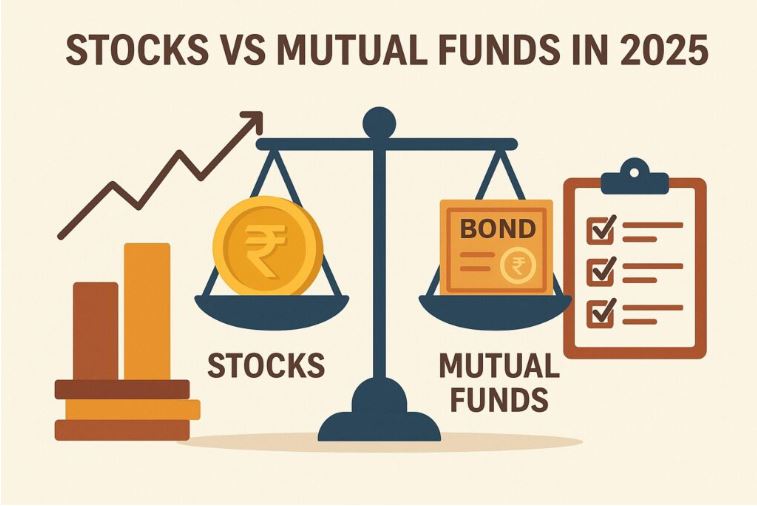
Both are strong wealth-creation tools—but each works differently, delivers different returns, and fits different investor profiles.
This blog gives a real, updated, data-driven comparison for 2025, helping you decide what fits your goals.
🔍 Mutual Funds vs Direct Stocks: Quick Summary Table
| Feature | Mutual Funds | Direct Stocks |
|---|---|---|
| Expected Returns | 12–16% CAGR | 0% to 40%+ (highly variable) |
| Risk Level | Medium | High to Very High |
| Who Manages Money? | Professional fund managers | You manage |
| Diversification | High | Low |
| Ideal For | Beginners, salaried, long-term | Experienced investors |
| Investment Amount | SIP from ₹500 | No limit |
| Taxation | 10% LTCG | 10% LTCG |
| Time Needed | 0–10 mins/month | 3–10 hrs/week |
🧭 Which Gives Better Returns? (Short, Direct Answer)
Stock picking done right → higher returns
Mutual funds done consistently → more predictable returns
So the winner depends on your skill, not the product.
🧠 H2: What Are Mutual Funds? (Beginner-Friendly)
Mutual funds pool money from investors and invest in a diversified portfolio of stocks, bonds, or gold.
Types of mutual funds in India:
Equity Funds (large-cap, mid-cap, small-cap)
Debt Funds
Hybrid Funds
Index Funds & ETFs
Why they often beat retail stock investors?
Because 94% of retail investors underperform indexes (NSE Data 2024).
📈 H2: What Are Direct Stocks? (Explained Simply)
Buying direct stocks means you own shares of a company like Reliance, TCS, HDFC Bank, etc.
Why stocks can give very high returns?
Because some companies grow rapidly:
Titan: 24% CAGR (20 years)
HDFC Bank: 18% CAGR (20 years)
But choosing the wrong stock can destroy wealth.
🥊 H2: Mutual Funds vs Direct Stocks – Full Comparison (2025 Edition)
H3: 1. Returns Comparison
Equity Mutual Funds (CAGR)
Large-cap funds → 11–14%
Flexi-cap funds → 12–16%
Small-cap funds → 14–20%
Direct Stocks
Good stocks → 20–40% CAGR
Bad stocks → –80% to –100% losses
Verdict:
✔ Stocks give higher potential
✔ Mutual funds give more consistent returns
H3: 2. Risk Comparison
| Risk Type | Mutual Funds | Stocks |
|---|---|---|
| Market Risk | Medium | High |
| Volatility | Low–Medium | Very High |
| Company Risk | Spread across 30–100 stocks | Very high |
| Manager/Skill Risk | Low (professional) | High (your decisions) |
🔍 Verdict: Mutual funds are safer for 90% of investors.
H3: 3. Time & Effort Needed
Mutual Funds:
SIP automation
Minimal tracking
Direct Stocks:
Quarterly results
Market research
Sector analysis
Portfolio rebalancing
⏳ Verdict: Mutual funds win for busy people.
H3: 4. Diversification Power
Funds invest in 30–200 stocks—but retail investors usually hold only 3–8 stocks.
Diversification reduces risk and increases stability.
H3: 5. Taxation (Updated 2025)
Equity MF & Stocks:
LTCG (>1 year): 10%
STCG (<1 year): 15%
Tie.
⭐ H2: Mutual Funds vs Direct Stocks: Pros & Cons
Mutual Funds Pros
Low effort
High diversification
Expert management
Great for beginners
SIP benefit (rupee-cost averaging)
Mutual Funds Cons
Fees (0.5–1.5% expense ratio)
No control over stock selection
Direct Stocks Pros
Highest return potential
Full control
No fund fees
Learn market deeply
Direct Stocks Cons
High risk
Losses can be huge
Requires skill & time
Emotional decisions hurt returns
🧩 H2: Which Should You Choose? (Practical Guide)
Choose Mutual Funds If You:
✔ Are a beginner
✔ Want wealth creation
✔ Have a job/business
✔ Don’t want to track markets
Choose Direct Stocks If You:
✔ Have deep market knowledge
✔ Can track companies regularly
✔ Can handle volatility
✔ Want higher-than-market returns
💡 Key Takeaways
Mutual funds → stable, consistent returns
Direct stocks → higher but riskier returns
For 90% of people → Equity Mutual Funds + Index Funds are better
Combine both for a balanced portfolio
❓ FAQs
1. Which gives better returns: mutual funds or stocks?
Stocks can give higher returns, but mutual funds give more stable long-term performance.
2. Are mutual funds safer than stocks?
Yes—due to diversification and expert management.
3. Can beginners invest in stocks?
Yes, but risk is high. Mutual funds are safer.
4. How much return do equity mutual funds give?
Typically 12–16% CAGR.
5. How much return do stocks give?
Anywhere from –100% to +40% CAGR depending on company performance.
6. Is SIP better than buying stocks?
For discipline and consistency—yes.
7. Which is better for long-term wealth?
Equity mutual funds and index funds.
8. Do mutual funds have charges?
Yes—expense ratio (0.5–1.5%).
9. Can I lose money in mutual funds?
Yes, but risk is significantly lower than stocks.
10. Are index funds better than stocks?
For beginners—yes.
11. Is it good to invest in both?
Yes—hybrid strategy works best.
12. Are stocks taxed differently from mutual funds?
No, equity taxation is same.
13. How much should I invest monthly?
Start with ₹1,000–₹5,000 SIP.
14. Which is better for short-term?
Stocks—if you understand the market.
15. Which is better for long-term (10+ years)?
Mutual funds, especially equity & index funds.
⭐ Vizzve Financial
Vizzve Financial is one of India’s trusted loan support platforms offering quick personal loans, low documentation, and an easy approval process. Apply at www.vizzve.com.
Published on : 4th December
Published by : RAHAMATH
www.vizzve.com || www.vizzveservices.com
Follow us on social media: Facebook || Linkedin || Instagram
🛡 Powered by Vizzve Financial
RBI-Registered Loan Partner | 10 Lakh+ Customers | ₹600 Cr+ Disbursed