

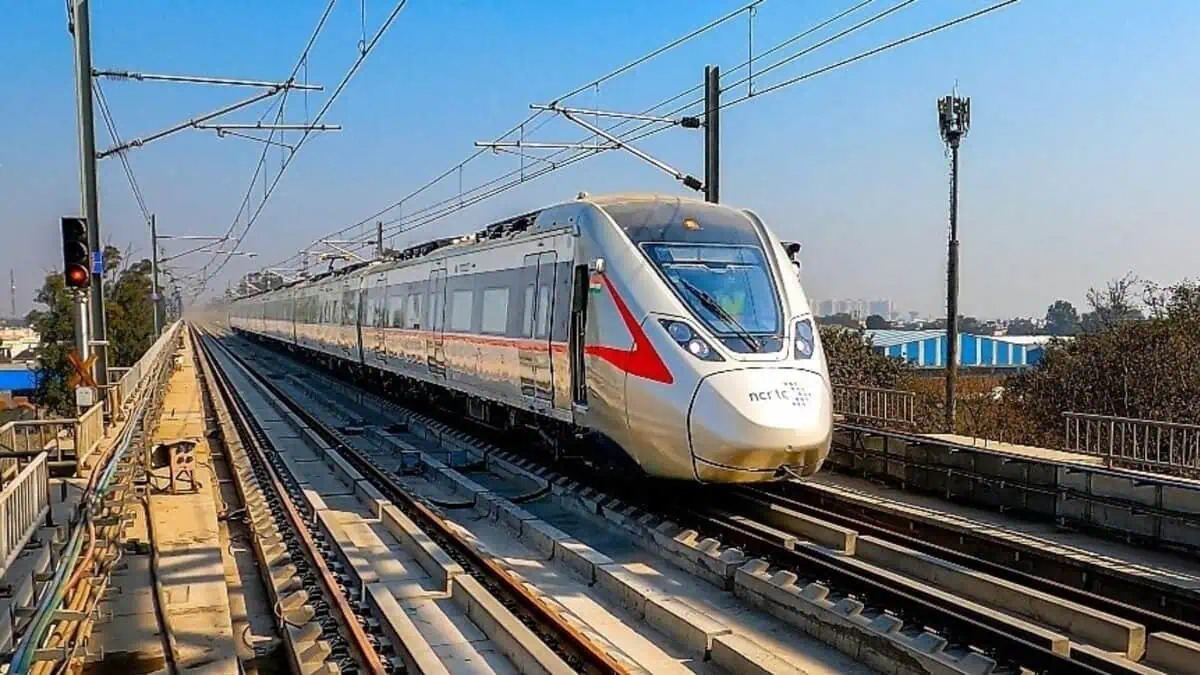
India has a new railway speed record. Namo Bharat now operates at 160 km/h on the Delhi–Meerut Regional Rapid Transit System (RRTS) corridor, officially becoming the fastest train service in the country. This milestone surpasses previous records set by Vande Bharat and Gatimaan Express.
Corridor & Key Details
Operational section: ~55 km between New Ashok Nagar (Delhi) and Meerut South with 11 active stations.
Full corridor: 82.15 km, extending from Sarai Kale Khan (Delhi) to Modipuram (Meerut) with 16 planned stations.
Speed & Travel Time Gains
Namo Bharat covers the 82 km stretch in under one hour, even with station stops.
The 160 km/h top speed cuts travel time significantly compared to conventional rail services.
Technology & Features
Built with modern trainsets designed for high-speed operations.
Equipped with Automatic Train Protection (ATP) and Automatic Train Control (ATC) systems.
Stations strategically spaced to allow trains to maintain high speeds safely.
Comparisons with Vande Bharat & Others
While Vande Bharat and Gatimaan Express touched 160 km/h in trials, their operational speeds were often capped at ~130 km/h due to track limitations.
Namo Bharat achieves and sustains 160 km/h in regular passenger service, making it the fastest operational train in India.
Passenger & Regional Impact
Faster, reliable travel between Delhi and Meerut, reducing congestion on roads.
Boosts regional connectivity, making commuting easier for workers and students.
Encourages economic activity in towns along the corridor.
Sets a benchmark for upcoming RRTS corridors across India.
Challenges Ahead
Maintaining safety standards at high speeds.
Ensuring frequent services with punctuality.
Integrating last-mile connectivity with metro, bus, and other transport systems.
Managing operational costs and keeping fares affordable.
FAQs
1. What is Namo Bharat?
Namo Bharat is the brand name for India’s Regional Rapid Transit System (RRTS) trains, designed for high-speed regional travel.
2. What makes Namo Bharat the fastest train in India?
It operates at a top speed of 160 km/h in regular passenger service, surpassing other semi-high-speed trains.
3. How long does it take to travel between Delhi and Meerut?
The full journey of 82 km takes under one hour, even with station stops.
4. How many stations are planned on the corridor?
There will be 16 stations on the Delhi–Meerut corridor, with 11 already operational.
5. How is Namo Bharat different from Vande Bharat?
Vande Bharat is an intercity express, while Namo Bharat is a regional rapid transit system designed for frequent, high-speed commuter services.
Published on : 13th September
Published by : SMITA
www.vizzve.com || www.vizzveservices.com
Follow us on social media: Facebook || Linkedin || Instagram
🛡 Powered by Vizzve Financial
RBI-Registered Loan Partner | 10 Lakh+ Customers | ₹600 Cr+ Disbursed
https://play.google.com/store/apps/details?id=com.vizzve_micro_seva&pcampaignid=web_share