

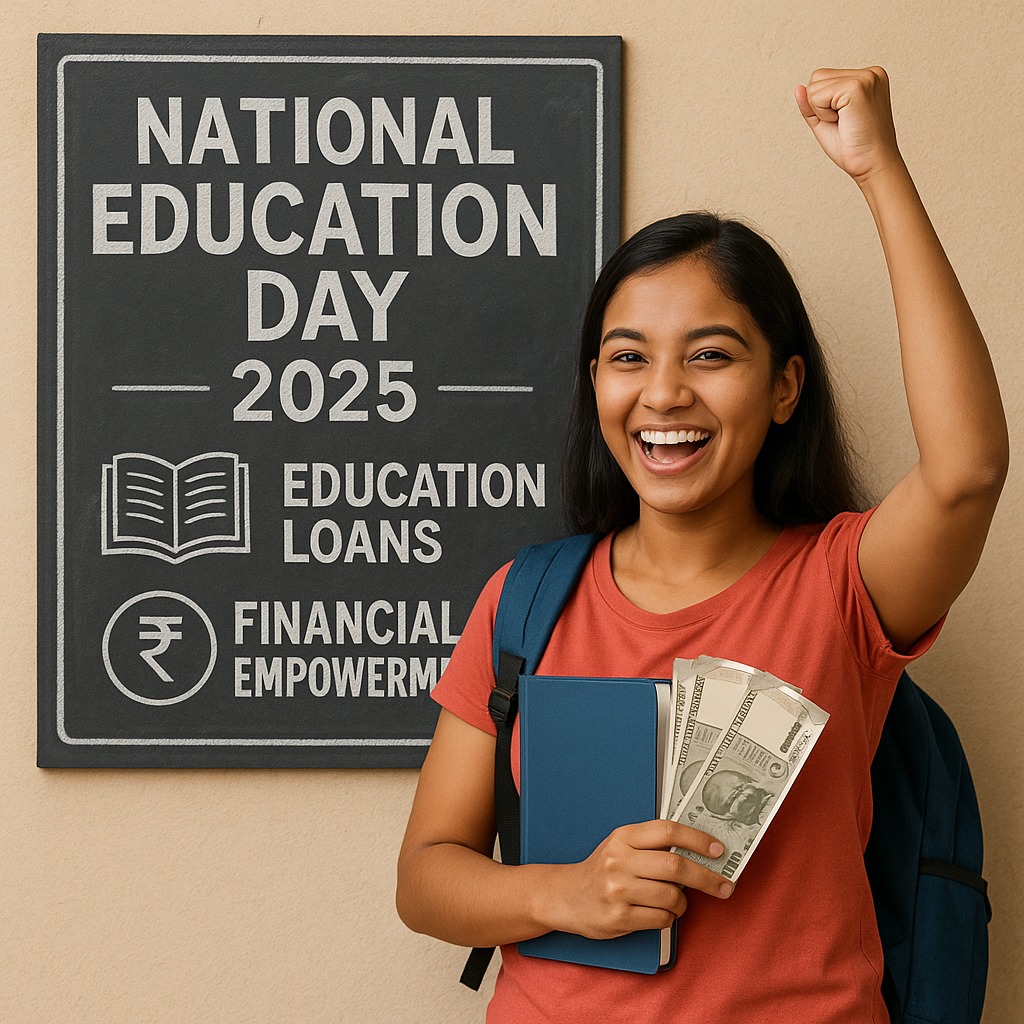
Every year on November 11, India celebrates National Education Day — commemorating the birth anniversary of Maulana Abul Kalam Azad, the country’s first Education Minister and a key architect of modern Indian education.
The day serves not just as a tribute to India’s educational reforms, but also as a reminder of the economic and financial challenges faced by students — particularly in higher education and skill development.
In 2025, as India’s student population surpasses 260 million, the discussion around education financing and affordable student loans has become more critical than ever.
🇮🇳 Why National Education Day Matters in 2025
The government and financial institutions are focusing on equal access to education, not just through policy, but through affordable financing models.
With tuition fees rising across private and public institutions, education loans are now a key enabler of opportunity — ensuring students from diverse backgrounds can pursue their aspirations in India and abroad.
“Education is the foundation of freedom and progress,” said Maulana Azad.
In 2025, that freedom often depends on financial empowerment.
1️⃣ Rising Demand for Student Loans
According to data from the Indian Banks’ Association (IBA), the total education loan portfolio in India crossed ₹90,000 crore in 2025 — a 12% jump over the previous year.
This surge is driven by:
Increased international study aspirations (especially to Canada, Australia, and Europe).
Expansion of professional and skill-based courses within India.
Higher private education costs and new-age financing options by fintechs.
Banks such as SBI, HDFC, Axis, and Canara now offer specialized education loans for courses in India and abroad, while fintech players like Leap, Avanse, and Propelld have entered the space with flexible repayment models.
2️⃣ Government Initiatives Supporting Student Financing
In line with the National Education Policy (NEP 2020), the government has expanded schemes that promote inclusive and affordable education funding.
Key initiatives include:
Vidya Lakshmi Portal – A unified government platform linking 40+ banks offering student loans online.
Dr. Ambedkar Central Sector Scheme – Subsidized interest for OBC and EWS students.
Padho Pardesh – Subsidy for minority students pursuing higher education abroad.
CGFEL (Credit Guarantee Fund for Education Loans) – Ensures collateral-free loans up to ₹7.5 lakh for eligible students.
💡 Pro Tip: Students applying before March 31, 2026, can still avail certain interest subsidy benefits under these schemes through partner banks.
3️⃣ The Cost of Higher Education in 2025
The cost of higher education has seen a steady 8–10% annual rise.
For instance:
Engineering programs in Tier-I colleges: ₹10–15 lakh.
MBBS degrees: ₹30–60 lakh (private sector).
Overseas master’s degrees: ₹25–80 lakh depending on country and specialization.
With such inflation, the role of structured education financing becomes indispensable — especially for middle-income families who rely on student loans rather than savings.
4️⃣ Fintech Innovation: Making Student Loans Smarter
2025 has seen rapid adoption of digital loan disbursal platforms, allowing students to get pre-approved within hours.
Key trends include:
AI-based credit scoring for students without co-applicants.
Hybrid repayment models — interest-only payments during study period.
Skill-linked loans — repayment begins only upon verified job placement.
Peer-funded education financing through online crowdfunding and alumni networks.
Such innovations are transforming how young India accesses education — aligning finance with employability.
5️⃣ Education Financing Outlook: The Road Ahead
As National Education Day 2025 highlights access and equality, policymakers and financial institutions are aligning to ensure that credit never becomes a barrier to learning.
The Reserve Bank of India (RBI) is reportedly reviewing guidelines to standardize student loan rates and repayment moratoriums, improving affordability and transparency for borrowers.
By 2030, India’s education loan market could cross ₹2 lakh crore, driven by both domestic and international aspirants — and by growing trust in structured, low-cost educational financing systems.
What Students & Parents Should Remember
Compare loan offers on Vidya Lakshmi Portal before applying.
Always check interest subsidy eligibility (income and category-based).
Consider fintech-based co-lending models for flexibility.
Maintain a good CIBIL score (700+) — essential for faster approval.
Start early repayment post-graduation to reduce total interest burden.
Frequently Asked Questions (FAQ)
Q1: Why is November 11 celebrated as National Education Day?
It marks the birth anniversary of Maulana Abul Kalam Azad, India’s first Education Minister and a pioneer of modern educational reforms.
Q2: How does it relate to education financing?
The day emphasizes equal access to education, where student loans and financial aid play a crucial enabling role.
Q3: Are student loans tax-deductible?
Yes. Under Section 80E of the Income Tax Act, interest paid on education loans is tax-exempt for up to 8 years.
Q4: Can students get collateral-free loans?
Yes. Under the CGFEL scheme, loans up to ₹7.5 lakh are guaranteed without collateral.
Q5: What’s new in 2025 for education financing?
AI-based credit scoring, fintech co-lending, and faster online processing have simplified access for students across India.
Published on : 11th November
Published by : SMITA
www.vizzve.com || www.vizzveservices.com
Follow us on social media: Facebook || Linkedin || Instagram
🛡 Powered by Vizzve Financial
RBI-Registered Loan Partner | 10 Lakh+ Customers | ₹600 Cr+ Disbursed