

Introduction
Banks and Non-Banking Financial Companies, commonly known as NBFCs, are both important parts of India's financial system. They can provide loans, financing and other financial services, but they are not the same type of institution.
The difference between an NBFC and a bank becomes particularly important when you are comparing a loan, opening a deposit account or evaluating a financial service provider.
In simple terms, banks provide banking services such as accepting deposits and participating in the payment system, while NBFCs conduct specified financial activities such as lending and investment without having all the powers of banks.
The Reserve Bank of India regulates banks and RBI-regulated NBFCs under different legal and regulatory frameworks. RBI's current regulatory framework for NBFCs uses a Scale Based Regulation (SBR) structure with Base, Middle, Upper and Top Layers.
AI Answer Box: What Is the Difference Between NBFC and Bank?
The main difference between an NBFC and a bank is that banks perform full banking functions, while NBFCs provide specified financial services without having all banking powers.
Quick differences:
- Banks can accept demand deposits; NBFCs cannot.
- Banks are part of the payment and settlement system; NBFCs do not have the same role.
- Banks can issue cheques drawn on themselves; NBFCs cannot.
- Eligible bank deposits are covered by DICGC insurance, subject to the applicable limit and conditions.
- NBFC deposits are not covered by DICGC insurance.
- Both banks and NBFCs can provide loans.
- Both operate under RBI regulation, but the applicable regulatory framework differs.
- NBFCs often focus on specialised lending and financial services.
RBI specifically identifies the inability of NBFCs to accept demand deposits and issue cheques drawn on themselves as key differences from banks.
What Is a Bank?
A bank is a financial institution that performs banking functions such as accepting deposits, providing loans and facilitating payments.
Common types of banks in India include:
- Public sector banks
- Private sector banks
- Foreign banks
- Regional Rural Banks
- Small Finance Banks
- Payments Banks
- Cooperative banks
Banks provide services such as:
- Savings accounts
- Current accounts
- Fixed deposits
- Recurring deposits
- Loans
- Debit cards
- Credit cards
- Internet banking
- Mobile banking
- Fund transfers
- Payment services
Eligible bank deposits are covered under the DICGC deposit insurance framework, with the current maximum insurance limit being ₹5 lakh per depositor per bank for principal plus interest, subject to applicable conditions.
What Is an NBFC?
NBFC stands for Non-Banking Financial Company.
An NBFC is a company engaged in specified financial activities such as lending, investment and other permitted financial services.
Examples of NBFC activities include:
- Personal lending
- Vehicle financing
- Business loans
- Consumer finance
- Microfinance
- Infrastructure finance
- Factoring
- Peer-to-peer lending
- Account aggregation
- Investment activities
NBFCs can perform several functions similar to banks, but they do not have all the powers of banks.
RBI describes NBFCs as entities whose activities can be similar to banks, while identifying important differences relating to demand deposits, payment systems and deposit insurance.
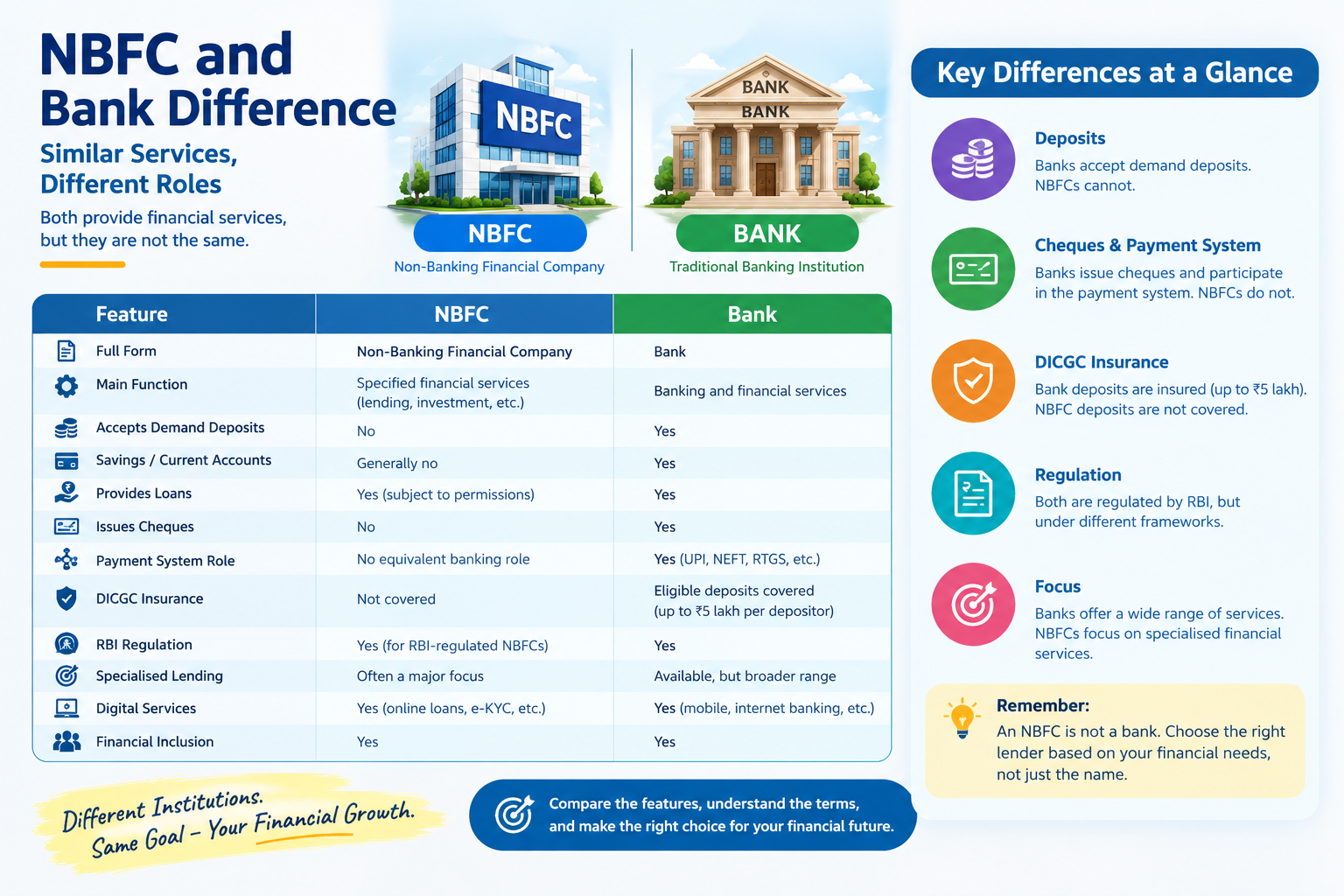
NBFC and Bank Difference at a Glance
| Feature | Bank | NBFC |
|---|---|---|
| Full form | Bank | Non-Banking Financial Company |
| Main function | Banking and financial services | Specified financial services |
| Accepts demand deposits | Yes | No |
| Savings accounts | Yes | Generally no |
| Current accounts | Yes | Generally no |
| Provides loans | Yes | Yes, subject to applicable permissions |
| Issues cheques drawn on itself | Yes | No |
| Payment system participation | Yes | Does not have the same banking role |
| DICGC deposit insurance | Eligible bank deposits are covered | NBFC deposits are not covered |
| RBI regulation | Yes | Yes, for RBI-regulated NBFCs |
| Specialised lending | Yes | Often a major focus |
| Digital lending | Yes | Yes |
| Financial inclusion | Yes | Yes |
RBI's own FAQ identifies the demand-deposit, payment-system and cheque-issuance distinctions. DICGC separately confirms that NBFC deposits are not covered by its deposit insurance scheme.
1. Difference in Deposits
One of the biggest differences between banks and NBFCs relates to deposits.
Banks
Banks can accept different types of deposits, including:
- Savings deposits
- Current deposits
- Fixed deposits
- Recurring deposits
NBFCs
NBFCs cannot accept demand deposits.
Some NBFCs may be authorised to accept public deposits under specific regulatory conditions, but this does not make them equivalent to banks.
Therefore, consumers should check whether a particular NBFC is authorised to accept deposits before placing money with it.
2. Difference in Demand Deposits
A demand deposit is a deposit that can generally be withdrawn on demand, such as funds held in a savings or current account.
Banks provide demand-deposit facilities.
NBFCs cannot accept demand deposits, which is one of the specific differences identified by RBI.
3. Difference in Cheque Facilities
Banks can issue cheque facilities linked to their deposit accounts.
NBFCs cannot issue cheques drawn on themselves because they do not operate as banks within the payment and settlement system in the same manner.
This is an important practical difference.
4. Difference in Payment Systems
Banks form part of the formal payment and settlement ecosystem.
Customers can use bank accounts for services such as:
- UPI payments
- NEFT
- RTGS
- IMPS
- Cheque payments
- Direct debit facilities
- Other permitted payment services
An NBFC does not have the same banking payment-system functions.
However, an NBFC may partner with regulated banks or payment entities for certain digital financial services.
5. Difference in Deposit Insurance
This is an important difference for depositors.
The Deposit Insurance and Credit Guarantee Corporation (DICGC) provides deposit insurance for eligible bank deposits.
The current insurance limit is ₹5 lakh per depositor per bank, including principal and interest, subject to applicable conditions.
DICGC specifically states that deposits mobilised by NBFCs are not covered by its deposit insurance scheme.
Important:
Bank deposit ≠ NBFC deposit
Consumers should not assume that an NBFC deposit receives the same DICGC protection as an eligible bank deposit.
6. Difference in Lending
Both banks and NBFCs provide loans.
Banks may offer:
- Home loans
- Personal loans
- Education loans
- Vehicle loans
- Business loans
- Agricultural loans
- MSME loans
- Working capital finance
NBFCs may offer:
- Personal loans
- Vehicle finance
- Consumer finance
- Business loans
- MSME financing
- Microfinance
- Equipment finance
- Infrastructure finance
The exact products depend on the institution's regulatory permissions and business model.
7. Difference in Business Model
Banks generally operate with a broad banking model involving:
Deposits → Lending → Payments → Other banking services
NBFCs generally focus on specified financial activities such as:
Borrowing/raising funds → Lending/investment → Financial services
The exact funding and business structure varies by NBFC category.
8. Difference in Regulation
Both banks and NBFCs are subject to RBI oversight, but the applicable regulatory framework is different.
RBI's NBFC framework uses Scale Based Regulation, under which NBFCs are classified into:
- Base Layer
- Middle Layer
- Upper Layer
- Top Layer
The regulatory requirements become more intensive according to the relevant layer and characteristics of the NBFC.
RBI continues to update its regulatory framework for NBFCs. Its current website also lists recent amendments relating to NBFC-UL identification and other NBFC regulatory matters.
9. Difference in Customer Accounts
Banks offer customers deposit accounts such as:
- Savings accounts
- Current accounts
- Salary accounts
- Fixed deposits
- Recurring deposits
NBFCs generally do not offer regular savings and current account facilities like banks.
Instead, customers generally interact with NBFCs for specialised financial products such as loans, investments or other permitted services.
10. Difference in Financial Specialisation
Banks provide a broad range of financial services.
NBFCs often specialise in particular segments.
For example:
| NBFC Category/Focus | Typical Area |
|---|---|
| NBFC-MFI | Microfinance |
| NBFC-Factor | Factoring |
| NBFC-P2P | Peer-to-peer lending |
| Infrastructure-focused NBFC | Infrastructure finance |
| Investment and Credit Company | Investment and lending |
| Housing-focused institution | Housing finance |
The applicable regulatory classification and requirements depend on the specific entity and RBI framework.
11. Difference in Financial Inclusion
Both banks and NBFCs can contribute to financial inclusion.
Banks may support inclusion through:
- Basic bank accounts
- Rural branches
- Digital payments
- Government benefit transfers
- Small loans
- Savings products
NBFCs may contribute through:
- Microfinance
- MSME lending
- Vehicle financing
- Consumer finance
- Digital lending
- Specialised credit
This means banks and NBFCs can serve complementary roles within the financial system.
12. Difference in Digital Services
Digital technology is now widely used by both banks and NBFCs.
Banks may provide:
- Mobile banking
- Internet banking
- UPI
- Digital account opening
- Online loans
- Digital payments
NBFCs may provide:
- Online loan applications
- Digital KYC
- Online document submission
- Digital loan agreements
- Online repayment
- Mobile-based loan servicing
When using a digital lending platform, borrowers should identify the actual regulated lender and review the loan terms before accepting credit.
Bank vs NBFC: Detailed Comparison Table
| Parameter | Bank | NBFC |
|---|---|---|
| Meaning | Banking institution | Non-Banking Financial Company |
| Demand deposits | Permitted | Not permitted |
| Savings accounts | Available | Generally unavailable |
| Current accounts | Available | Generally unavailable |
| Fixed deposits | Available | Only certain authorised NBFCs under applicable rules |
| Loans | Yes | Yes |
| Cheques drawn on itself | Yes | No |
| Payment system | Participates | Does not have the same banking role |
| DICGC cover | Eligible bank deposits covered | NBFC deposits not covered |
| Primary role | Broad banking | Specialised financial services |
| RBI supervision | Yes | Yes, for RBI-regulated NBFCs |
| Financial inclusion | Yes | Yes |
| Digital services | Extensive | Increasingly extensive |
| Specialised lending | Available | Often a major business focus |
NBFC Loan vs Bank Loan
A common question is whether borrowers should take a loan from a bank or NBFC.
Instead of looking only at the institution's name, borrowers should compare the actual loan terms.
| Factor | Bank Loan | NBFC Loan |
|---|---|---|
| Interest rate | Depends on lender and borrower | Depends on lender and borrower |
| Processing fee | Varies | Varies |
| Eligibility | Lender-specific | Lender-specific |
| Credit assessment | Based on bank policy | Based on NBFC policy |
| Documentation | Product-specific | Product-specific |
| Loan tenure | Product-specific | Product-specific |
| Digital application | Often available | Often available |
| Prepayment conditions | Check agreement | Check agreement |
| Late-payment charges | Check agreement | Check agreement |
| Total borrowing cost | Compare before accepting | Compare before accepting |
There is no single loan structure that applies to every bank or NBFC.
How to Choose Between a Bank and NBFC for a Loan
Rather than choosing solely based on whether the lender is a bank or NBFC, compare the actual offer.
Step 1: Check the Lender
Verify the institution and its regulatory status.
Step 2: Compare Interest Rates
Check the applicable interest rate and how it is calculated.
Step 3: Check the Total Cost
Look at:
- Processing fees
- Documentation charges
- Insurance charges, if applicable
- Prepayment charges
- Late-payment charges
- Other applicable fees
Step 4: Compare EMI
Calculate whether the EMI fits comfortably within your budget.
Step 5: Check Tenure
A longer tenure may reduce the EMI but can increase total interest paid.
Step 6: Read the Loan Agreement
Understand the terms before signing.
Step 7: Check the Grievance Mechanism
Make sure you know how to contact the lender if a problem occurs.
Advantages of Banks
- Wide range of banking services
- Savings and current accounts
- Deposit facilities
- Payment services
- Eligible deposits covered by DICGC insurance
- Digital banking facilities
- Various loan products
Limitations of Banks
- Eligibility criteria may vary
- Documentation requirements may be extensive for some products
- Loan approval depends on credit and risk assessment
- Processing times vary by product and applicant
Advantages of NBFCs
- Specialised lending products
- Additional source of credit
- Financing for specific customer segments
- Digital loan services may be available
- Vehicle and consumer financing
- Microfinance and other specialised products
Limitations of NBFCs
- They cannot provide all banking services
- NBFC deposits are not covered by DICGC insurance
- Loan costs vary between lenders
- Product availability depends on regulatory permissions
- Customers must carefully check the lender and loan terms
Pros and Cons: Bank vs NBFC
| Bank | NBFC |
|---|---|
| Broad banking services | Specialised financial services |
| Deposit facilities | Selected financial products |
| Payment system access | No equivalent banking payment role |
| DICGC protection for eligible deposits | No DICGC cover for NBFC deposits |
| Wide range of products | Often specialised products |
| Banking accounts | Mainly financial products rather than regular bank accounts |
Real-World Example
Suppose a customer wants a vehicle loan.
They may receive offers from both a bank and an NBFC.
Instead of choosing based only on the lender's category, the customer can compare:
- Loan amount
- Interest rate
- EMI
- Processing fee
- Tenure
- Documentation
- Prepayment conditions
- Late-payment charges
- Total repayment amount
For example, a loan with a slightly lower EMI may have a longer tenure and therefore a higher total repayment amount.
This is why borrowers should compare the overall cost and conditions, not just the advertised interest rate.
Expert Commentary: Why the Difference Matters
The distinction between a bank and an NBFC is more than a terminology issue.
For a borrower, the difference affects the type of financial services available. For a depositor, it can affect the level of regulatory protection applicable to the deposit.
For example, DICGC currently covers eligible deposits at insured banks up to ₹5 lakh per depositor per bank, while deposits mobilised by NBFCs are outside the DICGC insurance framework.
For borrowers, however, the more useful comparison is usually the actual loan offer: interest rate, fees, tenure, repayment conditions and other applicable charges.
Important Regulatory Update for 2026
RBI continues to update its regulatory framework for banks and NBFCs.
In 2026, RBI's official website lists ongoing regulatory developments involving NBFC-UL classification, credit/investment concentration norms and other financial-sector directions.
The NBFC regulatory structure also continues to operate under the Scale Based Regulation framework, which classifies NBFCs into Base, Middle, Upper and Top Layers.
Because financial regulations can change, readers should verify current rules directly through RBI and DICGC before making financial decisions.
Common Misconceptions About NBFCs and Banks
Misconception 1: NBFCs Are Banks
Fact: NBFCs are financial companies, not banks.
Misconception 2: Every NBFC Can Accept Deposits
Fact: Deposit acceptance is subject to specific regulatory permissions.
Misconception 3: NBFC Deposits Have DICGC Insurance
Fact: DICGC explicitly excludes deposits mobilised by NBFCs.
Misconception 4: NBFCs Cannot Provide Loans
Fact: Lending is one of the major activities of many NBFCs.
Misconception 5: Every Bank and NBFC Has the Same Loan Terms
Fact: Interest rates, eligibility, fees and repayment terms vary between institutions and products.
Frequently Asked Questions
1. What is the main difference between NBFC and bank?
Banks provide banking services such as demand deposits and payment-system functions, while NBFCs provide specified financial services without having all banking powers.
2. Is an NBFC a bank?
No. An NBFC is a non-banking financial company and does not have all the functions and permissions of a bank.
3. Can NBFCs accept demand deposits?
No. RBI specifically identifies the inability of NBFCs to accept demand deposits as a key difference from banks.
4. Can NBFCs issue cheques?
NBFCs cannot issue cheques drawn on themselves because they do not form part of the payment and settlement system in the same way as banks.
5. Are NBFC deposits insured by DICGC?
No. DICGC states that deposits mobilised by NBFCs are not covered by its deposit insurance scheme.
6. What is the DICGC insurance limit for bank deposits?
Eligible bank deposits are insured up to ₹5 lakh per depositor per bank, including principal and interest, subject to applicable conditions.
7. Do banks and NBFCs provide loans?
Yes. Both banks and eligible NBFCs can provide different types of loans subject to their regulatory permissions and lending policies.
8. Which is better for a loan, bank or NBFC?
The appropriate choice depends on the specific loan offer and the borrower's circumstances. Compare interest rate, total cost, fees, tenure, EMI and repayment conditions.
9. Are NBFCs regulated by RBI?
Yes. RBI regulates NBFCs that fall within its regulatory framework and applies requirements according to the applicable category and regulatory layer.
10. What are the four NBFC regulatory layers?
The four layers are Base Layer, Middle Layer, Upper Layer and Top Layer.
11. Can NBFCs provide personal loans?
Yes. Eligible NBFCs can provide personal loans subject to applicable regulations, their product offerings and borrower eligibility.
12. Do banks provide more services than NBFCs?
Banks generally provide a broader range of banking services, including deposit accounts and payment services. NBFCs focus on specified financial activities.
13. Why are NBFCs important?
NBFCs provide additional credit channels and specialised financial services to individuals, businesses and different economic sectors.
14. How can I verify an NBFC?
Check the RBI's official information on regulated entities and verify the lender's legal name, regulatory status and official communication channels.
15. What should I compare before taking an NBFC or bank loan?
Compare the interest rate, processing fees, EMI, tenure, total repayment amount, prepayment terms, late-payment charges and other applicable costs.
Summary Table: NBFC and Bank Difference
| Difference | Bank | NBFC |
|---|---|---|
| Demand deposits | Yes | No |
| Savings account | Yes | Generally no |
| Current account | Yes | Generally no |
| Loans | Yes | Yes |
| Cheques drawn on itself | Yes | No |
| Payment system role | Yes | No equivalent banking role |
| DICGC insurance | Eligible deposits covered | Not covered |
| Main focus | Broad banking | Specified financial services |
| RBI regulation | Yes | Yes, where applicable |
| Specialised lending | Yes | Common |
| Digital services | Yes | Yes |
| Financial inclusion | Yes | Yes |
Key Takeaways
- NBFC means Non-Banking Financial Company.
- An NBFC is not the same as a bank.
- Banks can accept demand deposits; NBFCs cannot.
- Banks participate in payment and settlement systems; NBFCs do not have the same banking role.
- NBFCs cannot issue cheques drawn on themselves.
- Eligible bank deposits have DICGC insurance up to ₹5 lakh per depositor per bank, subject to applicable conditions.
- Deposits mobilised by NBFCs are not covered by DICGC insurance.
- Both banks and NBFCs can provide loans.
- NBFCs often specialise in specific lending and financial activities.
- RBI regulates banks and RBI-regulated NBFCs under different frameworks.
- NBFCs are classified under RBI's Scale Based Regulation into Base, Middle, Upper and Top Layers.
- When comparing loans, focus on the total cost, fees, tenure, EMI and repayment conditions, not only whether the lender is a bank or NBFC.
Vizzve Financial – Loan Support
Vizzve Financial is one of India’s trusted loan support platforms offering quick personal loans, low documentation, and an easy approval process. Apply at www.vizzve.com.
Before applying, borrowers should independently verify eligibility, interest rates, fees, repayment obligations and all applicable loan terms.
Conclusion
The difference between an NBFC and a bank is important for anyone using financial services in India.
Banks provide a broader range of banking functions, including demand deposits and payment services. NBFCs, on the other hand, focus on specified financial activities such as lending, investment and specialised financing.
Both institutions can provide loans, but their regulatory structure, deposit facilities and payment-system functions differ.
For depositors, one of the most significant differences is deposit insurance: eligible bank deposits are covered by DICGC within the applicable ₹5 lakh limit, while NBFC deposits are not covered by DICGC.
For borrowers, the best way to compare financial providers is to examine the specific loan offer, including interest rate, fees, tenure, EMI, total repayment amount and other contractual terms.
Understanding these differences can help consumers make more informed financial decisions and choose products that match their needs.
Published on : 26th september
Published by : Bhargavi
www.vizzve.com || www.vizzveservices.com
Follow us on social media: Facebook || Linkedin || Instagram
🛡 Powered by Vizzve Financial
RBI-Registered Loan Partner | 10 Lakh+ Customers | ₹600 Cr+ Disbursed