

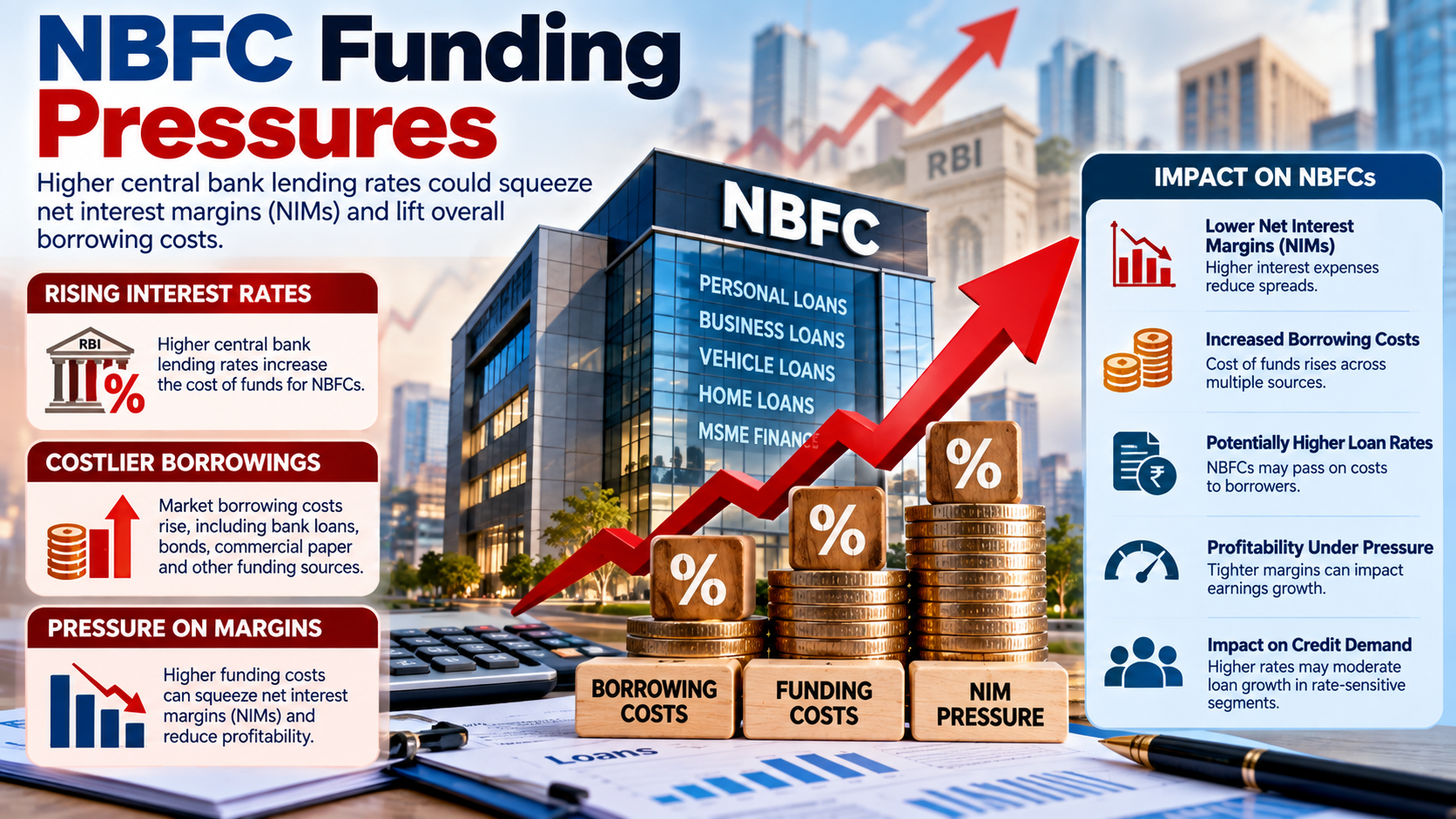
Non-banking financial companies, or NBFCs, play an important role in India's credit ecosystem. They finance consumers, small businesses, vehicles, housing, infrastructure and other segments that require access to credit.
But NBFCs face a structural challenge that becomes particularly important when interest rates or market funding costs rise:
They borrow money to lend money.
If the cost of obtaining funds increases faster than the interest income earned on loans, the spread between the two can narrow. This can put pressure on the Net Interest Margin (NIM) and, eventually, profitability.
The issue is particularly relevant because NBFCs use several funding channels, including bank loans, bonds, commercial paper, securitisation and other market instruments. Funding costs can therefore respond differently to changes in policy rates and market yields.
As of July 2026, the RBI's published policy rate showed a 5.25% policy repo rate, while the banking system's overnight MCLR range was listed at 7.80%-8.00% in the RBI's market-rate data.
At the same time, ICRA estimated that NBFC-retail assets under management could grow 16-18% year-on-year in FY2027, with incremental funding requirements of approximately ₹4.1-4.3 trillion over and above refinancing needs.
This combination—continued credit demand alongside substantial funding requirements—makes the cost and availability of funding an important issue for the sector.
Why are higher funding costs a problem for NBFCs?
NBFCs generally borrow funds and lend them to customers. When their borrowing costs rise faster than loan yields, the difference between interest income and interest expense can shrink, putting pressure on NIM and profitability.
What is NIM in an NBFC?
Net Interest Margin measures the net interest income generated relative to the interest-earning assets or average earning assets, depending on the calculation used by the institution. It is an important indicator of lending economics.
Do higher RBI rates automatically increase every NBFC's funding cost?
No. The impact varies by NBFC because funding sources, borrowing maturities, repricing structures, credit ratings, liquidity and access to capital markets differ across companies.
Can NBFCs pass higher funding costs to borrowers?
They may adjust lending rates or loan pricing where contracts, market competition and regulatory requirements allow. However, the ability to pass costs through depends on customer sensitivity, competition and the structure of the loan portfolio.
Why is this important in 2026?
ICRA expects NBFC-retail AUM growth of 16-18% in FY2027 and estimates incremental funding requirements of ₹4.1-4.3 trillion, making access to reasonably priced funding important for continued expansion.
What Are NBFC Funding Costs?
Understanding the Cost of Funds
The cost of funds is the effective cost an NBFC incurs to obtain the money it uses for lending and other operations.
NBFCs can raise money through several channels.
Major funding sources include:
- Bank borrowings
- Non-convertible debentures
- Commercial paper
- Certificates of deposit, where applicable
- External commercial borrowings
- Securitisation
- Term loans
- Deposits for eligible deposit-taking NBFCs
- Equity capital
The funding mix varies significantly between NBFCs.
A large, highly rated NBFC may have access to multiple sources of relatively competitive funding, while a smaller lender may depend more heavily on particular channels.
What Is Net Interest Margin?
Net Interest Margin (NIM) is a key measure of lending profitability.
At a simplified level:
NIM = Net Interest Income ÷ Average Interest-Earning Assets
Where:
Net Interest Income = Interest Income − Interest Expense
Simple example
Suppose an NBFC earns:
- ₹12 crore in interest income
- ₹7 crore in interest expense
Net interest income:
₹12 crore − ₹7 crore = ₹5 crore
If average interest-earning assets are ₹100 crore:
NIM = ₹5 crore ÷ ₹100 crore = 5%
This is a simplified illustration. Actual NBFC disclosures and analyst calculations can use different definitions and adjustments.
How Higher Funding Costs Can Pressure NIMs
Consider an NBFC that initially has:
| Metric | Before Funding Cost Increase |
|---|---|
| Average loan yield | 14% |
| Cost of funds | 8% |
| Simplified spread | 6% |
Now assume the cost of funds rises to 9%.
| Metric | After Increase |
|---|---|
| Average loan yield | 14% |
| Cost of funds | 9% |
| Simplified spread | 5% |
The simplified spread has declined by one percentage point.
If the lender cannot immediately reprice its loans, the higher funding cost can put pressure on interest margins.
Why NBFCs May Not Immediately Pass Higher Costs to Borrowers
It may appear straightforward:
Funding cost rises → Lending rate rises
In reality, the process is more complicated.
1. Existing fixed-rate loans
If an NBFC has already issued a fixed-rate loan, it may not be able to immediately increase the borrower's interest rate.
2. Competitive pressure
If competitors maintain lower loan rates, raising prices too aggressively can reduce new loan demand.
3. Customer sensitivity
Retail borrowers and MSMEs can be sensitive to monthly EMI changes.
4. Loan tenure
Longer-duration loans can create a mismatch between the timing of funding-cost changes and loan repricing.
5. Product structure
Floating-rate and fixed-rate loans respond differently to changes in market rates.
Current NBFC Funding Environment in India
The current environment is not simply a story of rising rates.
The RBI's published July 2026 data showed the policy repo rate at 5.25%, with the standing deposit facility at 5.00% and marginal standing facility rate at 5.50%.
Meanwhile, credit demand remained meaningful.
ICRA estimated that incremental bank credit expansion in FY2026 was ₹29.2 trillion and projected FY2027 incremental credit growth of ₹28.75-30.25 trillion, equivalent to 13.5-14.2% year-on-year growth.
For NBFCs specifically, ICRA estimated FY2027 retail AUM growth of 16-18%.
This suggests that lenders may continue to see opportunities for loan growth while simultaneously needing to manage funding costs carefully.
Funding Sources Used by NBFCs
| Funding Source | How It Works | Key Consideration |
|---|---|---|
| Bank loans | NBFC borrows from banks | Bank pricing and credit limits |
| Bonds/NCDs | Debt securities issued to investors | Market yields and credit rating |
| Commercial paper | Short-term market borrowing | Refinancing and liquidity risk |
| Securitisation | Receivables/loan pools monetised | Asset quality and investor demand |
| ECBs | Borrowing from overseas sources | Currency and market risks |
| Deposits | Available to eligible deposit-taking NBFCs | Regulatory requirements |
| Equity | Capital raised from investors | Dilution and investor appetite |
ICRA has noted that securitisation has become an increasingly important funding channel. In Q1 FY2027, securitisation volumes were estimated at ₹61,000 crore, up about 19% year-on-year, with NBFCs and HFCs recording approximately 27% growth over Q1 FY2026.
Why Funding Diversification Matters
A lender that depends heavily on one source of funding can be more vulnerable if that source becomes expensive or unavailable.
Diversification can involve:
- Bank funding
- Capital-market borrowing
- Securitisation
- External commercial borrowings
- Internal accruals
- Equity capital
CRISIL Intelligence highlighted funding diversification as an important consideration for NBFCs, noting increased use of ECBs, securitisation and NCDs as lenders diversified their resource mix.
What Happens When Funding Costs Rise?
The effect can move through several stages.
Stage 1: Funding becomes more expensive
The NBFC pays more to raise new debt or refinance maturing liabilities.
↓
Stage 2: Interest expense increases
Higher funding costs increase the company's financial expense.
↓
Stage 3: NIM can narrow
If loan yields do not increase proportionately, the interest spread decreases.
↓
Stage 4: Profitability comes under pressure
Lower margins can reduce pre-tax and net profitability.
↓
Stage 5: Lending decisions may change
The NBFC may adjust:
- Loan pricing
- Product mix
- Growth targets
- Underwriting standards
- Funding strategy
Higher Rates and Borrowers: What Could Change?
Borrowers may experience the effects through loan pricing.
Potential impacts include:
- Higher interest rates on new loans
- Higher EMIs for eligible floating-rate products
- More stringent credit assessment
- Reduced promotional pricing
- Changes in loan tenure
- Greater focus on secured lending
However, the impact varies considerably by lender and loan product.
Impact on Different NBFC Segments
Not every NBFC faces the same funding pressure.
Retail NBFCs
Consumer, vehicle, personal and small-business lenders may have relatively high loan yields but can also face credit-cost risks.
Housing Finance Companies
Housing lenders generally operate with longer-duration assets, making asset-liability management particularly important.
ICRA reported that housing-finance-company AUM had crossed ₹10 lakh crore as of December 2025 and expected 15-17% AUM growth in FY2026 and FY2027. It also flagged funding costs as an area to monitor.
Microfinance Institutions
NBFC-MFIs can face a different combination of funding, asset-quality and borrower-overleveraging risks.
ICRA said in July 2026 that NBFC-MFI asset quality showed signs of stabilisation, but remained monitorable, with FY2027 AUM growth expected at 15-17%.
Gold Loan NBFCs
Gold-loan lenders have a different collateral structure, which can affect credit-risk characteristics and pricing.
ICRA expects gold loans to remain an important contributor to NBFC-retail growth in FY2027.
Funding Cost vs Credit Cost: Two Different Risks
Investors sometimes confuse these two concepts.
Funding cost
What the NBFC pays to obtain money.
Credit cost
The cost associated with borrowers failing to repay or loans becoming impaired.
An NBFC can therefore face pressure from both directions:
Higher funding cost + Higher credit cost = Greater profitability pressure
ICRA expects retail NBFC credit costs to remain relatively elevated at 2.1-2.3% in FY2027, while estimating 18-20% AUM growth for NBFC-retail excluding HFCs.
Why Asset Quality Matters Alongside NIM
A lender's profitability does not depend only on its interest spread.
Consider:
Net interest income
− Operating expenses
− Credit costs
= Profit before other adjustments
Therefore, an NBFC could maintain a relatively stable NIM but still experience earnings pressure if credit losses rise.
Conversely, a temporary NIM decline may be manageable if asset quality remains strong and operating efficiency improves.
Pros and Cons of Higher Funding Rates for NBFCs
Potential Challenges
- Higher interest expense
- Pressure on NIM
- Higher refinancing costs
- Potentially higher borrowing rates for customers
- Slower loan growth in rate-sensitive segments
- Greater competition for low-cost funding
- Potential pressure on profitability
Potential Offsetting Factors
- Ability to reprice new loans
- Stronger loan yields in certain segments
- Diversified funding sources
- Better securitisation access
- Strong credit ratings
- Improved operating efficiency
- Growth in higher-yielding products
How Strong NBFCs Can Manage Funding Pressure
1. Diversify Funding Sources
Using a mix of banks, bonds, securitisation and other channels can reduce dependence on one funding source.
2. Match Asset and Liability Tenures
Asset-liability management helps reduce the risk that liabilities need to be refinanced before loan cash flows are received.
3. Reprice Loans Carefully
New lending can be priced to reflect changes in funding costs, risk and competition.
4. Maintain Strong Liquidity
Adequate liquidity can reduce refinancing stress during volatile market conditions.
5. Protect Asset Quality
Lower credit losses can partly offset pressure from funding costs.
6. Control Operating Expenses
Technology and process improvements can help protect profitability when financial margins are under pressure.
Step-by-Step: How Investors Can Analyse NBFC Funding Pressure
Step 1: Check the cost of funds
Look at the NBFC's reported weighted average cost of borrowing or cost of funds.
Step 2: Check NIM
Compare current NIM with previous quarters and years.
Step 3: Study the funding mix
Identify the share of:
- Bank loans
- Bonds
- Commercial paper
- Securitisation
- ECBs
- Other borrowings
Step 4: Check asset-liability maturity
Look for large refinancing requirements over the next 12-24 months.
Step 5: Examine credit ratings
Credit ratings can influence the price and availability of market borrowing.
Step 6: Review asset quality
Monitor:
- GNPA
- NNPA
- Stage 2/Stage 3 assets
- Credit costs
- Collection efficiency
Step 7: Compare loan yields
A lender with higher funding costs may still protect margins if it can generate sufficient asset yields.
Step 8: Examine capital adequacy
Strong capital buffers can provide additional resilience during periods of market stress.
Key Financial Metrics to Watch
| Metric | Why It Matters |
|---|---|
| Cost of funds | Shows borrowing expense |
| NIM | Measures interest-margin economics |
| Loan yield | Shows income generated from lending |
| AUM growth | Indicates loan-book expansion |
| GNPA | Measures gross stressed assets |
| NNPA | Measures net stressed assets |
| Credit cost | Captures cost of loan losses |
| Capital adequacy | Shows capital buffer |
| Liquidity | Measures ability to meet obligations |
| Funding mix | Shows dependence on different sources |
| ALM gaps | Highlights refinancing/tenor risks |
Real-World Example: How a 1% Funding Increase Can Matter
Suppose an NBFC has ₹10,000 crore of interest-bearing liabilities.
If its average funding cost increases by 1 percentage point, the simplified annualised additional interest expense would be:
₹10,000 crore × 1% = ₹100 crore
This does not mean the company's profit automatically falls by ₹100 crore.
The actual impact depends on:
- Loan repricing
- Hedging
- Funding maturity
- Fixed vs floating borrowing
- Asset growth
- Changes in loan yields
- Tax
- Other income and expenses
The example simply demonstrates why even a seemingly small change in funding cost can become financially significant at scale.
Expert Commentary: Why NIM Alone Is Not Enough
NIM is an important measure, but it should not be viewed in isolation.
An investor evaluating an NBFC should ideally look at the entire earnings structure:
Loan growth → Loan yield → Funding cost → NIM → Operating expenses → Credit costs → Profitability
For example, an NBFC might report slightly lower NIM while achieving stronger asset growth and lower credit costs.
Another lender could report a stable NIM while experiencing rising delinquencies.
The two situations can have very different implications for financial performance.
Current Industry Signals for FY2027
Current industry research points to continued growth but also several areas requiring monitoring.
ICRA estimates:
- NBFC-retail AUM growth of 18-20% in FY2027 in its July 2026 update.
- Credit costs of approximately 2.1-2.3%.
- Incremental risks from geopolitical developments and economic conditions.
ICRA's earlier January 2026 outlook estimated NBFC-retail AUM growth of 16-18% in FY2027 and incremental funding requirements of ₹4.1-4.3 trillion.
The difference between these estimates illustrates why sector forecasts can change as economic and business conditions evolve.
What Borrowers Should Know
Funding pressure is primarily an industry and lender-level issue, but borrowers may eventually feel some of its effects.
Before taking a loan, borrowers should compare:
- Interest rate
- APR/effective borrowing cost where disclosed
- Processing fee
- Insurance or ancillary charges
- Prepayment terms
- Late-payment charges
- Loan tenure
- EMI
- Total repayment amount
- Key Facts Statement and other lender disclosures
RBI's regulatory framework requires NBFCs to disclose important loan terms transparently, and for relevant retail and MSME term loans, a Key Facts Statement (KFS) is used to provide standardised information.
Funding Pressures and the Indian Economy
NBFCs are important providers of credit to sectors that support economic activity.
They finance:
- Consumers
- Small businesses
- MSMEs
- Vehicles
- Housing
- Commercial assets
- Infrastructure-related activity
- Agriculture-linked borrowers in some segments
If funding becomes substantially more expensive, lenders may become more selective about where they deploy capital.
That can influence credit availability and economic activity.
At the same time, strong demand for credit can encourage NBFCs to maintain loan growth when economics remain attractive.
Key Takeaways
- NBFCs depend on funding to support their lending businesses.
- Higher funding costs can pressure NIM when loan yields do not increase proportionately.
- The RBI's July 2026 published policy repo rate was 5.25%.
- NBFC funding costs vary according to funding source, maturity, credit quality and market conditions.
- Bank loans, bonds, securitisation and other market instruments all play roles in NBFC funding.
- ICRA expects NBFC-retail AUM growth of 16-18% in FY2027 in its January outlook, with ₹4.1-4.3 trillion of incremental funding needs.
- ICRA's July 2026 update estimated NBFC-retail AUM growth at 18-20% for FY2027 and credit costs at 2.1-2.3%.
- Securitisation is becoming an increasingly important funding channel for NBFCs and HFCs.
- Funding cost and credit cost are separate risks and should be analysed separately.
- Strong liquidity, capitalisation, asset quality and diversified funding can help lenders manage periods of funding pressure.
- Borrowers should compare the complete cost of a loan rather than focusing only on the headline interest rate.
Frequently Asked Questions
1. What are NBFC funding pressures?
NBFC funding pressures occur when lenders face higher costs or reduced availability of the money they use to finance their loan portfolios.
2. How do higher interest rates affect NBFCs?
Higher market or policy rates can increase the cost of some NBFC funding, particularly when existing liabilities mature and need to be refinanced.
3. What is NIM in an NBFC?
NIM, or net interest margin, measures the net interest income generated relative to the relevant interest-earning asset base. It is an important indicator of lending economics.
4. Can higher funding costs reduce NBFC profitability?
Yes. If funding costs rise faster than loan yields, net interest income and profitability can come under pressure.
5. Can NBFCs increase loan interest rates when funding costs rise?
They may reprice new loans or eligible floating-rate loans, but their ability to pass through higher costs depends on contracts, competition, customer demand and regulatory requirements.
6. What are the main funding sources for NBFCs?
Common sources include bank borrowing, bonds, commercial paper, securitisation, external commercial borrowings and equity capital.
7. Why is securitisation important for NBFCs?
Securitisation can provide an additional funding channel by converting pools of eligible loan receivables into financing, subject to regulatory and market conditions.
8. What is the difference between funding cost and credit cost?
Funding cost is what an NBFC pays to obtain money. Credit cost relates to losses or provisions associated with borrowers who do not repay as expected.
9. What happens to borrowers when NBFC funding becomes expensive?
Depending on the lender and loan product, borrowers may face changes in loan pricing, eligibility criteria, loan structures or other lending terms.
10. Does a higher repo rate always increase NBFC borrowing costs immediately?
No. The timing and magnitude vary according to the NBFC's funding mix, maturity profile, credit rating, market conditions and repricing arrangements.
11. What should investors check when analysing NBFC funding risk?
Investors can examine cost of funds, NIM, funding mix, ALM gaps, liquidity, credit ratings, asset quality, credit costs and capital adequacy.
12. Why is asset quality important for NBFC profitability?
Poor asset quality can increase provisions and credit costs, reducing profitability even if the NBFC maintains a stable interest margin.
13. What is the current RBI repo rate cited in this article?
The RBI's published July 2026 data showed a policy repo rate of 5.25%. Rates can change after subsequent monetary-policy decisions.
14. Is NBFC loan growth expected to continue in FY2027?
ICRA's 2026 research estimated continued NBFC-retail AUM growth in FY2027, although forecasts vary by report and segment.
15. Should borrowers choose an NBFC solely based on its interest rate?
No. Borrowers should compare the complete borrowing cost, fees, repayment terms, lender disclosures, service conditions and suitability for their financial situation.
Internal Linking Suggestions
For a finance website such as Vizzve Financial, consider linking this article to:
- What Is an NBFC?
- NBFC vs Bank: Key Differences
- How Interest Rates Affect Personal Loans
- What Is Net Interest Margin (NIM)?
- What Is Repo Rate and How Does It Affect Loans?
- How to Compare Personal Loan Interest Rates
- How to Improve Your Credit Score
- How to Reduce Your Loan Interest Cost
- Understanding EMI and Loan Tenure
- What Is a Key Facts Statement (KFS)?
External Linking Suggestions
For authoritative and research-based references, consider linking to:
- Reserve Bank of India
- RBI – Financial Stability and Regulatory Information
- ICRA Research
- CRISIL Research
- SEBI
- AMFI
Published on : 23nd september
Published by : Shanlee JV
www.vizzve.com || www.vizzveservices.com
Follow us on social media: Facebook || Linkedin || Instagram
🛡 Powered by Vizzve Financial
RBI-Registered Loan Partner | 10 Lakh+ Customers | ₹600 Cr+ Disbursed