

Introduction
Non-Banking Financial Companies, commonly called NBFCs, are an important part of India's financial system.
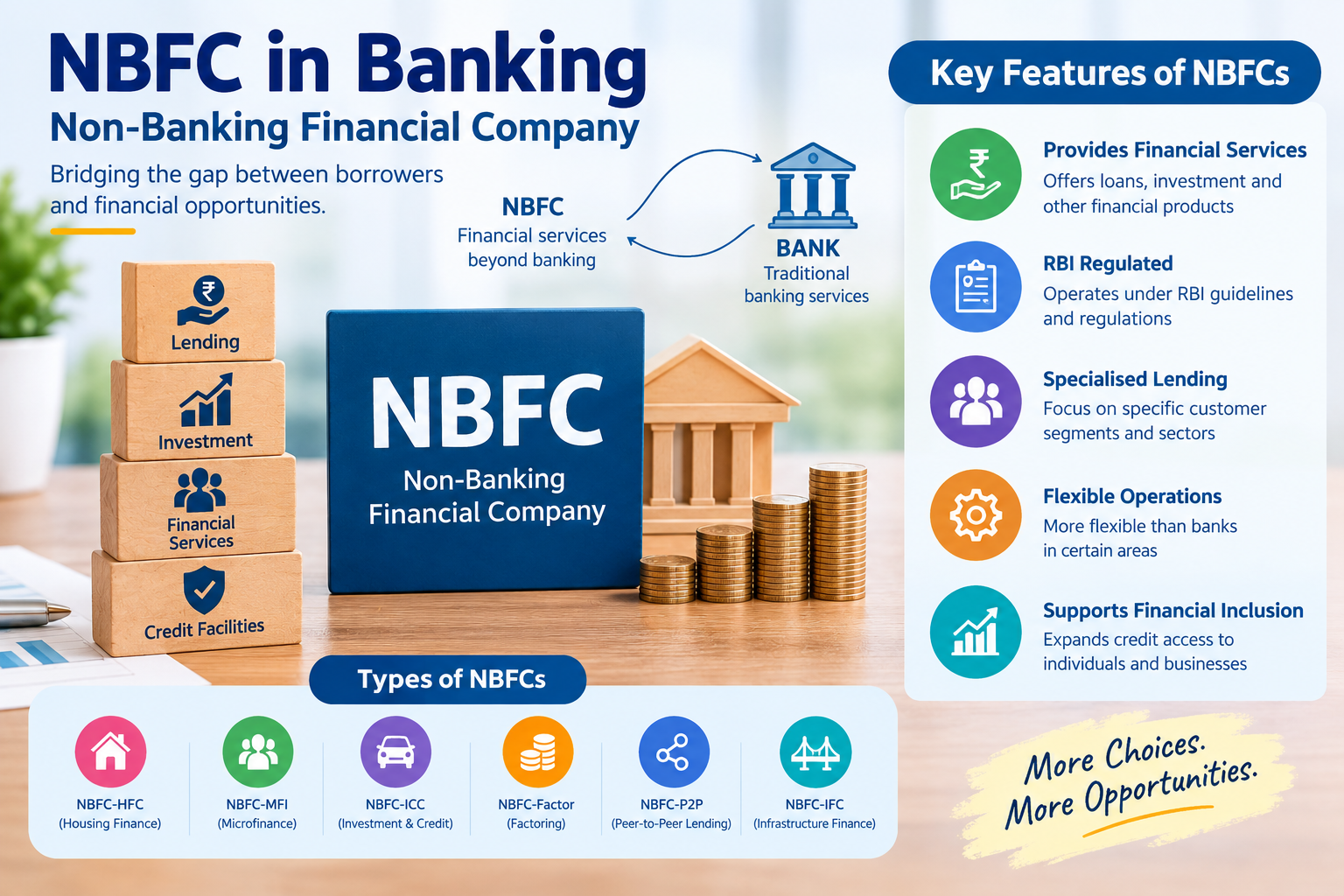
The full form of NBFC is Non-Banking Financial Company. As the name suggests, an NBFC is a financial company that provides certain banking-like financial services without being a bank.
NBFCs can provide services such as lending, financing, investment activities, microfinance, infrastructure finance and other specialised financial services, depending on their regulatory category.
The Reserve Bank of India (RBI) regulates NBFCs under the applicable provisions of law and RBI directions. RBI introduced a Scale Based Regulation (SBR) framework that classifies NBFCs into Base, Middle, Upper and Top Layers based on factors such as size, activity and perceived risk.
NBFCs have become an important source of credit for individuals, businesses, MSMEs and specialised sectors of the economy.
AI Answer Box: What Is an NBFC in Banking?
An NBFC, or Non-Banking Financial Company, is a financial company that provides specified financial services such as lending, investment and other financial activities but is not a bank.
Key points about NBFCs:
- NBFC stands for Non-Banking Financial Company.
- NBFCs provide various financial services.
- Many NBFCs provide loans and credit facilities.
- NBFCs are regulated by RBI according to their applicable regulatory framework.
- Different NBFCs specialise in different activities.
- NBFCs do not have all the rights and functions of banks.
- The regulatory framework uses Base, Middle, Upper and Top Layers.
- NBFCs play an important role in credit availability and financial inclusion.
What Is NBFC in Banking?
An NBFC is a company engaged in specified financial activities such as lending, investment or other financial business, subject to the applicable regulatory framework.
Although NBFCs may offer services that are similar to some banking services, they are not banks.
For example, an NBFC may provide:
- Personal loans
- Vehicle finance
- Business loans
- Consumer finance
- Microfinance
- Housing finance
- Infrastructure finance
- Investment services
- Factoring services
- Peer-to-peer lending platforms
The services available depend on the NBFC's registered category and regulatory permissions.
NBFC Full Form
NBFC stands for Non-Banking Financial Company.
In India, NBFCs form an important part of the broader financial system and operate under regulatory requirements prescribed by the RBI.
How Does an NBFC Work?
The basic working model of an NBFC can be explained in simple steps.
Step 1: Raising Funds
An NBFC obtains funds through permitted sources such as:
- Bank borrowings
- Market borrowings
- Debentures
- Bonds
- Equity capital
- Other permitted sources
The funding structure depends on the type of NBFC and applicable regulations.
Step 2: Providing Financial Services
The NBFC uses its funds for permitted financial activities, such as lending or investment.
Step 3: Earning Income
An NBFC may earn income through:
- Interest on loans
- Fees
- Investment income
- Other permitted financial activities
Step 4: Managing Credit Risk
NBFCs assess borrowers and manage risks associated with lending and investments.
Step 5: Repayment and Recovery
Borrowers repay loans according to agreed schedules. The NBFC manages collections, credit risk and applicable recovery processes.
Key Features of NBFCs
1. Financial Services Without Being a Bank
NBFCs provide financial services but are legally and operationally different from banks.
2. Lending and Credit Facilities
Many NBFCs specialise in providing credit to individuals, businesses and specific sectors.
3. RBI Regulation
NBFCs falling within RBI's regulatory framework are subject to applicable RBI directions and prudential requirements.
4. Specialised Financial Services
Some NBFCs focus on specific activities such as microfinance, infrastructure finance, factoring or peer-to-peer lending.
5. Customer-Focused Lending
Some NBFC business models are designed around specific customer segments and financing requirements.
6. Risk-Based Regulation
RBI's Scale Based Regulation framework applies progressively based on an NBFC's layer, size, activities and risk profile.
7. Digital Financial Services
Many NBFCs use digital platforms for applications, verification, documentation, servicing and loan management.
8. Alternative Source of Credit
NBFCs can provide credit alongside banks and other regulated financial institutions.
Types of NBFCs in India
NBFCs can be classified based on their activities as well as their regulatory layer.
Some important categories include:
NBFC-ICC
Investment and Credit Company is an important NBFC category that carries out investment and/or lending-related activities subject to applicable conditions.
NBFC-MFI
An NBFC-MFI specialises in microfinance activities.
RBI revised the qualifying asset criteria for NBFC-MFIs in June 2025. Under the revised framework, qualifying assets must constitute at least 60% of total assets, netted off by intangible assets, on an ongoing basis.
NBFC-Factor
These NBFCs focus on factoring activities, where eligible receivables are financed or managed under applicable arrangements.
NBFC-P2P
An NBFC-P2P operates a peer-to-peer lending platform within the RBI regulatory framework.
NBFC-AA
An NBFC-AA, or Account Aggregator, facilitates the consent-based sharing of financial information between financial information providers and users through an Account Aggregator framework.
NBFC-IFC
An Infrastructure Finance Company focuses primarily on infrastructure financing.
IDF-NBFC
An Infrastructure Debt Fund-NBFC is a specialised category permitted to refinance eligible infrastructure projects subject to applicable conditions.
NBFC-HFC
Housing Finance Companies are specialised financial companies primarily engaged in housing finance and are regulated by RBI under the applicable framework.
NBFC-CIC
A Core Investment Company primarily holds investments in group companies and is subject to specific regulatory requirements.
NBFC Regulatory Layers
One of the most important developments in NBFC regulation is the Scale Based Regulation framework.
RBI's framework divides NBFCs into four layers:
| Layer | Name | General Description |
|---|---|---|
| Base Layer | NBFC-BL | Lower-risk/smaller NBFCs and specified categories |
| Middle Layer | NBFC-ML | Larger NBFCs and specified categories |
| Upper Layer | NBFC-UL | NBFCs identified for enhanced regulatory requirements |
| Top Layer | NBFC-TL | Intended to remain empty unless systemic risk significantly increases |
The framework is based on factors including size, activity and perceived riskiness.
The top ten eligible NBFCs by asset size are required to be placed in the Upper Layer, irrespective of other factors, under the SBR framework.
NBFC vs Bank
One of the most common questions is whether an NBFC is the same as a bank.
It is not.
| Feature | Bank | NBFC |
|---|---|---|
| Main activity | Banking services | Specified financial activities |
| Deposits | Banks can accept permitted deposits | Deposit-taking is subject to specific RBI permissions and categories |
| Demand deposits | Banks provide demand deposit facilities | NBFCs generally cannot accept demand deposits |
| Cheque facility | Banks provide cheque/demand deposit facilities | NBFCs cannot issue cheques drawn on themselves |
| Payment system role | Banks can participate in payment systems subject to rules | NBFCs do not have all banking payment functions |
| Lending | Yes | Yes, depending on category |
| RBI regulation | Yes | Yes, where RBI-regulated |
| Specialisation | Broad banking services | Often specialised financial services |
The distinction is important because an NBFC should not automatically be treated as equivalent to a bank simply because it provides loans.
Can NBFCs Accept Deposits?
Some NBFCs may be permitted to accept public deposits, but deposit-taking is subject to RBI authorisation and applicable regulatory requirements.
Therefore, consumers should not assume that every NBFC accepts deposits.
The RBI's Scale Based Regulation framework places all deposit-taking NBFCs in the Middle Layer, subject to the applicable regulatory structure.
Do NBFC Deposits Have DICGC Insurance?
A key distinction between bank deposits and NBFC deposits is deposit insurance.
Deposits with NBFCs are not covered by the Deposit Insurance and Credit Guarantee Corporation (DICGC) deposit insurance framework applicable to insured bank deposits.
Therefore, consumers should carefully verify the regulatory status and terms before placing money with any deposit-taking NBFC.
Major Functions of NBFCs
1. Providing Loans
One of the biggest functions of NBFCs is providing credit.
Examples include:
- Personal loans
- Vehicle loans
- Business loans
- Consumer loans
- Equipment finance
- Commercial vehicle finance
2. Supporting MSMEs
NBFCs can provide financing to small and medium-sized businesses that require working capital or asset financing.
3. Consumer Financing
NBFCs may finance purchases such as:
- Electronics
- Two-wheelers
- Cars
- Household products
- Other consumer goods
4. Microfinance
NBFC-MFIs provide microfinance loans under the applicable regulatory framework.
5. Infrastructure Financing
Specialised NBFCs can provide financing to eligible infrastructure projects.
6. Housing Finance
Housing-focused financial institutions provide financing for housing-related requirements.
7. Investment Activities
Certain NBFC categories engage in investment activities subject to applicable regulations.
8. Factoring
NBFC-Factors provide specialised receivables financing services.
Role of NBFCs in the Indian Banking and Financial System
NBFCs complement the banking system by providing additional channels for credit and financial services.
RBI publications describe NBFCs as an integral part of India's financial system and note their importance in credit provision relative to scheduled commercial banks.
Important areas where NBFCs contribute include:
- Retail lending
- MSME financing
- Vehicle finance
- Consumer credit
- Microfinance
- Housing finance
- Infrastructure financing
- Financial inclusion
- Specialised credit
NBFCs and Financial Inclusion
Financial inclusion means increasing access to useful and affordable financial services.
NBFCs can contribute to financial inclusion by providing credit to customers and businesses that may have different financing requirements from those served through traditional banking channels.
Digital technology has also changed how financial services are delivered.
Digital applications can simplify:
- Loan applications
- Document submission
- Customer verification
- Repayment
- Account servicing
- Customer communication
However, customers should always verify that a lender is appropriately regulated or partnered with a regulated entity before borrowing.
Benefits of NBFCs
For Individuals
- Multiple credit options
- Personal finance products
- Vehicle financing
- Consumer financing
- Digital application processes
- Specialised lending products
For Businesses
- Business financing
- Equipment finance
- Working-capital-related products
- MSME-focused lending
- Sector-specific financing
For the Financial System
- Additional credit channels
- Specialised lending
- Competition in financial services
- Wider access to financing
- Support for financial inclusion
Pros and Cons of NBFCs
Pros
- Provide additional sources of credit
- Offer specialised financial products
- Can serve specific customer segments
- Support MSME and consumer financing
- Use digital technology extensively
- Complement traditional banking channels
Cons
- Loan interest rates and fees can vary significantly
- Borrowers must carefully review charges
- Credit assessment may differ between lenders
- Some products may have strict eligibility requirements
- Not all NBFCs offer the same services
- Customers need to verify the lender's regulatory status and terms
NBFC Loan Process: Step-by-Step Guide
If you are considering a loan from an NBFC, the general process may look like this:
Step 1: Check the Lender
Verify the lender's identity and regulatory status.
Step 2: Check Eligibility
Review:
- Age
- Income
- Employment/business status
- Credit history
- Existing obligations
- Other lender-specific criteria
Step 3: Compare Loan Terms
Look at:
- Interest rate
- Annualised cost where applicable
- Processing fee
- Tenure
- EMI
- Prepayment/foreclosure conditions
- Late-payment charges
- Other applicable fees
Step 4: Submit Documents
Documents may include:
- Identity proof
- Address proof
- Income documents
- Bank statements
- Business documents, where applicable
Step 5: Credit Assessment
The lender evaluates the application and supporting information.
Step 6: Approval and Agreement
If approved, the borrower receives the applicable loan terms and agreement.
Step 7: Disbursement
After completion of required formalities, the loan amount is disbursed according to the agreement.
Step 8: Repayment
The borrower makes repayments according to the agreed schedule.
How to Check Whether an NBFC Is Genuine
Before taking a loan, customers should verify the lender carefully.
Check these points:
- Is the lender an RBI-regulated NBFC?
- Is the company name clearly disclosed?
- Are interest rates and charges explained?
- Is there a proper loan agreement?
- Are customer grievance details available?
- Are repayment instructions clear?
- Does the lender ask for unnecessary payments before processing?
- Is the loan being offered through an authorised digital channel?
RBI maintains information on regulated entities and publishes regulatory directions and updates through its official website.
NBFC and Digital Lending
Digital lending has become an important part of the modern financial ecosystem.
NBFCs may use technology for:
- Online applications
- Automated credit assessment
- Digital KYC processes
- Electronic documentation
- Digital loan servicing
- Online repayments
- Customer support
However, digital convenience should not replace due diligence.
Borrowers should check the actual regulated lender behind a digital lending platform, read the loan agreement and understand all charges before accepting credit.
RBI Regulation of NBFCs
The RBI has progressively strengthened the regulatory framework for NBFCs.
The Scale Based Regulation framework introduced four regulatory layers based on the size, activity and perceived riskiness of NBFCs.
The Upper Layer receives enhanced regulatory requirements. RBI also publishes lists of NBFCs identified in the Upper Layer. For 2024-25, RBI published an Upper Layer list in January 2025.
RBI has continued to update NBFC regulations in 2025 and 2026, including changes relating to specific NBFC activities and regulatory requirements.
Expert Commentary: Why NBFCs Matter in Banking
NBFCs should be viewed as an important part of the broader financial ecosystem rather than simply as alternatives to banks.
Their major contribution is specialisation.
For example, one NBFC may focus heavily on vehicle financing, another on housing finance, another on microfinance and another on infrastructure lending.
This specialisation allows different financial institutions to serve different segments of borrowers.
At the same time, NBFCs operate with credit, liquidity, operational and other risks. This is why RBI's regulatory framework applies different requirements depending on the size, activities and risk profile of an NBFC.
Real-World Example of an NBFC
Suppose a small business needs ₹8 lakh to purchase equipment.
The business may approach:
- A commercial bank
- An NBFC
- Another eligible regulated financial institution
The NBFC may assess the business based on its income, cash flows, credit history, collateral and other applicable criteria.
If approved, the NBFC provides financing according to the loan agreement.
The business then repays the loan through scheduled instalments.
This example demonstrates how NBFCs can provide an additional channel for business credit.
NBFC vs Bank: Quick Comparison
| Question | Bank | NBFC |
|---|---|---|
| Provides loans? | Yes | Yes |
| Accepts demand deposits? | Yes, subject to banking regulations | No |
| Can issue cheques drawn on itself? | Yes | No |
| Provides specialised lending? | Yes | Often a major focus |
| Regulated by RBI? | Yes | Yes, for RBI-regulated NBFCs |
| Deposit insurance through DICGC? | Eligible bank deposits may be insured within applicable limits | NBFC deposits are not covered under DICGC deposit insurance |
| Digital lending? | Yes | Yes |
| Financial inclusion role? | Yes | Yes |
Important RBI Regulatory Update
The RBI's current regulatory framework is not static.
For example, RBI issued a June 2025 amendment revising the qualifying asset requirement for NBFC-MFIs. Under the revised requirement, qualifying assets must constitute a minimum of 60% of total assets, net of intangible assets, on an ongoing basis.
This illustrates why readers should verify current RBI directions when writing about specific NBFC categories.
Common Mistakes Borrowers Should Avoid
1. Assuming Every NBFC Is a Bank
NBFCs and banks have important legal and operational differences.
2. Looking Only at the Interest Rate
Always examine the total cost of borrowing.
3. Ignoring Processing Fees
Fees can increase the overall cost of a loan.
4. Not Reading the Loan Agreement
The agreement contains important repayment conditions.
5. Ignoring Late-Payment Charges
Understand what happens if an EMI is delayed.
6. Using Unverified Loan Apps
Always identify the regulated lender behind a digital lending service.
7. Sharing Sensitive Information Carelessly
Use official and secure channels when submitting financial documents.
Frequently Asked Questions
1. What is NBFC in banking?
NBFC means Non-Banking Financial Company. It is a company that conducts specified financial activities such as lending and investment but is not a bank.
2. What is the full form of NBFC?
NBFC stands for Non-Banking Financial Company.
3. Is NBFC a bank?
No. An NBFC is a financial company but does not have all the functions and permissions of a bank.
4. What are the main functions of NBFCs?
Major functions include lending, consumer finance, vehicle finance, business finance, microfinance, investment and other specialised financial activities.
5. Are NBFCs regulated by RBI?
Yes. RBI regulates NBFCs that fall under its regulatory framework and issues directions applicable to different categories and regulatory layers.
6. Can NBFCs provide personal loans?
Yes, eligible NBFCs can provide personal loans subject to their regulatory permissions, credit policies and borrower eligibility.
7. Can NBFCs accept deposits?
Certain NBFCs may accept public deposits if permitted by RBI and subject to applicable requirements. Not every NBFC can accept deposits.
8. What is the difference between NBFC and bank?
Banks provide full banking services within the banking regulatory framework, while NBFCs provide specified financial services and do not have all banking powers.
9. What are the four layers of NBFC regulation?
The four layers are Base Layer, Middle Layer, Upper Layer and Top Layer.
10. What is NBFC-MFI?
NBFC-MFI is an NBFC category specialising in microfinance activities and subject to specific RBI requirements.
11. What is NBFC-ICC?
NBFC-ICC stands for Investment and Credit Company. It is a category covering specified investment and lending activities.
12. What is NBFC-P2P?
NBFC-P2P is a Non-Banking Financial Company that operates a peer-to-peer lending platform under RBI's regulatory framework.
13. Are NBFC loans safe?
The safety and suitability of a loan depend on the regulated lender, product terms, borrower circumstances and applicable protections. Borrowers should verify the lender and carefully review the loan agreement.
14. Do NBFCs affect the banking system?
Yes. NBFCs are an important part of India's financial system and contribute to credit provision alongside banks and other financial institutions.
15. How can I verify an NBFC?
Check the RBI's official information on regulated entities and verify the lender's legal name, regulatory status and official communication channels.
Summary Table: NBFC at a Glance
| Topic | Key Information |
|---|---|
| Full Form | Non-Banking Financial Company |
| Main Role | Providing specified financial services |
| Regulator | Reserve Bank of India for RBI-regulated NBFCs |
| Major Activity | Lending and other financial activities |
| Examples | NBFC-ICC, NBFC-MFI, NBFC-Factor, NBFC-P2P |
| Regulatory Layers | Base, Middle, Upper and Top |
| Customers | Individuals, businesses and specialised sectors |
| Digital Services | Online applications and loan servicing may be offered |
| Banking Status | Not a bank |
| Deposit Insurance | NBFC deposits are not covered by DICGC deposit insurance |
| Major Contribution | Credit availability and specialised financial services |
Key Takeaways
- NBFC stands for Non-Banking Financial Company.
- NBFCs provide specified financial services but are not banks.
- Lending is one of the major activities of many NBFCs.
- NBFCs can specialise in areas such as consumer finance, vehicle finance, microfinance and infrastructure finance.
- RBI regulates NBFCs under an evolving regulatory framework.
- RBI's Scale Based Regulation has four layers: Base, Middle, Upper and Top.
- NBFCs can complement banks by providing additional credit channels.
- Not every NBFC can accept deposits.
- NBFC deposits do not have DICGC deposit insurance.
- Borrowers should verify the lender, compare total loan costs and read the loan agreement carefully.
- RBI's official website should be used to verify current regulatory information.
Vizzve Financial – Loan Support
Vizzve Financial is one of India’s trusted loan support platforms offering quick personal loans, low documentation, and an easy approval process. Apply at www.vizzve.com.
Before applying for any loan, borrowers should independently check eligibility, interest rates, fees, repayment obligations and other applicable terms.
Conclusion
NBFCs have become an important component of India's financial ecosystem. They provide lending and specialised financial services to individuals, businesses and different economic sectors.
While NBFCs share some similarities with banks, they are not banks and do not have all banking powers. Their activities, permissions and regulatory obligations depend on their specific category and regulatory layer.
For consumers, understanding the difference between an NBFC and a bank is particularly important when choosing a loan or considering financial products.
The RBI's Scale Based Regulation framework has strengthened the regulatory structure by applying requirements according to the size, activity and risk profile of NBFCs.
As India's financial sector continues to become more digital, NBFCs are likely to remain an important channel for credit and specialised financial services.
Published on : 26th september
Published by : Bhargavi
www.vizzve.com || www.vizzveservices.com
Follow us on social media: Facebook || Linkedin || Instagram
🛡 Powered by Vizzve Financial
RBI-Registered Loan Partner | 10 Lakh+ Customers | ₹600 Cr+ Disbursed