

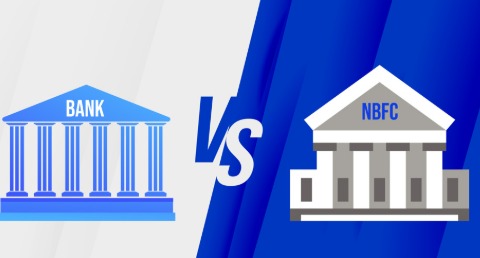
Banks are regulated by the Reserve Bank of India (RBI) and offer a wide range of credit services — from MSME loans to working capital lines. They follow strict compliance norms and focus on borrowers with strong credit profiles.
What are NBFCs?
NBFCs, also regulated by the RBI, are more flexible financial institutions that provide loans without traditional banking infrastructure. They focus on faster disbursals, lenient eligibility, and minimal paperwork — ideal for small and medium businesses.
2. Key Comparison: Banks vs NBFCs
| Criteria | Banks | NBFCs |
|---|---|---|
| Interest Rates | Lower (8%–14%) | Slightly higher (10%–18%) |
| Processing Time | Longer (7–15 days) | Faster (24–72 hours) |
| Documentation | Extensive (ITR, GST, financials) | Minimal (KYC, bank statements) |
| Credit Score Requirement | Strict (700+) | Flexible (650 and above accepted) |
| Loan Amount Range | Up to ₹5 crore or more | ₹50,000 – ₹2 crore typical |
| Collateral Requirement | Often required | Many offer unsecured options |
| Customer Support | Formal, branch-based | Digital-first, app-based |
3. Why NBFCs Are Gaining Popularity in 2025
Faster approvals: Digital processing and AI-based underwriting enable same-day loan disbursals.
Custom loan products: Tailored for startups, freelancers, and micro-entrepreneurs.
Flexible repayment: Options like daily EMIs or revenue-linked repayments.
Less emphasis on paperwork: Great for small businesses without formal financial statements.
With India’s digital credit market projected to cross ₹10 lakh crore by 2026, NBFCs are becoming a key driver of MSME financing.
4. Why Banks Still Have an Edge
Lower interest rates: Ideal for businesses with strong credit and collateral.
Longer repayment tenure: Some banks offer loans up to 10 years.
Bundled services: Access to overdraft, current accounts, and trade finance under one umbrella.
Stronger regulatory oversight: Ensures stability and borrower protection.
For established small businesses, traditional banks remain a reliable, low-cost option.
5. Which Option Should You Choose in 2025?
Your choice depends on business profile, urgency, and credit health:
✅ Choose NBFCs if:
You need quick funds for working capital or inventory.
You lack long credit history or collateral.
You prefer paperless, digital processing.
✅ Choose Banks if:
You have an existing banking relationship and good financials.
You can wait for processing time.
You want a large, long-term loan at a lower rate.
👉 Pro Tip: Many businesses use a hybrid approach — getting short-term credit from NBFCs and long-term loans from banks.
6. The Future: Collaboration, Not Competition
In 2025, the lines between banks and NBFCs are blurring.
Co-lending partnerships allow both to share risk and reach more borrowers.
The RBI’s new digital lending guidelines are making the ecosystem safer and more transparent.
This means small businesses can look forward to faster, smarter, and fairer loans than ever before.
FAQs: Small Business Loans in 2025
1. Can I get a business loan without collateral?
Yes. Many NBFCs and fintech lenders offer unsecured business loans up to ₹50 lakh.
2. Which offers faster approval — banks or NBFCs?
NBFCs, especially digital ones, usually approve and disburse loans within 1–3 days.
3. Are NBFC loans safe?
Yes, as long as you borrow from RBI-registered NBFCs or regulated fintech partners.
4. Do banks offer special MSME loan schemes?
Yes. Look for schemes under CGTMSE, Mudra, and SIDBI that support small enterprises.
5. Will my credit score affect eligibility?
Yes. Both banks and NBFCs check credit reports, but NBFCs are generally more lenient with lower scores.
Published on : 8th October
Published by : SMITA
www.vizzve.com || www.vizzveservices.com
Follow us on social media: Facebook || Linkedin || Instagram
🛡 Powered by Vizzve Financial
RBI-Registered Loan Partner | 10 Lakh+ Customers | ₹600 Cr+ Disbursed
https://play.google.com/store/apps/details?id=com.vizzve_micro_seva&pcampaignid=web_share