

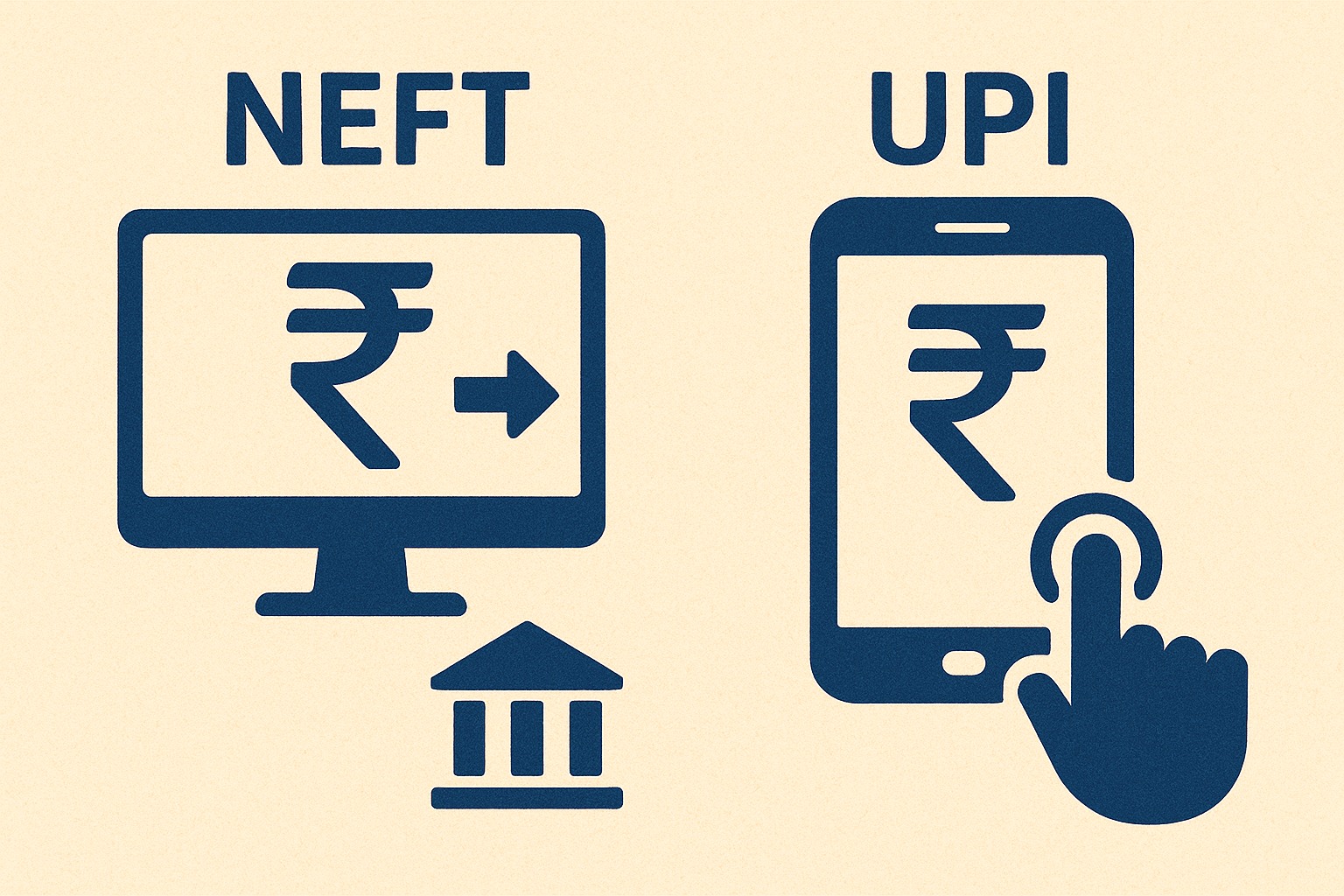
Digital payments have revolutionized the way we transfer money. Two popular options in India are NEFT (National Electronic Funds Transfer) and UPI (Unified Payments Interface). But which one is better for everyday transactions? Let’s break it down.
What is NEFT?
NEFT is a bank-to-bank electronic fund transfer system where money moves from one bank account to another via the central bank’s settlement system.
Key Features:
Transfers occur in batches throughout the day.
Can be used for any amount, subject to bank limits.
Typically takes 30 minutes to a few hours, depending on the bank.
Charges may apply for transactions above certain limits.
What is UPI?
UPI is a real-time payment system that allows users to transfer money instantly between bank accounts using a mobile app.
Key Features:
Money transfers are instant and available 24/7.
Transfers can be made using mobile numbers, VPA (Virtual Payment Address), or QR codes.
Usually no transaction fees for most payments.
Can be linked to multiple bank accounts for flexibility.
NEFT vs UPI: Head-to-Head Comparison
| Feature | NEFT | UPI |
|---|---|---|
| Speed | Batch-based, may take hours | Instant, real-time |
| Availability | Limited to bank working hours | 24/7, including holidays |
| Transaction Limit | Depends on bank, can be high | Usually capped per app or RBI limit |
| Ease of Use | Requires bank account & IFSC code | Very simple via mobile app |
| Charges | May apply for large amounts | Usually free |
| Best For | Large fund transfers | Daily, quick transactions |
Which is Better for Daily Use?
For daily transactions, UPI clearly has the edge:
Instant transfers allow payments for groceries, bills, or splitting costs with friends.
No bank visit or IFSC codes required.
Works even for small amounts, making it ideal for routine expenses.
NEFT, on the other hand, is better suited for large, scheduled payments such as rent, school fees, or corporate transactions. It provides a safe, formal bank-to-bank transfer but is slower and less convenient for frequent small payments.
Tips for Using Both Efficiently
UPI for everyday use – groceries, small bill payments, peer-to-peer transfers.
NEFT for high-value payments – rent, property transactions, large invoices.
Check bank limits – both NEFT and UPI have limits per transaction or per day.
Security – Always verify recipient details before transferring money.
Final Thoughts
Both NEFT and UPI have their place in modern banking. UPI is best for convenience and instant small payments, while NEFT remains reliable for large, formal transfers. Understanding their strengths helps you choose the right method for each transaction, making your digital payments faster, safer, and more efficient.
FAQs
Q1. Can I use UPI for large payments?
Yes, but most UPI apps and banks have daily or per-transaction limits. For very large transfers, NEFT is recommended.
Q2. Is NEFT safer than UPI?
Both are secure, but NEFT has the bank’s settlement mechanism and is suitable for large amounts. UPI is also safe if you follow proper authentication practices.
Q3. Can NEFT be done on holidays?
Most banks have started providing 24x7 NEFT, but historically, NEFT was limited to working hours.
Q4. Are there charges for UPI transactions?
Most UPI apps offer free transactions for normal users; charges may apply for business or merchant payments.
Q5. Do I need a smartphone to use NEFT?
No, NEFT can be initiated via bank branches, net banking, or mobile banking. UPI requires a smartphone with an app.
Published on : 7th November
Published by : SMITA
www.vizzve.com || www.vizzveservices.com
Follow us on social media: Facebook || Linkedin || Instagram
🛡 Powered by Vizzve Financial
RBI-Registered Loan Partner | 10 Lakh+ Customers | ₹600 Cr+ Disbursed