

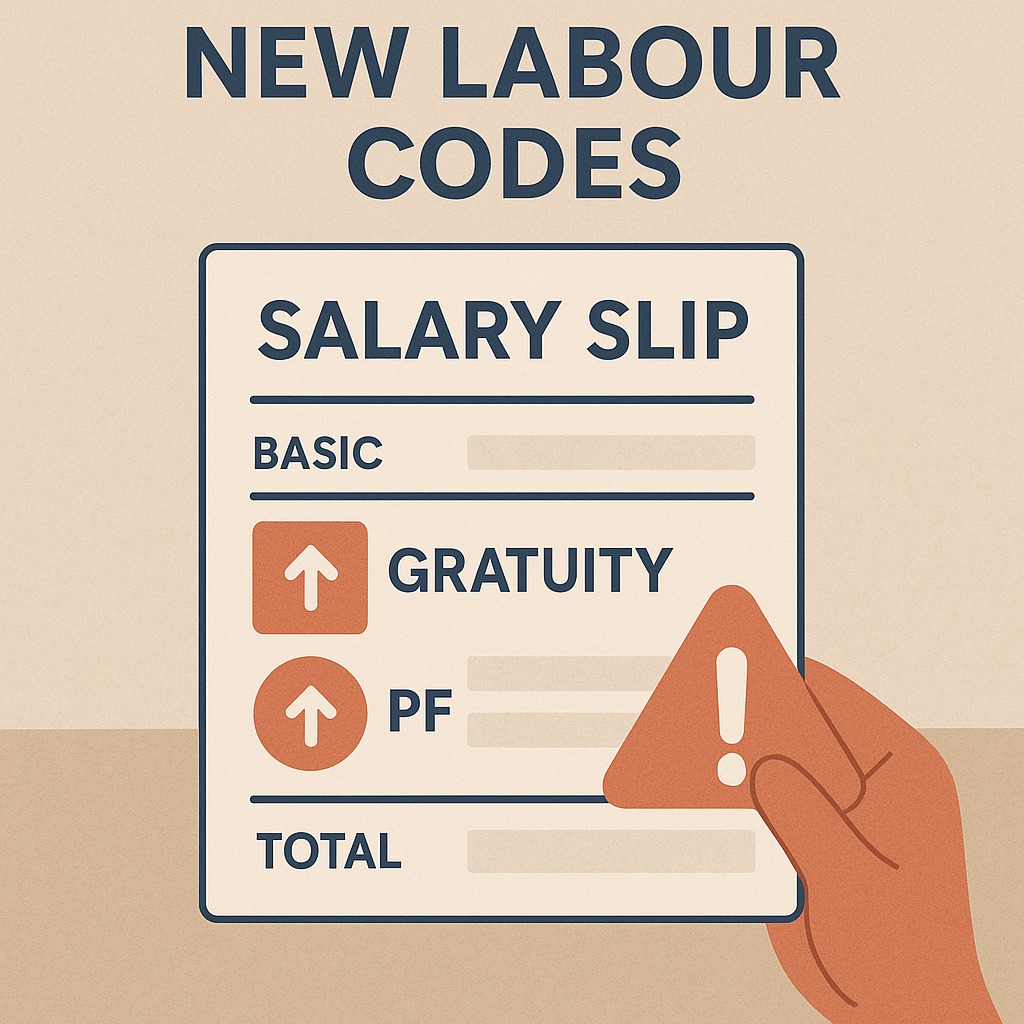
India’s new labour codes — the Wage Code, Social Security Code, Industrial Relations Code, and Occupational Safety Code — are designed to modernise the country’s labour ecosystem.
Among the many changes they bring, two key employee benefits are being significantly impacted:
➡ Gratuity
➡ Provident Fund (PF)
Both these changes influence your take-home salary, retirement corpus, long-term savings, and even job mobility.
Here’s a simple, clear breakdown of how the new rules affect you.
1. The ‘Wage Definition’ Is Changing Everything
The cornerstone of the new labour codes is the revised definition of wages, which mandates that:
Basic Salary = Minimum 50% of Total CTC
This has a direct impact on gratuity, PF contributions, overtime, and leave encashment.
Currently, many companies keep basic pay at 25–35% of CTC and inflate allowances.
Under the new rules, employers cannot reduce basic wages below 50% by increasing allowances.
This will:
✔ Increase retirement benefits
✔ Decrease take-home salary
✔ Create uniformity across industries
2. Impact on Provident Fund (PF)
Your PF contributions are based on Basic Salary + Dearness Allowance (DA).
With higher basic pay under the new codes:
✔ PF Employee Contribution Increases (12%)
More money gets deducted from your salary.
✔ PF Employer Contribution Also Increases (12%)
Your long-term savings grow faster.
✔ Your Take-Home Salary Reduces Slightly
Because PF deductions rise.
✔ Your Retirement Corpus Becomes Larger
You benefit significantly over time due to compounding.
Example: PF Impact (Simplified)
Let’s say your current CTC is ₹6,00,000.
Before new labour codes:
Basic Salary = ₹1,80,000 (30% of CTC)
PF Employee Contribution = 12% of ₹1,80,000 = ₹21,600/year
After new labour codes:
Basic Salary = Minimum ₹3,00,000 (50% of CTC)
PF Employee Contribution = 12% of ₹3,00,000 = ₹36,000/year
➝ PF increases by ₹14,400/year
➝ But take-home reduces by the same amount
➝ Retirement savings grow substantially
3. Impact on Gratuity Rules
The new labour codes expand gratuity access and make it more employee-friendly.
✔ 1. Faster Gratuity Eligibility for Contractual/Fixed-Term Workers
They can earn gratuity without completing 5 years, if they finish 1 year of service.
A big win for gig workers, start-up employees, and project-based roles.
✔ 2. Higher Gratuity Amounts for Full-Time Employees
Because gratuity is calculated as:
Gratuity = 15 days’ basic salary × years of service
And Basic Salary is now higher → Gratuity payout increases significantly.
✔ 3. Better Protection for Gig & Platform Workers
Gig workers, delivery partners, and freelancers may be included under the Social Security Fund in the future.
✔ 4. Gratuity Rules Uniform Across Companies
Companies can no longer manipulate salary structures to reduce gratuity liabilities.
4. Impact on Take-Home Salary
Here’s the part employees care about the most:
✔ Take-home salary may reduce
Because PF and gratuity-linked components are rising.
✔ Overall CTC remains the same
But more goes toward long-term savings.
✔ Employers cannot reduce allowances to bypass rules
A more transparent salary structure is expected.
5. Who Benefits the Most?
✔ Mid-level and senior employees
Higher basic pay → Higher PF → Strong retirement corpus.
✔ Younger employees
Compounding over 20–30 years leads to massive PF growth.
✔ Contractual and fixed-term workers
Early gratuity entitlement protects them better.
✔ Gig workers (future rollout)
Will receive social security for the first time.
6. Who Might See a Drawback?
❌ Employees looking for higher take-home salary
Deductions increase.
❌ Companies with large workforce
Higher PF and gratuity liabilities.
❌ Workers who frequently switch jobs
Longer PF lock-in and higher deductions may feel restrictive.
7. PF & Gratuity After the New Codes: Quick Comparison
| Feature | Old System | New Labour Codes |
|---|---|---|
| Basic Wage % | 25–35% | Minimum 50% |
| PF Contribution | Lower | Higher |
| Take-Home Salary | Higher | Lower |
| Gratuity Eligibility | 5 years | 1 year for FTEs |
| Gig Worker Coverage | No | Yes (planned) |
| Retirement Corpus | Moderate | Much Higher |
Conclusion
The new labour codes are designed to shift India toward stronger retirement benefits rather than short-term salary gains.
In short:
Take-home salary decreases slightly
PF and gratuity increase significantly
Long-term financial security improves
For employees, especially younger professionals, these reforms can create a much larger retirement fund and better social security in the long run.
❓ FAQs
1. Will my take-home salary decrease under new labour codes?
Yes, because PF and gratuity-linked contributions will rise.
2. Do I get more PF under the new rules?
Yes, since PF is calculated on higher basic salary.
3. Can fixed-term employees now get gratuity?
Yes, after completing 1 year, they become eligible.
4. Does the new code benefit gig workers?
Yes, they will be included under Social Security schemes.
5. When will the new labour codes be fully implemented?
Implementation will begin once states notify aligned rules.
Published on : 24th November
Published by : SMITA
www.vizzve.com || www.vizzveservices.com
Follow us on social media: Facebook || Linkedin || Instagram
🛡 Powered by Vizzve Financial
RBI-Registered Loan Partner | 10 Lakh+ Customers | ₹600 Cr+ Disbursed
Source Credit : MINT