

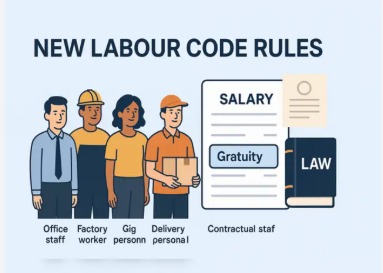
The government’s new labour codes have introduced a uniform definition of “wages”, bringing significant changes to how employers structure salaries and how employees receive benefits like PF, pension, leave encashment, and gratuity.
Under the new rules, basic pay must be at least 50% of the total CTC, and several allowances are now restricted—directly impacting take-home salary and long-term retirement benefits.
Here’s a simple breakdown of the new definition and what it means for employees.
What the New Labour Codes Say About ‘Wages’
Under the new codes, “Wages” include:
Basic Salary
Dearness Allowance (DA)
Retaining Allowance
Allowances cannot exceed 50% of total salary.
If allowances exceed this limit, the extra amount must be added back to “wages”.
This is the biggest change affecting salary structuring in India.
🔹 Impact on Basic Salary
Since basic salary must form at least 50% of the total cost-to-company (CTC):
Many employees will see an increase in basic pay
Allowances such as conveyance, HRA, and special allowance may reduce
Employers can no longer keep a low basic salary to minimise PF or gratuity outflow
This may reduce the take-home salary in many cases.
🔹 Impact on PF Contributions
PF is calculated as:
12% of Basic + DA
With basic pay rising to 50% of CTC:
Employee PF contribution increases
Employer PF contribution increases
Monthly take-home salary may decrease
Long-term PF balance will grow faster
This is good for retirement savings but may reduce monthly disposable income.
🔹 Impact on Pension
Since pension (EPS) also depends on basic wages:
Higher basic pay → higher pensionable salary
This improves retirement pension benefits over time
Long-serving employees stand to gain more
🔹 Impact on Gratuity
Gratuity is calculated as:
15 days’ wages × years of service
With a higher basic salary becoming mandatory, gratuity amounts will increase.
This impacts:
Full-time employees
Fixed-term employees, who will now earn gratuity proportionally
Retirees, who will receive higher payouts
🔹 Impact on Leave Encashment
Leave encashment is based on last drawn basic salary.
With basic salary higher, leave encashment amounts will rise.
What It Means for Employees
✔ Higher retirement benefits
PF, pension, and gratuity will see a long-term boost.
✔ Lower take-home salary
Higher PF contributions reduce monthly in-hand pay.
✔ More transparent salary structure
The uniform definition prevents companies from manipulating allowances.
What It Means for Employers
Higher PF outflows
Higher gratuity liabilities
Need to restructure salary components
Higher long-term HR costs
FAQs
1. Why is basic salary increasing under new labour codes?
Because the new definition says basic + DA must be at least 50% of the total salary.
2. Will my take-home salary decrease?
Yes, if PF contributions increase due to a higher basic salary.
3. Will gratuity increase under the new rules?
Yes, because gratuity is based on basic wages.
4. Will pension benefits improve?
Yes, higher basic pay leads to higher pensionable salary.
5. When will the labour codes be fully implemented?
They are expected to roll out in phases based on state notifications.
Published on : 27th November
Published by : SMITA
www.vizzve.com || www.vizzveservices.com
Follow us on social media: Facebook || Linkedin || Instagram
🛡 Powered by Vizzve Financial
RBI-Registered Loan Partner | 10 Lakh+ Customers | ₹600 Cr+ Disbursed
Source Credit: Content inspired by MINT