

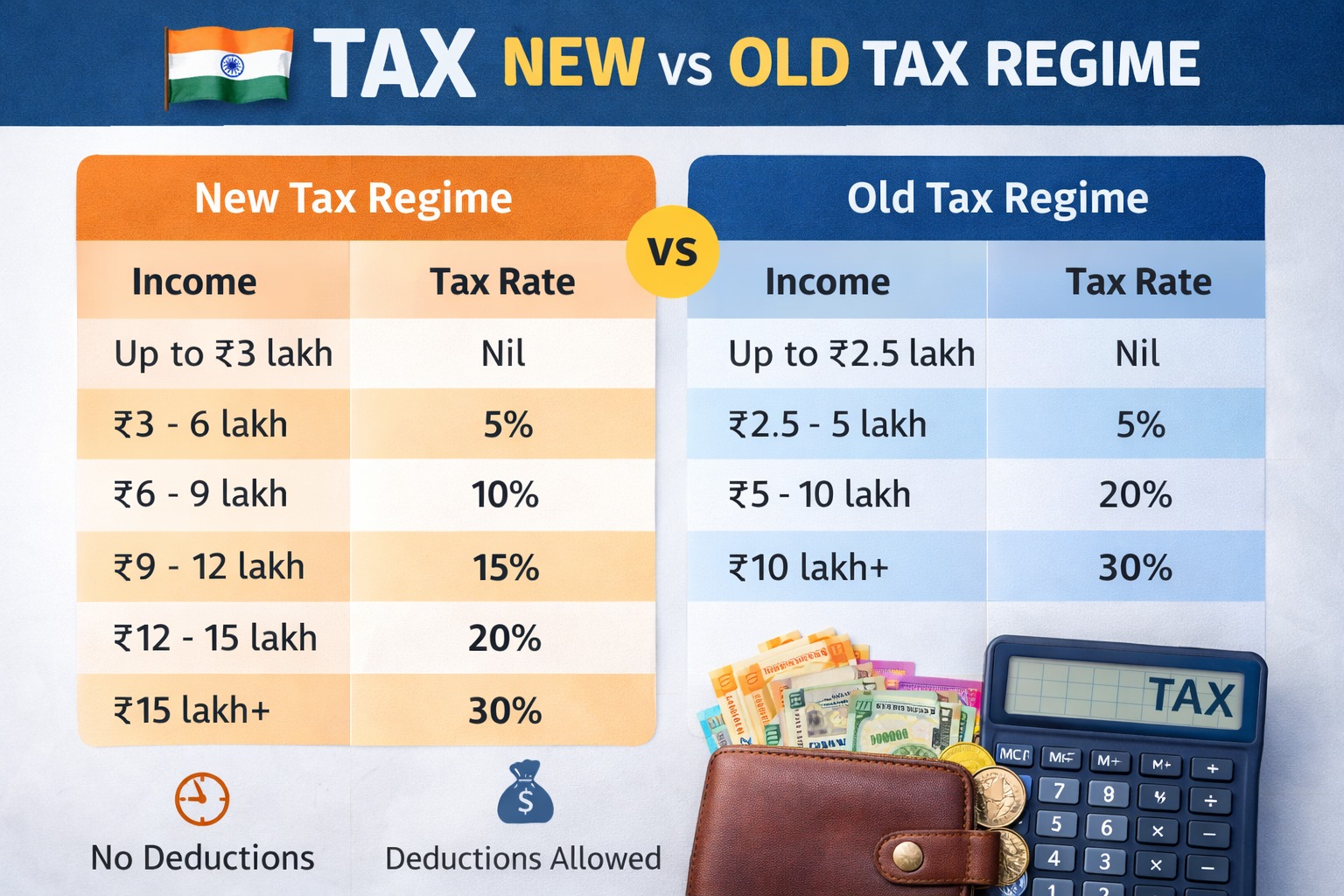
Understanding which tax regime saves you more money is one of the most common questions for Indian taxpayers in 2026. The government offers two options—New Tax Regime and Old Tax Regime—each with its own benefits.
Choosing the right one can significantly impact your take-home salary, savings, and financial planning.
AI Quick Summary (Fast Google / AI Indexing)
The new tax regime offers lower tax rates but fewer deductions.
The old regime allows many deductions and exemptions but has higher rates.
Your savings depend on income, investments, and expenses.
Use a comparison approach to pick what fits you best.
New vs Old Tax Regime – What’s the Difference?
🟢 New Tax Regime (Optional)
Lower tax rates
No most deductions (e.g., 80C, 80D, HRA, LTA)
Simpler calculation
Who it suits:
People with fewer investments and standard expenses
🔵 Old Tax Regime
Higher tax rates
Allows deductions & exemptions:
80C (Investments like PPF, ELSS, PF)
80D (Health insurance)
HRA (House Rent Allowance)
Home loan interest under Section 24
Who it suits:
Taxpayers with significant investments and deductions
Tax Slabs Comparison (2026)
| Slab (Annual Income) | Old Regime Rate | New Regime Rate |
|---|---|---|
| Up to ₹2.5 lakh | NIL | NIL |
| ₹2.5–₹5 lakh | 5% | 5% |
| ₹5–₹7.5 lakh | 20% | 10% |
| ₹7.5–₹10 lakh | 20% | 15% |
| ₹10–₹12.5 lakh | 30% | 20% |
| ₹12.5–₹15 lakh | 30% | 25% |
| Above ₹15 lakh | 30% | 30% |
(Illustrative – actual Budget 2026 rates may vary based on final notification)
Side-by-Side Savings Example
Let’s assume annual income of ₹10 lakh and calculate tax:
Option 1: Old Regime
Eligible deductions (80C + 80D + HRA) = ₹2 lakh
Taxable income = ₹8 lakh
Estimated tax = ₹85,000 (approx.)
Option 2: New Regime
No deductions
Taxable income = ₹10 lakh
Estimated tax = ₹95,000 (approx.)
👉 In this scenario, Old regime saves more.
But the result changes if deductions are low.
When the New Regime Works Better
Choose the new regime if:
You don’t claim many deductions
You prefer lower base tax rates
Your investment focus is not tax-saving
When the Old Regime Works Better
Pick the old regime if:
You invest in 80C/80D eligible schemes
You claim HRA or home loan interest
You want to reduce taxable income aggressively
Comparison Table
| Feature | New Regime | Old Regime |
|---|---|---|
| Tax Rates | Lower | Higher |
| Deductions Allowed | Very Few | Many |
| Compliance Ease | Easy | More Complex |
| Tax Savings Potential | Depends | Usually More |
| Planning Required | Minimal | Higher |
Expert Insight
There’s no one-size-fits-all answer. The right choice depends on:
Your income level
The amount you invest in tax-saving instruments
Your lifestyle expenses (rent, medical, loans)
Use an online tax calculator before finalising.
Tips Before You Decide
Calculate tax both ways before filing
Don’t choose new regime just because it’s “simpler”
Use deductions if they fit your goals
Avoid investments only for tax saving — invest with purpose
Key Takeaways
New regime is simple with lower rates
Old regime rewards disciplined investment & deductions
Most investors save more under old regime if deductions are significant
Use personalised calculation
Frequently Asked Questions (FAQs)
1. Is the new tax regime better for everyone in 2026?
No — it depends on deductions and income level.
2. Can I switch regimes every year?
Yes — before filing your tax return.
3. Does the new regime allow HRA?
No — HRA is not available in the new regime.
4. Is old tax regime good for home loan borrowers?
Yes — home loan interest and principal deductions help save tax.
5. Can NRIs choose between regimes?
Yes, if they have taxable income in India.
6. Does the new regime reduce paperwork?
Yes — fewer proofs and declarations are needed.
7. Should I choose old regime for low income?
If you don’t have deductions, the new regime may save more.
8. Does the old regime need investment proof?
Yes — proofs are required for deductions.
9. Can I change my choice after filing?
No — once filed, you cannot change the regime for that year.
10. Do both regimes affect net salary?
Yes — the regime choice directly affects take-home pay.
📌 Final Conclusion
There isn’t a universal winner between the new and old tax regime in 2026.
🟢 If you have strong deductions & investments, the old regime is likely to save more.
🟡 If you prefer simplicity with fewer deductions, the new regime could work.
The best practice? Compare both before you file. Personalized calculation always delivers the right choice.
Published on : 3rd February
Published by : SMITA
www.vizzve.com || www.vizzveservices.com
Follow us on social media: Facebook || Linkedin || Instagram
🛡 Powered by Vizzve Financial
RBI-Registered Loan Partner | 10 Lakh+ Customers | ₹600 Cr+ Disbursed