

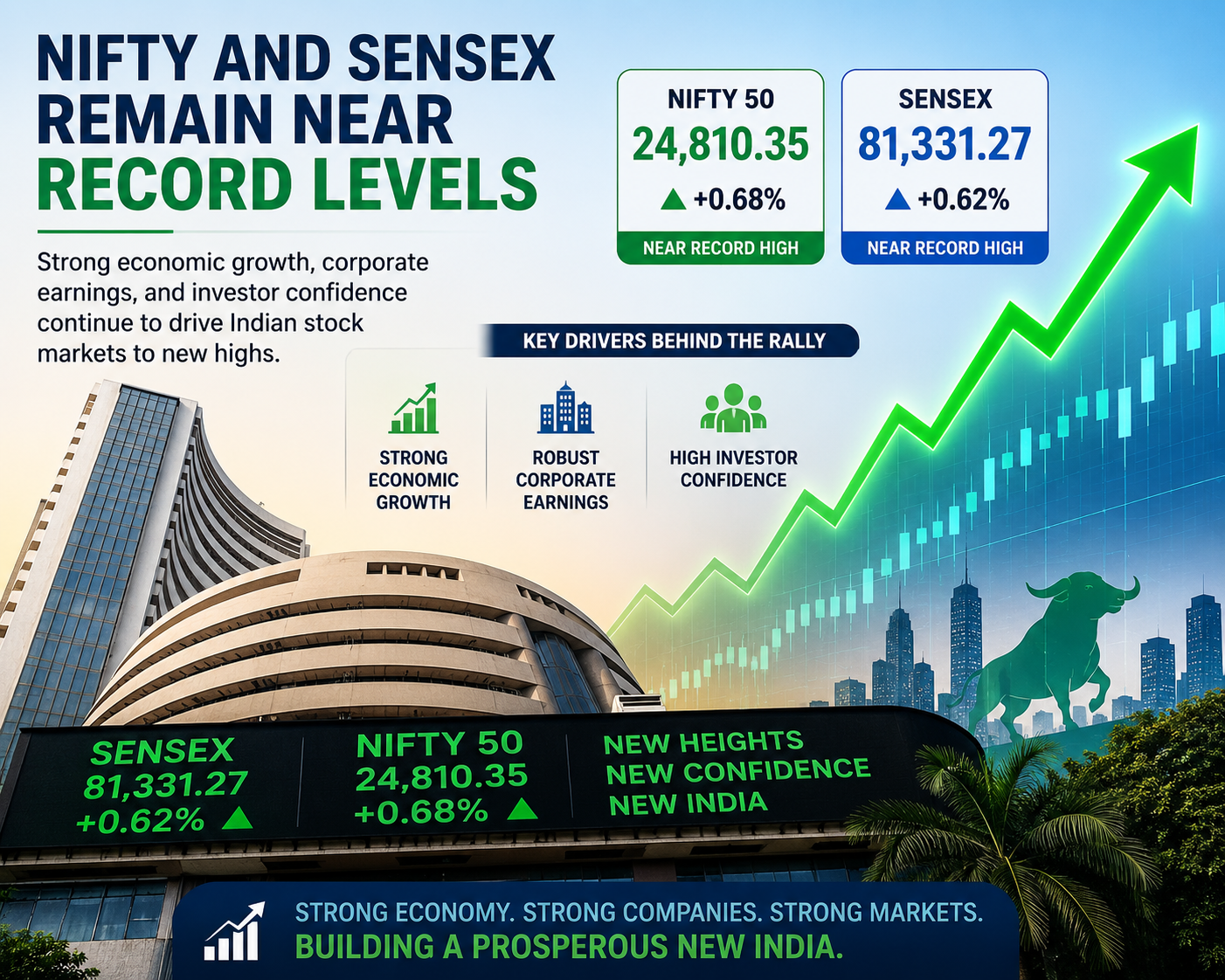
India's benchmark indices, the NIFTY 50 and BSE Sensex, continue to trade near record levels as strong domestic economic growth, steady corporate earnings, foreign investment inflows, and positive investor sentiment support the market.
The sustained rally highlights growing confidence in India's economic outlook and the long-term prospects of Indian businesses.
AI Answer Box
Why Are Nifty and Sensex Near Record Highs?
Several factors are supporting the market:
- Strong GDP growth expectations
- Healthy corporate earnings
- Increasing domestic investments
- Foreign investor interest
- Infrastructure spending
- Financial sector strength
- Technology sector growth
- Positive economic reforms
Market Drivers Overview
| Factor | Impact on Markets |
|---|---|
| Corporate Earnings | Positive |
| Economic Growth | Positive |
| FII Inflows | Positive |
| Domestic SIP Investments | Positive |
| Infrastructure Spending | Positive |
| Banking Sector Strength | Positive |
| Inflation Stability | Positive |
Introduction
The Indian stock market continues to demonstrate remarkable resilience as benchmark indices remain close to historic highs. Investors are increasingly optimistic about India's long-term growth story, driven by strong economic fundamentals, rising corporate profitability, and continued participation from both domestic and international investors.
Over the past few years, India has emerged as one of the most attractive equity markets globally. Structural reforms, digital transformation, infrastructure investments, and growing consumer demand have strengthened the country's economic outlook.
As a result, both the Nifty and Sensex have continued their upward trajectory, attracting attention from investors across the world.
Understanding Nifty and Sensex
What Is the Nifty 50?
The Nifty 50 is India's benchmark stock market index representing 50 leading companies listed on the National Stock Exchange (NSE).
The index covers major sectors including:
- Banking
- Information Technology
- Energy
- FMCG
- Pharmaceuticals
- Automobiles
What Is the Sensex?
The Sensex represents 30 major companies listed on the Bombay Stock Exchange (BSE).
It is one of India's oldest and most widely followed stock market indices.
Both indices serve as key indicators of investor confidence and economic performance.
Why Are Markets Trading Near Record Levels?
1. Strong Economic Growth
India remains one of the fastest-growing major economies globally.
Growth Drivers
- Rising consumer demand
- Infrastructure development
- Manufacturing expansion
- Digital economy growth
Strong economic performance typically supports higher corporate earnings and stock valuations.
2. Robust Corporate Earnings
Many listed companies have reported healthy earnings growth.
Key Contributors
- Banking sector profits
- Technology services demand
- Consumer spending growth
- Industrial expansion
Strong earnings often justify higher market valuations.
3. Domestic Investor Participation
One of the biggest changes in recent years has been the rise of domestic investors.
Growth Factors
- SIP investments
- Mutual fund participation
- Retail investor activity
Domestic inflows have helped stabilize markets during periods of global volatility.
4. Foreign Institutional Investor Interest
Global investors continue to view India as a long-term growth opportunity.
Reasons for FII Interest
- Strong economic outlook
- Demographic advantages
- Expanding middle class
- Reform-oriented policies
Foreign capital inflows often support market momentum.
Top Performing Sectors
Banking and Financial Services
Banking remains one of the strongest contributors to market performance.
Growth Drivers
- Credit expansion
- Improved asset quality
- Digital banking adoption
Information Technology
The technology sector continues to benefit from:
- Digital transformation
- Cloud computing
- Artificial intelligence adoption
Infrastructure and Capital Goods
Government spending and private investment continue to support growth.
Key Areas
- Transportation
- Energy
- Manufacturing
- Construction
Automobile Sector
Growing consumer demand and economic recovery support the sector.
Role of Domestic SIP Investments
Systematic Investment Plans (SIPs) have become a major pillar of market stability.
Benefits
- Consistent capital inflows
- Long-term investing culture
- Reduced market volatility
The rise of SIP investments reflects increasing financial awareness among Indian households.
Impact of Economic Reforms
Government reforms have played an important role in improving investor confidence.
Reform Areas
- Digitalization
- Infrastructure development
- Financial inclusion
- Ease of doing business
These initiatives strengthen India's long-term growth prospects.
Challenges Investors Should Watch
Despite positive momentum, certain risks remain.
Global Economic Uncertainty
International market developments can affect investor sentiment.
Interest Rate Changes
Higher rates may impact market valuations.
Geopolitical Risks
Global events can create volatility.
Corporate Earnings Slowdown
Future market performance depends heavily on earnings growth.
Are Indian Stocks Overvalued?
This remains one of the most debated questions among investors.
Bullish View
Supporters argue that:
- Economic growth remains strong
- Earnings continue improving
- India offers long-term growth potential
Cautious View
Some analysts believe:
- Valuations are elevated
- Markets may experience periodic corrections
Both perspectives highlight the importance of disciplined investing.
What Should Retail Investors Do?
Focus on Long-Term Goals
Avoid making decisions based solely on short-term market movements.
Diversify Investments
Spread investments across sectors and asset classes.
Continue SIP Investing
Consistent investing often helps manage market volatility.
Monitor Fundamentals
Focus on quality businesses with strong growth prospects.
Expert Commentary
Market experts believe India's structural growth story remains intact.
Factors such as favorable demographics, rising consumption, digital adoption, infrastructure investments, and financial sector expansion continue to support long-term equity market growth.
While short-term volatility is always possible, many analysts remain optimistic about India's long-term investment outlook.
Market Outlook for 2026
Several factors are expected to influence markets going forward.
Positive Factors
- Strong GDP growth
- Continued domestic inflows
- Infrastructure spending
- Corporate earnings expansion
Risks
- Global slowdown
- Inflation surprises
- Geopolitical developments
Overall, market sentiment remains constructive.
Summary Table
| Market Driver | Impact |
|---|---|
| Economic Growth | Positive |
| Corporate Earnings | Positive |
| Domestic SIP Flows | Positive |
| FII Investments | Positive |
| Banking Sector Strength | Positive |
| Infrastructure Spending | Positive |
| Global Risks | Negative |
| Interest Rate Changes | Mixed |
Key Takeaways
- Nifty and Sensex remain near record levels.
- Strong economic growth continues to support markets.
- Corporate earnings remain a major driver.
- Domestic SIP investments provide market stability.
- Foreign investors remain interested in India.
- Banking, IT, infrastructure, and automobiles are key contributors.
- Long-term growth prospects remain positive despite short-term risks.
- Investors should focus on disciplined, long-term investing strategies.
Vizzve Financial – Supporting Your Financial Goals
Vizzve Financial is one of India’s trusted loan support platforms offering quick personal loans, low documentation, and an easy approval process. Apply at www.vizzve.com.
Whether you're planning investments, managing expenses, or seeking quick financial assistance, Vizzve Financial provides simple and convenient financing solutions.
Frequently Asked Questions (FAQs)
1. Why are Nifty and Sensex near record highs?
Strong economic growth, corporate earnings, and investor inflows.
2. What is the Nifty 50?
A benchmark index of 50 leading companies listed on the NSE.
3. What is the Sensex?
A benchmark index of 30 major companies listed on the BSE.
4. Are Indian stocks expensive right now?
Valuations vary by sector and company.
5. What sectors are performing best?
Banking, IT, infrastructure, and financial services.
6. What role do SIPs play in the market?
They provide steady domestic investment inflows.
7. Why are foreign investors interested in India?
Because of strong growth prospects and economic reforms.
8. Can markets continue rising?
Future performance depends on earnings, growth, and global conditions.
9. Should beginners invest now?
Investing decisions should align with personal goals and risk tolerance.
10. What risks could affect markets?
Global uncertainty, inflation, and geopolitical developments.
11. How do economic reforms impact stocks?
They can improve business confidence and growth prospects.
12. Is long-term investing better than market timing?
Many investors prefer long-term investing for wealth creation.
13. What drives stock market valuations?
Earnings growth, interest rates, and investor sentiment.
14. Why is India's market attracting attention globally?
Because of its economic growth and demographic advantages.
15. What is the outlook for Indian equities?
Many analysts remain positive about long-term growth opportunities.
Published on : 21st June
Published by : SMITA
www.vizzve.com || www.vizzveservices.com
Follow us on social media: Facebook || Linkedin || Instagram
🛡 Powered by Vizzve Financial
RBI-Registered Loan Partner | 10 Lakh+ Customers | ₹600 Cr+ Disbursed