

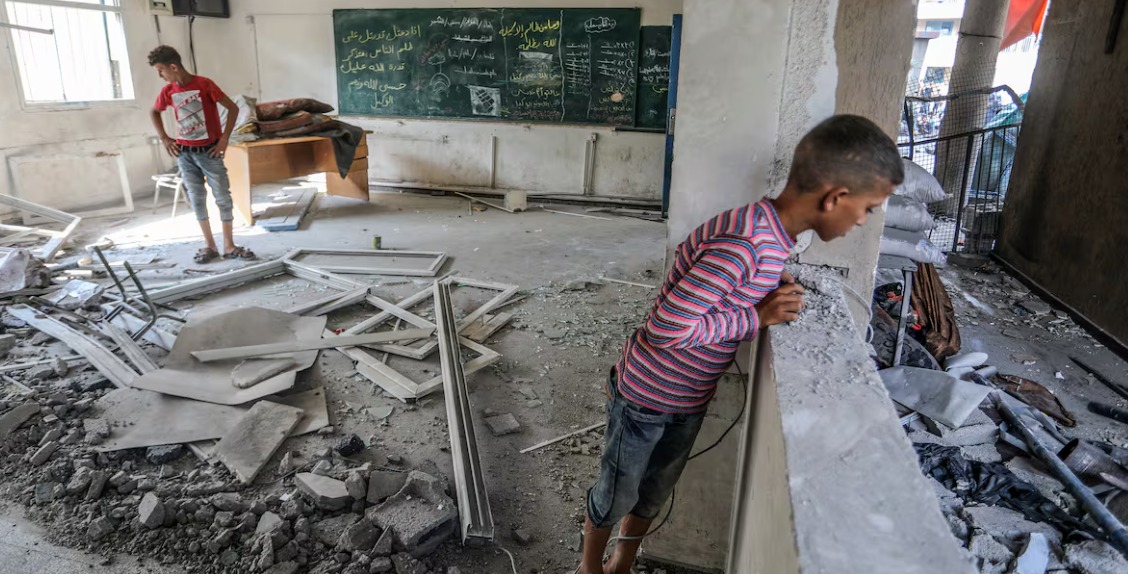
Children in Gaza are returning to what little remains of their schools — makeshift classrooms built from rubble, tents, and temporary shelters.
According to a report by Agence France-Presse (AFP), most children arrive with no backpacks, no books, no uniforms, and often no guarantee of safety. Yet, their determination to learn remains unwavering.
Months of conflict have destroyed or severely damaged hundreds of schools, leaving students and teachers with no proper infrastructure, furniture, or learning materials. In many areas, classes are being held in open courtyards, under torn tarpaulins, or inside damaged buildings.
A Classroom Without Chairs, Desks, or Books
In most temporary learning spaces:
Students sit on the ground, sand, or pieces of broken concrete
Teachers write on scraps of cardboard or walls
The few remaining textbooks are shared among dozens of children
Plastic sheets or blankets act as roofs and walls
Children often carry only a pencil — if they have one at all.
Despite these challenges, classrooms fill up quickly, as education offers a sense of normalcy and hope amid trauma.
Schools Turned Shelters Turned Classrooms
Thousands of displaced families are living inside former schools, forcing teachers to carve out any available corner for study.
Many classrooms now serve multiple purposes:
Morning: Shelter for displaced families
Afternoon: Classes for children
Night: Emergency relief stations
This constant transformation makes consistent learning extremely difficult.
Teachers Working in Crisis Conditions
Teachers in Gaza continue to work despite:
Little or no pay
Limited supplies
Psychological strain
Overcrowded conditions
Personal loss or displacement
They often create improvised lessons and use storytelling, drawing in sand, or oral teaching to keep students engaged.
Children Learning Under Trauma
Most children attending school have:
Lost family members
Witnessed destruction
Experienced displacement
Limited access to food and medical care
Learning becomes a form of emotional healing, helping them cope with fear, uncertainty, and instability.
Education as Resistance and Hope
Humanitarian groups emphasize that restoring education is essential to:
Protect children's mental well-being
Reduce long-term trauma
Prevent a “lost generation”
Provide stability in conflict
Despite the absence of basic resources, children show remarkable resilience, often smiling as they reunite with classmates.
FAQs
1. Why are Gaza children studying in makeshift classrooms?
Because many schools have been damaged, destroyed, or turned into shelters due to conflict.
2. What resources are missing?
Chairs, desks, books, backpacks, uniforms, and teaching tools.
3. Where are classes taking place?
In tents, damaged school buildings, courtyards, or temporary shelters.
4. Are teachers able to teach properly?
They try their best, but face major challenges including lack of supplies and overcrowding.
5. Why is education important during conflict?
It provides emotional stability, routine, and hope for children living in crisis.
Published on : 27th November
Published by : SMITA
www.vizzve.com || www.vizzveservices.com
Follow us on social media: Facebook || Linkedin || Instagram
🛡 Powered by Vizzve Financial
RBI-Registered Loan Partner | 10 Lakh+ Customers | ₹600 Cr+ Disbursed
Source Credit: Content inspired by reporting from Agence France-Presse (AFP),