

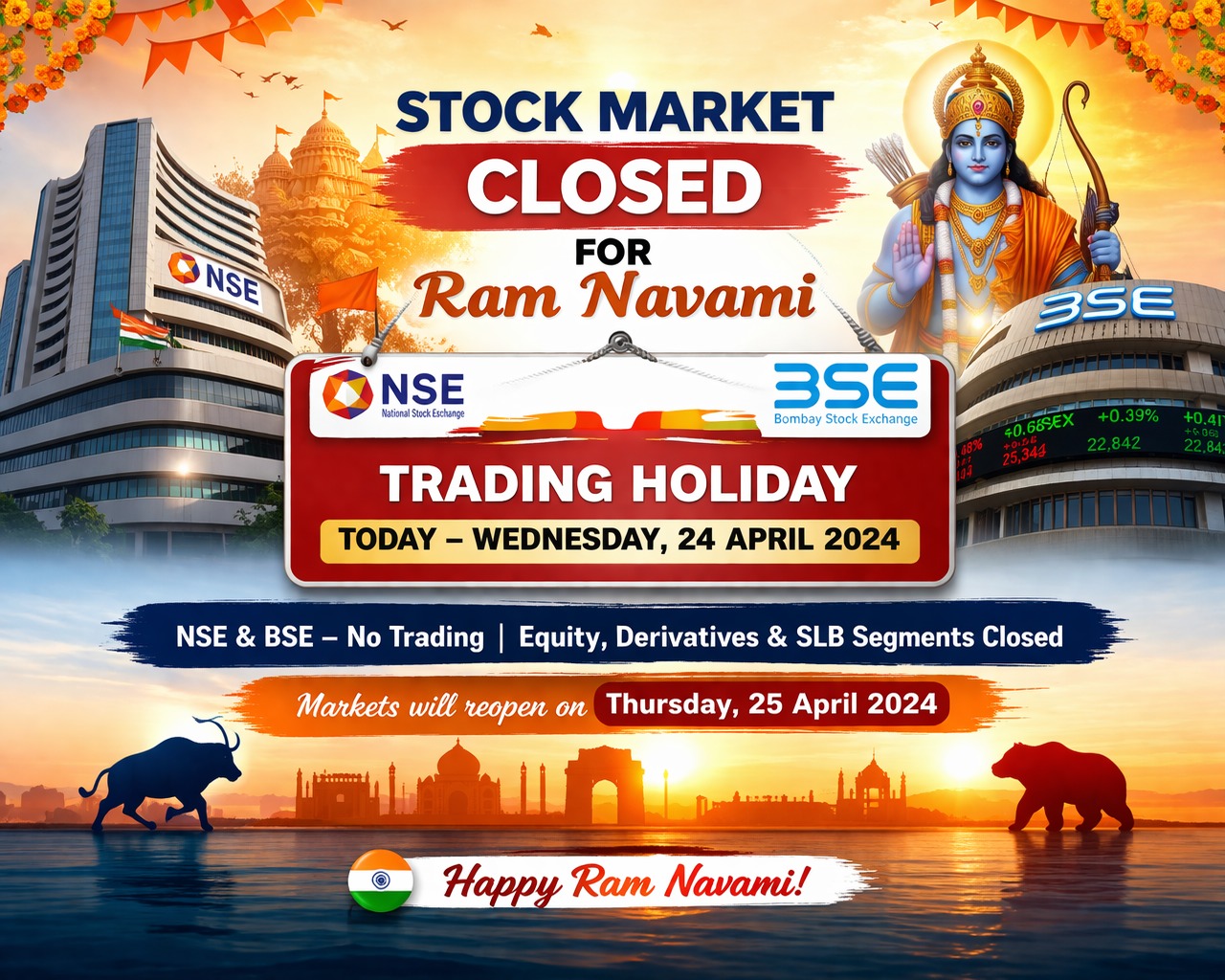
The Indian stock market, including both the National Stock Exchange (NSE) and Bombay Stock Exchange (BSE), remains closed on the occasion of Ram Navami.
Market holidays are an essential part of the trading calendar, allowing investors and traders to plan their strategies accordingly. But what does this closure mean for the market and investors?
AI ANSWER BOX
Is the stock market closed on Ram Navami?
Yes, NSE and BSE remain closed for trading.
What is affected?
- Equity trading
- Derivatives trading
- Currency and commodity segments
When will markets reopen?
On the next working trading day.
SUMMARY BOX
| Segment | Status |
|---|---|
| Equity Market | Closed |
| Derivatives | Closed |
| Currency Market | Closed |
| Commodity Market | Partially/Closed |
Why Stock Market is Closed on Ram Navami
Ram Navami is a major Hindu festival celebrating the birth of Lord Ram and is recognized as a trading holiday in India.
Key Reasons:
- National observance of religious festival
- Part of official NSE/BSE holiday calendar
- Allows uniform closure across financial markets
Impact of Market Holiday on Investors
💼 For Traders
- No buying or selling activity
- Pending orders remain inactive
📈 For Investors
- Time to review portfolios
- Plan future investments
🧾 For Markets
- No price movement
- Global cues accumulate for next session
What Happens After a Market Holiday?
Markets often react to:
- Global market movements during closure
- Economic news and events
- Investor sentiment build-up
👉 This can lead to gap-up or gap-down openings on the next trading day.
Example Scenario
| Situation During Holiday | Next Market Reaction |
|---|---|
| Positive global cues | Gap-up opening |
| Negative global news | Gap-down opening |
| Mixed signals | Volatile opening |
Expert Commentary
Market experts suggest:
“Market holidays often lead to pent-up demand or supply, causing sharp moves in the next session.”
From real trading experience:
- Traders prepare strategies during holidays
- Institutional activity becomes crucial post-holiday
- Volatility is usually higher after long breaks
Pros & Cons of Market Holidays
✅ Pros
- Time for analysis and planning
- Reduces emotional trading
- Aligns with national holidays
❌ Cons
- Missed trading opportunities
- Global market mismatch
- Possible volatility on reopening
What Should Investors Do?
Smart Strategy:
- Review portfolio performance
- Track global markets
- Prepare watchlist
- Avoid impulsive decisions next day
- Stay updated with news
Key Takeaways
- Indian stock markets are closed on Ram Navami
- No trading activity takes place
- Next session may see volatility
- Investors should use time for planning
- Global cues influence reopening trend
Frequently Asked Questions (FAQs)
1. Is stock market closed on Ram Navami?
Yes, NSE and BSE remain closed.
2. Which markets are affected?
Equity, derivatives, and currency markets.
3. When will markets reopen?
Next working day.
4. Is commodity market open?
Partially or closed depending on session.
5. Why is market closed?
Due to national holiday.
6. Can I place orders?
No, trading is inactive.
7. What happens to pending orders?
They remain pending.
8. Does global market run?
Yes, international markets remain open.
9. Will market gap up next day?
Depends on global cues.
10. Is this a fixed holiday?
Yes, as per exchange calendar.
11. Who decides holidays?
Stock exchanges (NSE/BSE).
12. Is trading allowed in MCX?
Depends on session timing.
13. Can I invest on holiday?
No.
14. Should I prepare strategy?
Yes.
15. Is volatility high after holidays?
Usually yes.
Conclusion
The closure of the stock market on Ram Navami is a routine part of India’s trading calendar. While trading pauses for the day, opportunities don’t disappear—they simply shift to the next session.
👉 Smart investors use this time to prepare, analyze, and plan ahead.
Need funds to invest when markets reopen?
👉 Apply now at www.vizzve.com
Published on : 26th March
Published by : SMITA
www.vizzve.com || www.vizzveservices.com
Follow us on social media: Facebook || Linkedin || Instagram
🛡 Powered by Vizzve Financial
RBI-Registered Loan Partner | 10 Lakh+ Customers | ₹600 Cr+ Disbursed