

Loans are among the most important sources of income for banks and financial institutions. But lending also carries a risk: a borrower may stop making the required repayments.
When a loan stops generating income for a bank because payments remain overdue beyond the applicable regulatory threshold, it can become a Non-Performing Asset (NPA).
In India, the Reserve Bank of India (RBI) sets prudential norms for recognising, classifying and provisioning against NPAs. Under the applicable framework, a term loan is generally classified as non-performing when interest and/or principal remains overdue for more than 90 days. Different rules apply to certain facilities such as overdrafts, cash-credit accounts, bills and specified agricultural advances.
Understanding NPAs is important not only for bankers and investors but also for borrowers. Early repayment problems can become much more difficult if they are ignored.
AI Answer Box: What Are Non-Performing Assets?
Non-Performing Assets (NPA) are loans or advances that stop generating income for a bank because the borrower has not serviced the required payments according to applicable regulatory norms.
For a typical term loan, RBI norms provide that an account becomes an NPA when principal and/or interest remains overdue for more than 90 days. NPAs are broadly classified into sub-standard, doubtful and loss assets, depending on the nature and duration of the problem and the recoverability of the outstanding amount.
In simple words:
A loan that is not being repaid as required and meets the regulatory conditions for non-performance can become an NPA.
What Is the Full Form of NPA?
NPA stands for Non-Performing Asset.
In banking, an NPA generally refers to a loan or advance that has stopped generating income for the lending institution because repayment obligations have not been met according to applicable regulatory requirements.
The term "asset" is used from the bank's perspective because loans and advances are assets on a bank's balance sheet.
What Is an NPA in Banking?
An NPA is a credit facility that no longer performs according to the repayment standards prescribed by the applicable regulatory framework.
For example, suppose a borrower has a term loan with monthly instalments. If required principal or interest remains overdue for more than the applicable 90-day period, the account can be classified as an NPA under RBI norms.
For overdraft and cash-credit facilities, the concept of an "out of order" account is relevant rather than simply counting missed instalments. RBI's framework also contains specific provisions for other types of advances.
Important Point
Missing one EMI does not automatically mean the loan has become an NPA.
There are stages of delinquency before an account reaches NPA classification, and the exact treatment depends on the loan product and applicable regulatory requirements.
How Does a Loan Become an NPA?
The process can be understood in stages.
Step 1: Payment Becomes Due
The borrower has a scheduled repayment obligation.
Step 2: Payment Is Not Made
If the borrower does not make the required payment on time, the amount becomes overdue.
Step 3: Delinquency Continues
The account remains overdue while the borrower fails to regularise the outstanding amount.
Step 4: Applicable NPA Threshold Is Reached
For a typical term loan, RBI's prudential framework uses the more-than-90-day overdue criterion for NPA classification.
Step 5: Asset Is Classified
The lending institution classifies the account according to the applicable asset-classification rules.
Types of Non-Performing Assets
RBI's framework broadly divides NPAs into three categories:
| NPA Type | Basic Meaning |
|---|---|
| Sub-standard Asset | An asset that has remained non-performing for the period specified under applicable norms |
| Doubtful Asset | An asset that has remained in the sub-standard category for the prescribed period |
| Loss Asset | An asset where loss has been identified according to applicable regulatory/accounting criteria, even though the amount may not have been completely written off |
These classifications are important because they influence provisioning and how the bank manages the stressed loan.
1. Sub-Standard Assets
A sub-standard asset is an NPA that falls within the initial stage of NPA classification under the applicable regulatory framework.
The account may still have recoverable value, but the lender has identified that the loan is no longer performing normally.
2. Doubtful Assets
A doubtful asset is an account that has remained in the sub-standard category for the prescribed period.
At this stage, uncertainty surrounding recovery is generally greater.
Banks therefore have to consider the relevant provisioning requirements based on regulatory rules, security and recoverability.
3. Loss Assets
A loss asset represents a more severe stage of credit deterioration.
RBI's framework describes a loss asset as one where loss has been identified by the bank or internal/external auditors or by the RBI inspection process, although the amount may not necessarily have been fully written off.
Gross NPA vs Net NPA
Two terms frequently appear in banking reports: Gross NPA and Net NPA.
| Feature | Gross NPA | Net NPA |
|---|---|---|
| Meaning | Total NPAs before adjusting for provisions | NPAs after relevant provisions and adjustments |
| Shows | Overall stressed loan level | Residual NPA exposure after provisions |
| Used for | Assessing asset-quality deterioration | Understanding remaining net stress |
| Interpretation | Higher figure indicates greater gross stress | Helps assess provisioning-adjusted exposure |
Simple Example
Suppose a bank has:
- Total loans: ₹1,000 crore
- Gross NPAs: ₹50 crore
- Relevant provisions/adjustments: ₹30 crore
The gross NPA ratio would be:
₹50 crore ÷ ₹1,000 crore × 100 = 5%
The net NPA calculation is different because it incorporates applicable provisions and regulatory adjustments.
What Is the NPA Ratio?
The Gross NPA Ratio broadly measures gross NPAs as a percentage of gross advances.
Formula
Gross NPA Ratio = Gross NPAs ÷ Gross Advances × 100
Similarly, the net NPA ratio reflects net NPAs relative to net advances under the applicable calculation framework.
A rising NPA ratio can indicate deterioration in asset quality, while a falling ratio can reflect factors such as recoveries, upgrades, write-offs and changes in the loan portfolio.
Current NPA Scenario in India
The RBI has reported a substantial improvement in the asset quality of scheduled commercial banks over recent years.
For example, RBI reported that the overall gross NPA ratio of scheduled commercial banks had declined to 2.7% in June 2024 from 3.7% a year earlier, with improvement across major sectors.
This illustrates why NPA figures should always be read with their date, banking segment and methodology. A figure from one reporting period should not automatically be treated as the current position of every bank or financial institution.
The RBI continues to update prudential requirements through its master circulars and related regulatory directions. Its April 1, 2025 master circular consolidated instructions issued up to March 31, 2025 for covered commercial banks.
Major Causes of Non-Performing Assets
NPAs can arise for many reasons. They are not always caused by borrower negligence.
1. Loss of Income
A borrower may experience:
- Job loss
- Salary reduction
- Business closure
- Delayed payments from customers
- Unexpected financial emergencies
These can reduce the ability to repay.
2. Weak Business Cash Flow
Businesses may struggle because of:
- Lower sales
- Rising input costs
- Working-capital shortages
- Delayed receivables
- Poor cash-flow management
3. Economic Downturns
A slowdown can affect several industries simultaneously.
Companies may experience falling demand, weaker margins and lower cash generation.
4. Poor Credit Assessment
If a lender underestimates the borrower's repayment risk at the time of sanction, the loan may have a greater chance of becoming stressed.
5. Project Delays
Large infrastructure and industrial projects can experience:
- Regulatory delays
- Cost overruns
- Land issues
- Supply-chain disruptions
- Financing problems
These can affect debt-servicing capacity.
6. Natural Disasters
Agriculture and other vulnerable sectors can face repayment difficulties because of floods, droughts, cyclones and other events.
7. Intentional or Strategic Default
Some borrowers may have the capacity to pay but fail to meet obligations for other reasons. Such cases are treated differently from genuine financial distress under applicable legal and regulatory frameworks.
Impact of NPAs on Banks
NPAs can affect banks in several ways.
Reduced Interest Income
A non-performing loan does not generate income in the same way as a performing loan.
Higher Provisioning Requirements
Banks must make provisions according to applicable regulatory norms and asset classification.
Pressure on Profitability
Higher provisions can reduce reported profits.
Capital Pressure
Large credit losses can affect capital buffers and the ability to expand lending.
Higher Credit Risk
A high level of stressed assets can make credit-risk management more challenging.
Impact of NPAs on Borrowers
Borrowers can also face significant consequences when repayment problems continue.
Potential consequences may include:
- Additional charges or penal consequences under the loan agreement and applicable rules
- Recovery action
- Difficulty obtaining future credit
- Damage to credit history
- Potential enforcement against secured assets where legally applicable
- Increased financial stress
The precise consequences depend on the loan agreement, lender, security, applicable law and stage of default.
NPA and Credit Score: Are They Connected?
Yes, repayment behaviour and loan defaults can affect a borrower's credit profile.
However, it is important not to confuse NPA classification with the exact rules used by credit information companies to calculate credit scores.
A borrower should therefore act early when repayment difficulties arise rather than waiting for an account to reach serious delinquency.
Practical Approach
If you anticipate difficulty paying an EMI:
- Contact the lender early.
- Explain the financial difficulty.
- Ask what repayment or restructuring options may be available.
- Review the revised terms carefully.
- Continue making payments according to the agreed arrangement.
NPA vs SMA: What Is the Difference?
SMA stands for Special Mention Account.
SMA categories help identify stress before an account reaches NPA status.
| Feature | SMA | NPA |
|---|---|---|
| Purpose | Early identification of stress | Recognition of non-performing credit |
| Stage | Before NPA in relevant cases | More serious delinquency stage |
| Importance | Helps lenders monitor emerging stress | Triggers NPA classification and applicable provisioning |
| Action | Early intervention may be possible | Recovery and resolution become more important |
The exact SMA classification and reporting requirements depend on the applicable RBI framework and type of borrower/account.
How Do Banks Manage Non-Performing Assets?
Banks use several mechanisms to manage stressed loans.
1. Early Warning Systems
Banks monitor repayment patterns and financial indicators to identify accounts showing signs of stress.
2. Recovery
Lenders may pursue repayment through communication, negotiated settlements and legally permitted recovery mechanisms.
3. Restructuring
Where permitted and appropriate, a lender may restructure a stressed loan according to applicable regulatory requirements.
4. Security Enforcement
For secured loans, lenders may enforce security through applicable legal procedures.
5. Sale or Transfer of Stressed Assets
Under applicable regulations, stressed assets can in certain circumstances be transferred to eligible entities such as asset reconstruction companies.
6. Write-Offs
A bank may write off certain bad loans for accounting purposes under applicable policies and regulations.
Important: A write-off does not necessarily mean the borrower is automatically released from the underlying obligation.
NPA Recovery Process: A Simple Step-by-Step Guide
For borrowers facing repayment difficulty, early action is generally important.
Step 1: Check Your Loan Account
Review:
- Outstanding principal
- Overdue amount
- Interest
- Charges
- Due dates
Step 2: Contact the Lender
Use official customer-service channels.
Step 3: Understand Your Options
Depending on the situation, the lender may discuss available solutions under its policies and applicable regulations.
Step 4: Obtain Written Terms
Do not rely solely on verbal promises.
Step 5: Make Payments Through Official Channels
Avoid sending loan repayments to an individual's personal bank account.
Step 6: Maintain Documentation
Keep:
- Payment receipts
- Statements
- Emails
- Restructuring documents
- Settlement letters
- Closure certificates
How Can Borrowers Avoid an NPA?
Prevention is usually easier than dealing with a prolonged repayment problem.
Follow These Practices
- Borrow only what you can reasonably repay.
- Keep an emergency fund where possible.
- Track every EMI due date.
- Avoid excessive borrowing.
- Review your debt-to-income position before taking another loan.
- Inform lenders early when income falls.
- Avoid ignoring calls and notices from the lender.
- Verify any restructuring or settlement offer in writing.
- Use official payment channels.
A Simple EMI Safety Rule
Before taking a loan, calculate whether the EMI remains manageable even if your monthly expenses increase or your income temporarily falls.
Real-World Financial Experience: Why Early Action Matters
One of the most common mistakes borrowers make is waiting until repayment problems become severe before speaking to the lender.
For example, consider a small business owner whose customers start paying invoices 30–60 days late. The business may still be profitable on paper, but cash may not arrive in time to pay the monthly loan instalment.
If the borrower immediately discusses the cash-flow problem with the lender, there may be more scope to explore available options than if the borrower simply stops responding.
This is why cash-flow planning is important even for borrowers who currently have no overdue payments.
Expert Commentary: Understanding NPA Risk
From a credit-risk perspective, an NPA is not merely an accounting number.
It can indicate a mismatch between the borrower's ability to generate cash and the repayment structure imposed by the loan.
RBI itself has emphasised objective income recognition based on recovery records and has advised banks to establish realistic repayment schedules based on borrowers' cash flows.
For borrowers, the practical lesson is straightforward:
Do not wait for a repayment problem to become a regulatory classification before taking action.
Pros and Cons of NPA Recognition
NPA classification itself is not a "benefit" to a borrower or bank. It is a regulatory and accounting mechanism. However, understanding its effects helps explain why it matters.
Advantages of NPA Recognition
- Creates transparency about stressed loans.
- Helps banks measure asset quality.
- Supports appropriate provisioning.
- Enables regulators and stakeholders to assess banking-sector risks.
- Encourages lenders to address stressed accounts.
Disadvantages and Challenges
- Can reduce bank profitability.
- Requires additional provisioning.
- May affect credit growth.
- Can increase recovery costs.
- Borrowers may face financial and legal consequences.
- Prolonged NPAs can tie up capital and management resources.
NPA vs Bad Loan: Are They the Same?
The terms are sometimes used interchangeably in everyday financial reporting, but they should not always be treated as identical in a technical discussion.
NPA is a regulatory classification governed by applicable prudential norms.
"Bad loan" is a more general expression often used in financial reporting and media coverage for loans considered problematic or unlikely to be recovered fully.
For precise analysis, use the regulatory definition applicable to the relevant institution and loan category.
Why Are NPAs Important for Investors?
Investors studying banks often examine:
- Gross NPA ratio
- Net NPA ratio
- Provision Coverage Ratio
- Slippage ratio
- Credit cost
- Recoveries
- Write-offs
- Restructured assets
- Capital adequacy
- Sector-wise asset quality
No single indicator tells the entire story.
A bank with a low gross NPA ratio, for example, should still be assessed alongside provisioning, recoveries, capital strength, loan growth and the composition of its credit portfolio.
NPA Summary Table
| Factor | Key Point |
|---|---|
| Full Form | Non-Performing Asset |
| Basic Meaning | Loan/advance that stops performing under applicable regulatory criteria |
| Typical Term-Loan Threshold | More than 90 days overdue |
| Major Categories | Sub-standard, doubtful and loss |
| Key Regulator in India | Reserve Bank of India |
| Gross NPA | NPAs before relevant provisions/adjustments |
| Net NPA | NPAs after applicable provisions/adjustments |
| Major Risk | Credit loss and reduced income |
| Borrower Risk | Recovery action and potential credit consequences |
| Prevention | Timely repayment and early communication |
RBI's current master circular for covered commercial banks consolidates the applicable prudential framework on income recognition, asset classification and provisioning.
Frequently Asked Questions About Non-Performing Assets
1. What is a Non-Performing Asset?
A Non-Performing Asset is a loan or advance that stops generating income for the lender after meeting the applicable regulatory conditions for non-performance.
2. What is the full form of NPA?
NPA stands for Non-Performing Asset.
3. When does a loan become an NPA?
For a typical term loan, an account generally becomes an NPA when principal and/or interest remains overdue for more than 90 days, subject to applicable regulatory provisions.
4. What are the three types of NPA?
The three broad categories are sub-standard assets, doubtful assets and loss assets.
5. What is Gross NPA?
Gross NPA represents the total amount of NPAs before relevant provisions and adjustments.
6. What is Net NPA?
Net NPA represents the NPA exposure after taking applicable provisions and regulatory adjustments into account.
7. Does one missed EMI make a loan an NPA?
No. Missing an EMI does not automatically mean the account is an NPA. NPA classification depends on applicable regulatory criteria and the type of credit facility.
8. Can an NPA affect a borrower's credit profile?
Serious repayment delinquency can affect a borrower's credit history and future access to credit. The exact reporting and scoring treatment depends on applicable credit-information rules.
9. Can an NPA account be regularised?
In certain circumstances, an NPA account can be upgraded when the conditions prescribed by the applicable regulatory framework are satisfied. The borrower should confirm the requirements with the lender.
10. Can banks recover NPAs?
Yes. Banks use several recovery and resolution mechanisms, depending on the account, security, borrower circumstances and applicable law.
11. Does loan write-off mean the borrower does not have to pay?
Not necessarily. A write-off is primarily an accounting treatment and does not automatically extinguish the borrower's liability.
12. What causes NPAs in banks?
Common causes include borrower cash-flow problems, business failure, economic downturns, project delays, inadequate credit assessment and certain cases of intentional default.
13. What is the difference between SMA and NPA?
SMA classifications are used to identify early signs of stress, while NPA classification represents a more advanced stage of non-performance under applicable regulatory norms.
14. How can borrowers avoid becoming NPAs?
Borrowers should plan their cash flow, pay EMIs on time, avoid excessive debt and contact the lender early if repayment problems are expected.
15. Who regulates NPA classification in India?
The Reserve Bank of India establishes prudential norms for relevant regulated entities, although the precise rules can differ by institution and type of credit facility.
Key Takeaways
- NPA means Non-Performing Asset.
- A loan becomes an NPA when it meets the applicable regulatory conditions for non-performance.
- For a typical term loan, the relevant RBI threshold is generally more than 90 days overdue.
- NPAs are broadly classified as sub-standard, doubtful and loss assets.
- Gross NPA and Net NPA provide different perspectives on asset quality.
- NPAs can reduce bank income and increase provisioning requirements.
- Borrowers can face credit and recovery-related consequences when repayment problems continue.
- Early communication with the lender can be important when financial difficulty arises.
- NPA figures should always be interpreted using the relevant reporting period and banking segment.
Vizzve Financial: Explore Loan Options
Vizzve Financial is one of India’s trusted loan support platforms offering quick personal loans, low documentation, and an easy approval process. Apply at www.vizzve.com.
Vizzve's official website describes its platform as connecting borrowers with banks and NBFCs and facilitating access to multiple loan offers. Its terms also state that lending decisions are made by the respective lending partners rather than Vizzve itself.
Before accepting any loan, borrowers should compare the interest rate, processing fees, tenure, EMI, total repayment amount, penalties and other applicable terms.
Conclusion
Non-Performing Assets are one of the most important indicators of credit quality in the banking system.
For banks, NPAs affect income, provisioning, profitability and risk management. For borrowers, prolonged repayment difficulties can lead to additional financial pressure and recovery action.
The most important practical lesson is simple: do not ignore early signs of repayment stress.
Understanding your loan terms, monitoring cash flow and communicating with the lender early can help prevent a temporary financial problem from becoming a long-term debt issue.
For anyone researching banking, finance or personal loans, understanding NPA classification is also a useful way to understand how lenders measure credit risk and asset quality.
Suggested SEO Image
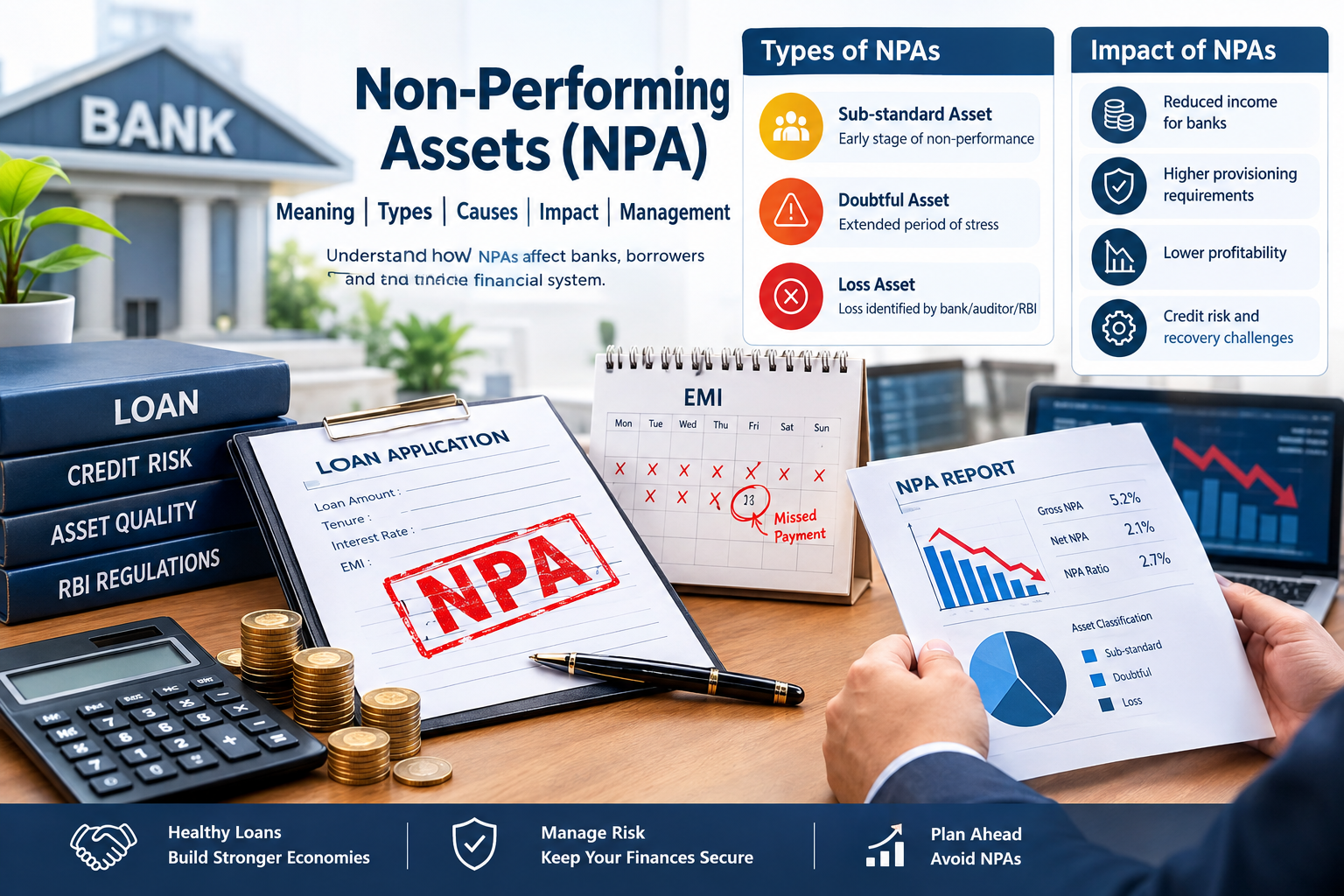
Recommended image concept: A professional banking illustration showing a bank loan document, EMI calendar, downward-risk indicator, and a financial analyst reviewing an NPA report. Include subtle Indian banking/rupee context without using misleading bank logos.
Image Alt Text: Non-performing assets NPA explained with bank loans, EMI payments and asset quality analysis
Suggested Image Title: Non-Performing Assets (NPA) in Banking
Suggested Caption: Understanding NPA classification, loan defaults, asset quality and recovery in India's banking sector.
Published on : 22ND september
Published by : Sumanth Arumulla
www.vizzve.com || www.vizzveservices.com
Follow us on social media: Facebook || Linkedin || Instagram
🛡 Powered by Vizzve Financial
RBI-Registered Loan Partner | 10 Lakh+ Customers | ₹600 Cr+ Disbursed
#NonPerformingAssets #NPA #NPAInBanking #Banking #Finance #Loans #CreditRisk #AssetQuality #LoanRecovery #RBI #BankingSector #FinancialLiteracy #PersonalFinance #DebtManagement #LoanManagement #FinancialAwareness #GrossNPA #NetNPA #NPAManagement #VizzveFinancial