

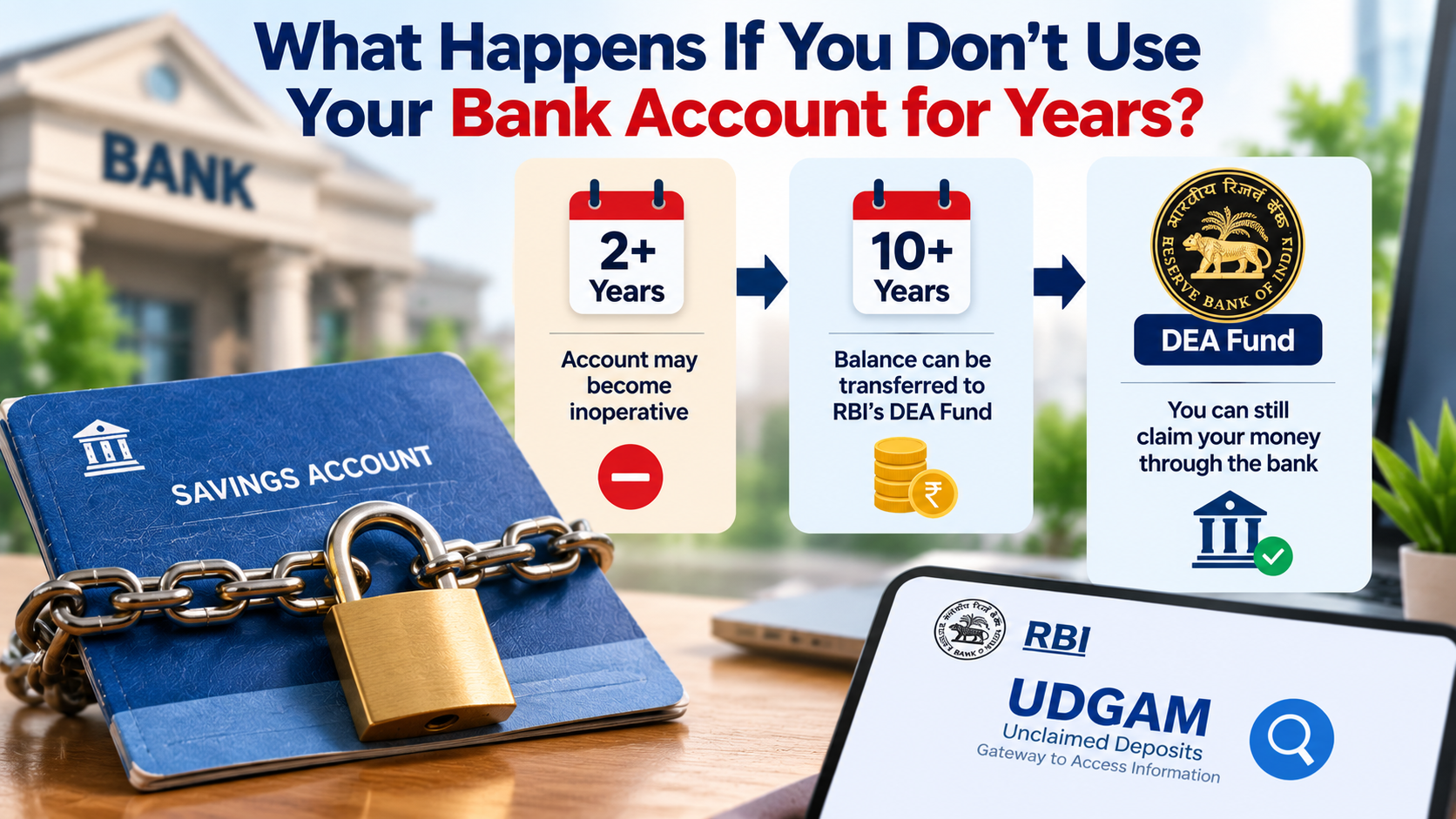
Many people have an old savings account that they stopped using years ago. It could be a previous salary account, a second savings account, a student account or simply a bank account that was forgotten after opening another one.
But what happens if you don't use your bank account for several years?
In India, a bank account can eventually be classified as an inoperative or dormant account when there are no qualifying customer-induced transactions for more than two years. This does not mean that the money automatically disappears or that the bank simply takes ownership of your balance.
If the account remains unclaimed for 10 years or more, the balance can be transferred by the bank to the Reserve Bank of India's Depositor Education and Awareness (DEA) Fund. However, eligible depositors or beneficiaries can still claim the money from the concerned bank.
So, if you have an old bank account that you haven't touched for years, it is worth checking its status rather than simply assuming the money is gone.
AI Answer Box: What Happens If You Don't Use Your Bank Account for Years?
If there are no customer-induced transactions in a savings or current account for more than two years, the account can be classified as inoperative under RBI rules.
After 10 years of being unoperated or remaining unclaimed, the balance is transferred to the RBI's DEA Fund. The depositor or eligible claimant can still approach the bank to claim the money. RBI also provides the UDGAM portal to search for certain unclaimed deposits transferred to the DEA Fund.
Importantly, an inoperative account is not the same as a permanently closed account, and RBI says there should be no charge for activating an inoperative account.
What Is an Inoperative or Dormant Bank Account?
An inoperative account is a bank account where there have been no customer-induced transactions for a specified period.
Under RBI guidance, savings and current accounts are generally treated as inoperative when there are no transactions for more than two years.
The key word here is customer-induced.
For example, simply receiving interest from the bank or having certain bank service charges deducted does not by itself count as customer activity for determining whether an account is inoperative. RBI's framework distinguishes such bank-generated entries from customer-induced transactions.
How Long Can a Bank Account Remain Unused?
There are two important time periods to remember:
| Period | What Can Happen |
|---|---|
| Up to 2 years | Account can remain operative if there are qualifying customer-induced transactions |
| More than 2 years | Savings/current account can be classified as inoperative |
| 10 years or more unclaimed/unoperated | Balance can be transferred to RBI's DEA Fund |
The two-year and ten-year rules are not the same thing.
After two years, an account can become inoperative.
After ten years, the balance can become an unclaimed deposit and be transferred to the DEA Fund.
Does the Bank Take Your Money After 2 Years?
No.
This is one of the biggest misconceptions about dormant accounts.
When an account becomes inoperative, the money does not simply become the bank's property.
The balance remains associated with the depositor, subject to the applicable banking and legal process.
Even if the money is eventually transferred to the RBI's DEA Fund after the applicable 10-year period, eligible customers can still claim it through the concerned bank.
What Happens to Your Money in an Inoperative Savings Account?
For savings accounts, interest continues to be credited regularly even when the account is inoperative, according to RBI's financial-awareness guidance.
This means that simply leaving your savings account unused does not mean that interest automatically stops.
However, the exact treatment of different deposit products can vary.
For example, RBI's guidance states that when a fixed deposit matures and the proceeds remain unpaid/unclaimed, the amount can attract the applicable savings-account rate or the contracted rate on the matured fixed deposit, whichever is lower, subject to the applicable rules.
Can You Still Withdraw Money From an Inoperative Account?
An inoperative account is subject to restrictions until it is activated.
If you discover that your old account has become inoperative, you should complete the bank's required activation/KYC process rather than assuming the balance is inaccessible permanently.
RBI requires banks to provide facilities for KYC updation for activation of inoperative accounts and unclaimed deposits. The facility must be available at branches, including non-home branches, and banks are also required to endeavour to provide V-CIP-based KYC updation where applicable.
How to Activate an Inoperative Bank Account
The process may vary from bank to bank, but RBI's current framework makes activation easier than simply requiring a visit to the original branch.
Depending on the bank, you may be able to complete the process through:
- Your home branch
- A non-home branch
- Internet banking
- Mobile banking
- Video Customer Identification Process (V-CIP)
- An authorised Business Correspondent, where applicable
RBI's 2025 amendment specifically allows banks to use authorised Business Correspondents for activation of inoperative accounts, in addition to the other available channels.
Typical Steps
Step 1: Contact your bank or check its official app.
Step 2: Confirm whether the account is operative or inoperative.
Step 3: Complete KYC updation if required.
Step 4: Submit the required documents or self-declaration, depending on the bank's process.
Step 5: Wait for the bank to remove the inoperative status.
RBI's guidance says banks should intimate customers through SMS and registered email once the inoperative status has been removed based on the KYC documents submitted.
Is There a Charge to Activate an Inoperative Account?
No.
RBI's financial-awareness guidance specifically states that there are no charges for activation of an inoperative account.
Therefore, if someone asks you to pay a special “RBI activation fee” to reactivate an old bank account, be cautious and verify the request directly with your bank.
Never transfer money to an unknown person who claims that a payment is required to “unfreeze” or “activate” your account.
What Happens If Your Account Is Unused for 10 Years?
This is the stage where the rules become particularly important.
Under RBI instructions, balances in deposit accounts that have not been operated upon for 10 years or more, or amounts that remain unclaimed for 10 years or more, are required to be transferred to the Depositor Education and Awareness Fund maintained by RBI.
But this does not mean you lose the money permanently.
The UDGAM system helps people search for certain unclaimed deposits that have been transferred to the DEA Fund.
What Is the RBI UDGAM Portal?
UDGAM stands for:
Unclaimed Deposits – Gateway to Access Information.
It is a centralised RBI portal that allows registered users to search for unclaimed deposits/accounts across participating banks.
The portal is designed to make it easier for people to identify old deposits that they may have forgotten about.
However, UDGAM does not itself pay the money to you.
According to RBI's UDGAM FAQ, the portal provides search information and the relevant claim/settlement process, while the actual claim must be made through the respective bank.
How to Search for an Old Bank Account on UDGAM
If you think you or a family member may have an old unclaimed deposit, you can use the RBI's UDGAM portal.
For an individual search, RBI says users may need details such as:
- Name of the account holder
- Bank name
- PAN
- Driving licence number
- Voter ID
- Passport number
- Date of birth
Other permitted information may also be used depending on the search process.
If a match is found, the search result can provide information needed to approach the concerned bank.
Important
You claim the money from the bank, not directly from RBI through UDGAM.
What If the Account Belonged to a Deceased Family Member?
Old bank accounts are sometimes forgotten after the account holder passes away.
In such cases, the legal heir or eligible claimant may need to approach the concerned bank and complete its claim process.
Banks have procedures for handling claims relating to deceased depositors, including requirements around nomination, legal heirs and supporting documents depending on the circumstances.
If a family member has passed away, don't ignore old bank statements or account information. The money may still be recoverable through the bank's prescribed process.
What Happens to a Salary Account If You Stop Using It?
This is particularly common when people change jobs.
Suppose your employer used to credit your salary into Bank A, but after changing jobs you start receiving your salary in Bank B.
If you completely stop using Bank A, the account may eventually become inoperative after the applicable period of inactivity.
The important point is that salary credit stopping is not itself the same as account closure.
The old account can remain open but become inoperative if qualifying customer-induced activity does not occur for more than two years.
What Happens to a Student Bank Account After Graduation?
Student accounts can also become inactive.
For example:
- You opened an account during college.
- You graduated.
- You moved to another city.
- You opened another account after getting a job.
- You stopped using the old account.
After sufficient inactivity, the old account may become inoperative.
If there is money in it, don't assume that the bank has taken it.
You can contact the bank and follow the activation process.
Does an Inoperative Account Affect Your Credit Score?
Generally, simply having an unused savings account does not automatically reduce your CIBIL score or credit score.
A bank account and a credit account serve different purposes.
However, other issues connected with the account—such as unpaid loan obligations, credit-card dues or other reported credit activity—can affect your credit history separately.
So:
Unused savings account ≠ automatically bad credit score.
Does KYC Expiry Make an Account Inoperative?
Not necessarily.
Inactivity and KYC non-compliance are separate issues, although both can contribute to account restrictions.
RBI noted in its December 2024 supervisory communication that long inactivity and pending KYC/periodic KYC updation were among the reasons for the high number of inoperative/frozen accounts at some banks.
Therefore, even if you occasionally use an account, you should not ignore KYC updation requests from your bank.
Can an Inoperative Account Still Receive Money?
The exact treatment depends on the account status and applicable banking rules.
RBI has separately required banks to ensure that certain accounts used for Government Scheme DBT/EBT credits can continue receiving such credits even after becoming inoperative.
For ordinary accounts, customers should check with their bank before assuming that every type of incoming transaction will work normally once the account is classified as inoperative.
Can the Bank Close an Unused Account?
An inoperative account is not automatically the same as a closed account.
Banks have specific procedures for handling inoperative accounts, and RBI requires facilities for activation.
Therefore, if you have not used an account for years, the first step should be to check its current status rather than assuming it has been permanently closed.
How to Prevent Your Bank Account From Becoming Inactive
If you want to keep an account active, don't simply forget about it.
Follow These Simple Steps
1. Review your bank accounts regularly
Make a list of all savings and current accounts you have.
2. Keep your KYC updated
Make sure your identity, address and other relevant information are current.
3. Monitor bank communications
Don't ignore genuine SMS, email or app notifications from your bank.
4. Check old accounts after changing jobs
Salary accounts are commonly forgotten after switching employers.
5. Maintain nominee details
Review nomination information and update it when necessary.
6. Keep account records
Save important account numbers, statements and bank correspondence securely.
Inoperative vs Unclaimed Deposit vs Closed Account
These terms should not be confused.
| Status | Meaning |
|---|---|
| Active Account | Account is operating normally |
| Inoperative Account | No qualifying customer-induced transactions for more than two years |
| Unclaimed Deposit | Deposit/account balance remains unclaimed or unoperated for 10 years or more and is subject to transfer to the DEA Fund |
| Closed Account | Banking relationship has been formally closed |
The key distinction is that inoperative does not automatically mean closed.
2-Year vs 10-Year Rule
This is the easiest way to remember the process:
After 2+ Years
Your savings or current account may become inoperative if there have been no qualifying customer-induced transactions.
After 10 Years
If the balance remains unoperated/unclaimed for 10 years or more, it is transferred to the RBI's DEA Fund under the applicable rules.
After Transfer
The rightful depositor or eligible claimant can still approach the concerned bank to claim the money.
Frequently Asked Questions
1. What happens if I don't use my bank account for years?
If there are no qualifying customer-induced transactions for more than two years, a savings or current account can be classified as inoperative under RBI rules.
2. Will my bank account be closed after two years?
Not necessarily. Two years of inactivity can lead to an inoperative status; this is different from formal account closure.
3. Will I lose my money if my account becomes dormant?
No. Becoming inoperative does not mean that the money automatically becomes the bank's property.
4. What happens to money after 10 years?
Balances remaining unoperated or unclaimed for 10 years or more are transferred to the RBI's Depositor Education and Awareness Fund under the applicable rules.
5. Can I get money back after it is transferred to the DEA Fund?
Yes. Eligible depositors or claimants can approach the respective bank through its prescribed claim process. UDGAM can help locate eligible unclaimed deposits.
6. What is UDGAM?
UDGAM is RBI's centralised portal for searching unclaimed deposits/accounts across participating banks.
7. Does UDGAM directly give me my money?
No. UDGAM helps you search for unclaimed deposits and provides information about the claim process. The actual claim is made through the concerned bank.
8. Is there a fee to activate an inoperative bank account?
RBI's financial-awareness guidance says there are no charges for activation of an inoperative account.
9. Does an unused bank account stop earning interest?
For savings accounts, RBI says interest continues to be credited regularly even when the account is inoperative.
10. Can I activate an inoperative account at any bank branch?
RBI requires banks to make KYC updation facilities available for activation at all branches, including non-home branches.
11. Can I activate an old account online?
Depending on the bank, activation/KYC updation may be available through mobile banking, internet banking or other digital channels. RBI has encouraged banks to provide easier digital activation processes.
12. What if I forgot the account number?
You can contact the bank and provide available identification and account-holder information. If the deposit has reached the unclaimed stage and is covered by UDGAM, the portal can also help search for it.
13. Does KYC affect inactive bank accounts?
Yes. KYC updation can be required to activate an inoperative account, and RBI has identified pending KYC as one factor contributing to inoperative/frozen accounts at some banks.
14. Can a salary account become inactive?
Yes. If you stop using a salary account after changing jobs and there are no qualifying customer-induced transactions for the applicable period, it can become inoperative.
15. Should I keep an old bank account open?
That depends on your personal banking needs. If you no longer need an account, it can be worth formally closing it rather than leaving it forgotten for years.
Published on : 25th September
Published by : SMITA
www.vizzve.com || www.vizzveservices.com
Follow us on social media: Facebook || Linkedin || Instagram
🛡 Powered by Vizzve Financial
RBI-Registered Loan Partner | 10 Lakh+ Customers | ₹600 Cr+ Disbursed