

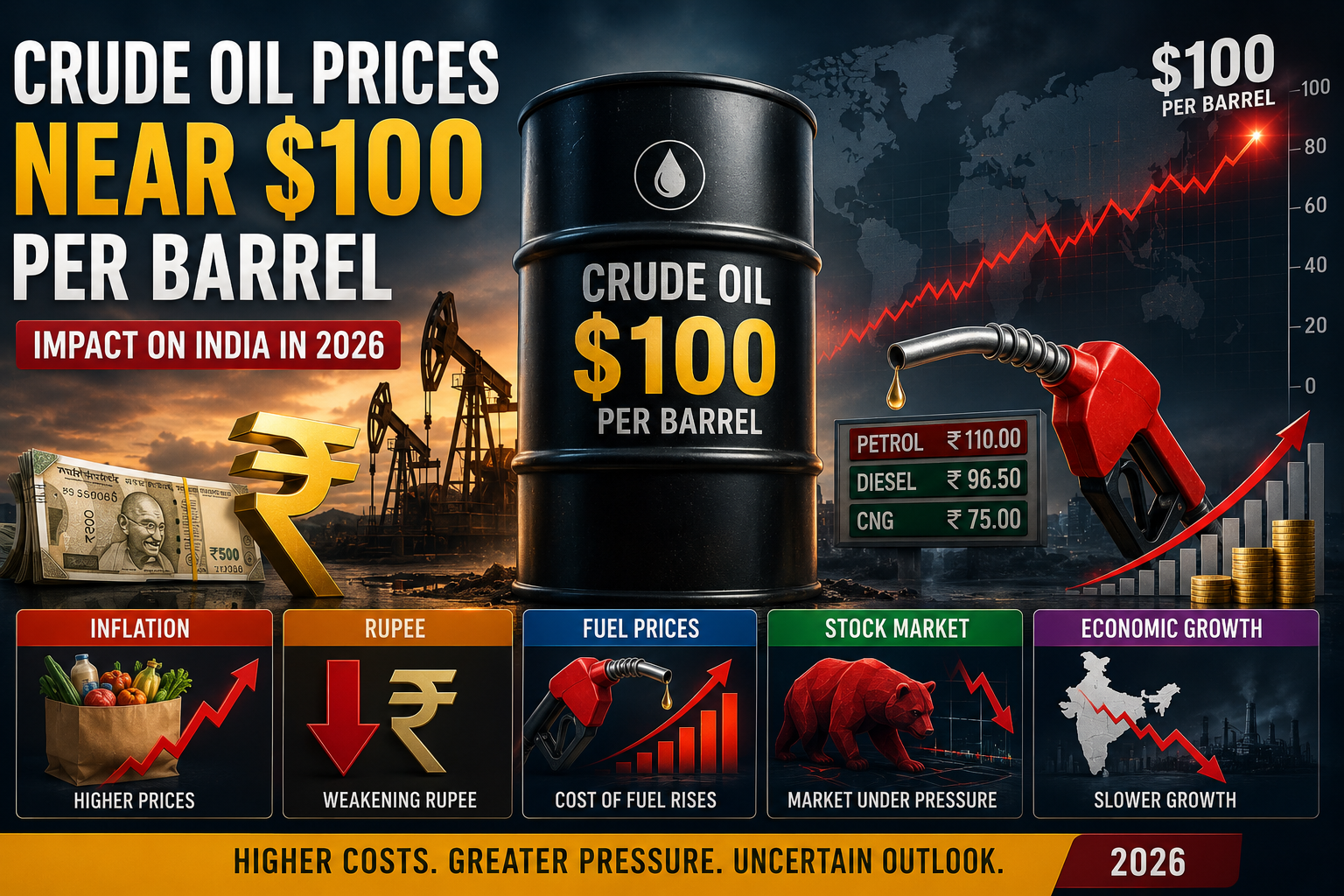
Global crude oil prices are once again approaching the critical $100-per-barrel mark, raising concerns among investors, policymakers, businesses, and consumers across India.
As one of the world's largest oil-importing nations, India is particularly sensitive to sharp movements in energy prices. Higher crude prices can affect everything from fuel costs and inflation to government finances and economic growth.
While India's economy remains resilient, sustained oil-price increases could create significant challenges in the months ahead.
The big question now is:
Will expensive crude oil slow India's growth story in 2026?
AI Answer Box
Why are oil prices important for India?
India imports nearly 85% of its crude oil requirements. Higher oil prices increase import costs, inflation, and pressure on the rupee.
How does expensive crude affect consumers?
It can lead to higher fuel costs, transportation expenses, and prices of everyday goods and services.
Can oil prices hurt economic growth?
Yes. Sustained high oil prices can reduce consumer spending, increase business costs, and put pressure on government finances.
Why Oil Matters So Much to India
Unlike major oil-producing nations, India depends heavily on imported crude oil.
Every year, billions of dollars are spent importing energy to support:
- Transportation
- Manufacturing
- Agriculture
- Power generation
- Logistics
As a result, oil prices have a direct impact on the overall economy.
India's Oil Dependency
| Factor | Status |
|---|---|
| Oil Import Dependence | ~85% |
| Impact of Higher Oil Prices | High |
| Effect on Inflation | Significant |
| Impact on Rupee | Negative |
| Government Concern Level | Very High |
1. Higher Oil Prices Increase Inflation
Inflation is usually the first major concern when crude prices rise.
Why?
Oil affects nearly every part of the economy.
Higher fuel costs increase:
- Transportation expenses
- Manufacturing costs
- Logistics charges
- Agricultural input costs
Businesses often pass these higher costs to consumers.
As a result, prices of many goods and services can rise.
How Oil Drives Inflation
Direct Impact
- Petrol prices
- Diesel prices
- LPG costs
- Aviation fuel
Indirect Impact
- Food transportation
- Product delivery
- Industrial production
- Consumer goods pricing
This makes crude oil one of the most important inflation drivers.
2. Pressure on the Indian Rupee
Higher oil prices increase India's import bill.
When oil companies purchase crude:
- More US dollars are required.
- Dollar demand rises.
- Pressure on the rupee increases.
A weaker rupee can create additional inflation by making imports more expensive.
Rupee and Oil Relationship
| Oil Price Trend | Rupee Impact |
|---|---|
| Rising Oil | Negative |
| Stable Oil | Neutral |
| Falling Oil | Positive |
3. Government Finances May Face Pressure
Higher oil prices can affect public finances in several ways.
Key Risks
- Increased subsidy burdens
- Reduced fiscal flexibility
- Higher government expenditure
Policymakers may face difficult decisions regarding fuel pricing and fiscal management.
4. Impact on Consumers
Consumers often feel the effects of oil-price increases quickly.
Areas Affected
- Petrol and diesel
- Public transportation
- Food prices
- Household budgets
- Travel expenses
Higher living costs can reduce discretionary spending.
5. Businesses Face Higher Costs
Companies across industries may experience rising expenses.
Most Affected Sectors
- Aviation
- Logistics
- Chemicals
- Manufacturing
- Transportation
Higher costs can reduce profitability if businesses cannot fully pass them on to customers.
Sector-Wise Impact
| Sector | Impact |
|---|---|
| Aviation | Negative |
| Logistics | Negative |
| Chemicals | Negative |
| FMCG | Margin Pressure |
| Manufacturing | Cost Increase |
| Oil Producers | Positive |
6. Stock Market Volatility Could Increase
Financial markets closely monitor crude oil prices.
Investors worry that sustained oil-price increases could lead to:
- Higher inflation
- Slower economic growth
- Lower corporate earnings
As a result, oil-price spikes often increase market volatility.
Which Stocks Could Be Most Affected?
Vulnerable Sectors
- Airlines
- Auto companies
- Paint manufacturers
- Consumer goods firms
Potential Beneficiaries
- Energy producers
- Oil exploration companies
- Select commodity businesses
7. Impact on Economic Growth
One of the biggest concerns is the effect on GDP growth.
Higher oil prices can:
- Reduce consumer spending
- Increase business costs
- Slow investment activity
- Weaken demand
These factors may moderate economic growth if oil remains expensive for a prolonged period.
Why India Is Better Prepared Today
Despite the risks, India is stronger than in previous oil-price cycles.
Key Strengths
- Large foreign-exchange reserves
- Strong GST collections
- Expanding digital economy
- Diversified economic base
- Improved financial stability
These factors provide some protection against external shocks.
What the RBI Is Watching
The Reserve Bank of India closely monitors oil prices because they influence:
- Inflation
- Currency stability
- Interest-rate decisions
- Economic growth
If oil prices continue rising, RBI policy decisions could become more challenging.
Expert Commentary
Economists generally agree that oil near $100 per barrel represents a significant risk for India.
However, most experts believe the impact depends on:
Duration
Temporary spikes are easier to absorb.
Intensity
Prices significantly above $100 create greater risks.
Global Conditions
Broader economic conditions will influence overall outcomes.
Many analysts expect policymakers to remain vigilant and use available tools to manage the impact.
Oil Prices: Risks vs Strengths
| Risks | Strengths |
|---|---|
| Higher Inflation | Strong Domestic Demand |
| Rupee Pressure | Large Forex Reserves |
| Costlier Imports | Digital Economy Growth |
| Slower Growth | Infrastructure Spending |
| Fiscal Challenges | Strong Financial System |
Key Takeaways
✅ Crude oil prices are approaching $100 per barrel.
✅ India imports most of its oil requirements.
✅ Higher oil prices increase inflation risks.
✅ The rupee may face additional pressure.
✅ Businesses and consumers could experience higher costs.
✅ India's economy remains resilient but vulnerable to prolonged oil-price increases.
Pros & Cons of High Oil Prices
Pros
- Benefits oil producers
- Supports energy-sector revenues
- Encourages energy diversification
Cons
- Higher inflation
- Increased fuel costs
- Pressure on the rupee
- Slower economic growth
- Reduced consumer spending
Future Outlook
The direction of oil prices will remain one of the most important economic variables for India in 2026.
If crude stabilizes below $100, the economy may continue growing without major disruptions.
However, a sustained move above $100 could:
- Increase inflation pressures
- Affect RBI policy decisions
- Slow consumer spending
- Create market volatility
For now, investors, businesses, and policymakers will continue watching global energy markets closely.
Conclusion
Oil prices nearing $100 per barrel present both a challenge and a test for India's economy.
While the country is better prepared than in past oil-price shocks, prolonged increases could still affect inflation, the rupee, government finances, and economic growth.
The coming months will be crucial in determining whether expensive crude becomes a temporary concern or a major economic headwind for India's growth story.
Frequently Asked Questions (FAQs)
1. Why does oil matter to India?
India imports around 85% of its oil needs.
2. How do higher oil prices affect inflation?
They increase transportation and production costs.
3. Can oil prices weaken the rupee?
Yes, higher imports increase dollar demand.
4. Which sectors are most affected?
Aviation, logistics, chemicals, and manufacturing.
5. Can oil prices impact stock markets?
Yes, they influence inflation and corporate profits.
6. Will petrol prices increase?
Higher crude prices often increase fuel-price pressures.
7. How does RBI react to rising oil prices?
It monitors inflation and economic risks closely.
8. Can high oil prices slow GDP growth?
Yes, if sustained for a long period.
9. Is India prepared for higher oil prices?
India has stronger reserves and economic fundamentals than before.
10. What should investors watch?
Oil prices, inflation, RBI policy, and rupee movements.
Published on : 8th June
Published by : SMITA
www.vizzve.com || www.vizzveservices.com
Follow us on social media: Facebook || Linkedin || Instagram
🛡 Powered by Vizzve Financial
RBI-Registered Loan Partner | 10 Lakh+ Customers | ₹600 Cr+ Disbursed