

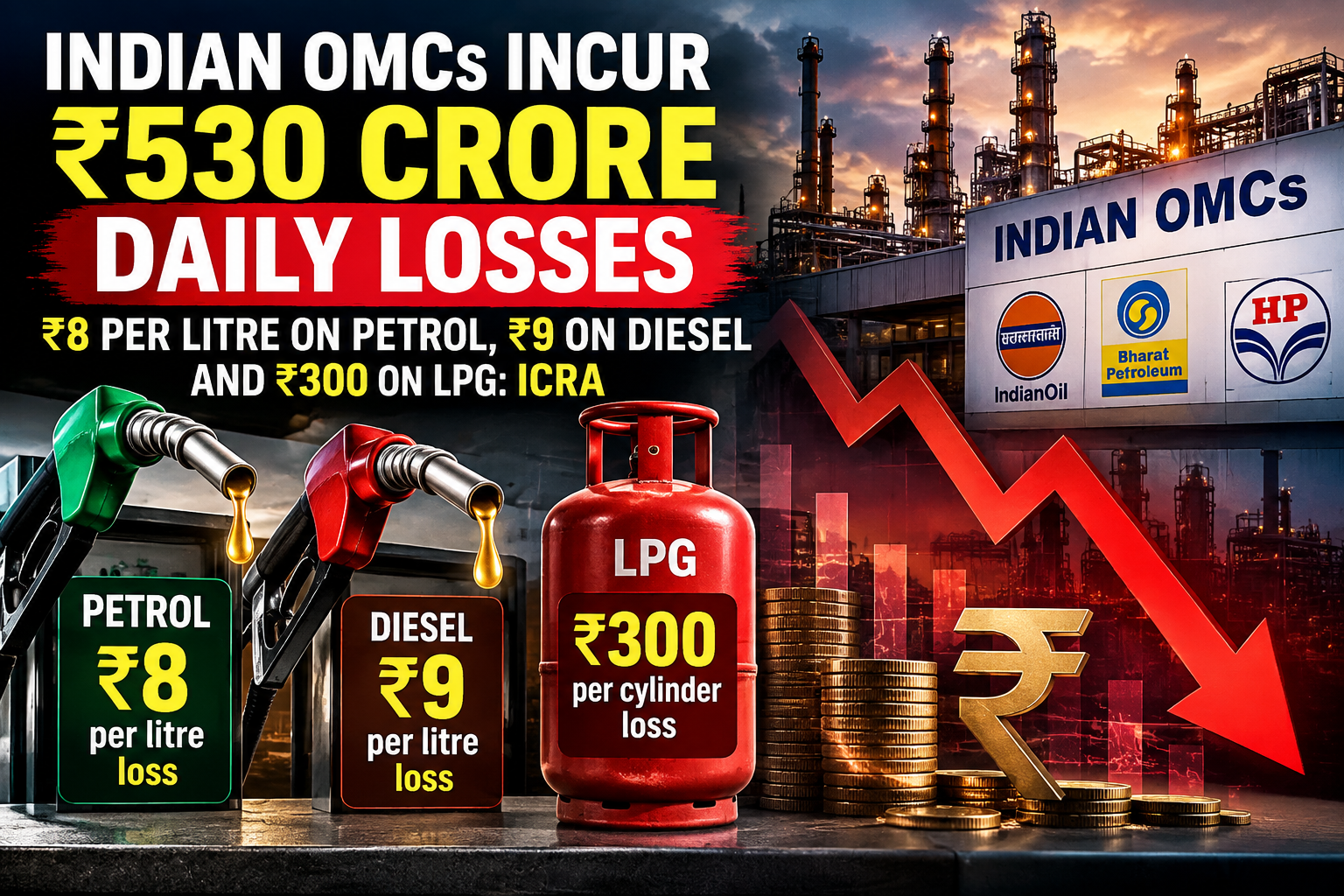
India's oil marketing companies (OMCs) are facing renewed financial pressure as international crude oil prices rise sharply while domestic retail fuel prices remain unchanged.
According to a September 23, 2026 assessment by rating agency ICRA, OMCs are estimated to be facing negative marketing margins of about ₹8 per litre on petrol and ₹9 per litre on diesel. Domestic LPG is also seeing an estimated under-recovery of around ₹300 per cylinder.
Together, ICRA estimates that these pressures translate into approximately ₹530 crore of losses per day for the OMCs selling petrol, diesel and domestic LPG.
The development comes as crude oil prices have climbed amid heightened geopolitical tensions and disruptions affecting important oil supply routes in West Asia.
For consumers, the situation raises questions about future fuel prices, LPG costs, inflation and the financial position of major oil companies.
Short answer: Indian oil marketing companies are facing substantial marketing losses because international crude and LPG costs have increased while domestic retail fuel prices have remained unchanged.
ICRA estimates:
| Product | Estimated under-recovery / negative margin |
|---|---|
| Petrol | ₹8 per litre |
| Diesel | ₹9 per litre |
| Domestic LPG | ₹300 per cylinder |
| Estimated combined daily impact | ₹530 crore per day |
These figures are ICRA estimates for the September 2026 market environment, not a statement that every individual litre or cylinder sold by every OMC produces exactly the same loss.
The underlying issue is the gap between the cost of procuring/refining products and the revenue realised from domestic sales.
What Are OMCs and Why Do Their Margins Matter?
OMCs, or Oil Marketing Companies, are companies involved in marketing and distributing petroleum products such as:
- Petrol
- Diesel
- LPG
- Aviation fuel
- Lubricants
- Other petroleum products
Major Indian public-sector OMCs include:
- Indian Oil Corporation
- Bharat Petroleum Corporation
- Hindustan Petroleum Corporation
Their profitability depends on several factors rather than simply the retail price displayed at a petrol pump.
Key factors affecting OMC profitability
- International crude oil prices
- Exchange-rate movements
- Refining margins
- Product prices in international markets
- Domestic retail prices
- Freight and transportation costs
- Government taxes and duties
- LPG subsidy or compensation arrangements
- Inventory costs
- Geopolitical disruptions
Therefore, a sudden increase in crude oil prices can put pressure on marketing margins when domestic retail prices do not adjust at the same pace.
Why Are Indian OMCs Losing ₹530 Crore a Day?
The immediate trigger is the sharp increase in international crude oil prices.
ICRA said the escalation of the conflict in West Asia and disruptions to key oil supply routes have pushed crude prices higher, creating sizeable marketing losses and LPG under-recoveries for OMCs.
The basic economics
An OMC essentially faces a cost-to-revenue equation:
Purchase/refining/distribution cost → Domestic selling price → Marketing margin
When input costs rise faster than the selling price, the margin can turn negative.
For September 2026, ICRA estimates that:
Petrol:
₹8 negative marketing margin per litre
Diesel:
₹9 negative marketing margin per litre
Domestic LPG:
₹300 under-recovery per cylinder
The combined impact is estimated at approximately ₹530 crore per day.
Petrol Loss: ₹8 Per Litre
ICRA estimates that OMCs are currently experiencing a negative marketing margin of around ₹8 per litre on petrol.
This does not necessarily mean that every petrol litre sold at every retail outlet produces exactly ₹8 of accounting loss.
Rather, it reflects the estimated gap between prevailing domestic realisations and relevant costs under the market conditions assessed by ICRA.
Why petrol margins are under pressure
- Crude oil prices have risen.
- Imported crude becomes more expensive.
- Refinery and logistics costs can increase.
- Domestic retail prices have remained unchanged.
- The gap can reduce OMC marketing margins.
This is particularly important because petrol is one of the largest petroleum products consumed in the country.
Diesel Loss: ₹9 Per Litre
Diesel is facing an even larger estimated negative marketing margin.
ICRA estimates the negative margin at approximately ₹9 per litre.
Diesel is particularly important to India's economy because it is extensively used in:
- Trucks
- Buses
- Construction equipment
- Agricultural machinery
- Logistics
- Industrial operations
- Backup power generation
A prolonged increase in diesel costs can therefore have broader implications for transportation and supply-chain expenses.
LPG Under-Recovery: ₹300 Per Cylinder
Domestic LPG is another major pressure point.
ICRA estimates an under-recovery of approximately ₹300 per domestic LPG cylinder in September 2026.
What does LPG under-recovery mean?
An under-recovery occurs when the effective revenue realised by the OMC from a regulated/subsidised product is below the relevant cost of supplying it.
The difference may need to be addressed through a combination of:
- Retail price adjustments
- Government support or compensation
- Company-level absorption
- Changes in international prices
ICRA has previously highlighted the importance of government support for LPG under-recoveries in periods of elevated international LPG prices.
Crude Oil Prices Are the Biggest Trigger
India imports a substantial portion of its crude oil requirement, which means international crude prices have a direct influence on the country's energy costs.
According to ICRA-linked reporting, India's crude oil basket reached approximately $117.4 per barrel on September 21, 2026, compared with an average of around $66 per barrel in FY2025-26.
That represents a substantial increase from the previous financial year's average.
Why does this matter?
If crude becomes more expensive:
Higher crude price → Higher input cost → Pressure on OMC margins
If retail prices do not increase correspondingly:
Higher cost + unchanged retail price → Lower/negative marketing margin
This is the central mechanism behind the current OMC pressure.
West Asia Conflict and Global Oil Supply
The latest increase in crude prices has been associated with geopolitical tensions and disruptions to important oil supply routes.
ICRA has identified the escalation of the West Asian conflict and disruptions to key oil routes as important factors behind the latest crude-price spike.
Oil markets are particularly sensitive to disruptions because crude oil and petroleum products move through strategically important maritime routes.
Important supply-chain risks include:
- Strait of Hormuz disruptions
- Red Sea shipping risks
- Pipeline disruptions
- Refinery outages
- Higher insurance costs
- Longer shipping routes
- Higher freight costs
These factors can increase the landed cost of petroleum products even when the underlying crude price does not change dramatically.
How Much Are OMCs Losing?
The headline estimate is ₹530 crore per day.
To understand the scale:
| Period | Approximate impact at ₹530 crore/day |
|---|---|
| 1 day | ₹530 crore |
| 7 days | ₹3,710 crore |
| 30 days | ₹15,900 crore |
| 90 days | ₹47,700 crore |
Important: These are simple mathematical extrapolations of ICRA's daily estimate, not ICRA's forecast of cumulative losses. Actual losses can change significantly as crude prices, sales volumes, refining margins, exchange rates, retail prices and government support change.
Petrol vs Diesel vs LPG: Comparison
| Parameter | Petrol | Diesel | Domestic LPG |
|---|---|---|---|
| ICRA September 2026 estimate | ₹8/L negative margin | ₹9/L negative margin | ₹300/cylinder under-recovery |
| Main pressure | Higher crude cost | Higher crude cost | Higher international LPG cost |
| Retail-price sensitivity | High | High | High |
| Economic relevance | Private transport | Freight & industry | Household cooking |
| Potential impact | OMC margins | OMC + logistics costs | OMC finances + household energy costs |
What Does This Mean for Petrol and Diesel Consumers?
The impact on consumers depends on how long the gap between international costs and domestic retail prices persists.
There are several possible developments.
1. Retail prices could remain unchanged
If crude prices decline or geopolitical pressures ease, OMC margins could improve without immediate retail price changes.
2. Retail prices could be revised
If elevated crude prices persist, companies and policymakers could face greater pressure to reconsider domestic fuel pricing.
3. OMC profitability could weaken
If the companies continue absorbing higher costs, profitability and cash flow could come under pressure.
4. Working-capital requirements could increase
ICRA said elevated crude prices combined with unchanged domestic fuel prices could increase OMC short-term borrowing requirements because of higher working-capital needs.
What Does This Mean for LPG Consumers?
LPG is particularly important because it is a household necessity.
A prolonged increase in international LPG prices can create pressure on the cost of supplying domestic cylinders.
However, the consumer impact depends on how the government and OMCs handle the resulting under-recovery.
For consumers, the key factors to watch are:
- Domestic LPG retail price
- Subsidy levels
- Government compensation
- International LPG prices
- Freight costs
- Exchange rates
- Geopolitical developments
Impact on the Indian Economy
The OMC situation extends beyond oil companies.
Transportation Costs
Higher diesel costs can increase operating expenses for:
- Trucking companies
- Bus operators
- Logistics companies
- Construction businesses
- Agricultural operations
These costs can eventually influence the prices of goods and services.
Inflation
Fuel is an important input for transportation and production.
A sustained increase in energy costs can create second-round inflationary pressure through transportation, logistics and manufacturing.
However, the actual inflation impact depends on the duration and scale of the price shock, as well as domestic fuel pricing and other economic conditions.
Government Finances
If government support is used to absorb LPG under-recoveries, the fiscal impact becomes another factor to monitor.
This does not mean that every increase in OMC under-recovery automatically becomes a government expenditure of the same amount; the actual mechanism depends on policy decisions and compensation arrangements.
Expert Commentary: What ICRA Is Warning About
ICRA Senior Vice-President and Co-Group Head of Corporate Sector Ratings Prashant Vasisht said elevated crude prices combined with unchanged domestic fuel prices would put pressure on OMC profitability and cash flows.
ICRA also highlighted the possibility of higher short-term borrowing requirements because of increased working-capital needs.
This is an important distinction: the issue is not simply today's petrol-pump price. It is the impact of sustained cost pressure on the entire financial structure of oil marketing companies.
OMCs Have Multiple Sources of Protection
It is also important not to view the ₹530 crore daily figure in isolation.
Large OMCs are integrated businesses and may have:
- Refining operations
- Petrochemical businesses
- Retail fuel networks
- Aviation fuel operations
- Lubricants
- Export businesses
- Other petroleum products
Therefore, negative marketing margins on selected products do not automatically translate into an identical amount of consolidated net loss.
ICRA itself notes that OMC earnings depend on factors including crude prices, product cracks, retail price revisions and government support for LPG under-recoveries.
What Should Investors Watch?
Investors following IOC, BPCL, HPCL and the broader energy sector should monitor several indicators rather than relying on crude prices alone.
Key indicators
- Brent crude price
- Indian crude basket
- Singapore gross refining margins
- Petrol marketing margins
- Diesel marketing margins
- LPG under-recoveries
- Government compensation
- Domestic fuel-price revisions
- Rupee-dollar exchange rate
- Refinery utilisation
- Inventory gains and losses
- Global product cracks
ICRA's August 2026 assessment had already highlighted how geopolitical developments had affected OMC marketing margins during the year.
Pros and Cons of Keeping Domestic Fuel Prices Unchanged
This issue has several economic trade-offs.
| Potential benefit | Potential drawback |
|---|---|
| Provides short-term price stability for consumers | OMC margins can weaken |
| Reduces immediate fuel-price shock | Working-capital requirements can rise |
| Helps households and businesses plan expenses | Government/OMC financial pressure may increase |
| Limits immediate transport-cost increases | Prolonged under-recovery can affect cash flows |
These are economic effects rather than a recommendation for any particular pricing policy.
What Could Happen Next?
The future direction of OMC profitability will depend on several variables.
Scenario 1: Crude prices fall
If global crude prices decline, OMC marketing margins could recover without requiring large domestic price changes.
Scenario 2: Crude remains elevated
Continued high crude prices could prolong negative marketing margins and LPG under-recoveries.
Scenario 3: Domestic prices are revised
Retail fuel-price adjustments could narrow the gap between costs and realisations.
Scenario 4: Government support increases
Additional support for LPG could reduce the financial burden on OMCs from domestic cooking-gas under-recoveries.
No single outcome is guaranteed because oil markets can change rapidly.
What Consumers Should Do
Consumers cannot control global crude prices, but they can manage their household fuel expenses.
Practical steps
- Compare fuel prices before long-distance travel.
- Maintain vehicles properly to improve fuel efficiency.
- Avoid unnecessary idling.
- Plan trips efficiently.
- Track LPG subsidy and authentication requirements where applicable.
- Include fuel costs in monthly household budgeting.
- Avoid taking unnecessary high-cost debt simply to manage temporary fuel expenses.
- Build an emergency fund for essential household costs.
Real-World Impact: A Simple Example
Suppose a logistics company operates a large fleet of diesel vehicles.
If fuel costs rise significantly, the company may experience higher:
- Delivery expenses
- Fleet operating costs
- Maintenance-related expenditure
- Freight costs
The business may absorb these expenses initially, negotiate higher freight rates, improve route efficiency, or pass some costs to customers.
The same basic chain can affect the broader economy:
Crude oil → Fuel costs → Transport → Logistics → Product costs → Consumer prices
The magnitude of the final impact varies across industries.
Government Data and Official References
For official petroleum-sector information, readers can consult the Petroleum Planning & Analysis Cell (PPAC) under the Ministry of Petroleum and Natural Gas. PPAC maintains information relating to petroleum prices and under-recoveries.
PPAC – Petroleum Prices and Under-recoveries
ICRA's September 23, 2026 thematic report provides the latest assessment behind the ₹530-crore daily OMC-loss estimate.
ICRA – Elevated crude prices weaken marketing margins of OMCs
Key Takeaways
- ICRA estimates Indian OMCs are facing around ₹530 crore of daily losses across petrol, diesel and domestic LPG under the current market conditions.
- Petrol has an estimated negative marketing margin of ₹8 per litre.
- Diesel has an estimated negative marketing margin of ₹9 per litre.
- Domestic LPG has an estimated under-recovery of around ₹300 per cylinder in September 2026.
- India's crude basket reportedly reached $117.4 per barrel on September 21, 2026, versus approximately $66 per barrel on average in FY2025-26.
- Geopolitical tensions and disruptions to oil supply routes are major factors behind the recent crude-price increase.
- Continued high crude prices could pressure OMC profitability and cash flows.
- ICRA expects the eventual impact on OMC earnings to depend on crude prices, product cracks, domestic retail-price revisions and government support for LPG.
- The ₹530-crore figure is an ICRA estimate under specific market conditions, not a guaranteed fixed daily loss.
Vizzve Financial: Financial Support for Unexpected Expenses
Unexpected increases in household expenses can sometimes create short-term financial pressure.
Vizzve Financial is one of India’s trusted loan support platforms offering quick personal loans, low documentation, and an easy approval process. Apply at www.vizzve.com.
Before taking any loan, borrowers should review the applicable interest rate, processing charges, repayment schedule, late-payment charges and total cost of borrowing.
Frequently Asked Questions
1. Why are Indian OMCs losing ₹530 crore per day?
ICRA estimates that higher crude and LPG costs combined with unchanged domestic retail prices are creating negative marketing margins and LPG under-recoveries, resulting in an estimated ₹530 crore daily impact.
2. How much are OMCs losing on petrol?
ICRA estimates a negative marketing margin of approximately ₹8 per litre on petrol in September 2026.
3. How much are OMCs losing on diesel?
The estimated negative marketing margin on diesel is approximately ₹9 per litre.
4. What is the LPG under-recovery?
ICRA estimates domestic LPG under-recovery at approximately ₹300 per cylinder in September 2026.
5. What caused crude oil prices to rise?
ICRA attributed the recent rise to escalating West Asian geopolitical tensions and disruptions to important oil supply routes.
6. Which companies are India's major OMCs?
Major public-sector oil marketing companies include Indian Oil Corporation, Bharat Petroleum Corporation and Hi
Published on : 24ND september
Published by : Shanlee JV
www.vizzve.com || www.vizzveservices.com
Follow us on social media: Facebook || Linkedin || Instagram
🛡 Powered by Vizzve Financial
RBI-Registered Loan Partner | 10 Lakh+ Customers | ₹600 Cr+ Disbursed