

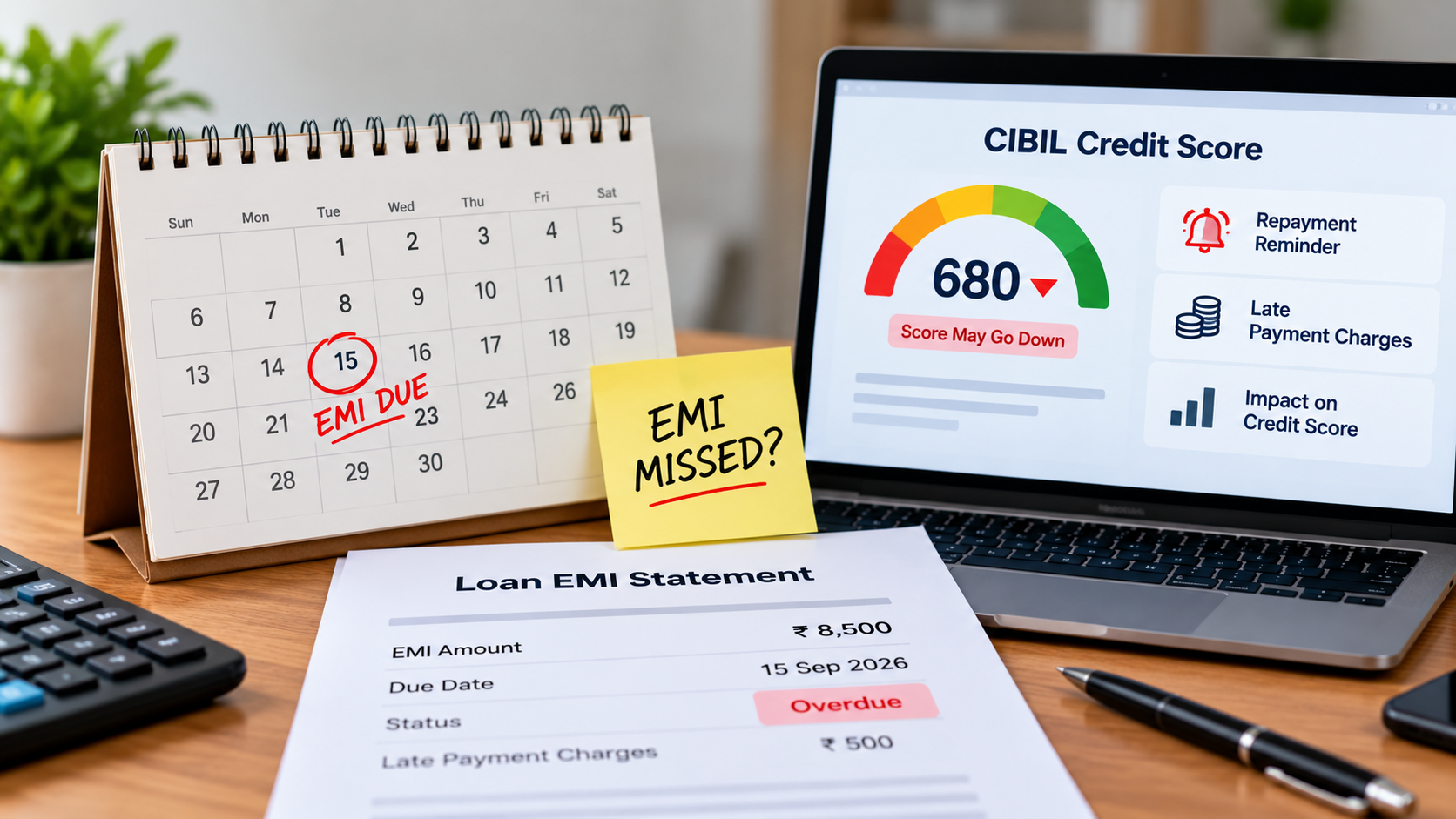
Missing one loan EMI can lead to late payment or bounce charges, reminders from your lender and a possible negative impact on your credit history. The actual consequences depend on your lender's terms, how long the payment remains overdue and whether the delay is reported to credit bureaus.
The most important step is to pay the overdue EMI as soon as possible, confirm any additional charges with your lender and check your credit report later. A single missed EMI does not automatically mean your loan is classified as a defaulted account or that your CIBIL score will fall by a fixed number of points.
Introduction
A loan EMI is a fixed amount that a borrower pays every month to repay a loan. Whether you have taken a personal loan, home loan, car loan or another type of instalment-based loan, paying your EMI on time is an important part of managing your finances.
But what happens when you miss just one EMI?
It can happen for several reasons. Your salary may be delayed, an unexpected expense may affect your monthly budget, or your bank account may not have enough balance when the automatic payment is attempted.
Missing one payment does not necessarily mean you are in a serious financial situation. However, ignoring the missed EMI can make the problem more expensive and may affect your credit history.
In this guide, we explain what happens after missing one EMI, how it may affect your CIBIL score, what charges you could face and how to manage the situation responsibly.
What Happens Immediately After You Miss an EMI?
When your EMI is not paid on the scheduled date, your loan account may show an overdue amount. The exact process depends on your lender and the terms of your loan agreement.
Here are the common consequences.
1. Your EMI Becomes Overdue
If the payment does not reach the lender by the due date, the instalment may be marked as unpaid.
Your lender may attempt to collect the payment again, depending on the repayment arrangement. However, you should not assume that another automatic debit will happen.
Check your bank account and loan account to confirm whether the payment was successful.
2. You May Have to Pay Late Charges
A missed EMI may result in charges under your loan agreement. These could include a payment-return or EMI-bounce charge, where applicable, and penal charges for the overdue payment.
The amount varies by lender and loan product. Check your loan agreement, Key Facts Statement (KFS), or the lender's schedule of charges rather than assuming a standard penalty applies to every loan.
RBI rules require applicable penal charges to be reasonable, disclosed and handled according to the relevant regulatory requirements. Penal charges cannot simply be added to the loan balance so that further interest is charged on those penal charges.
3. Your Lender May Send Reminders
Your lender may contact you through SMS, email, phone calls or its loan app to remind you about the unpaid instalment.
These reminders are intended to inform you that the payment is outstanding and explain how to clear it.
Do not ignore these messages. If you cannot pay immediately, contact the lender and explain your situation.
4. Your Credit History May Be Affected
Lenders report credit information to credit information companies, including TransUnion CIBIL. An overdue EMI may appear in your credit history depending on the account status and reporting process.
A missed EMI does not guarantee a specific reduction in your credit score. The effect depends on factors such as your existing credit history, the length of the delay, and the information reported by the lender.
Will Missing One EMI Affect Your CIBIL Score?
Yes, it can—but the impact is not identical for every borrower.
Your CIBIL score is based on information in your credit report, including your repayment history and credit accounts. Payment delays can affect the way lenders assess your creditworthiness.
Consider these situations:
| Situation | Possible impact |
|---|---|
| EMI missed but paid promptly | You may avoid a prolonged overdue, but charges may still apply |
| EMI remains unpaid for several weeks | Greater risk of overdue reporting and additional charges |
| Multiple EMIs missed | More serious repayment-history concerns |
| Regular payments resume | Helps establish a positive repayment pattern going forward |
Paying the EMI quickly is important, but it does not guarantee that a delay will never appear in your credit report.
Does One Day of Delay Automatically Damage Your CIBIL Score?
Not necessarily. A one-day delay does not automatically translate into a fixed score reduction. The outcome depends on the lender's records, reporting practices and the credit bureau's processing.
If you missed an EMI by mistake, pay it as soon as possible and ask your lender whether the payment has been recorded correctly.
What If You Miss an EMI Because of an Auto-Debit Failure?
An EMI may fail even when you intended to pay on time.
Common reasons include:
- Insufficient balance in your bank account
- Salary credited later than expected
- Expired or inactive auto-debit mandate
- Incorrect bank account details
- A technical issue with the payment system
If an auto-debit fails, check both your bank statement and your loan account. Sometimes a debit may be pending or reversed, so verify the final status before paying again.
If the EMI remains unpaid, use the lender's official payment channel to clear the dues. Keep the transaction receipt or payment confirmation for your records.
What Should You Do After Missing One EMI?
Taking action early can help prevent a small payment issue from becoming a larger financial problem.
Step 1: Check Your Loan Account
Log in to your lender's official website or mobile app. Confirm whether the EMI is unpaid, the amount overdue and any charges that have been applied.
Step 2: Pay the Overdue EMI as Soon as Possible
If you can afford the payment, clear the overdue instalment through an approved payment method.
Do not wait until the next EMI date simply because you expect the next month's payment to cover the missed one. Your lender may require the overdue instalment and applicable charges to be paid separately.
Step 3: Confirm the Total Amount Due
Ask your lender for a clear breakdown of:
- The unpaid EMI
- Any applicable bounce or return charges
- Any applicable penal charges
- Any regular interest due under the loan agreement
If a charge appears incorrect, request an explanation and raise a complaint through the lender's official grievance process if necessary.
Step 4: Keep Proof of Payment
Save the payment receipt, transaction reference number, bank statement or confirmation message.
These records can help if your loan account continues to show an overdue amount after payment.
Step 5: Check Your Credit Report
After the lender has processed your payment and updated its records, review your credit report to check whether the loan account information is accurate.
If the overdue status is not updated correctly, contact the lender and the relevant credit bureau to raise a dispute.
What Happens If You Miss Two or Three EMIs?
Missing multiple EMIs can create a more serious repayment problem than missing a single instalment.
The longer an account remains overdue, the greater the possibility of additional charges, repeated collection reminders and adverse credit reporting.
For eligible bank loans, an account may be classified as a non-performing asset (NPA) when the applicable regulatory criteria are met. For many term loans, the 90-day overdue norm is relevant, but the applicable classification rules depend on the type of facility and lender.
Do not treat 90 days as a safe period to delay repayment. Charges and credit-reporting consequences may arise well before that point.
If you are unable to pay several instalments, contact your lender as early as possible to discuss the available options.
Can You Pay a Missed EMI Along With Next Month's EMI?
You may be able to pay both amounts together, but you should confirm the total dues with your lender first.
For example, suppose your monthly EMI is ₹8,000 and you miss one payment. When the next EMI becomes due, you may have to pay:
| Particulars | Amount |
|---|---|
| Previous unpaid EMI | ₹8,000 |
| Current month's EMI | ₹8,000 |
| Additional applicable charges | As per lender |
| Total before charges | ₹16,000 |
This is only an illustration. Your actual amount may differ depending on payment dates, interest and the terms of your loan.
If paying both instalments at once is difficult, speak to the lender rather than assuming the missed amount will automatically be added to the end of the loan tenure.
What If You Cannot Afford the Missed EMI?
If your financial situation has changed, focus on finding a realistic repayment plan.
You can consider the following steps:
- Contact your lender: Explain why the payment was missed and ask about the available repayment options.
- Review your monthly budget: Identify non-essential expenses that can be reduced temporarily.
- Prioritise essential payments: Account for housing, food, utilities and other necessary expenses before making a repayment commitment you cannot maintain.
- Ask about restructuring, if appropriate: Any change to your repayment schedule is subject to the lender's policies and approval.
- Avoid taking another expensive loan without calculating the cost: Borrowing to repay an EMI may shift the problem rather than solve it.
Never promise a payment date that you know you cannot meet. A realistic plan is more useful than repeatedly missing promised payments.
Can the Bank Take Legal Action for One Missed EMI?
Missing one EMI does not automatically mean that a lender will take legal action.
However, continued non-payment can lead to more formal recovery steps, depending on the loan agreement, the type of loan, applicable law and the lender's policies.
If you receive a formal notice, read it carefully and respond within any stated deadline. If you believe a recovery agent is behaving improperly, preserve the relevant messages and call records and complain to the lender through its official grievance channel.
Borrowers should be treated fairly during recovery. If a complaint remains unresolved, you may be able to use the RBI's applicable complaint-resolution mechanisms, subject to their eligibility requirements.
How to Avoid Missing Your Next EMI
A few simple habits can make EMI payments easier to manage.
Set Up Payment Reminders
Set a reminder several days before the EMI due date. This gives you time to arrange funds if your salary or other income is delayed.
Maintain a Bank Balance Buffer
Keep enough money in the linked account to cover the EMI and any other scheduled payments. Where possible, maintain a small buffer for unexpected expenses.
Align Your EMI Date With Your Income
If your lender permits a change in the EMI date, ask whether it can be aligned with your salary or regular income date.
Track All Your Loan Payments
If you have multiple loans, maintain a simple calendar or spreadsheet showing each EMI amount, due date and payment status.
Build an Emergency Fund
Even a modest emergency fund can help cover temporary income disruptions or unexpected expenses without immediately missing a loan payment.
RBI Rules on Loan Penalties: What Borrowers Should Know
The Reserve Bank of India has issued rules on penal charges for loan-related non-compliance.
For applicable loans, lenders must follow their approved policies and disclose the relevant charges. Penal charges should be reasonable and proportionate to the nature of the non-compliance.
The RBI's framework also distinguishes penal charges from penal interest. Penal charges should not be capitalised—that is, additional interest should not be charged on the penal charges themselves. Regular interest on unpaid amounts may still apply according to the loan contract and applicable rules.
For the exact charges applicable to your loan, refer to your loan agreement, KFS and the lender's current schedule of charges.
Frequently Asked Questions (FAQs)
1. What happens if I miss one EMI?
Your EMI may become overdue, and your lender may apply charges under your loan agreement. You may also receive repayment reminders, and the delay could affect your credit history.
2. Will my CIBIL score drop if I miss one EMI?
It may, but a fixed score reduction is not guaranteed. The effect depends on your credit profile, the duration of the delay and the information reported by your lender.
3. Can I pay my missed EMI the next day?
In many cases, you can clear the overdue payment the next day. Check your lender's official payment process and confirm the total amount due, including any applicable charges.
4. Will I be charged a penalty for a missed EMI?
You may be charged a payment-return fee or penal charges, depending on your loan terms and the reason for the charge. Check your loan agreement and KFS for the applicable details.
5. Does one missed EMI make me a loan defaulter?
A missed EMI is a repayment delay, but it does not automatically mean that your loan has been classified as an NPA. Account classification depends on the applicable rules and the period of overdue.
6. Can I pay two EMIs in the next month?
You may be able to pay the previous overdue EMI along with the current EMI. Confirm the total outstanding amount and payment instructions with your lender.
7. What happens if my EMI auto-debit fails?
The EMI may remain unpaid, and applicable charges may arise. Check your bank and loan account, then clear the overdue amount through an authorised payment method.
8. Can I ask my bank to waive EMI bounce charges?
You can request a waiver, particularly if there was a genuine error or unusual circumstance. Approval depends on the lender's policy and the facts of your case.
9. How long does a missed EMI stay on my credit report?
The reporting and retention of repayment information depend on the applicable credit-reporting rules and bureau practices. A corrected or paid overdue may still have a recorded payment history; payment does not necessarily erase the past delay.
10. Can I get another loan after missing one EMI?
You may still be eligible, but lenders consider several factors, including income, existing obligations, repayment history and credit score. Approval is never guaranteed.
11. What should I do if my credit report shows an EMI as unpaid even after payment?
Keep your payment proof and contact your lender to request an update. If the information remains incorrect, raise a dispute with the relevant credit bureau and track the complaint.
12. Can the lender call me repeatedly for one missed EMI?
Lenders may contact borrowers about overdue payments, but recovery communications must comply with applicable rules and fair practices. If you experience harassment or improper conduct, document it and complain to the lender.
13. Is it better to miss an EMI or take another loan to pay it?
There is no universal answer. Compare the costs, risks and repayment terms before borrowing again. Contact your existing lender first to understand your options.
14. Can I change my EMI due date?
Some lenders may permit a due-date change, subject to their policies and approval. Contact your lender to check whether this option is available.
15. How can I avoid missing an EMI in the future?
Set reminders, maintain sufficient account balance, track your due dates and build an emergency fund. If your income date is different from your EMI date, ask your lender whether the payment date can be changed.
Published on : 29th September
Published by : SMITA
www.vizzve.com || www.vizzveservices.com
Follow us on social media: Facebook || Linkedin || Instagram
🛡 Powered by Vizzve Financial
RBI-Registered Loan Partner | 10 Lakh+ Customers | ₹600 Cr+ Disbursed