

Introduction
Applying for a loan online has become easier with digital banking, mobile applications and financial platforms. Today, borrowers can explore different loan options, compare interest rates, check eligibility and submit applications without visiting a bank branch.
However, choosing the right online loan is important. Different lenders offer different interest rates, repayment periods, processing fees and eligibility requirements. Understanding these differences can help borrowers make better financial decisions.
In this guide, we will explain the different online loan application options, how they work, their differences and the important factors to compare before applying.
1. What Are the Different Online Loan Application Options?
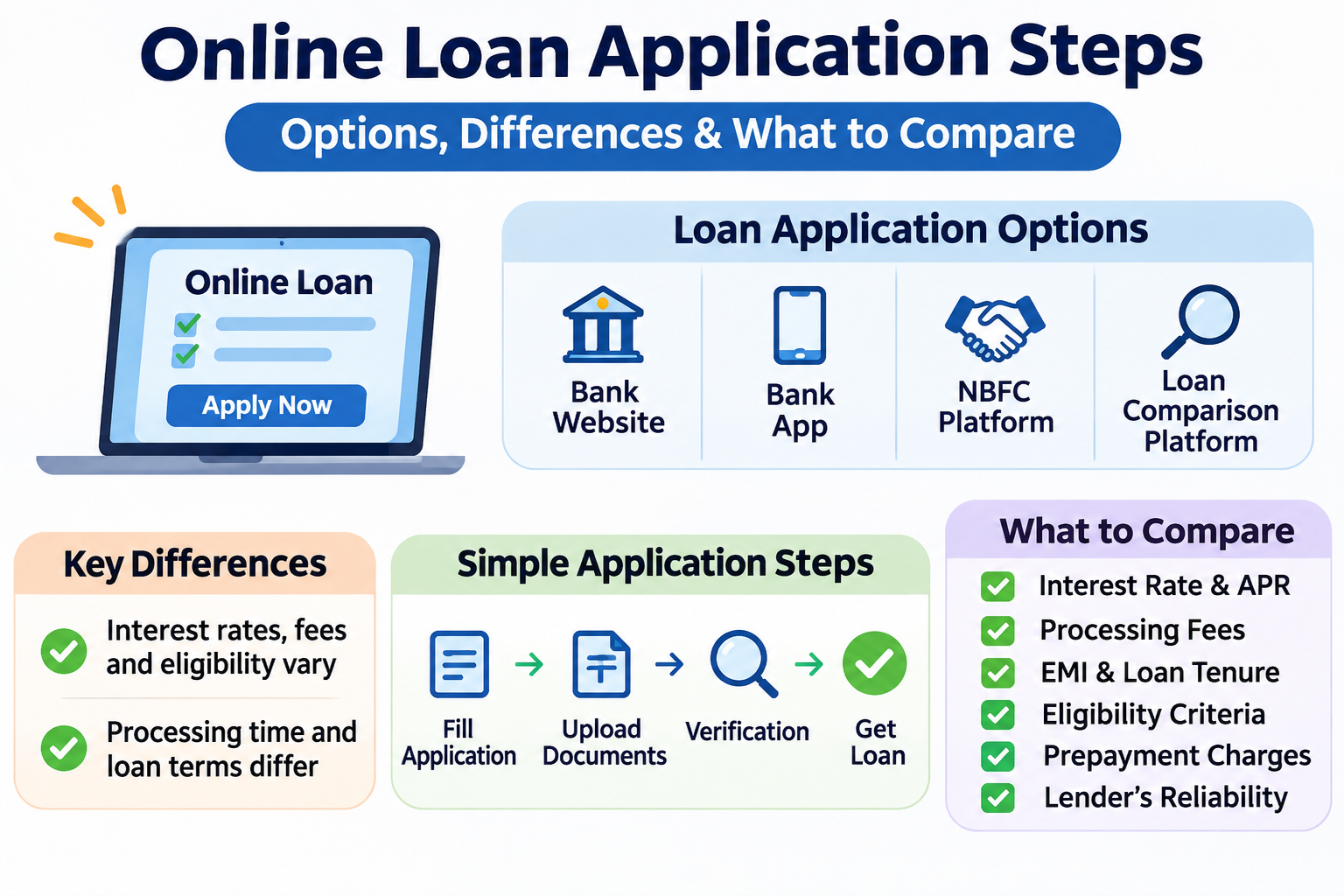
Borrowers can apply for loans through several digital platforms. The most common options include:
1. Bank Websites
Many banks allow customers to apply for personal loans directly through their official websites.
-
Online eligibility checking.
-
Digital application forms.
-
Document submission.
-
Loan status tracking.
2. Bank Mobile Applications
Banking apps allow existing customers to check pre-approved loan offers and apply using their mobile phones.
3. NBFC Websites and Applications
Non-Banking Financial Companies (NBFCs) provide digital loan application facilities with different eligibility requirements and repayment options.
4. Digital Lending Platforms
Digital lending platforms help borrowers explore loan products and connect with regulated lenders. Always verify the actual lender before submitting an application.
5. Loan Comparison Platforms
These platforms help users compare loan offers based on interest rates, fees, repayment periods and other conditions.
2. Differences Between Online Loan Application Options
|
Loan option |
Main benefit |
What to check |
|---|---|---|
|
Bank website |
Direct lender application |
Eligibility and interest rate |
|
Bank mobile app |
Convenient application |
Pre-approved offer conditions |
|
NBFC platform |
Alternative lending options |
Total borrowing cost |
|
Digital lending platform |
Easy online process |
Actual regulated lender |
|
Comparison platform |
Compare multiple offers |
Accuracy of displayed offers |
3. Step-by-Step Online Loan Application Process
Applying for a loan online generally involves the following steps:
-
Choose a loan type: Decide whether you need a personal loan, business loan, education loan or another loan product.
-
Compare lenders: Check interest rates, processing fees, repayment periods and eligibility conditions.
-
Check eligibility: Review the lender's minimum income, age, employment and credit score requirements.
-
Complete the application form: Enter your personal, employment and income details.
-
Upload documents: Submit the required identity, address and income documents.
-
Complete verification: The lender may verify your details and assess your repayment capacity.
-
Review the loan offer: Read the interest rate, APR, EMI, charges and repayment conditions.
-
Accept the loan agreement: Proceed only after understanding and accepting the terms.
-
Receive the loan amount: Once approved, the lender disburses the amount according to the agreed terms.
4. What Should You Compare Before Applying for an Online Loan?
Comparing loan offers helps borrowers understand the actual cost of borrowing.
Interest Rate
Check whether the interest rate is fixed or floating. A lower interest rate may reduce your repayment cost.
Annual Percentage Rate (APR)
APR represents the annual cost of borrowing, including applicable interest and associated charges. It is useful when comparing different loan offers.
Processing Fees
Some lenders charge a processing fee when approving a loan. Check whether GST and other applicable charges are included.
Loan Tenure
Loan tenure refers to the time allowed to repay the borrowed amount. A longer tenure may reduce monthly EMI but increase the total interest paid.
Monthly EMI
Compare the monthly instalment with your income and regular expenses. Choose an EMI that you can comfortably afford.
Prepayment and Foreclosure Charges
Check whether the lender allows early repayment and whether any applicable charges or conditions apply.
Customer Support
Choose a lender with accessible customer support and a clear complaint-resolution process.
5. Important Documents Required for Online Loan Applications
Most lenders may request the following documents:
-
Aadhaar card or other accepted identity proof.
-
PAN card.
-
Address proof.
-
Recent salary slips.
-
Bank account statements.
-
Employment or business details.
-
Recent photographs, if required.
Document requirements differ depending on the lender and loan type.
6. Online Loan Application: Important Factors to Check
Before submitting your application, consider these important points:
|
Factor |
What to check |
|---|---|
|
Lender verification |
Confirm the actual bank or RBI-regulated NBFC |
|
Loan amount |
Borrow only what you need |
|
Interest rate |
Compare the offered rate |
|
APR |
Understand the overall borrowing cost |
|
EMI |
Check monthly affordability |
|
Hidden charges |
Review all applicable fees |
|
Privacy |
Read the data collection policy |
|
Loan agreement |
Understand all terms and conditions |
Important: According to the RBI Digital Lending Directions, 2025, borrowers should receive important loan disclosures, including a Key Facts Statement (KFS). Digital lending arrangements also have requirements relating to lender identification, data protection and customer grievance redressal.
7. Common Mistakes to Avoid When Applying for Online Loans
Avoid these mistakes to make better borrowing decisions:
-
Applying without comparing different lenders.
-
Choosing a loan only because of quick approval.
-
Ignoring processing fees and other charges.
-
Borrowing more than your actual requirement.
-
Selecting an EMI without checking your budget.
-
Sharing OTPs or banking passwords with unknown people.
-
Accepting loan agreements without reading them.
-
Using unverified loan applications.
8. Tips for Choosing the Right Online Loan Option
-
Compare at least two or three suitable loan offers.
-
Check the lender's official website.
-
Review the Key Facts Statement before accepting.
-
Maintain a healthy credit history.
-
Choose a suitable repayment period.
-
Check the total repayment amount.
-
Keep copies of your loan documents.
-
Avoid suspicious loan applications promising guaranteed approval.
9. Advantages and Limitations of Online Loan Applications
|
Advantages |
Limitations |
|---|---|
|
Convenient application process |
Approval is not guaranteed |
|
Apply from home |
Requires internet access |
|
Easy document submission |
Verification may take time |
|
Compare multiple offers |
Offers may have different conditions |
|
Digital status tracking |
Data privacy must be considered |
10. Frequently Asked Questions (FAQs)
1. What are the different options for applying for an online loan?
You can apply through bank websites, mobile banking apps, NBFC platforms and digital lending platforms.
2. Is applying for a loan online safe?
It can be safe when you use verified platforms and confirm that the actual lender is a regulated financial institution.
3. Can I compare multiple online loan offers?
Yes. You can compare interest rates, APR, processing fees, EMI and repayment periods.
4. What documents are required for an online loan?
Common documents include PAN, identity proof, address proof, income proof and bank statements.
5. Is a lower interest rate always better?
Not necessarily. Compare APR and the total borrowing cost, including applicable charges.
6. What is APR in an online loan?
APR represents the annual cost of borrowing, including interest and associated charges.
7. Can I apply for an online loan using my mobile phone?
Yes. Many banks and regulated lenders provide mobile-based application facilities.
8. Does applying for an online loan affect my credit score?
A lender's credit enquiry may affect your credit score. The impact depends on the type of enquiry and credit bureau assessment.
9. Can I repay my online loan early?
Many lenders allow early repayment, subject to applicable terms and charges.
10. How do I know whether an online loan platform is genuine?
Verify the actual lender, check its official website and review the lender's digital lending disclosures.
11. What is a Key Facts Statement (KFS)?
A KFS is a standardised document explaining important loan details, including APR, repayment obligations and applicable charges.
12. Can an online loan application be rejected?
Yes. Applications may be rejected because of eligibility requirements, income, credit history or repayment capacity.
11. Key Takeaways
-
Online loans are available through several digital channels.
-
Different lenders offer different interest rates and repayment conditions.
-
Compare APR instead of looking only at the interest rate.
-
Check processing fees, EMI and loan tenure.
-
Verify the actual lender before applying.
-
Read the KFS and loan agreement carefully.
-
Borrow responsibly and choose an affordable repayment plan.
Conclusion
Online loan applications make borrowing more convenient by allowing people to explore loan options, submit documents and track applications digitally. However, choosing the right loan requires careful comparison of interest rates, APR, processing fees, repayment periods and lender reliability.
Before applying, understand the loan conditions and calculate your repayment capacity. A well-informed decision can help you avoid unnecessary financial pressure and manage your borrowing responsibly.
Published on : 24th Novemebr
Published by : monisha
www.vizzve.com || www.vizzveservices.com
Follow us on social media: Facebook || Linkedin || Instagram
🛡 Powered by Vizzve Financial
RBI-Registered Loan Partner | 10 Lakh+ Customers | ₹600 Cr+ Disbursed