

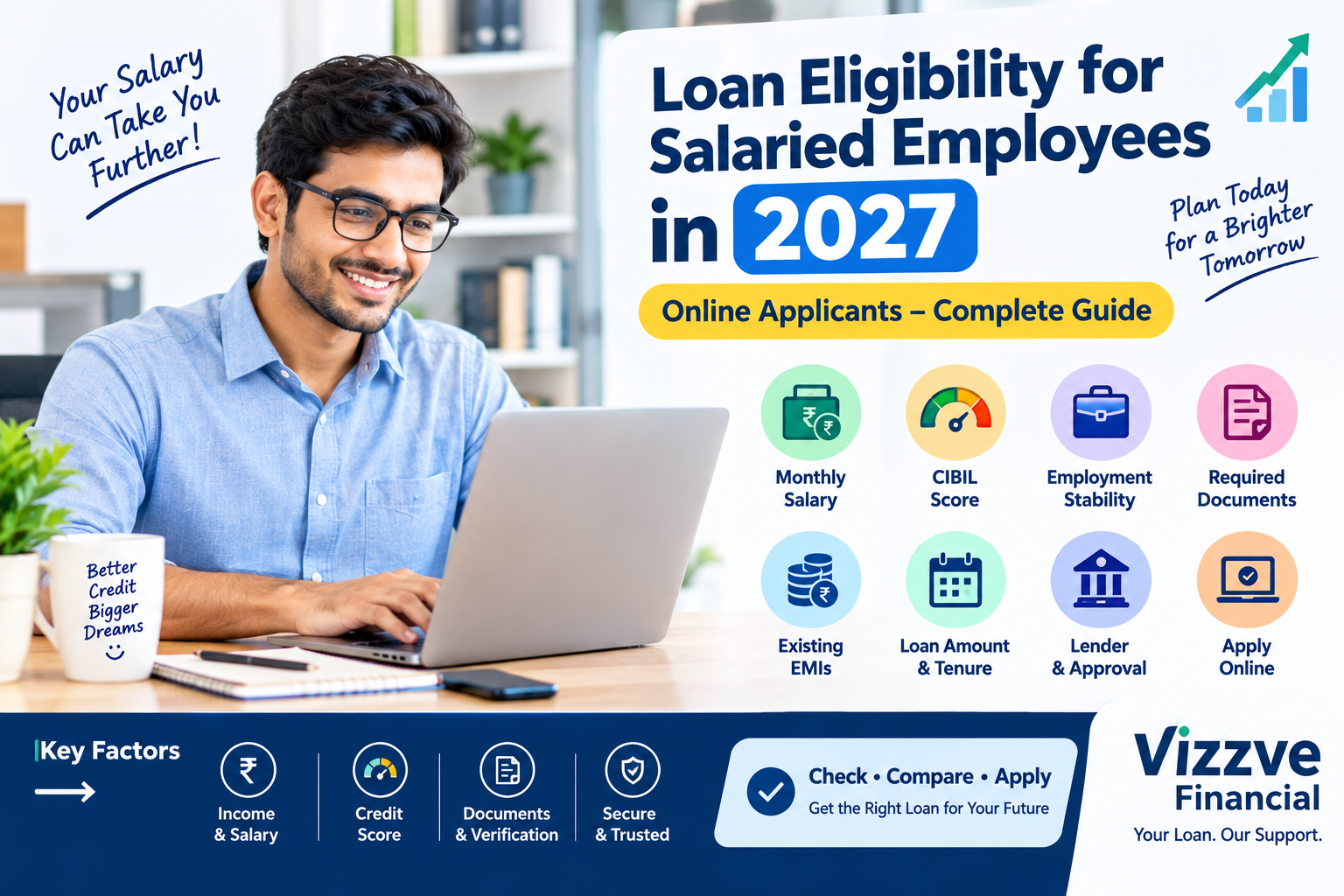
Applying for a personal loan online can be convenient, especially for salaried employees who already have regular income and digital salary records.
But filling out an online application does not mean that every applicant will automatically qualify.
Whether you apply through a bank, NBFC or a digital lending platform, the lender may assess your income, existing obligations, credit history, employment profile, age, requested loan amount, repayment capacity and documentation.
For borrowers planning to apply in 2027, understanding these factors before submitting an online application can help avoid unnecessary applications and improve financial preparedness.
The important point is this:
Loan eligibility is based on your overall financial profile, not simply your monthly salary or CIBIL score.
Lenders can have different eligibility requirements, so the figures and examples in this article should be treated as illustrations rather than guaranteed approval limits.
AI Answer Box: Loan Eligibility for Salaried Employees in 2027
What is loan eligibility for salaried employees in 2027?
For online applicants, loan eligibility generally depends on income, employment stability, credit history, existing EMIs, age, requested loan amount, repayment capacity and lender-specific policies.
A salaried employee can prepare for an online application by:
- Checking their CIBIL/credit report
- Maintaining timely repayment of existing loans
- Keeping credit-card balances manageable
- Reducing unnecessary debt
- Maintaining stable salary credits
- Keeping salary slips and bank statements ready
- Choosing a realistic loan amount
- Comparing interest rates and total borrowing costs
- Checking the lender and digital lending partner
- Reading the Key Facts Statement and loan agreement before accepting the loan
Important: A high CIBIL score or high salary does not guarantee loan approval. The final lending decision is made by the lender after evaluating the applicant's overall profile. TransUnion CIBIL states that its score ranges from 300 to 900 and that the lending decision rests with the lender.
What Does Loan Eligibility Mean for Online Applicants?
Loan eligibility is an assessment of whether a lender considers an applicant suitable for a particular loan amount and repayment structure.
For an online applicant, the process may be largely digital, but the underlying credit assessment still matters.
A lender may review:
| Eligibility Factor | What the Lender May Assess |
|---|---|
| Monthly income | Salary and income consistency |
| Employment | Employer and employment stability |
| Credit history | Previous borrowing and repayment |
| CIBIL score | Creditworthiness indicator |
| Existing EMIs | Current repayment obligations |
| Credit-card debt | Outstanding balances and obligations |
| Age | Repayment period and lender criteria |
| Loan amount | Requested borrowing |
| Tenure | Proposed repayment period |
| Bank statements | Salary credits and financial activity |
| Documents | Identity, income and employment verification |
The exact weight assigned to each factor varies by lender.
How Does Online Loan Eligibility Work for Salaried Employees?
An online loan application usually follows a series of verification and credit-assessment steps.
Step 1: Enter Basic Information
The applicant may be asked for information such as:
- Name
- Mobile number
- Date of birth
- PAN
- Employment details
- Monthly income
- Residential information
- Requested loan amount
Step 2: Income Verification
The lender may verify salary information through documents, bank records or permitted digital verification methods.
Step 3: Credit Assessment
The lender may review the applicant's credit history and other available information.
Step 4: Repayment-Capacity Assessment
The lender considers existing obligations and the proposed loan repayment.
Step 5: Document Verification
Documents may be verified digitally or through other approved processes.
Step 6: Loan Decision
The lender makes the final decision according to its own credit policy.
Step 7: Agreement and Disbursal
If approved and accepted, the borrower receives the applicable loan documents and funds according to the lender's process.
Online does not mean automatic
One of the biggest misconceptions about online personal loans is that submitting an application guarantees instant approval.
It does not.
Online application = digital application process.
Loan approval = lender's credit decision.
These are two different things.
Main Factors Affecting Salaried Employee Loan Eligibility in 2027
1. Monthly Take-Home Salary
Your income is one of the most important factors in understanding repayment capacity.
However, lenders may distinguish between:
- Gross salary
- Net salary
- Take-home salary
- Fixed salary
- Variable pay
- Bonuses
- Incentives
- Allowances
A regular and clearly documented salary can make income verification easier.
Example
Suppose two applicants earn:
Applicant A: ₹50,000 per month with ₹5,000 existing EMI
Applicant B: ₹50,000 per month with ₹20,000 existing EMI
Although their salaries are identical, their available repayment capacity may be very different.
This is why salary alone cannot determine the maximum loan amount.
2. CIBIL Score
CIBIL Score is a three-digit summary of credit history ranging from 300 to 900. CIBIL explains that the score is derived from information in the credit report, including account and enquiry information.
Lenders can use credit information as part of their loan assessment.
What can influence your credit profile?
- Timely repayment
- Outstanding balances
- Credit utilisation
- Existing loans
- Credit-card accounts
- Recent credit enquiries
- Repayment history
Does a 750 CIBIL score guarantee approval?
No.
There is no single CIBIL score that guarantees approval from every lender.
CIBIL itself states that the lending decision is made by the lender, not by CIBIL.
Therefore, borrowers should avoid statements such as:
"A score above X guarantees a personal loan."
Such claims are misleading because lender policies differ.
3. Existing EMIs
Existing debt is another major consideration.
Imagine an employee earning ₹70,000 per month.
They already pay:
- Home loan EMI: ₹15,000
- Car loan EMI: ₹8,000
- Credit-card repayment: ₹4,000
Their existing monthly obligations already total ₹27,000.
Adding another large personal-loan EMI could significantly reduce monthly disposable income.
Practical lesson
Before applying online, calculate:
Existing monthly obligations + proposed new EMI
Then compare the result with your take-home salary and essential household expenses.
4. Employment Stability
Salaried employees generally have documented income, but employment stability can still matter.
A lender may consider:
- Current employer
- Length of employment
- Overall work experience
- Probation status
- Recent job changes
- Employment type
- Industry or employer profile
This does not mean changing jobs automatically prevents loan approval.
It simply means employment information can form part of a lender's overall assessment.
5. Age
Age may affect the available loan tenure and lender eligibility criteria.
For example, an applicant with many years of expected working life may have different tenure options from someone approaching retirement.
The lender's specific age limits should always be checked before applying.
6. Loan Amount
The amount you request matters.
A borrower earning ₹50,000 per month may not have the same repayment capacity for a ₹2 lakh loan and a ₹10 lakh loan.
The requested amount should therefore be connected to:
- Monthly income
- Existing EMIs
- Household expenses
- Savings
- Emergency fund
- Expected EMI
- Loan tenure
7. Loan Tenure
Loan tenure affects both EMI and total interest.
Generally:
Shorter tenure
- Higher EMI
- Faster repayment
- Potentially lower total interest
Longer tenure
- Lower EMI
- Longer repayment period
- Potentially higher total interest
Therefore, "lowest EMI" does not always mean "lowest total cost."
8. Bank Account and Salary-Credit History
For online applicants, financial information may be verified digitally depending on the lender and permitted process.
Regular salary credits can help establish income consistency.
Borrowers should ensure that:
- Salary credits are clearly identifiable
- Bank information is accurate
- Documents are genuine
- Financial information submitted matches supporting records
9. Recent Credit Enquiries
When borrowers submit several credit applications, lenders may make credit enquiries as part of their assessment.
CIBIL reports include information about lender enquiries.
This is one reason applicants should research loan requirements before submitting multiple applications.
How Much Personal Loan Can a Salaried Employee Get in 2027?
There is no single loan amount applicable to all salaried employees.
Eligibility may depend on:
Salary + Existing EMIs + Credit Profile + Employment + Age + Tenure + Lender Policy
Illustrative examples
| Monthly Take-Home Salary | Existing EMI | Example Planning Approach |
|---|---|---|
| ₹30,000 | ₹3,000 | Keep new EMI conservative |
| ₹40,000 | ₹5,000 | Review monthly disposable income |
| ₹50,000 | ₹7,000 | Compare multiple repayment scenarios |
| ₹60,000 | ₹10,000 | Assess new EMI carefully |
| ₹80,000 | ₹15,000 | Consider total debt burden |
| ₹1,00,000 | ₹20,000 | Evaluate affordability before borrowing |
These are financial-planning illustrations, not lender-approved loan limits.
How to Calculate Your Personal Loan Affordability
A simple starting point is:
Available income after existing obligations
Monthly take-home income − existing EMI obligations = income before the proposed new EMI
For example:
- Take-home salary: ₹75,000
- Existing EMIs: ₹15,000
- Income remaining before new EMI: ₹60,000
The applicant should then consider household expenses, savings and the proposed EMI.
A lender may use its own affordability calculations, which can differ from this simplified example.
Documents Required for Online Personal Loan Applications
Requirements vary between lenders, but salaried applicants may commonly need:
Identity Documents
- PAN
- Aadhaar or another accepted identity document
- Address proof, where applicable
Income Documents
- Recent salary slips
- Salary certificate, where required
- Bank statements
- Form 16 or other income documentation, where required
Employment Information
- Employer name
- Employee ID
- Joining date
- Employment details
Other Information
- Existing loan details
- Bank-account information
- Contact information
Important
Never upload forged or altered documents.
Incorrect information can delay verification and may create serious problems with the application.
Online Loan Application vs Offline Application
| Feature | Online Application | Offline Application |
|---|---|---|
| Application method | Digital | Branch/physical or assisted |
| Document submission | Often digital | Often physical/digital |
| Convenience | Can apply remotely | May require branch visit |
| Status tracking | Often available digitally | Depends on lender |
| Verification | May use digital methods | May include physical verification |
| Approval | Depends on lender | Depends on lender |
| Documentation | Product-dependent | Product-dependent |
The application channel does not remove the need for credit assessment.
Bank vs NBFC vs Digital Lending Platform
| Factor | Bank | NBFC | Digital Lending Platform |
|---|---|---|---|
| Application | Online/branch | Online/branch | Primarily digital |
| Credit assessment | Lender policy | Lender policy | Usually based on lending partner |
| Documentation | Varies | Varies | Often digital |
| Processing | Varies | Varies | May be streamlined |
| Actual lender | Bank | NBFC | May be partner bank/NBFC |
| Borrower check | Verify terms | Verify terms | Verify actual regulated lender |
A digital platform may facilitate an application without being the entity that actually lends the money.
RBI's digital-lending framework makes clear that regulated entities remain responsible for their lending-service-provider and digital-lending arrangements.
What Should Online Applicants Check Before Taking a Digital Loan?
This is particularly important for borrowers searching for "instant" or "quick" loans.
Check the actual lender
Find out which bank or NBFC is actually providing the loan.
Check the total cost
Do not focus only on the advertised interest rate.
Review:
- Interest rate
- APR
- Processing fees
- Other charges
- Penal charges
- Repayment schedule
- Prepayment terms
- Total repayment
Read the Key Facts Statement
RBI's digital-lending framework requires regulated entities to provide a Key Facts Statement before execution of the contract for digital lending products, with the APR disclosed upfront.
RBI's broader KFS framework has also standardised key loan-cost disclosures for applicable retail and MSME term loans.
Digital Lending Safety: What Has Changed?
Digital lending has become increasingly important in India's financial ecosystem, but convenience also makes borrower awareness important.
In August 2024, RBI announced a public repository of digital lending apps deployed by regulated entities to help consumers verify claimed associations.
Before using an online loan app:
- Verify the actual lender.
- Check whether the app is associated with a regulated entity.
- Read the KFS.
- Understand the APR and charges.
- Review privacy permissions.
- Avoid suspicious SMS or social-media loan links.
- Do not share passwords or confidential banking credentials.
- Avoid paying suspicious upfront fees.
Credit Information Is Becoming More Current
An important development for borrowers is the increased frequency of credit-information reporting.
RBI directions made credit-information updates fortnightly from January 1, 2025, meaning information is updated as of the 15th and the last day of the month, subject to the prescribed reporting timelines.
Why does this matter?
For example, if a borrower repays or closes an obligation, updated credit information can become available more frequently than under a purely monthly reporting cycle.
This supports more current credit assessment by lenders.
For online applicants in 2027, maintaining accurate repayment records can therefore remain particularly important.
2027 Outlook for Online Salaried Loan Applicants
2027 is a future period, so borrowers should not assume that today's lender-specific criteria will remain unchanged.
However, existing trends suggest that the application experience may continue to become more digital.
Possible developments include:
Faster digital verification
Technology can reduce manual paperwork and streamline document collection.
More data-driven underwriting
Lenders may continue using structured financial and credit information as part of automated assessment.
More transparent digital-lending disclosures
Existing RBI requirements around KFS, APR and digital-lending practices provide a framework for greater borrower transparency.
More current credit information
The fortnightly reporting framework already provides a more frequent information cycle than the earlier monthly baseline.
Important distinction
These developments may improve the application experience, but they do not mean every salaried employee will receive automatic approval.
Real-World Example: Online Applicant With a ₹60,000 Salary
Consider an employee named Priya.
Her financial profile is:
- Take-home salary: ₹60,000
- Existing personal-loan EMI: ₹5,000
- Car EMI: ₹7,000
- Stable employment
- Regular salary credits
- Healthy credit history
- Proposed personal loan: ₹2.5 lakh
Before applying online, Priya:
- Reviews her credit report.
- Checks her existing obligations.
- Estimates the new EMI.
- Compares lender terms.
- Checks fees and total repayment.
- Reviews the KFS before accepting an applicable digital loan.
- Applies only after confirming that the repayment fits her budget.
What can we learn from this example?
The important question is not:
"How much will the app approve?"
It is:
"Can I comfortably repay the proposed loan without putting my monthly finances under pressure?"
Pros and Cons of Applying for a Personal Loan Online
Pros
- Convenient application process
- Can reduce branch visits
- Digital document submission may save time
- Application status may be available online
- Easy comparison of available options
- Convenient for salaried employees with digital salary records
Cons
- Online application does not guarantee approval
- Some applicants may still require additional verification
- Multiple applications can create additional enquiries
- Digital fraud and impersonation risks exist
- Borrowers may overlook fees when focusing on speed
- Fast approval can encourage unnecessary borrowing
Step-by-Step Guide: How Salaried Employees Can Apply Online
Step 1: Decide the Required Amount
Borrow only what you actually need.
Step 2: Check Your Credit Profile
Review your credit report and identify any inaccuracies.
Step 3: Calculate Existing Debt
List every EMI and recurring credit obligation.
Step 4: Estimate the New EMI
Check whether the proposed EMI fits comfortably within your monthly budget.
Step 5: Compare Loan Terms
Compare:
- Interest rate
- APR
- Processing fee
- Tenure
- Total repayment
- Prepayment conditions
- Other charges
Step 6: Verify the Lender
If applying through a digital platform, identify the actual bank or NBFC providing the loan.
Step 7: Prepare Documents
Keep income, identity and employment information ready.
Step 8: Complete the Online Application
Enter information accurately.
Step 9: Review the Offer
Do not accept a loan merely because the approval process is fast.
Step 10: Read the Agreement
Check all material terms before accepting.
Step 11: Plan Your EMI
Set a repayment reminder or appropriate automatic payment arrangement.
How to Improve Loan Eligibility Before Applying Online
1. Pay Existing EMIs on Time
A consistent repayment record supports a healthy credit profile.
2. Keep Credit-Card Balances Manageable
High outstanding balances can affect your overall debt position.
3. Avoid Unnecessary Applications
Research lender requirements before submitting applications.
4. Reduce Existing Debt Where Practical
Lower obligations can improve monthly cash flow.
5. Maintain Stable Employment
Keep employment and income records accurate.
6. Check Your Credit Report
Look for errors in:
- Personal details
- Loan accounts
- Outstanding amounts
- Payment status
- Credit enquiries
7. Keep Documents Ready
Having accurate documents available can make the application process smoother.
Common Mistakes Online Applicants Should Avoid
Mistake 1: Believing "instant approval" means guaranteed approval
Approval still depends on the lender's assessment.
Mistake 2: Choosing a loan only because the EMI is low
A longer tenure can reduce EMI but increase total interest.
Mistake 3: Ignoring existing debt
Your current EMIs can affect your capacity to take additional credit.
Mistake 4: Applying everywhere
Multiple unnecessary applications are not a good substitute for comparing eligibility first.
Mistake 5: Ignoring the lender's identity
Always establish who actually provides the loan.
Mistake 6: Sharing sensitive information carelessly
Use legitimate applications and websites and review permissions carefully.
Mistake 7: Skipping the KFS
The KFS is designed to help borrowers understand important loan terms and costs.
Expert Commentary: What Matters Most for Salaried Borrowers?
From a practical financial-planning perspective, online borrowers should focus less on obtaining the maximum possible loan and more on selecting an amount that fits their financial capacity.
Three questions are particularly useful:
Can I afford the EMI?
Do not calculate the EMI in isolation. Include existing debt and household expenses.
Is the total borrowing cost reasonable?
Review interest, APR, fees and the total repayment amount.
Is the lender legitimate?
For digital applications, identify the actual regulated lender and review the applicable disclosures.
This approach helps turn a quick online application into a more informed borrowing decision.
Simple Online Loan Eligibility Checklist
Before clicking Apply, ask:
☐ Is my monthly income stable?
☐ Do I know my existing total EMI?
☐ Have I checked my credit report?
☐ Is my repayment history accurate?
☐ Do I actually need the requested loan amount?
☐ Can I comfortably afford the new EMI?
☐ Have I compared total borrowing costs?
☐ Do I know the actual lender?
☐ Have I reviewed the KFS where applicable?
☐ Have I read the loan agreement?
☐ Am I using a legitimate application or website?
If the answer to these questions is yes, you are better prepared for the application process.
Published on : 1st October
Published by : Shanlee JV
www.vizzve.com || www.vizzveservices.com
Follow us on social media: Facebook || Linkedin || Instagram
🛡 Powered by Vizzve Financial
RBI-Registered Loan Partner | 10 Lakh+ Customers | ₹600 Cr+ Disbursed