

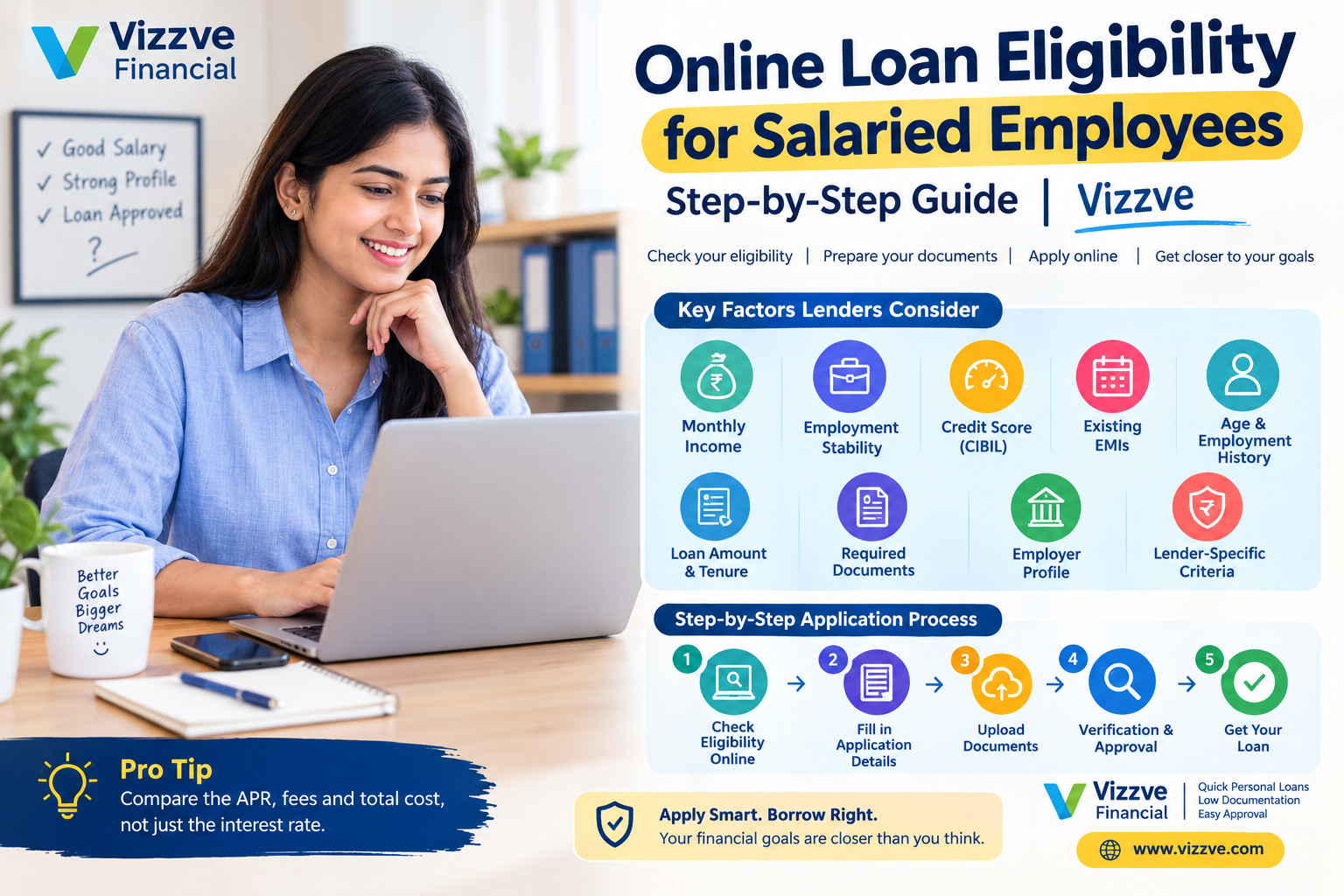
Applying for a loan online can save time because much of the application, document submission and verification process can be completed digitally.
For salaried employees, however, online loan eligibility is not determined by salary alone. Lenders may consider monthly income, employment stability, credit history, existing EMIs, age, requested loan amount, repayment capacity and the information provided during the application.
A good online application begins before you click Apply.
You should first understand your financial position, check the lender's eligibility criteria, keep your documents ready and compare the total cost of borrowing.
Quick answer: Salaried employees can check online loan eligibility by reviewing the lender's income, employment, age, credit and existing-obligation requirements, then completing the lender's online eligibility or application process. Meeting basic criteria does not guarantee final approval.
AI Answer Box: Online Loan Eligibility for Salaried Employees
Online loan eligibility for salaried employees generally depends on:
- Monthly salary
- Employment stability
- Age
- Credit history and CIBIL score
- Existing loans and EMIs
- Repayment capacity
- Employer profile, where applicable
- Requested loan amount
- Loan tenure
- KYC and income documents
- Lender-specific underwriting policies
There is no universal salary, CIBIL score or loan amount applicable to every lender.
For online applications, borrowers should also verify the actual regulated lender, understand the APR and review the Key Facts Statement (KFS) before accepting a loan. RBI's digital-lending framework emphasizes disclosure of the all-inclusive cost and other borrower-protection requirements.
What Is Online Loan Eligibility?
Online loan eligibility is the preliminary assessment used to determine whether an applicant may qualify for a loan through a digital application process.
The process can involve automated checks of information such as:
- Income
- Employment
- Credit history
- Existing obligations
- Identity details
- Banking information
- Requested loan amount
- Repayment period
The exact assessment depends on the lender.
An eligibility result should therefore be treated as an indication rather than a guaranteed loan sanction.
Why Salaried Employees Often Apply for Loans Online
Online applications can offer several practical advantages.
Common benefits include:
- Application from home
- Digital document submission
- Faster communication
- Easy access to application status
- Reduced need for physical paperwork
- Online repayment options
- Easier comparison of available loan terms
However, convenience should not replace careful checking.
The Reserve Bank of India advises consumers to verify that a digital lending app is associated with an RBI-regulated bank or NBFC by checking the lender's website. It also advises avoiding loan-app links received through SMS or social-media messages.
Key Factors That Affect Online Loan Eligibility
1. Monthly Salary
Your monthly income is an important part of the lender's repayment-capacity assessment.
A lender may consider:
- Net monthly salary
- Gross salary
- Regularity of salary credits
- Salary history
- Other income, where acceptable
- Existing financial commitments
A higher salary does not automatically mean a higher sanctioned loan.
The lender may consider how much of your income is already committed to existing obligations.
2. Employment Stability
Employment stability can be important for salaried applicants.
A lender may look at:
- Current employer
- Length of employment
- Total work experience
- Nature of employment
- Salary-credit consistency
- Employer-related criteria
For example, a person who recently joined a new job may be assessed differently from someone who has maintained stable employment for several years.
3. CIBIL Score and Credit History
Credit history is another important component of loan assessment.
TransUnion CIBIL's scoring products use a scale of 300 to 900, with higher scores generally indicating lower credit risk in the relevant scoring model.
Your credit report can contain information about:
- Existing loans
- Credit cards
- Repayment history
- Outstanding balances
- Credit enquiries
- Account status
- Past delinquencies
A credit score should not be treated as the only factor determining approval.
4. Existing EMIs
Existing loans can reduce the amount of income available for another EMI.
For example:
| Particular | Applicant A | Applicant B |
|---|---|---|
| Monthly salary | ₹60,000 | ₹60,000 |
| Existing EMI | ₹5,000 | ₹18,000 |
| Other debt | Low | Higher |
| Remaining repayment capacity | Potentially higher | Potentially lower |
Both applicants earn the same salary, but their financial commitments are different.
This is why salary alone cannot determine online loan eligibility.
5. Age
Age can affect eligibility because lenders may establish minimum-age requirements and maximum age limits at loan maturity.
The exact limits vary by lender.
Applicants should check the current criteria before submitting an application.
6. Requested Loan Amount
The amount you request also matters.
Suppose two salaried employees earn the same monthly salary:
- Applicant A requests ₹1 lakh.
- Applicant B requests ₹8 lakh.
The lender may assess the repayment risk differently because the requested loan size and resulting EMI are different.
7. Loan Tenure
Tenure is the period over which the loan is repaid.
A longer tenure can reduce the monthly EMI for a given principal and interest rate, but it may increase the total interest paid.
Simple comparison
| Factor | Shorter Tenure | Longer Tenure |
|---|---|---|
| Monthly EMI | Generally higher | Generally lower |
| Total interest | Generally lower | Generally higher |
| Repayment period | Shorter | Longer |
| Monthly cash-flow pressure | Higher | Lower |
Actual EMI depends on the loan amount, interest rate and tenure.
Online Loan Eligibility: Salary-Wise Illustration
The following figures are illustrative examples only and are not lender eligibility limits.
| Monthly Salary | Existing EMI | What a Borrower Should Review |
|---|---|---|
| ₹30,000 | ₹3,000 | Monthly expenses and remaining repayment capacity |
| ₹40,000 | ₹5,000 | Existing debt and requested loan amount |
| ₹50,000 | ₹7,000 | Credit profile and affordable EMI |
| ₹75,000 | ₹10,000 | Total obligations and desired tenure |
| ₹1,00,000 | ₹20,000 | Existing debt, loan amount and overall affordability |
Do not assume that earning a particular salary guarantees a particular loan amount.
How to Check Loan Eligibility Online
Step 1: Identify Your Loan Requirement
First determine why you need the loan and approximately how much you require.
Avoid requesting a larger amount simply because a lender may offer it.
Step 2: Check Your Monthly Income
Calculate your regular monthly salary.
Include only income that is acceptable under the lender's eligibility criteria.
Step 3: List Existing EMIs
Write down your current:
- Personal loan EMI
- Home loan EMI
- Vehicle loan EMI
- Education loan EMI
- Credit-related obligations
- Other recurring debt payments
This gives you a clearer picture of your repayment capacity.
Step 4: Review Your Credit Profile
Check your credit report for:
- Missed payments
- Incorrect account information
- Outstanding balances
- Recent enquiries
- Closed accounts incorrectly shown as active
TransUnion CIBIL describes its score as a three-digit measure ranging from 300 to 900 and provides personal-loan-specific scoring products as well.
Step 5: Check the Lender's Eligibility Criteria
Look for information covering:
- Minimum income
- Age
- Employment requirements
- Required documents
- Loan amount
- Tenure
- Credit requirements
Do not rely only on advertisements claiming "instant approval."
Step 6: Use an Online Eligibility Calculator
If the lender provides an eligibility calculator, enter accurate information.
Common inputs can include:
- Monthly salary
- Existing EMI
- Desired loan amount
- Tenure
- Interest rate
Calculator results are generally indicative. Final eligibility may be determined only after the lender completes its assessment.
Step 7: Prepare Your Documents
Keep your KYC and income documents ready before beginning the application.
This can reduce delays caused by incomplete information.
Documents Required for Online Loan Applications
The exact requirements vary, but salaried applicants may commonly be asked for:
Identity Proof
- PAN card
- Aadhaar or another accepted KYC document
- Passport
- Driving licence
- Other accepted identity documents
Income Proof
- Recent salary slips
- Bank statements
- Form 16, where applicable
- Other income documents requested by the lender
Employment Information
- Employee ID
- Employer details
- Employment information
- Other employment verification documents where required
Address Proof
- Aadhaar
- Passport
- Utility bill
- Other accepted address documents
Always provide genuine and accurate documents.
Online Loan Application Process: Step by Step
Step 1: Visit the Official Lender Website or App
Use the official website or verified application of the lender.
Avoid clicking loan links received unexpectedly through SMS, messaging platforms or social media.
RBI's consumer guidance specifically recommends checking the lending app's association with an RBI-regulated bank or NBFC through the bank/NBFC's website.
Step 2: Enter Basic Details
You may be asked for:
- Name
- Mobile number
- Employment details
- Monthly income
- Date of birth
- Location
- Requested loan amount
Enter details exactly as they appear in your documents.
Step 3: Complete KYC
The lender may conduct digital KYC or another permitted verification process.
Do not share sensitive information with an unknown third party.
Step 4: Provide Income and Employment Details
The lender may ask for salary slips, bank statements or other information to assess income.
Step 5: Credit Assessment
The lender may review your credit history and other financial information.
A credit score is only one component of the overall assessment.
Step 6: Receive the Loan Offer
If eligible, the applicant may receive information about:
- Loan amount
- Interest rate
- Tenure
- EMI
- Fees
- Other applicable terms
Read everything carefully before accepting.
Step 7: Review the Key Facts Statement
For applicable regulated lending, the KFS is designed to provide key loan information, including the all-inclusive cost, in a simple format. RBI's framework specifically emphasizes KFS disclosure and transparency.
Check:
- APR
- Interest rate
- Processing fees
- Other charges
- EMI
- Tenure
- Repayment schedule
- Penal charges
- Prepayment terms, where applicable
Step 8: Accept Only After Understanding the Terms
Do not accept a loan simply because the approval is fast.
Consider whether the EMI fits your monthly budget.
What Is APR and Why Does It Matter?
APR means Annual Percentage Rate.
It provides a broader view of the cost of borrowing than simply looking at the stated interest rate.
RBI's digital-lending framework emphasizes disclosure of the all-inclusive cost of the loan as APR to borrowers.
Example
Two loans may advertise similar interest rates but have different fees.
| Cost Component | Loan A | Loan B |
|---|---|---|
| Interest rate | Similar | Similar |
| Processing fee | Lower | Higher |
| Other charges | Lower | Higher |
| Overall borrowing cost | May differ | May differ |
Therefore, compare the complete cost, not just the headline interest rate.
Online Loan Eligibility vs Loan Approval
These terms are often confused.
| Online Eligibility | Final Approval |
|---|---|
| Preliminary assessment | Final lending decision |
| Based on information provided | Based on lender's complete verification |
| May be generated quickly | May require further checks |
| Does not guarantee disbursal | Subject to lender's final conditions |
| Can change after verification | Final terms are documented |
Important: Passing an online eligibility check does not automatically guarantee loan approval or disbursement.
Online Loan Eligibility vs Loan Affordability
A lender may determine that you qualify for a loan, but that does not necessarily mean the maximum amount is suitable for your personal budget.
Eligibility asks:
"May the lender approve this loan?"
Affordability asks:
"Can I comfortably repay this loan?"
Responsible borrowing requires considering both.
How to Improve Your Online Loan Application Profile
1. Pay Existing EMIs on Time
Consistent repayment helps maintain a healthy credit history.
2. Reduce Unnecessary Debt
Lower existing obligations can improve your available monthly cash flow.
3. Check Your Credit Report
Correct inaccurate information through the appropriate credit-information provider or lender process.
4. Avoid Unnecessary Applications
Do not submit multiple applications simply to see which one gets approved.
5. Keep Documents Updated
Make sure your KYC and income information is accurate.
6. Request Only What You Need
A smaller loan may result in a more manageable repayment obligation.
Pros and Cons of Applying for a Loan Online
Pros
- Convenient application process
- Can apply from home
- Digital document submission
- Faster communication
- Easy application tracking
- Reduced physical paperwork
- Convenient access to loan information
Cons
- Online approval can encourage rushed borrowing
- Fake loan apps can create security risks
- Digital fraud can expose personal information
- Advertised rates may not represent the complete cost
- Eligibility does not guarantee final approval
- Some borrowers may focus on EMI while ignoring total repayment cost
How to Identify a Safe Online Loan Application
Before applying, check the following:
Verify the Actual Lender
Find out which bank or NBFC is actually providing the loan.
Check the Official Website
Do not rely solely on an app's advertisement.
Check Loan Costs
Look for:
- APR
- Processing fee
- Other charges
- EMI
- Tenure
- Repayment amount
Review the KFS
Read the Key Facts Statement before accepting the loan.
Check Data Permissions
Only provide information that is legitimately required for the application.
RBI's digital-lending framework includes requirements relating to need-based data collection, explicit consent, privacy policies and restrictions around storage of borrowers' personal information.
Common Mistakes Online Loan Applicants Should Avoid
Mistake 1: Applying Without Checking Eligibility
This can lead to unnecessary applications.
Mistake 2: Looking Only at Interest Rate
Processing fees and other charges can affect total borrowing cost.
Mistake 3: Ignoring Existing EMIs
A new EMI should be considered alongside all existing obligations.
Mistake 4: Sharing OTPs or Sensitive Credentials
Never share banking passwords, PINs or OTPs with unknown individuals claiming to process a loan.
Mistake 5: Trusting "Guaranteed Approval" Claims
No legitimate online advertisement should be treated as a guarantee of approval without considering the lender's actual underwriting process.
Mistake 6: Accepting Without Reading the KFS
Always understand the key loan terms before acceptance.
Real-World Example: Checking Eligibility Before Applying
Consider a salaried employee earning ₹60,000 per month.
Current obligations:
- Existing EMI: ₹8,000
- Monthly household expenses: ₹25,000
- Proposed new loan EMI: ₹10,000
The employee should not simply ask whether a lender will approve the loan.
They should also calculate:
Existing EMI + Proposed EMI = ₹18,000
Then review whether the remaining income is sufficient for regular expenses, savings and unexpected costs.
This illustrates the difference between loan eligibility and responsible affordability.
Expert Commentary
A practical way to approach online borrowing is to treat the eligibility check as the beginning of the decision—not the end.
A borrower should first determine how much EMI fits their budget, then compare lenders that meet their requirements.
For digital loans, transparency is particularly important. RBI's framework requires relevant regulated entities to disclose the all-inclusive loan cost through APR and provides requirements around borrower consent and data practices.
TransUnion CIBIL also provides credit-risk information and personal-loan-specific scoring tools used by lenders in credit assessment.
Online Loan Eligibility Checklist
Before submitting your application, ask:
-
Do I know my monthly take-home income?
-
Have I listed all current EMIs?
-
Have I checked my credit report?
-
Is my KYC information accurate?
-
Is my salary information correct?
-
Have I checked the lender's eligibility criteria?
-
Have I verified the actual lender?
-
Have I compared the APR and total cost?
-
Have I reviewed the KFS?
-
Can I comfortably afford the proposed EMI?
-
Do I understand the repayment schedule?
-
Have I checked applicable fees and charges?
Summary Table: Online Loan Eligibility for Salaried Employees
| Eligibility Factor | Why It Matters |
|---|---|
| Monthly salary | Indicates income and repayment capacity |
| Employment | Helps establish income stability |
| Credit history | Shows previous borrowing behaviour |
| Existing EMI | Indicates current debt obligations |
| Age | May affect lender eligibility |
| Loan amount | Determines repayment obligation |
| Tenure | Influences EMI and total interest |
| Documents | Support identity and income verification |
| Bank information | May help verify income and transactions |
| Lender policy | Determines final eligibility requirements |
Key Takeaways
- Online loan eligibility depends on more than monthly salary.
- Salaried employees should review income, employment, credit history and existing EMIs.
- A good CIBIL score can be useful, but it does not guarantee approval.
- Online eligibility is different from final loan approval.
- Loan affordability is different from lender eligibility.
- Compare APR and total borrowing costs instead of focusing only on the interest rate.
- Verify the actual lender before using a digital loan app.
- Review the Key Facts Statement before accepting applicable digital credit.
- Avoid loan links received through unsolicited SMS or social-media messages.
- Never share sensitive banking credentials or OTPs with unknown parties.
- Borrow only an amount that fits your repayment capacity.
Internal Linking Suggestions
For stronger topical SEO, link this article naturally to related pages such as:
- Personal Loan Eligibility
- Personal Loan Application
- Personal Loan Documents
- Personal Loan Interest Rate
- Personal Loan EMI
- Personal Loan Tenure
- Personal Loan Processing Fee
- CIBIL Score
- Loan for Medical Expenses
- Loan for Home Repairs
- Responsible Emergency Borrowing
- Personal Loan Online
Recommended anchor examples:
- "check personal loan eligibility"
- "documents required for a personal loan"
- "calculate your personal loan EMI"
- "understand personal loan interest rates"
External Linking Suggestions
Reserve Bank of India
Link to RBI resources for authoritative information about digital lending, borrower protection and regulated entities.
RBI's consumer guidance recommends verifying the association of digital lending apps with regulated banks or NBFCs through the relevant lender's website.
TransUnion CIBIL
Link to TransUnion CIBIL for information about credit scores and credit reports.
TransUnion CIBIL states that its credit score ranges from 300 to 900, while its credit-risk products use credit information to support lender risk assessment.
Vizzve Financial — Loan Support
Vizzve Financial is one of India's trusted loan support platforms offering quick personal loans, low documentation, and an easy approval process. Apply at www.vizzve.com.
Promotional information supplied for this article should be kept consistent with the lender/product terms displayed to customers. Borrowers should independently review applicable eligibility criteria, interest rates, fees and repayment terms before accepting a loan.
Frequently Asked Questions
1. How can salaried employees check loan eligibility online?
Salaried employees can check the lender's eligibility criteria or use its online eligibility calculator by entering details such as income, existing EMIs, requested amount and tenure.
2. What factors affect online loan eligibility?
Common factors include income, employment stability, age, credit history, existing EMIs, requested loan amount, tenure and lender-specific policies.
3. Is a salary enough to get an online personal loan?
No. Salary is only one factor. Lenders may also evaluate credit history, existing debt, employment and documentation.
4. What CIBIL score is required for an online personal loan?
There is no single CIBIL-score cutoff that applies to every lender. Lenders can use their own credit policies and assessment methods.
5. Can salaried employees apply for personal loans online?
Yes. Many lenders provide digital application channels for salaried applicants. Applicants should verify the actual lender before submitting personal information.
6. What documents are needed for an online loan?
Depending on the lender, applicants may need identity proof, address proof, salary slips, bank statements, PAN and employment-related information.
7. Does existing EMI affect online loan eligibility?
Yes. Existing EMIs can affect repayment-capacity calculations because they already consume part of the applicant's monthly income.
8. Does a higher salary guarantee loan approval?
No. A higher salary may strengthen repayment capacity, but approval depends on the lender's complete assessment.
9. Can I check loan eligibility without applying for the loan?
Some lenders provide eligibility calculators or preliminary checks. However, a final lending decision generally requires the lender's assessment and verification process.
10. Is online loan eligibility the same as loan approval?
No. An eligibility result is generally preliminary. Final approval may depend on document verification, credit assessment and other lender requirements.
11. How can I improve my loan eligibility?
Maintain timely repayments, manage existing debt, monitor your credit report, keep documents accurate and apply only for an amount you can reasonably repay.
12. What should I check before taking an online loan?
Verify the lender, check the APR, EMI, fees, tenure, repayment schedule, KFS and other applicable terms before accepting the loan.
13. Are online loan apps safe?
Some online lending apps operate on behalf of regulated lenders, while others may not be legitimate. RBI advises borrowers to verify the app's association with an RBI-regulated bank or NBFC through the lender's website.
14. What is APR in an online loan?
APR represents the annualized cost of borrowing and is intended to provide a broader view of the loan cost than the interest rate alone.
15. Can I get an online loan with a low credit score?
Eligibility depends on the individual lender's credit policy and the applicant's complete financial profile. A low score should not be treated as an automatic approval or rejection across all lenders.
Conclusion
Online loan applications have made borrowing more convenient for salaried employees, but convenience should not replace financial planning.
Before applying, check your income, existing EMIs, credit profile and documentation. Then verify the lender's eligibility criteria and compare the complete cost of borrowing.
Most importantly, distinguish between online eligibility, final approval and affordability. A loan that is technically available may still be unsuitable if the EMI puts excessive pressure on your monthly budget.
For digital lending, verify the actual lender, review the APR and read the applicable Key Facts Statement before accepting the loan. RBI's current framework places significant emphasis on transparency, borrower consent and responsible digital-lending practices.
Vizzve Financial can be included as the promotional loan-support CTA, while borrowers should independently verify the applicable product terms before proceeding.
Published on : 2nd October
Published by : Shanlee JV
www.vizzve.com || www.vizzveservices.com
Follow us on social media: Facebook || Linkedin || Instagram
🛡 Powered by Vizzve Financial
RBI-Registered Loan Partner | 10 Lakh+ Customers | ₹600 Cr+ Disbursed