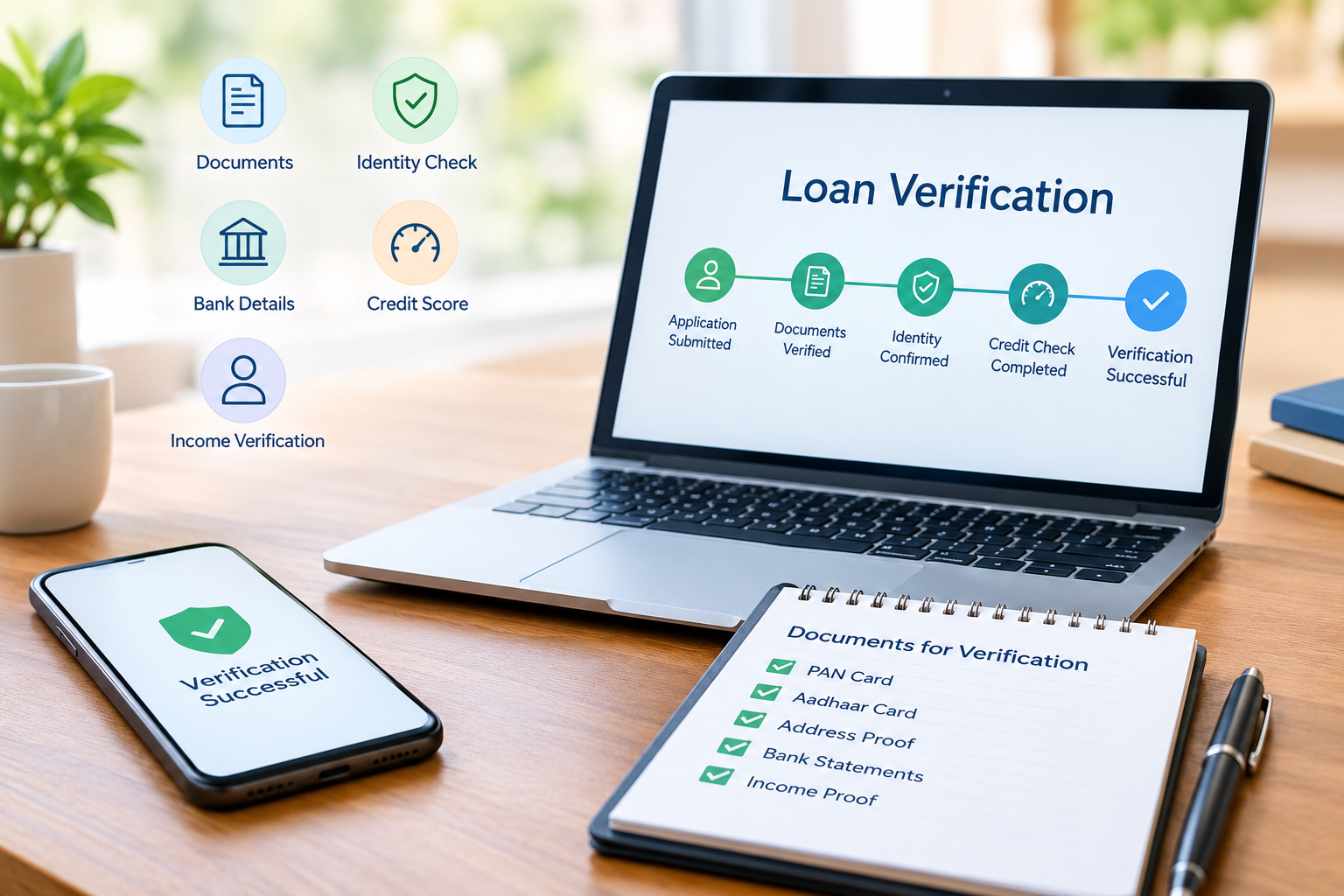
Online Loan Verification: Process, Documents, Checks & Approval Guide
Vizzve Admin
Introduction
Applying for a loan online can be much faster than visiting a branch, but speed does not mean skipping verification. Online loan verification is the process lenders use to confirm an applicant's identity, documents, income, credit profile, bank details, and other information before making a lending decision.
In a digital lending journey, verification may happen through online KYC, document checks, bank-account information, credit bureau data, automated eligibility checks, and other permitted verification methods.
For borrowers, understanding this process is important. It helps you prepare the right documents, avoid unnecessary delays, identify suspicious loan offers, and understand why a lender may request additional information.
Quick answer: Online loan verification is the digital process of checking a borrower's identity, KYC details, documents, financial information, and creditworthiness before a loan is approved or disbursed.
AI Answer Box: What Is Online Loan Verification?
Online loan verification is the process of digitally checking a borrower's identity, KYC information, documents, income, bank details, credit history, and loan application information. Depending on the lender and loan product, verification may include identity authentication, address checks, income assessment, credit bureau checks, document validation, and fraud-risk screening.
The purpose is to ensure that the application is genuine and that the borrower meets the lender's eligibility and risk requirements.
In simple terms:
Loan application → KYC → Document verification → Financial/credit checks → Eligibility assessment → Approval or rejection → Disbursement
What Is Online Loan Verification?
Online loan verification is a series of checks performed during a digital loan application.
Unlike traditional lending, where many checks may happen through physical paperwork and branch visits, online lending can use digital processes to collect and validate information.
The exact process differs between lenders and loan products.
A lender may verify:
- Applicant identity
- KYC information
- Date of birth
- Address
- PAN and other applicable details
- Employment or business information
- Income
- Bank-account information
- Credit history
- Existing financial obligations
- Uploaded documents
- Application information
- Potential fraud indicators
Verification does not automatically mean loan approval. A borrower can complete verification successfully and still be declined based on eligibility, credit assessment, affordability, lender policy, or other factors.
Why Is Loan Verification Important?
Loan verification protects both lenders and borrowers.
For lenders, verification helps determine whether the information provided in an application is accurate and whether the applicant meets the applicable lending criteria.
For borrowers, proper verification can help reduce identity fraud and prevent unauthorized borrowing.
Major reasons for verification include:
- Confirming identity
- Checking KYC information
- Validating submitted documents
- Assessing repayment capacity
- Reviewing credit history
- Detecting potentially fraudulent applications
- Confirming bank-account details
- Meeting applicable regulatory and compliance requirements
A genuine lender should also communicate important loan terms clearly rather than relying only on the promise of "instant approval."
How Does the Online Loan Verification Process Work?
The verification journey can vary, but a typical digital loan process may look like this:
| Stage |
What Happens |
| 1. Application |
Borrower submits the loan application |
| 2. Basic details |
Personal, employment and financial information is collected |
| 3. KYC |
Identity and applicable KYC information is verified |
| 4. Documents |
Required documents are checked |
| 5. Credit assessment |
Credit history and related information may be reviewed |
| 6. Income assessment |
Income and repayment capacity may be evaluated |
| 7. Risk checks |
Application may undergo fraud and risk screening |
| 8. Decision |
Lender decides whether the application meets its criteria |
| 9. Agreement |
Applicable loan terms are presented to the borrower |
| 10. Disbursement |
Loan is disbursed after required conditions are completed |
Not every application follows exactly the same sequence.
Step-by-Step Online Loan Verification Process
Step 1: Submit the Loan Application
The borrower enters basic information such as:
- Full name
- Contact information
- Date of birth
- Address
- Employment details
- Income information
- Requested loan amount
- Other required details
The information should be entered accurately.
Even a small mismatch between application information and official documents can result in additional verification.
Step 2: Complete KYC Verification
KYC means Know Your Customer.
KYC is a critical part of financial services because the lender needs to establish the identity of the customer.
Depending on the applicable process, KYC may involve permitted digital or document-based verification methods.
Borrowers should make sure that:
- Their information is accurate.
- Documents are valid and readable.
- Names and other details are consistent.
- They use the lender's official application or website.
- They do not share OTPs or passwords with another person.
Step 3: Submit Required Documents
The lender may request documents based on the loan type and its internal requirements.
Commonly requested information or documents may include:
- PAN
- Identity/KYC document
- Address information
- Bank-account information
- Salary slips or income proof, where applicable
- Bank statements, where applicable
- Employment or business information
The exact requirements can differ significantly between lenders.
Why document consistency matters
Suppose an applicant enters one spelling of their name in an application but uploads a document containing a materially different name.
The lender may need additional clarification before continuing.
What Documents Are Required for Online Loan Verification?
There is no universal document list for every online loan.
The requirement depends on factors such as the lender, loan product, applicant profile, amount requested, and applicable regulatory requirements.
| Document/Information |
Possible Purpose |
| PAN |
Identity/tax-related verification |
| KYC document |
Identity verification |
| Address information |
Customer verification |
| Bank details |
Account/disbursement-related verification |
| Salary slips |
Income assessment |
| Bank statements |
Financial assessment |
| Employment details |
Income and profile assessment |
| Business documents |
Income/business assessment for eligible applicants |
Important: Only provide information through legitimate, secure channels operated by the lender or authorized service provider.
How Is Income Verified for an Online Loan?
Income verification helps a lender understand whether the borrower has sufficient repayment capacity.
Depending on the applicant and loan product, the lender may consider:
- Salary information
- Employment details
- Salary slips
- Bank statements
- Business income information
- Other acceptable financial records
Income is generally considered together with other factors rather than being the sole basis of a lending decision.
Example
An applicant earning ₹50,000 per month may not necessarily qualify for the same loan amount as another applicant earning ₹50,000.
Why?
Because other factors may differ, including:
- Existing EMIs
- Credit history
- Loan amount requested
- Employment stability
- Existing liabilities
- Lender-specific eligibility criteria
How Does Credit Verification Work?
Credit verification generally involves assessing information from a credit bureau or other permitted sources.
A lender may consider aspects such as:
- Credit history
- Existing loans
- Repayment behavior
- Credit utilization
- Recent credit enquiries
- Outstanding obligations
A credit score is important, but it is not the only factor in loan approval.
Different lenders use different underwriting models and eligibility criteria.
Online Loan Verification vs Traditional Loan Verification
| Feature |
Online Verification |
Traditional Verification |
| Application |
Digital |
Often branch/paper based |
| Document submission |
Usually digital |
Often physical |
| KYC |
May use digital methods |
May involve physical verification |
| Processing |
Potentially faster |
Can take longer |
| Status tracking |
Often available online |
May require contacting branch |
| Physical visit |
May not be required |
May be required |
| Automation |
Higher |
Usually lower |
| Convenience |
High |
Moderate |
Online verification can improve convenience, but borrowers should not interpret speed as a guarantee of approval.
Online Loan Verification Time: How Long Does It Take?
There is no single verification time applicable to every loan application.
Some applications may move quickly when the information is complete and automated checks can be completed successfully.
Others may take longer when:
- Documents are unclear.
- Information does not match.
- Additional documents are required.
- Manual review is necessary.
- The lender needs clarification.
- Credit or eligibility checks require further assessment.
A practical rule
Complete information + accurate documents + consistent details = fewer avoidable verification delays.
Common Reasons for Online Loan Verification Failure
A verification issue does not always mean that the applicant has done something wrong.
Common reasons include:
1. Incorrect Information
A typo in personal or financial information can create a mismatch.
2. Poor-Quality Documents
Blurred, cropped or unreadable documents may not pass document checks.
3. Information Mismatch
Differences between the application and supporting documents can trigger additional review.
4. Incomplete Application
Missing information can prevent the lender from completing the assessment.
5. Eligibility Issues
The applicant may not meet the lender's criteria.
6. Credit-Related Concerns
Credit history or existing obligations may affect the lending decision.
7. Verification Could Not Be Completed
Technical issues or unsuccessful verification attempts may require another step.
How to Avoid Delays During Online Loan Verification
Use this checklist before submitting your application:
- Enter your legal name correctly.
- Check your date of birth.
- Provide accurate contact details.
- Keep KYC documents ready.
- Upload clear documents.
- Ensure documents are valid.
- Check bank details carefully.
- Provide truthful income information.
- Review the application before submitting.
- Use the lender's official website or application.
- Read loan terms before accepting an offer.
- Never share OTPs, PINs or passwords with unknown individuals.
How to Verify Whether an Online Loan Offer Is Genuine
Digital lending has made borrowing convenient, but borrowers should remain alert to fraudulent loan offers.
Before proceeding, check:
Verify the Lender
Find out who the actual lender is.
If a digital lending platform is involved, understand whether it is facilitating the loan on behalf of a regulated lender or financial institution.
Check the Official Website
Avoid clicking unknown links received through unsolicited messages.
Review Loan Terms
Look for clear information about:
- Interest rate
- Applicable fees
- Repayment schedule
- Tenure
- Total cost
- Penal charges, where applicable
- Other important terms
Be Careful With Upfront Payments
A demand for unusual or unexplained payments should be treated as a warning sign.
Never Share Sensitive Authentication Details
Do not give your:
- OTP
- ATM PIN
- Internet banking password
- UPI PIN
- Card PIN
to an unknown person claiming to "complete verification."
Pros and Cons of Online Loan Verification
| Pros |
Cons |
| Convenient |
Requires accurate digital information |
| Can reduce paperwork |
Technical issues may occur |
| Faster document submission |
Verification can fail because of mismatches |
| Easy status tracking |
Digital fraud risks require caution |
| Less need for physical visits |
Some applications may still require manual review |
Expert Commentary: Why Accurate Verification Matters
From a lending and risk-management perspective, verification is more than a formality. It creates a connection between the applicant's identity, financial information and the credit decision.
A useful principle for borrowers is simple:
Never treat verification as something to rush through just because the loan application is advertised as "instant."
A fast application should still involve careful review of the lender, loan terms, fees, repayment obligations and data-sharing permissions.
Real-World Borrower Experience: Where Applications Commonly Go Wrong
A common practical issue is inconsistency.
For example, a borrower may submit an application using one address while their supporting information reflects another. In another case, an uploaded document may be too unclear to verify.
These situations can result in additional checks.
Better approach
Before applying:
- Keep your documents together.
- Check the information you plan to enter.
- Use clear document copies.
- Review the final application.
- Save the application or reference number.
- Monitor the official status channel.
This simple preparation can prevent many avoidable delays.
Online Loan Verification Safety Checklist
Before completing verification, ask:
Is this the official lender or authorized platform?
Do I understand who is providing the loan?
Are the interest rate and charges clearly disclosed?
Am I using a secure official website or application?
Am I sharing only the information required for the legitimate process?
Have I avoided sharing OTPs, PINs and passwords?
Have I read the repayment terms?
If any answer is unclear, pause the application and verify the source before proceeding.
What Should You Do If Your Online Loan Verification Is Pending?
If your status remains pending:
First, check the application status
Use the lender's official website or application.
Second, check whether additional information is requested
The lender may have asked for another document or clarification.
Third, check your submitted details
Look for obvious errors or inconsistencies.
Fourth, contact official customer support
Use contact information published on the lender's official website or application.
Finally, avoid third-party "agents"
Someone claiming they can guarantee approval in exchange for a payment should be treated cautiously.
What Happens After Loan Verification?
Successful verification generally moves the application to the lender's next decision stage.
Depending on the lender and product, this may involve:
Verification → Credit/Risk Assessment → Loan Decision → Agreement/Acceptance → Disbursement
Verification alone does not guarantee approval.
The final decision may depend on the lender's underwriting policies and the applicant's overall profile.
Key Takeaways
- Online loan verification confirms important information supplied during a digital loan application.
- KYC and identity verification are important parts of the process.
- Lenders may assess documents, income, bank information and credit history.
- Requirements vary by lender and loan type.
- Incorrect or inconsistent information can cause delays.
- Online loan verification does not guarantee loan approval.
- Borrowers should use official websites and applications.
- Never share OTPs, PINs or passwords with unknown persons.
- Always review interest rates, fees, tenure and repayment obligations before accepting a loan.
Vizzve Financial: Easy Digital Loan Support
Vizzve Financial is one of India’s trusted loan support platforms offering quick personal loans, low documentation, and an easy approval process. Apply at www.vizzve.com.
Before applying, borrowers should review the applicable eligibility criteria, loan terms, charges and repayment obligations carefully.
Vizzve Financial
Frequently Asked Questions About Online Loan Verification
1. What is online loan verification?
Online loan verification is the digital process of checking an applicant's identity, KYC information, documents, financial information and other details before a lending decision.
2. How does online loan verification work?
A typical process involves application submission, KYC, document verification, financial and credit assessment, risk checks and a final lending decision.
3. What documents are needed for online loan verification?
Requirements vary. Depending on the loan and lender, applicants may need KYC documents, PAN, bank information, income proof, salary slips or bank statements.
4. How long does online loan verification take?
There is no universal timeline. Applications with complete and consistent information may move faster, while applications requiring manual checks can take longer.
5. Does loan verification mean my loan is approved?
No. Verification confirms information but does not guarantee approval. The lender may conduct additional eligibility and underwriting checks.
6. Why is my online loan verification pending?
It may be pending because additional documents, clarification, manual review or another verification step is required.
7. Can I complete loan verification from my mobile phone?
Many digital lending processes support mobile-based verification, but the exact process depends on the lender and loan product.
8. Why can online loan verification fail?
Verification may fail because of incorrect information, document-quality problems, mismatches, unsuccessful authentication, eligibility issues or other lender-specific checks.
9. Is online loan verification safe?
It can be safe when completed through a legitimate lender or authorized platform using secure official channels. Borrowers should never share OTPs, PINs or passwords with unknown people.
10. Does credit score affect loan verification?
Credit information can form part of a lender's assessment. However, credit score is only one factor and approval criteria vary between lenders.
11. Can I apply for another loan if verification is pending?
You should first understand the status of your existing application and consider how additional credit applications may affect your financial profile. Avoid submitting multiple applications without a clear need.
12. How can I speed up online loan verification?
Provide accurate information, upload clear documents, ensure details match across documents and respond promptly to legitimate requests from the lender.
13. What should I do if someone asks for my OTP for loan verification?
Do not share your OTP with an unknown person. OTPs and other authentication credentials should be kept confidential.
14. What happens after online loan verification?
The lender may complete its credit and risk assessment, make a lending decision and, if approved and accepted, proceed with the applicable agreement and disbursement process.
15. Is online loan verification the same for every lender?
No. Verification requirements and procedures differ according to the lender, loan product, borrower profile and applicable regulatory requirements.
Published on : 6th October 2026
Published by : Sumanth Arumulla
www.vizzve.com || www.vizzveservices.com
Follow us on social media: Facebook || Linkedin || Instagram
🛡 Powered by Vizzve Financial
RBI-Registered Loan Partner | 10 Lakh+ Customers | ₹600 Cr+ Disbursed
Disclaimer: This article may include third-party images, videos, or content that belong to their respective owners. Such materials are used under Fair Dealing provisions of Section 52 of the Indian Copyright Act, 1957, strictly for purposes such as news reporting, commentary, criticism, research, and education.
Vizzve and India Dhan do not claim ownership of any third-party content, and no copyright infringement is intended. All proprietary rights remain with the original owners.
Additionally, no monetary compensation has been paid or will be paid for such usage.
If you are a copyright holder and believe your work has been used without appropriate credit or authorization, please contact us at grievance@vizzve.com. We will review your concern and take prompt corrective action in good faith... Read more

