

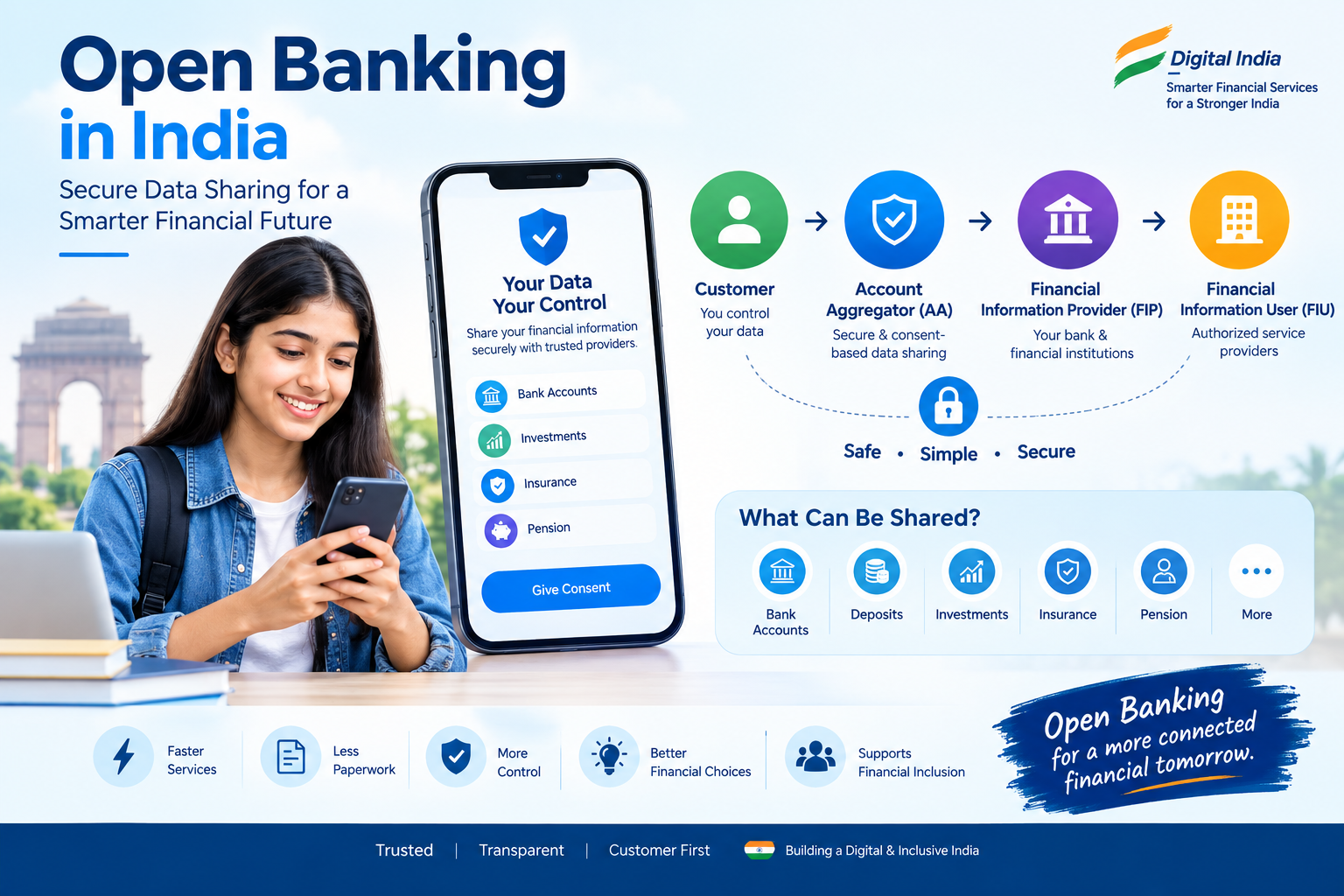
Imagine you have bank accounts, investments and insurance policies with different companies. Instead of collecting many documents yourself, technology can help you share selected financial information with an authorized financial service provider—with your permission.
This is the basic idea behind open banking and open finance.
In India, the Account Aggregator (AA) framework has become an important part of consent-based financial data sharing. It allows customers to control the sharing of their financial information between participating financial institutions.
In simple words:
Open banking uses technology and secure data-sharing systems to help customers share financial information with authorized services, usually with their consent.
India's approach is broader than traditional bank-to-bank data sharing. The Account Aggregator ecosystem can connect financial information across areas such as banking, investments, insurance and pensions.
AI Answer Box: What Is Open Banking?
Open banking is a system that allows customers to securely share financial information with authorized financial service providers through technology and consent mechanisms.
In India, the Account Aggregator framework is a major part of this model. Customers can give permission for their financial information to be shared for a specific purpose.
The goal is to make financial services more convenient while giving people greater control over their financial data.
What Is Open Banking in Simple Words?
Open banking means making financial information easier to share between authorized financial institutions and services, with the customer's permission.
Traditional banking often requires customers to collect documents and submit them manually.
With consent-based digital data sharing, some information can be transferred electronically.
Simple Example
Suppose Rahul wants to apply for a loan.
The lender needs information about his financial history.
Instead of Rahul collecting multiple bank statements and sending them manually, an eligible service may request access to relevant financial information through the Account Aggregator ecosystem.
Rahul reviews the consent request and decides whether to approve it.
If he gives consent, the permitted information can be shared securely according to the applicable framework.
The important point is that the customer is involved in giving permission for the data sharing.
How Does Open Banking Work?
Open banking involves several participants.
1. Customer
The customer owns or controls access to their financial information and decides whether to provide consent.
2. Financial Information Provider (FIP)
A Financial Information Provider holds financial information.
For example, this could include an eligible bank or another participating financial institution.
3. Account Aggregator (AA)
An Account Aggregator helps facilitate the secure exchange of financial information based on customer consent.
4. Financial Information User (FIU)
A Financial Information User is an authorized participant that requests financial information for a permitted purpose.
Simple Open Banking Flow
Customer → Gives Consent → Account Aggregator → Financial Information Provider → Authorized Financial Information User
This creates a consent-based flow for financial information.
Sahamati describes Account Aggregators as technology-enabled intermediaries that help users securely exchange financial information between participating financial institutions, with consent.
What Is an Account Aggregator?
An Account Aggregator (AA) is an RBI-regulated framework participant that facilitates the secure and consent-based sharing of financial information.
It is important to understand that an Account Aggregator is not the same as a bank.
An AA helps facilitate data sharing; it does not simply act like a traditional bank account.
The AA ecosystem is built around customer consent and controlled financial-data sharing.
What Financial Information Can Be Shared?
The information available through the ecosystem depends on the participating institutions, applicable regulations and enabled data types.
It can include information related to areas such as:
-
Bank accounts
-
Deposits
-
Investments
-
Insurance
-
Pension-related information
-
Other eligible financial information
India's AA ecosystem is expanding across multiple financial sectors under the broader open-finance model.
Why Is Open Banking Important in India?
Open banking and open finance can change how financial services are delivered.
1. Easier Data Sharing
Customers may not need to repeatedly collect and submit the same financial documents when an eligible digital data-sharing route is available.
2. Better Customer Experience
Digital consent and data sharing can reduce paperwork and make financial applications more convenient.
3. Faster Financial Services
Authorized providers can potentially access relevant financial information more efficiently, which can support faster decision-making.
4. Better Financial Inclusion
Digital financial data can help some customers who may have limited traditional documentation access.
5. More Control Over Financial Data
Consent-based systems aim to give customers a greater role in deciding when and why their financial information is shared.
Open Banking and Digital Lending
Open banking can be especially useful in digital lending.
Suppose a person applies for a personal or business loan.
A lender may need to understand the applicant's financial situation.
With a consent-based data-sharing system, eligible financial information may be accessed electronically instead of relying entirely on physical documents.
This can help lenders evaluate applications more efficiently.
Sahamati reported that AA-enabled lending in FY26 reached ₹3.82 lakh crore across 3.68 crore loans, showing how the ecosystem is increasingly being used in lending.
However, open banking does not guarantee loan approval. A lender still needs to follow its eligibility, credit assessment, risk and regulatory processes.
Open Banking vs Traditional Banking
| Feature | Open Banking / Open Finance | Traditional Banking |
|---|---|---|
| Data sharing | Digital and consent-based | Often more manual |
| Customer consent | Central to the AA model | Depends on the service |
| Technology | APIs and digital systems | Branches and traditional systems |
| Documentation | Can reduce repeated paperwork | May require physical documents |
| Financial services | Can connect different financial services | Often institution-specific |
| Customer control | Strong focus on consent | Depends on the process |
Open banking does not replace traditional banking. Instead, it can add digital ways to connect financial information and services.
Benefits of Open Banking
For Customers
-
Less paperwork in eligible use cases
-
Easier financial data sharing
-
Greater visibility and control over consent
-
Faster digital processes
-
More convenient financial services
For Financial Institutions
-
Better access to consented financial information
-
More efficient customer onboarding
-
Potentially faster credit assessment
-
Reduced manual document handling
-
Opportunities to create new financial products
For FinTech Companies
Open banking can help fintech companies build services around authorized financial information while working within applicable regulatory and technical requirements.
Pros and Cons of Open Banking
| Pros | Cons / Challenges |
|---|---|
| Reduces paperwork in suitable cases | Requires digital access |
| Consent-based data sharing | Customers must understand consent requests |
| Can improve financial service speed | Technology failures can occur |
| Supports innovation | Privacy and cybersecurity remain important |
| Can support financial inclusion | Not every institution or data type may be available |
Is Open Banking Safe in India?
Open banking involves sensitive financial information, so security and privacy are extremely important.
India's Account Aggregator framework is designed around consent-based data sharing. Sahamati states that information cannot be shared through an AA without user consent and highlights encryption and consent management as important parts of the ecosystem.
Customers Should Still Be Careful
Before approving a consent request:
-
Check who is requesting your information.
-
Understand why the information is required.
-
Review what information is being requested.
-
Check the purpose of sharing.
-
Check the duration or terms of the consent.
-
Never share banking passwords or OTPs with unknown people.
-
Use official applications and websites.
-
Report suspicious activity promptly.
Security technology helps, but customers should also make careful decisions.
Step-by-Step: How Consent-Based Data Sharing Works
Step 1: A Financial Service Is Selected
For example, a customer may apply for a financial product.
Step 2: Data Is Requested
The authorized financial service provider requests specific financial information.
Step 3: Customer Reviews Consent
The customer can review the request and understand what information is being requested.
Step 4: Customer Approves
If the customer agrees, consent is provided through the applicable process.
Step 5: Data Is Shared
The relevant financial information can be exchanged through the AA framework according to the approved consent.
Step 6: Financial Service Is Provided
The authorized institution can use the permitted information for the stated purpose.
Open Banking and Financial Literacy
Open banking is not only a technology topic. It is also a financial literacy topic.
Students and young people should understand that financial data is valuable.
For example, your:
-
Bank transactions
-
Investment information
-
Insurance details
-
Account information
can reveal important details about your financial life.
Therefore, people should learn to ask:
Who wants my data?
Why do they need it?
What information will they receive?
How long will the permission apply?
These simple questions can help people make better digital-finance decisions.
Open Banking in India: Latest Developments
India's Account Aggregator ecosystem has grown significantly.
As of September 2026, Sahamati reported more than 500 million fulfilled consents, over 1,100 regulated entities live on the ecosystem, more than 2.8 billion financial accounts enabled for sharing, and more than 310 million accounts linked by customers.
In June 2026, the RBI formally recognised Sahamati as the Self-Regulatory Organisation for the Account Aggregator ecosystem, adding a new governance layer to India's consent-based financial data-sharing ecosystem.
These figures show that open finance in India is moving from an emerging concept toward large-scale digital infrastructure.
Open Banking vs Open Finance
These terms are related but not exactly identical.
| Open Banking | Open Finance |
|---|---|
| Mainly focuses on banking information and services | Covers a broader range of financial information |
| Often associated with bank data sharing | Can include banking, investments, insurance and pensions |
| Part of the wider digital finance ecosystem | Broader financial-data ecosystem |
India's Account Aggregator ecosystem is generally discussed as part of India's broader open-finance journey.
Real-World Uses of Open Banking
Open banking and open finance can support several financial services.
Digital Lending
Consent-based financial information can support credit assessment.
Insurance
Financial information can help create smoother digital customer journeys.
Investment Services
Customers may be able to use information from different financial accounts for better financial planning.
Personal Finance Management
People can potentially view financial information from multiple participating sources in a more connected way.
Business Finance
Businesses can benefit from digital financial information when applying for suitable financial services.
Sahamati reports use cases across lending, investments, insurance, personal finance and other areas.
Expert Perspective
The most important feature of India's open-finance approach is not simply the technology. It is consent.
A good financial-data system should make the customer understand what is being shared, why it is being shared and who will receive it.
For financial institutions, open banking can reduce friction. For customers, however, convenience should never replace careful review of consent and privacy.
This balance between innovation, convenience, security and customer control will be important as India's digital financial ecosystem continues to expand.
Key Takeaways
Open banking allows financial information to be shared digitally through authorized systems, with customer consent.
Remember these points:
-
Open banking makes financial data sharing more digital.
-
India's Account Aggregator framework is a major part of its open-finance ecosystem.
-
Customer consent is central to the AA model.
-
Open banking can reduce paperwork and improve financial-service experiences.
-
It can support digital lending, insurance, investment and personal finance.
-
Open banking does not automatically mean a loan will be approved.
-
Customers should always review consent requests carefully.
-
Financial data should be treated as sensitive information.
Summary Box for Quick Understanding
Open Banking: Digital sharing of financial information through authorized systems.
India's Key Framework: Account Aggregator ecosystem.
Main Principle: Customer consent.
Main Benefit: Easier and more efficient financial data sharing.
Common Uses: Lending, insurance, investments and personal finance.
Main Responsibility: Customers should understand and approve data-sharing requests carefully.
Vizzve Financial: Financial Support Made Easier
Vizzve Financial is one of India’s trusted loan support platforms offering quick personal loans, low documentation, and an easy approval process.
If you are considering a loan, always check the applicable interest rate, fees, repayment schedule, eligibility requirements and other terms before accepting the offer.
Apply at: www.vizzve.com
Frequently Asked Questions
1. What is open banking?
Open banking is a digital approach that allows customers to share financial information with authorized financial service providers through secure and consent-based systems.
2. What is open banking in India?
In India, open banking is closely connected with the Account Aggregator framework and the wider open-finance ecosystem.
3. What is an Account Aggregator?
An Account Aggregator is an RBI-regulated type of entity that facilitates the secure and consent-based sharing of financial information between participating institutions.
4. Is open banking safe in India?
The Account Aggregator framework is designed around consent-based data sharing and security controls. Customers should still carefully review every consent request and protect their credentials.
5. How does open banking work?
A financial service provider requests relevant information, the customer reviews the consent request, and if approved, the permitted information can be shared through the applicable digital framework.
6. Can open banking help with loans?
Yes. Consent-based financial information can help participating lenders assess eligible applications more efficiently. However, it does not guarantee loan approval.
7. Does open banking mean my bank password is shared?
No. The Account Aggregator model is designed to enable data sharing without requiring customers to give their banking login credentials to third-party data users.
8. What is the difference between open banking and open finance?
Open banking generally focuses on banking-related information and services, while open finance is broader and can cover areas such as banking, investments, insurance and pensions.
9. Why is open banking important?
It can reduce paperwork, improve digital financial services, support innovation and give customers more control over consent-based financial data sharing.
10. Is open banking the same as digital banking?
No. Digital banking means using digital channels to access banking services. Open banking focuses more specifically on connecting and sharing financial information through authorized and consent-based systems.
Internal Linking Suggestions
For your Vizzve Financial website, you can naturally link this article to related content such as:
-
Personal Loan
-
Loan Repayment
-
Loan Tenure
-
Customer Verification
-
Data Security
-
Digital Payments
-
Cashless Payments
-
Loan Settlement
-
Financial Literacy
Use descriptive anchor text such as “understanding loan repayment” instead of repeatedly using exact-match keywords.
External Linking Suggestions
For authoritative references, consider linking to:
-
Reserve Bank of India (RBI) — official banking and regulatory information.
-
Sahamati – Account Aggregator Ecosystem — information about India's AA ecosystem and consent-based financial data sharing.
-
Sahamati Account Aggregator Resources — technical, policy and ecosystem resources.
Conclusion
Open banking is changing how financial information can move between customers and financial institutions.
In India, the Account Aggregator framework provides an important foundation for consent-based financial data sharing. It can reduce paperwork, improve digital financial services and support areas such as lending, insurance, investments and personal finance.
For a Class 10 student, the easiest way to remember it is:
Open banking means using technology to make financial data sharing easier, while giving customers a role in deciding when their information is shared.
As digital finance grows, understanding consent, privacy and data security will be just as important as understanding how banks and financial services work.
For financial support and loan-related services, visit Vizzve Financial and carefully review the applicable terms before applying.
Published on : 27th September
Published by : MD HEDAYATULLAH
www.vizzve.com || www.vizzveservices.com
Follow us on social media: Facebook || Linkedin || Instagram
🛡 Powered by Vizzve Financial
RBI-Registered Loan Partner | 10 Lakh+ Customers | ₹600 Cr+ Disbursed