

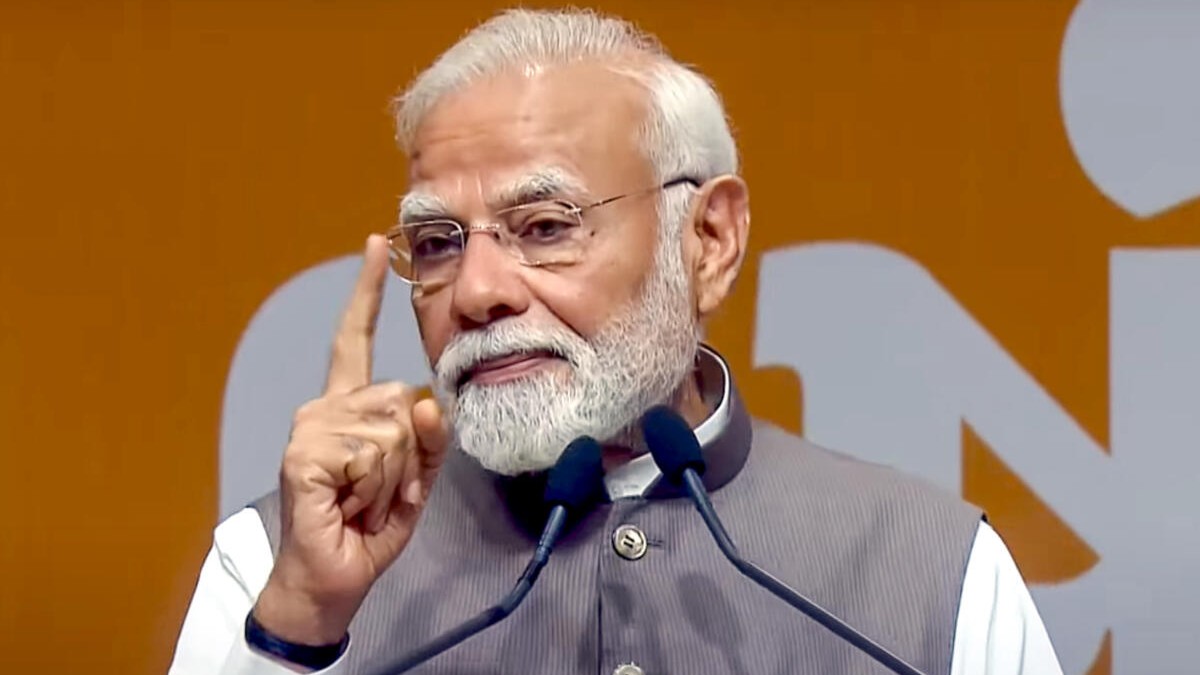
New Delhi/Washington – In the wake of Operation Sindoor, India’s decisive military response to the Pahalgam terror attack, a diplomatic reshuffle has followed. Prime Minister Narendra Modi has firmly denied any U.S. mediation in the ceasefire agreement with Pakistan, prompting former U.S. President Donald Trump to retract his earlier claim that America "stopped a war" between the two South Asian rivals.
🔴 Operation Sindoor: The Military Trigger
Operation Sindoor was launched by India on May 7, 2025, following a deadly terror attack on Indian soldiers in Pahalgam, Jammu & Kashmir. Over four days, the Indian Army carried out targeted precision strikes against cross-border terror infrastructure in Pakistan-occupied Kashmir (PoK). These retaliatory operations reportedly involved the use of drones and artillery to neutralize key launchpads and militant camps.
By May 10, both sides agreed to a ceasefire after a series of DGMO (Director General of Military Operations)-level communications. Indian officials confirmed that the initial outreach came from Pakistan’s side, seeking de-escalation after sustaining strategic losses.
🛑 PM Modi Sets the Record Straight
On June 18, during a phone call with Donald Trump, Prime Minister Modi reportedly refuted claims that the United States played any role in mediating the ceasefire. Modi emphasized India’s long-standing position: no third-party involvement in Indo-Pak matters.
According to Indian Foreign Secretary Vikram Misri, the Prime Minister made it “absolutely clear” that direct military coordination between India and Pakistan led to the ceasefire. Modi also conveyed that India’s sovereignty and strategic autonomy were non-negotiable principles in foreign policy.
🔁 Trump’s U-Turn: From Claiming Credit to Giving Credit
Just days earlier, Donald Trump had stated at a rally and later on social media that he “stopped a war” between India and Pakistan, taking credit for the ceasefire and suggesting that it reflected the U.S.'s diplomatic leverage.
However, following Modi’s clarification and his meeting with Pakistan Army Chief General Asim Munir in New York on June 19, Trump appeared to backtrack. Speaking to the press, Trump said:
“The leaders of India and Pakistan — both smart people — decided to de-escalate. We respect that. They didn’t need outside help.”
This marked the first time Trump publicly acknowledged that the ceasefire was decided independently by the two nations and not influenced by the U.S.
🇮🇳 India’s No-Mediation Policy Holds Firm
India has consistently rejected third-party mediation, especially in bilateral issues with Pakistan. Whether under the UN umbrella or through western powers, India maintains that all disputes — including Jammu & Kashmir — must be resolved bilaterally and peacefully.
By pushing back on Trump’s remarks, Modi not only reinforced India’s strategic independence but also corrected the global narrative, ensuring the ceasefire was seen as a result of India’s military and diplomatic resolve, not foreign pressure.
🌐 What This Means for Global Diplomacy
This episode underscores a few key points:
India continues to assert its regional autonomy on security matters.
The US, even under influential leadership figures like Trump, cannot assume de facto roles in South Asian military decisions.
Direct military and political channels between India and Pakistan remain the primary mechanisms for conflict management.
FAQ:
Q1: What is Operation Sindoor?
A: Operation Sindoor was a limited military operation launched by India in May 2025 in response to the Pahalgam terror attack. It targeted militant infrastructure across the border.
Q2: Did the US mediate the India-Pakistan ceasefire?
A: No. PM Modi clearly stated that the ceasefire was the result of direct military communication (DGMO-level) between India and Pakistan, not US mediation.
Q3: What did Donald Trump say about the ceasefire?
A: Initially, Trump claimed the US stopped a war between India and Pakistan. However, after Modi's clarification, he acknowledged that both countries independently chose to de-escalate.
Q4: Why is this development significant?
A: It reaffirms India's position against foreign mediation in bilateral disputes and highlights a diplomatic correction of the international narrative.
Published on 19th june
Publisher : SMITA
www.vizzve.com || www.vizzveservices.com
Follow us on social media: Facebook || Linkedin || Instagram