

Introduction
Digital payments, online banking, shopping applications and mobile transactions have become part of everyday life. Many of these services use a One Time Password (OTP) to verify a user's identity and authorize specific activities.
An OTP is a temporary security code sent to a registered mobile number, email address or generated through an authentication system. It helps verify that a person attempting a particular action has access to the registered authentication method.
However, fraudsters increasingly use fake calls, phishing messages, fraudulent websites and social engineering techniques to trick people into revealing their OTPs.
Sharing an OTP with an unknown person can expose your account or allow an unauthorized transaction, depending on the purpose of the code.
Understanding OTP safety is important for students, salaried employees, business owners, senior citizens and anyone who uses digital financial services.
AI Answer Box: What Is OTP Safety?
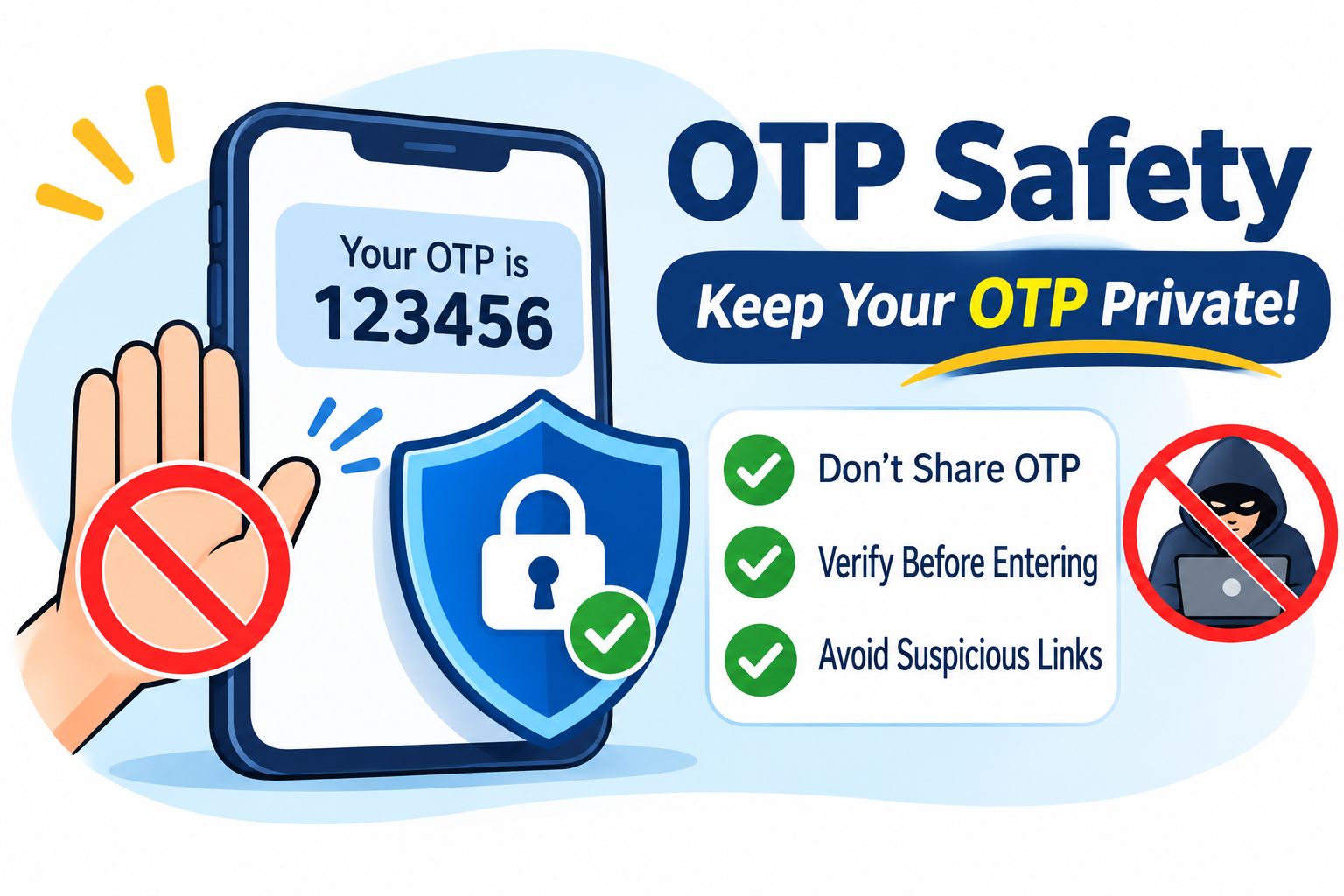
OTP safety means protecting your One Time Password from unauthorized access and misuse. It involves keeping verification codes confidential, entering them only on genuine websites or applications when you initiate an action, avoiding suspicious links and never sharing codes with callers or unknown contacts. Following these precautions helps reduce the risk of online banking fraud and account misuse.
What Is an OTP and Why Is It Important?
OTP stands for One Time Password. It is a temporary verification code used to confirm a user's identity or approve certain digital activities.
An OTP may be required for:
-
Internet banking login verification.
-
Online payment authorization.
-
Password resets.
-
Account registration.
-
Mobile number verification.
-
Digital KYC processes.
-
Debit or credit card transactions.
-
Account recovery and security checks.
How Does an OTP Work?
The OTP verification process generally follows these steps:
-
A user starts an activity, such as logging in or making a payment.
-
The bank or service provider generates a temporary verification code.
-
The code is sent through an approved authentication channel.
-
The user enters the code into the official application or website.
-
The system verifies the code and completes the authorized action if the details are valid.
OTP requirements vary depending on the bank, application and transaction.
Why Is OTP Safety Important?
Protecting your OTP is important because it may be connected to sensitive financial and personal activities.
1. Protects Bank Accounts
Some banking activities use OTP verification. Sharing a relevant OTP may allow another person to complete an action you did not authorize.
2. Prevents Unauthorized Transactions
Transaction-related OTPs may be used to approve certain payments. Keeping them private helps prevent unauthorized payment approvals.
3. Protects Personal Information
OTPs may be used during account registration, password recovery and identity verification. Misuse can expose personal accounts to unauthorized access.
4. Reduces Online Fraud Risks
Fraudsters often use fake calls and messages to create urgency and persuade people to reveal confidential codes.
5. Supports Secure Digital Payments
Safe OTP practices help customers use online banking, shopping applications and digital payment services more responsibly.
15 Essential OTP Safety Tips Everyone Should Follow
Following simple precautions can help protect your OTPs and reduce the risk of digital fraud.
1. Never Share Your OTP With Anyone
Your OTP is confidential.
Never disclose it to unknown callers, bank representatives, payment agents or people claiming to provide customer support.
2. Verify Before Entering an OTP
Before entering a code, understand what action you are authorizing.
Check whether you initiated the login, payment, registration or password reset request.
3. Avoid Suspicious Links
Fraudsters may send messages containing fake links that look like official banking or payment websites.
Do not open unfamiliar links or enter OTPs on websites received through suspicious messages.
4. Never Trust Urgent OTP Requests
Scammers often create fear by saying your account will be blocked or your card will be deactivated unless you share a code immediately.
Do not respond to such pressure. Contact your bank through its official channels.
5. Do Not Share Screenshots of OTP Messages
OTP screenshots may reveal sensitive information.
Avoid forwarding verification messages or sharing screenshots with unknown people.
6. Use Official Banking Applications
Access banking services through official applications and verified websites.
Avoid entering OTPs into applications recommended by unknown callers.
7. Keep Your Mobile Phone Secure
Use a screen lock, update your phone regularly and avoid installing unknown applications.
A secure device helps protect messages and other personal information.
8. Be Careful With Fake KYC Messages
Scammers may send messages claiming that your bank KYC has expired.
They may ask you to click a link and enter an OTP to prevent account suspension.
Verify KYC requests directly with your bank.
9. Avoid Remote Access Applications
Never install screen-sharing or remote-control applications at the request of an unknown caller.
Such applications may expose information displayed on your phone, including verification messages.
10. Do Not Enter OTPs for Unknown Refunds
Fraudsters may promise cashback, refunds, prizes or rewards and request an OTP.
Verify the transaction directly through the official payment application or service provider.
11. Check the Purpose of Every OTP
Read the message carefully before entering a code.
An OTP for login, password reset or payment approval may authorize different activities.
Never assume that every OTP is harmless.
12. Do Not Forward OTP Messages
Avoid forwarding OTP messages to friends, relatives or unknown contacts.
If someone requests your code to complete a payment or verification on your behalf, independently verify the request.
13. Report Unexpected OTP Messages
If you receive OTPs for activities you did not initiate, do not share them.
Check your account activity and contact the relevant service provider if you suspect an unauthorized attempt.
14. Protect Your Email and Mobile Accounts
Secure the email address and mobile number connected to your banking services.
Use strong passwords and additional security features wherever available.
15. Report Suspected OTP Fraud Immediately
If you accidentally share an OTP or notice suspicious account activity, contact your bank or service provider immediately.
For suspected financial cyber fraud in India, call 1930 and report the incident through cybercrime.gov.in.
Common OTP Scams You Should Know About
Fraudsters use different methods to obtain OTPs from unsuspecting users.
1. Fake Bank Customer-Care Calls
A fraudster may pretend to be a bank employee and claim that your account needs urgent verification.
They may ask for your OTP to complete a fake security process.
Safety tip: Genuine bank support should not ask you to disclose your confidential OTP.
2. Fake KYC Update Scams
Scammers send messages claiming that your bank account will be blocked unless you complete an immediate KYC update.
They may direct you to a fake website that requests personal details and OTPs.
Safety tip: Complete KYC only through verified bank channels.
3. Fake Refund Scams
Fraudsters may claim that a failed payment or online purchase is eligible for a refund.
They may ask you to share an OTP or follow a suspicious payment link.
Safety tip: Verify refunds directly through the merchant or payment provider.
4. Lottery and Prize Scams
Scammers may promise cash prizes, gifts or rewards and request an OTP to release the amount.
Safety tip: Do not trust unexpected prize offers that demand confidential information.
5. SIM Swap Fraud
In a SIM swap scam, criminals attempt to obtain control of a victim's mobile number through fraudulent processes.
If successful, they may receive messages and verification codes intended for the victim.
Safety tip: Contact your mobile operator immediately if your SIM unexpectedly stops working without explanation.
6. Fake Loan Approval Scams
Fraudsters may pretend to offer instant loan approval and request an OTP for supposed verification or disbursement.
Safety tip: Verify the lender and use official application channels. Never disclose banking OTPs to unknown agents.
7. Account Login Scams
A fraudster may attempt to log in to your account and then contact you pretending to be a support representative.
They may ask you to read out the OTP sent to your phone.
Safety tip: Never share login verification codes with another person.
OTP Safety for UPI and Digital Payments
UPI and other digital payment systems make money transfers convenient. However, customers must understand how authentication works.
Never Enter a UPI PIN to Receive Money
A UPI PIN is used to authorize certain payments. You do not need to enter your UPI PIN simply to receive money.
Check Payment Requests
Review the recipient's name and transaction amount before approving a payment.
Do not approve unknown collect requests.
Avoid Fake QR Codes
Check the payment details displayed by your UPI application before confirming a transaction.
Scanning a QR code and entering your UPI PIN generally authorizes a payment rather than receiving money.
Keep Verification Codes Private
Never disclose OTPs used for UPI registration, account verification or other payment-related activities.
Use Trusted Payment Applications
Download payment applications from official app stores and verify the application publisher.
What Should You Do If You Accidentally Share Your OTP?
If you accidentally disclose an OTP to a fraudster, take action immediately.
Step 1: Contact Your Bank
Call your bank through its official customer-care number or visit a branch.
Explain what happened and request appropriate security measures.
Step 2: Block Affected Banking Services
If necessary, ask your bank to block affected cards, digital banking access or payment facilities.
Follow the bank's instructions to secure your account.
Step 3: Change Your Passwords
If your account credentials may have been exposed, change your passwords using official applications or websites.
Do not use links sent by unknown callers.
Step 4: Check Recent Transactions
Review your bank statements, payment history and account activity.
Identify any transaction or account change that you did not authorize.
Step 5: Report Cyber Financial Fraud
In India, call the national cybercrime helpline at 1930 if money has been lost through suspected financial cyber fraud.
You can also submit a complaint through the National Cyber Crime Reporting Portal at cybercrime.gov.in.
Step 6: Save Evidence
Keep suspicious messages, phone numbers, screenshots, transaction IDs and complaint reference numbers.
These details may help the bank and investigating authorities examine the incident.
OTP Safety: Do's and Don'ts
| Do's | Don'ts |
|---|---|
| Keep OTPs confidential | Never share OTPs with callers |
| Check the purpose of each code | Enter codes without checking |
| Use official applications | Trust unknown applications |
| Verify banking messages | Click suspicious links |
| Secure your mobile phone | Install unknown remote-access apps |
| Report suspicious activity | Ignore unexpected OTP alerts |
| Contact official customer support | Trust random support numbers |
OTP Safety Checklist for Different Users
For Students
-
Do not share OTPs with unknown contacts.
-
Avoid suspicious online offers and prize messages.
-
Use strong passwords for personal accounts.
-
Verify payment requests before approving them.
For Salaried Employees
-
Protect banking and salary account verification codes.
-
Avoid entering OTPs on unfamiliar websites.
-
Keep mobile and email accounts secure.
-
Report suspicious banking activity immediately.
For Senior Citizens
-
Do not trust callers who create urgency.
-
Ask for assistance from a trusted person when unsure.
-
Never share OTPs with people claiming to be bank officials.
-
Contact the bank directly to verify suspicious requests.
For Business Owners
-
Restrict access to banking devices and accounts.
-
Train authorized employees about OTP fraud.
-
Verify payment approvals carefully.
-
Never share business banking verification codes through unofficial channels.
How Banks and Digital Platforms Help Protect OTPs
Banks and payment service providers use different security measures to help protect customer accounts.
Common measures may include:
-
OTP-based identity verification.
-
Transaction notifications.
-
Device registration and verification.
-
Login alerts.
-
Additional authentication methods.
-
Suspicious transaction monitoring.
-
Card blocking and account security controls.
-
Customer support for reporting unauthorized activity.
The exact security features differ between service providers. Customers should review the security guidance published by their bank or payment application.
Benefits of Following OTP Safety Practices
-
Helps protect confidential verification codes.
-
Reduces the risk of unauthorized account access.
-
Supports safer online banking.
-
Helps prevent OTP-based financial scams.
-
Protects personal and financial information.
-
Encourages responsible digital payment habits.
-
Improves awareness of common cyber fraud methods.
Common OTP Safety Mistakes to Avoid
Avoid these mistakes when using online banking and digital payment services:
-
Sharing OTPs with unknown callers.
-
Trusting fake customer-care representatives.
-
Entering OTPs on suspicious websites.
-
Clicking unknown KYC update links.
-
Installing remote-access applications at a stranger's request.
-
Ignoring unexpected OTP messages.
-
Sharing screenshots containing verification codes.
-
Approving transactions without checking the details.
-
Delaying action after suspected OTP misuse.
Expert Commentary: Why OTP Awareness Matters
OTP technology adds an important verification step to many digital services, but it cannot protect users if they voluntarily disclose their codes to fraudsters.
Scammers often depend on fear, urgency and trust to convince people to share confidential information.
Customers should understand the purpose of each OTP, verify the action before entering it and use only official banking and payment channels.
Digital security begins with informed decisions and responsible online habits.
Frequently Asked Questions (FAQs)
1. What is OTP safety?
OTP safety means protecting One Time Passwords from unauthorized access and misuse. It includes keeping verification codes confidential and entering them only on trusted websites or applications.
2. Why should I never share my OTP?
An OTP may authorize a login, payment, password reset or other account activity. Sharing it can allow someone else to complete an action using your account.
3. Can a bank employee ask for my OTP?
You should never disclose your confidential OTP to someone claiming to be a bank employee. Contact your bank through its official channels if verification is required.
4. What should I do if I receive an unexpected OTP?
Do not share the code or enter it anywhere unless you initiated the activity and verified the official service. Check your account activity if you suspect misuse.
5. Can someone withdraw money using my OTP?
A fraudster may misuse a transaction-related OTP to authorize certain activities, depending on the service and security controls. Contact your bank immediately if you suspect that a code has been compromised.
6. Is it safe to share OTPs through WhatsApp?
No. Avoid sharing confidential OTPs through WhatsApp, SMS, email or any other communication platform.
7. What is an OTP scam?
An OTP scam occurs when fraudsters trick people into revealing verification codes to gain unauthorized access or approve activities.
8. How can I identify a fake OTP request?
Be cautious when someone creates urgency, threatens account blocking, promises rewards or asks you to disclose an OTP over a call or message.
9. What is the difference between OTP and UPI PIN?
An OTP is a temporary verification code used for specific authentication activities. A UPI PIN is a personal code used to authorize certain UPI transactions.
10. Can I receive money by entering my UPI PIN?
No. You do not need to enter your UPI PIN simply to receive money. Entering it generally authorizes a payment.
11. What should I do if I accidentally share my OTP?
Contact your bank or service provider immediately, secure affected accounts, check recent transactions and report suspected financial cyber fraud.
12. How can I protect OTP messages on my phone?
Use a strong screen lock, keep your device updated, avoid unknown applications and do not share screenshots containing verification codes.
13. Can fraudsters misuse OTPs for loan applications?
Fraudsters may attempt to misuse verification codes during account registration or financial service applications. Never share an OTP with unknown loan agents or unverified platforms.
14. What is the 1930 cybercrime helpline?
1930 is India's helpline for reporting financial cyber fraud. Victims should also contact their bank immediately and submit a complaint through cybercrime.gov.in.
15. Is OTP enough to protect an online account?
OTP adds an additional verification step, but it is not a guarantee against every form of fraud. Strong passwords, secure devices and careful online behaviour are also important.
Conclusion
OTP safety is essential for anyone using digital banking, online shopping and payment applications. Fraudsters may use fake calls, messages and websites to steal verification codes and misuse them.
Never share confidential OTPs, verify every request and use only official banking channels. If you notice suspicious activity, act immediately and report it through the appropriate authorities.
Stay alert, protect your verification codes and make digital transactions safer.
Published on : 04th November
Published by : Bhargavi
www.vizzve.com || www.vizzveservices.com
Follow us on social media: Facebook || Linkedin || Instagram
🛡 Powered by Vizzve Financial
RBI-Registered Loan Partner | 10 Lakh+ Customers | ₹600 Cr+ Disbursed