

Introduction
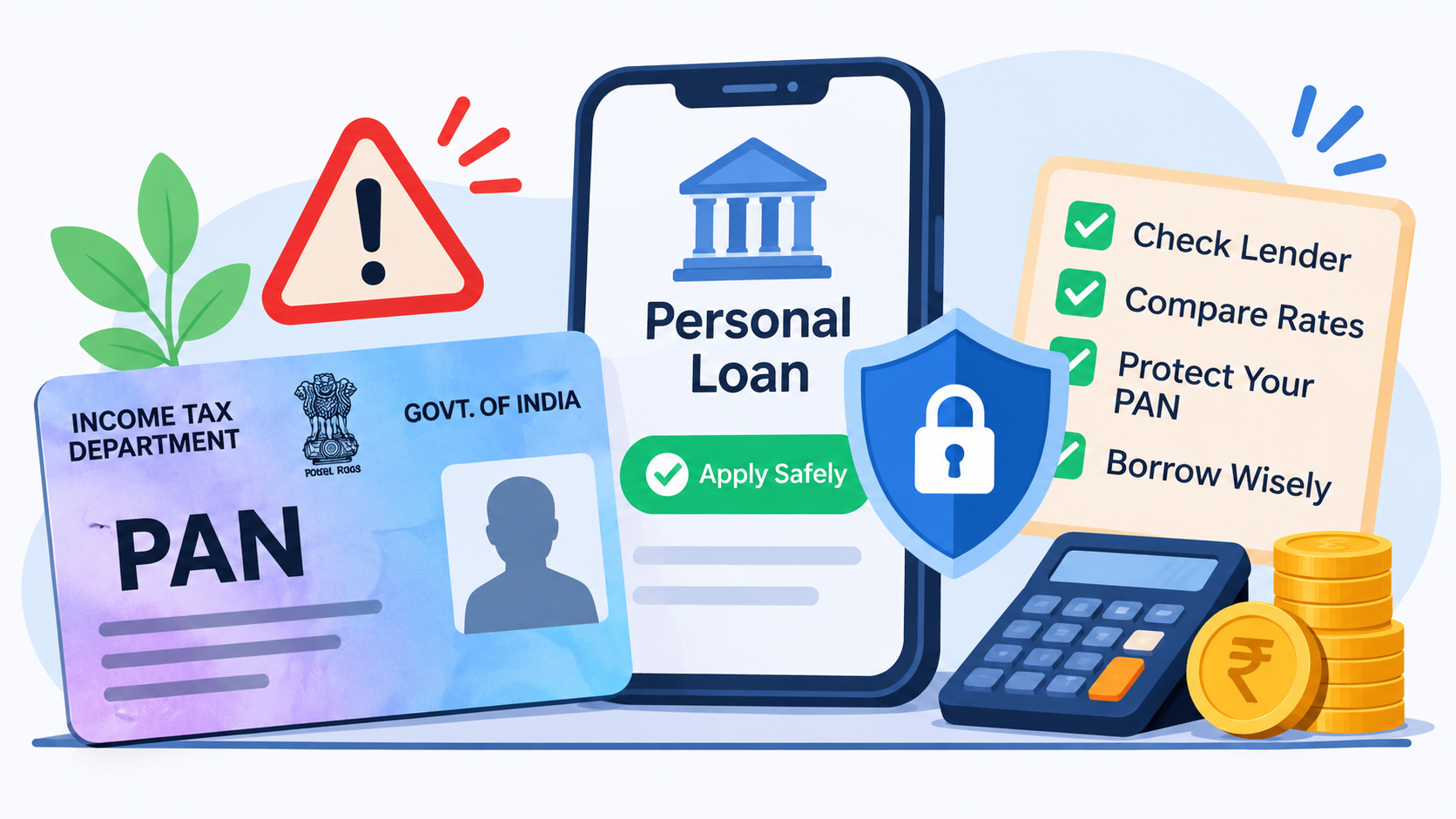
Applying for a personal loan using a PAN card has become easier with online lending services. Many banks, Non-Banking Financial Companies (NBFCs) and digital lending platforms allow applicants to submit PAN details and complete parts of the application process online.
However, convenience does not mean every loan offer is safe.
Some borrowers make mistakes such as sharing PAN details with unknown websites, accepting loans without checking interest rates, ignoring processing fees or borrowing more than they can repay. These decisions can create financial problems and expose individuals to identity theft, privacy violations and loan-related fraud.
A PAN card is an important financial identification document. It helps lenders verify applicants and conduct authorised credit assessments, but it does not guarantee loan approval.
This guide explains the common mistakes, financial risks, fraud warning signs and safer decisions borrowers should understand before applying for a loan using PAN.
3. AI Answer Box: What Are the Common Mistakes and Risks of Loan Using PAN?
The common mistakes when applying for a loan using PAN include trusting unverified loan apps, sharing personal information without checking the lender, ignoring interest rates and processing fees, applying for multiple loans unnecessarily and accepting repayment terms without reading the agreement.
The major risks include PAN misuse, identity theft, fraudulent loan offers, hidden charges, excessive debt and privacy violations.
Safer decisions include:
-
Apply through verified banks and RBI-regulated NBFCs.
-
Check the actual lender behind a digital lending platform.
-
Share PAN details only through secure, authorised channels.
-
Review the Key Facts Statement (KFS).
-
Compare APR, EMI and total repayment costs.
-
Borrow only what you can comfortably repay.
-
Never share OTPs, passwords or UPI PINs.
-
Report suspicious activity promptly.
Quick takeaway: A PAN card can support loan verification, but safe borrowing depends on checking the lender, understanding the loan terms and protecting personal information.
4. Common Mistakes to Avoid When Taking a Loan Using PAN
Borrowers often focus on getting loan approval quickly and overlook important financial and security checks. These mistakes can create problems even before the loan amount reaches their bank account.
4.1 Sharing PAN Details With Unverified Loan Apps
One of the biggest mistakes is entering PAN details into unknown mobile applications or websites.
Some fraudulent platforms collect PAN numbers, Aadhaar details, photographs and contact information under the name of instant loan approval.
Why is this a mistake?
-
Personal information may be collected without a genuine lending purpose.
-
Identity information may be misused.
-
Applicants may receive unwanted calls and messages.
-
Fraudsters may attempt financial scams using collected details.
Safer decision: Apply through the official website or application of a verified bank or regulated NBFC. Check the lender's identity before submitting documents.
4.2 Assuming PAN Card Guarantees Loan Approval
Some applicants believe that having a valid PAN card automatically makes them eligible for a personal loan.
This is incorrect.
Lenders generally evaluate:
-
Monthly income.
-
Employment stability.
-
Credit score.
-
Existing financial commitments.
-
Previous repayment history.
-
Overall repayment capacity.
Safer decision: Check your eligibility before applying and understand that PAN is primarily an identification and verification document.
4.3 Ignoring Interest Rates and Processing Fees
Another common mistake is accepting a loan because the advertised EMI appears affordable.
Borrowers sometimes overlook processing fees, taxes, late-payment charges and other applicable costs.
For example, a loan with a lower advertised interest rate may still have a higher overall borrowing cost because of additional fees.
Safer decision: Compare the APR, total repayment amount, processing fee and EMI before accepting the offer.
4.4 Applying to Multiple Loan Apps at the Same Time
When one application is rejected, some borrowers immediately apply through several other platforms.
This can create unnecessary hard credit enquiries when lenders access their credit reports.
Multiple applications may also indicate increased credit-seeking behaviour to lenders.
Safer decision: Understand why an application was rejected, review your credit report and apply selectively.
4.5 Providing Incorrect Personal or Income Information
Entering incorrect PAN details, salary information, employment details or bank account information can delay verification.
Providing false information may also result in rejection or other consequences.
Safer decision: Double-check all application details and submit genuine supporting documents.
4.6 Accepting a Loan Without Reading the Agreement
Some borrowers accept digital loan agreements without reading the terms and conditions.
They may later discover charges or repayment conditions they did not understand.
Safer decision: Read the loan agreement and Key Facts Statement before providing final acceptance.
4.7 Borrowing More Money Than Necessary
A borrower may accept a larger loan amount simply because the lender offers it.
However, a larger loan means higher repayment obligations and potentially more interest.
Safer decision: Calculate the actual financial requirement and borrow only what is necessary.
4.8 Ignoring Existing EMI Commitments
Taking another personal loan without considering existing EMIs can put pressure on monthly finances.
Safer decision: Calculate your total monthly debt obligations and check whether sufficient income remains for household expenses and savings.
4.9 Sharing OTPs and Banking Credentials
Fraudsters may pretend to be bank employees or loan agents and request OTPs, passwords, UPI PINs or card details.
These details can be misused to access financial accounts or authorise transactions.
Safer decision: Never share OTPs, UPI PINs, passwords or banking credentials with anyone, including people claiming to represent a lender.
4.10 Ignoring Privacy Permissions
Some suspicious loan applications request unnecessary access to contacts, call logs, photographs and other personal information.
Safer decision: Review app permissions and avoid applications that demand unrelated personal data.
RBI's Digital Lending Directions, 2025, require regulated entities to ensure need-based data collection with prior and explicit borrower consent, subject to applicable provisions.
5. Major Risks of Taking a Loan Using PAN Card
A loan application involving PAN details can create different types of risks if borrowers do not follow proper precautions.
5.1 PAN Card Misuse and Identity Theft
PAN is an important financial identification number.
If it is shared with unauthorised people, it may increase the risk of identity-related fraud and misuse of personal information.
Possible consequences include:
-
Unwanted financial communications.
-
Attempts to create fraudulent financial accounts.
-
Misuse of personal identification information.
-
Suspicious loan enquiries or applications.
-
Increased exposure to targeted scams.
Safer approach: Share PAN details only when necessary, with verified institutions, through secure channels.
5.2 Fake Loan Approval Scams
Fraudsters may send messages claiming that a personal loan has been approved using the applicant's PAN card.
They may demand an advance payment for:
-
Loan insurance.
-
File opening.
-
Approval confirmation.
-
Security deposits.
-
Processing charges through unofficial accounts.
These payments may not be connected to any genuine loan.
Safer approach: Confirm all charges directly with the actual lender and check that they are properly disclosed.
5.3 Hidden Charges and Expensive Borrowing
Some loan advertisements highlight low interest rates while giving less attention to other costs.
Borrowers may face:
-
Processing fees.
-
Applicable GST.
-
Late-payment charges.
-
Failed payment or bounce charges.
-
Prepayment or foreclosure charges, where applicable.
Safer approach: Request the complete cost breakdown and compare APR rather than focusing only on the advertised interest rate.
5.4 Data Privacy and Personal Information Risks
Unverified lending applications may collect more information than necessary.
Personal information can include:
-
PAN details.
-
Mobile numbers.
-
Email addresses.
-
Bank information.
-
Identity documents.
-
Employment details.
If information is handled improperly, borrowers may experience privacy violations, unwanted marketing or identity-related risks.
Safer approach: Read the privacy policy, understand why information is being collected and check how it will be stored and shared.
5.5 Debt Traps and Repayment Problems
Taking a loan without calculating repayment capacity can lead to a cycle of borrowing.
For example:
-
A borrower takes a personal loan for an emergency.
-
Monthly EMI payments become difficult.
-
The borrower uses another loan to pay existing obligations.
-
Total debt increases.
-
Financial stress becomes harder to manage.
Safer approach: Prepare a monthly budget and avoid borrowing to repay other loans unless you have carefully evaluated a suitable debt-restructuring or consolidation option.
5.6 Credit Score Damage
Late EMI payments, defaults and certain credit enquiries may negatively affect a borrower's credit profile.
A poor credit history can make future borrowing more difficult or expensive.
Safer approach: Set EMI reminders, maintain sufficient account balance and check your credit report periodically.
5.7 Unethical Loan Recovery Practices
Some unauthorised loan apps may use threatening calls, abusive messages or unauthorised contact with borrowers' family members.
Such behaviour should not be accepted as a normal part of debt recovery.
RBI's digital lending framework establishes borrower-protection and grievance-redressal requirements for regulated entities and their lending service providers.
Safer approach: Keep repayment records, save communications and report abusive recovery practices to the regulated lender and appropriate authorities.
6. Fake PAN Card Loan Offers: Warning Signs You Should Recognise
Not every online loan advertisement is genuine. Some offers use attractive promises to collect personal information or money.
Common Warning Signs
|
Warning sign |
Possible risk |
|---|---|
|
Guaranteed approval with only PAN |
Misleading loan advertisement |
|
Advance payment to a personal UPI ID |
Payment fraud |
|
No lender name disclosed |
Unclear lending responsibility |
|
Unnecessary contact access |
Privacy risk |
|
Pressure to apply immediately |
Manipulative sales tactics |
|
No loan agreement |
Unclear borrowing terms |
|
Unusually high interest charges |
Expensive borrowing |
|
Requests for OTP or UPI PIN |
Financial account compromise |
|
Threatening messages before verification |
Possible fraudulent recovery activity |
How to Check Whether a Loan Offer Is Genuine
Follow these steps:
-
Identify the actual bank or NBFC providing the loan.
-
Visit the lender's official website independently.
-
Check whether the digital lending platform is associated with the lender.
-
Verify the lender's regulatory status using official RBI information where applicable.
-
Review the privacy policy and customer support details.
-
Check the KFS and loan agreement.
-
Confirm that the loan amount and charges match the official offer.
Important: An app appearing in a lender's marketing material or using a professional-looking website does not automatically prove that it is safe. Verify the actual lending relationship independently.
7. Safer Decisions Before Applying for a Loan Using PAN
Making careful decisions before submitting an application can reduce financial and privacy risks.
7.1 Verify the Lending Institution
Choose a bank or RBI-regulated NBFC.
If a third-party digital platform helps arrange the loan, identify the regulated lender behind the offer.
RBI's Digital Lending Directions, 2025, require regulated entities to conduct due diligence on their Lending Service Providers (LSPs).
7.2 Protect Your PAN Information
Follow these precautions:
-
Avoid uploading PAN images to unknown websites.
-
Do not send PAN documents to random WhatsApp numbers.
-
Use official lender portals.
-
Avoid sharing unnecessary personal details.
-
Do not publish PAN information on social media.
-
Keep digital copies in secure storage.
7.3 Compare Loan Offers Carefully
Do not choose a loan based only on the advertised interest rate.
Compare the following:
|
Comparison factor |
What to check |
|---|---|
|
Interest rate |
Annual interest rate offered |
|
APR |
Overall annualised borrowing cost |
|
Processing fee |
Initial loan processing charges |
|
EMI |
Monthly repayment obligation |
|
Tenure |
Total repayment period |
|
Late charges |
Cost of missed payments |
|
Foreclosure terms |
Conditions for early closure |
|
Disbursement |
Actual amount credited |
7.4 Check Your Credit Report
Before applying, review your credit report to identify:
-
Incorrect personal information.
-
Unknown loan accounts.
-
Unrecognised credit enquiries.
-
Incorrect overdue amounts.
-
Repayment records that need correction.
If you identify an error, raise a dispute with the relevant credit bureau and lender.
7.5 Understand Your Repayment Capacity
A loan should fit within your monthly budget.
Consider:
-
Monthly take-home income.
-
Rent and household expenses.
-
Existing EMIs.
-
Insurance premiums.
-
Savings and emergency expenses.
-
Expected changes in income.
Do not borrow merely because you qualify for a particular amount.
7.6 Read the Key Facts Statement
The KFS is an important document for understanding the loan before acceptance.
Check:
-
Loan amount.
-
Interest rate.
-
APR.
-
Repayment schedule.
-
Processing fees.
-
Penal charges.
-
Other applicable costs.
-
Grievance officer details.
8. Safer Borrowing Decisions: What Should You Do Instead?
Borrowing responsibly means selecting a loan based on your actual needs rather than urgency or attractive advertisements.
|
Risky decision |
Safer decision |
|---|---|
|
Applying through unknown apps |
Use verified lending channels |
|
Sharing PAN with strangers |
Submit PAN through secure official portals |
|
Accepting the first offer |
Compare multiple lenders |
|
Ignoring the APR |
Review the complete borrowing cost |
|
Borrowing the maximum amount |
Borrow only what is needed |
|
Ignoring existing EMIs |
Calculate total monthly obligations |
|
Sharing OTPs |
Keep authentication details private |
|
Skipping the agreement |
Read all loan conditions |
|
Ignoring payment reminders |
Set automatic reminders |
|
Taking another loan to pay EMIs |
Review your budget and seek legitimate financial guidance |
A Simple Example
Suppose a person earns ₹35,000 per month and already pays ₹8,000 towards existing EMIs.
They want an additional personal loan for ₹1,00,000.
Instead of immediately accepting the offer, they should:
-
Calculate monthly household expenses.
-
Check the remaining income after existing EMIs.
-
Estimate the new loan EMI.
-
Compare different repayment tenures.
-
Check the APR and applicable charges.
-
Decide whether the additional EMI is affordable.
This approach helps prevent unnecessary financial pressure.
9. What to Do If Your PAN Details Are Misused?
If you suspect that someone has misused your PAN details or applied for a loan without your knowledge, take action quickly.
Step 1: Identify the Suspicious Activity
Check your credit report for unfamiliar loan accounts or credit enquiries.
Contact the lender if you discover an unknown account.
Step 2: Contact the Lender
Inform the lender that you did not apply for or authorise the loan.
Request an investigation and obtain a complaint reference number.
Step 3: Raise a Credit Bureau Dispute
Contact the relevant credit bureau if your credit report contains an account or enquiry that does not belong to you.
Step 4: Report Financial Cyber Fraud
If money has been lost due to online financial fraud, report it immediately.
-
National Cyber Crime Reporting Portal: cybercrime.gov.in
-
Cyber fraud helpline in India: 1930
Preserve screenshots, transaction IDs, phone numbers, messages and payment receipts.
Step 5: Contact the Appropriate Authorities
You can approach the police or cybercrime authorities and report suspicious financial activity.
For complaints involving an RBI-regulated lender, first approach the lender's grievance redressal mechanism. If the complaint is rejected, the response is unsatisfactory, or there is no response within 30 days, you may be eligible to complain through the RBI Complaint Management System.
10. RBI Guidelines and Borrower Protection for Digital Loans
The Reserve Bank of India introduced the Reserve Bank of India (Digital Lending) Directions, 2025, dated May 8, 2025.
These directions establish requirements for regulated entities involved in digital lending.
Important borrower-protection provisions include:
1. Creditworthiness Assessment
Lenders must obtain necessary information about a borrower's economic profile, including age, occupation and income details.
2. Transparent Loan Disclosures
Borrowers should receive a Key Facts Statement containing important loan information, including the applicable APR and charges.
3. Data Collection and Consent
Digital lending applications must follow applicable requirements concerning need-based information collection and borrower consent.
4. Cooling-Off Period
Eligible digital loans must provide an initial cooling-off period of at least one day. During this period, borrowers can exit by paying the principal and proportionate APR without a penalty, subject to the applicable rules. A reasonable one-time processing fee may be retained if disclosed upfront in the KFS.
5. Grievance Redressal
Regulated lenders and relevant lending service providers must provide grievance-related contact information and complaint-handling arrangements.
11. Benefits and Limitations of Safer PAN-Based Loan Applications
Taking time to verify a lender and understand loan terms can help borrowers make better financial decisions.
Benefits
-
Better information security: Sharing PAN details through verified channels reduces exposure to suspicious platforms.
-
Improved financial planning: Comparing loan offers helps identify affordable repayment options.
-
Lower fraud exposure: Checking lender credentials helps avoid common digital lending scams.
-
Transparent borrowing: Reviewing the KFS helps borrowers understand the total loan cost.
-
Better credit management: Timely EMI payments help maintain a healthy repayment history.
-
Informed decisions: Understanding loan conditions reduces unexpected financial surprises.
Limitations
-
Verification may take additional time.
-
Some lenders may require multiple supporting documents.
-
A good credit score does not guarantee approval.
-
Comparing loan offers requires careful research.
-
Even legitimate loans can become expensive if repayment is delayed.
-
PAN protection cannot completely eliminate identity theft risks.
Pros and Cons Comparison
|
Pros |
Cons |
|---|---|
|
Better financial awareness |
Requires additional research |
|
Reduced fraud exposure |
Verification takes time |
|
Better loan comparison |
Different lenders have different terms |
|
Improved repayment planning |
Financial discipline is necessary |
|
Better privacy awareness |
No process can eliminate every risk |
12. Practical Checklist Before Submitting Your PAN for a Loan
Use this checklist before applying for a personal loan online or offline.
My loan safety checklist
13. Common Mistakes vs Safer Decisions: Quick Comparison
|
Situation |
Avoid this |
Choose this instead |
|---|---|---|
|
PAN submission |
Unknown websites |
Official lender portal |
|
Loan approval |
Trusting instant approval claims |
Check eligibility |
|
Loan charges |
Ignoring hidden costs |
Compare APR |
|
Credit score |
Applying everywhere |
Apply selectively |
|
Repayment |
Ignoring EMI dates |
Set reminders |
|
Data security |
Sharing OTPs |
Keep credentials private |
|
Loan agreement |
Accepting without reading |
Review all terms |
|
Fraud complaints |
Ignoring suspicious activity |
Report immediately |
14. Expert Commentary: Why Responsible PAN-Based Borrowing Matters
PAN-based loan applications have made digital borrowing more convenient. However, convenience should never replace financial awareness.
A borrower's first responsibility is to identify the actual lender and understand the loan terms. A professional-looking mobile application, quick approval message or attractive interest rate should not be treated as proof of legitimacy.
From a financial planning perspective, three checks are especially important:
First: Identity protection. PAN details should only be shared with verified financial institutions for legitimate purposes.
Second: Cost transparency. Borrowers should compare APR, processing fees, EMI and total repayment instead of choosing loans based only on advertised interest rates.
Third: Repayment affordability. A loan should support a financial need without creating long-term repayment difficulties.
A responsible borrower does not simply ask, "How quickly can I get this loan?" They also ask, "Is this lender genuine, can I afford the EMI, and do I understand every condition?"
15. Vizzve Financial – Make Informed Loan Decisions
Choosing the right loan involves more than submitting PAN details. Borrowers should understand their eligibility, documentation, repayment capacity and the actual cost of borrowing.
Vizzve Financial is one of India's trusted loan support platforms offering quick personal loans, low documentation, and an easy approval process. Apply at www.vizzve.com.
Before proceeding, verify the actual lending institution, available loan terms, eligibility requirements and applicable charges. Loan approval remains subject to the lender's assessment.
Explore: Vizzve Financial – Official Website.
16. Frequently Asked Questions (FAQs)
1. What are the common mistakes when applying for a loan using PAN?
Common mistakes include sharing PAN details with unknown applications, ignoring interest rates, accepting loans without reading agreements, applying through multiple platforms and borrowing more than necessary.
2. Is it safe to share PAN details with loan apps?
It is important to share PAN details only with verified lenders and authorised lending platforms. Check the actual lender, privacy policy and purpose of data collection before submitting information.
3. Can someone misuse my PAN card to take a loan?
PAN misuse can expose individuals to identity-related fraud attempts. If you discover an unfamiliar loan account or credit enquiry, contact the lender and raise a dispute with the relevant credit bureau.
4. What are the major risks of taking a loan using PAN?
Major risks include identity theft, fake loan applications, privacy violations, hidden charges, high borrowing costs, repayment difficulties and credit score damage.
5. How can I identify a fake PAN card loan offer?
Warning signs include guaranteed approval without verification, advance payments to personal accounts, unknown lender names, requests for OTPs and suspicious application permissions.
6. Does applying for multiple loans affect my credit score?
Multiple hard credit enquiries within a short period can affect your credit score. They may also influence how lenders evaluate your credit-seeking behaviour.
7. Can a loan app access my contacts using PAN details?
PAN itself does not give an application access to your contacts. However, some applications may request unnecessary device permissions. Review and restrict permissions that are not required.
8. What should I check before accepting a PAN-based loan?
Check the lender's identity, interest rate, APR, EMI, processing fee, repayment period, KFS, loan agreement and grievance redressal information.
9. What happens if I cannot repay a personal loan?
Missed payments can lead to additional charges, collection activity and negative credit reporting. Contact the lender early to discuss legitimate repayment options.
10. Can I cancel a digital loan after accepting it?
Eligible digital loans must provide an initial cooling-off period of at least one day under RBI's Digital Lending Directions, 2025. The borrower can exit during this period by paying the principal and proportionate APR without a penalty, subject to applicable conditions and any disclosed reasonable one-time processing fee.
11. How can I protect my PAN details online?
Avoid uploading PAN documents to unknown websites, use secure official portals, avoid sharing unnecessary personal information and never disclose OTPs or banking passwords.
12. What should I do if a fake loan app threatens me?
Save evidence of the threats, avoid making unofficial payments, contact the actual lender if involved and report suspicious activity to the cybercrime authorities.
13. Where can I report online loan fraud in India?
You can report online financial fraud through the National Cyber Crime Reporting Portal at cybercrime.gov.in or call 1930 if money has been lost through financial cyber fraud.
14. Can I complain to RBI about an unsafe digital loan?
If the issue involves an RBI-regulated entity, first use its grievance redressal process. If the complaint remains unresolved or no response is received within 30 days, you may be eligible to approach RBI's Complaint Management System.
15. Is taking a loan using PAN a good financial decision?
It can be appropriate when the loan meets a genuine financial need, the lender is legitimate and the repayment is affordable. Borrowers should avoid unnecessary borrowing and carefully compare all loan costs.
17. Conclusion: Choose Safer Decisions When Taking a Loan Using PAN
A PAN card plays an important role in financial identification and loan verification in India. However, applying for a loan without understanding the risks can create financial and privacy problems.
The most common mistakes include trusting unknown loan apps, sharing sensitive information carelessly, ignoring interest rates, accepting unclear loan terms and borrowing beyond repayment capacity.
Borrowers can reduce these risks by verifying the lender, protecting PAN information, comparing APR, checking the KFS and maintaining a realistic repayment plan.
Remember: A genuine loan should provide financial support, not create unnecessary financial stress.
Make informed borrowing decisions and explore loan information through Vizzve Financial at www.vizzve.com.
Published on : 26th November
Published by : Bhargavi
www.vizzve.com || www.vizzveservices.com
Follow us on social media: Facebook || Linkedin || Instagram
🛡 Powered by Vizzve Financial
RBI-Registered Loan Partner | 10 Lakh+ Customers | ₹600 Cr+ Disbursed