

Introduction
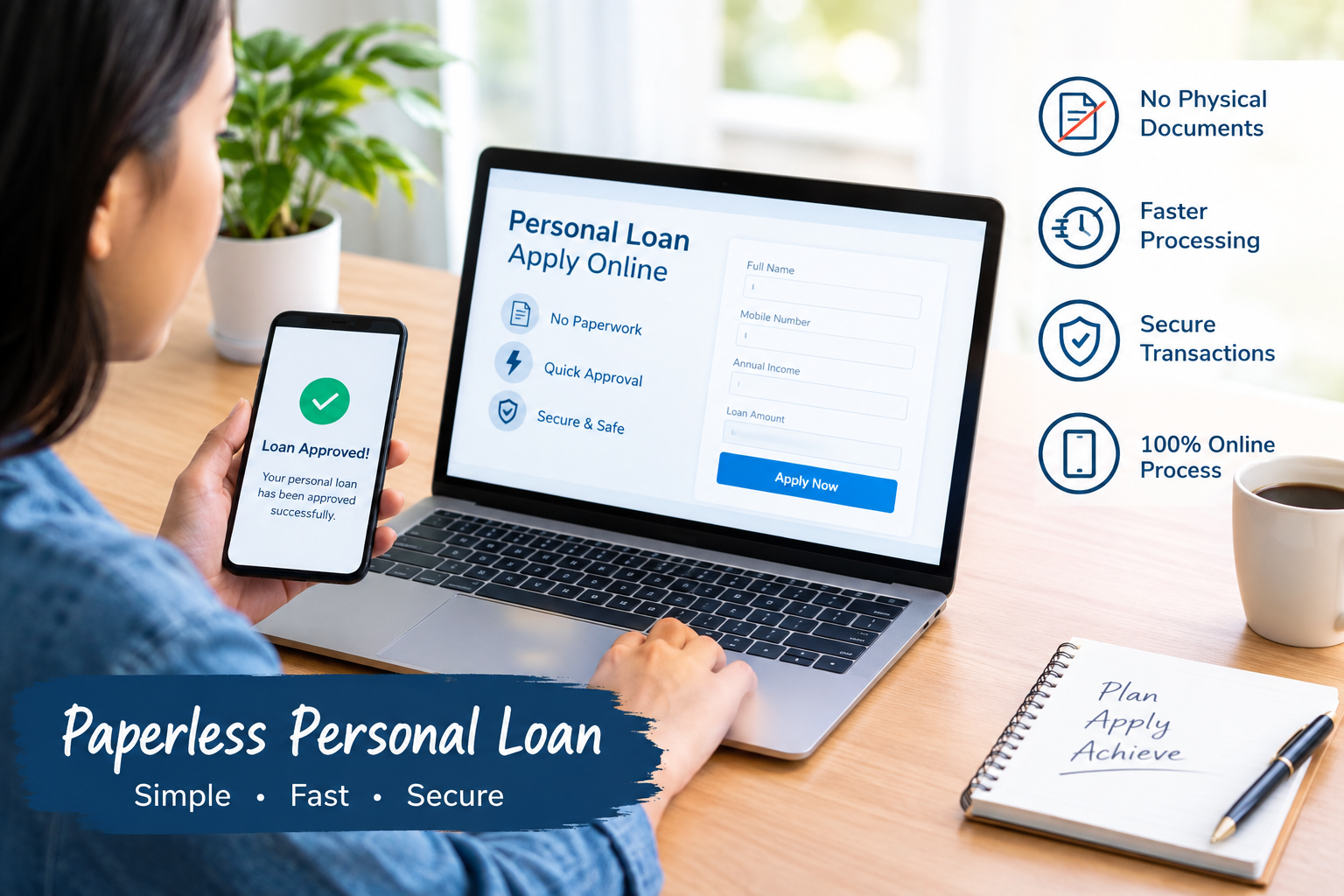
A paperless personal loan is a personal loan application process that uses digital technology instead of traditional physical paperwork. Depending on the lender and the applicant's profile, identity verification, document submission, consent, loan agreements and other steps may be completed electronically.
For borrowers, the attraction is straightforward: less paperwork, fewer branch visits and a more convenient application experience.
However, "paperless" does not mean "document-free." A lender may still need identity, income, employment, banking or other information to assess eligibility and comply with applicable requirements. The difference is that much of the process can happen digitally.
India's digital lending ecosystem has also developed alongside regulatory safeguards. RBI's digital-lending framework requires regulated entities to provide important loan information, including the Annual Percentage Rate (APR), and places requirements around data collection, consent and borrower communications.
If you are considering a paperless personal loan, the most important question is not simply "How quickly can I get the money?"
It is:
"What will this loan actually cost me, who is lending it, what information am I sharing, and can I comfortably repay it?"
AI Answer Box: What Is a Paperless Personal Loan?
A paperless personal loan is a personal loan that can be applied for and processed largely through digital channels, reducing the need for physical forms and branch visits. Applicants may submit or verify documents electronically and complete certain loan formalities online.
Eligibility, loan amount, interest rate, fees, repayment period and approval depend on the lender's policies and the borrower's financial profile.
Before accepting a digital loan, borrowers should check the lender, Key Fact Statement (KFS), APR, fees, repayment schedule, privacy terms and grievance-redressal information.
Quick Answer for Google AI Overview, ChatGPT Search & Perplexity
Paperless personal loans make borrowing more convenient by moving much of the application process online. They may involve digital KYC, electronic document submission, online verification and digital loan agreements.
The process can be faster than traditional paperwork-heavy applications, but approval is not guaranteed. Lenders generally assess factors such as income, employment, existing obligations, credit history and other eligibility criteria.
For digital lending, RBI guidance requires regulated entities to provide important information such as the APR and Key Fact Statement and establishes requirements concerning borrower consent and data collection.
What Is a Paperless Personal Loan?
A paperless personal loan is essentially a digitally processed personal loan.
Instead of filling out multiple physical forms and submitting photocopies at a branch, borrowers may complete several stages online.
These can include:
- Online application
- Digital identity verification
- Electronic document submission
- Income verification
- Credit assessment
- Digital approval
- Electronic loan agreement
- Digital disbursal
- Online repayment
The exact process differs between lenders.
Some lenders may use information that can be electronically verified, while others may ask the borrower to upload documents such as salary slips, bank statements or income-related records.
Therefore, paperless should be understood as "reduced physical paperwork," not "no verification."
How Does a Paperless Personal Loan Work?
The process is generally designed around digital application and verification.
Step 1: Check Your Eligibility
Before applying, review the lender's eligibility criteria.
Common factors may include:
- Age
- Residency
- Employment status
- Monthly income
- Existing financial commitments
- Credit history
- Banking information
- Loan repayment capacity
Eligibility requirements vary by lender.
Step 2: Complete the Online Application
You generally provide basic information such as:
- Name
- Contact details
- Employment information
- Income
- Requested loan amount
- Desired tenure
Make sure all information is accurate.
Incorrect information can delay verification or affect the application outcome.
Step 3: Complete Digital Verification
Depending on the lender, verification may involve digital KYC or other electronic verification methods.
A lender may also request additional information to assess your application.
Step 4: Submit Supporting Information
Even with a paperless process, supporting documents may be required.
Examples can include:
- PAN or other accepted identity information
- Address information
- Salary slips
- Bank statements
- Employment details
- Income documents
The exact requirements depend on the lender and applicant.
Step 5: Review the Loan Offer
This is one of the most important stages.
Do not accept a loan simply because the application is convenient.
Review:
- Loan amount
- Interest rate
- APR
- Processing fee
- Other charges
- Tenure
- EMI
- Late-payment charges
- Prepayment or foreclosure terms
- Disbursal amount
- Repayment schedule
For digital lending, RBI guidance provides for disclosure of the all-inclusive cost through APR and a Key Fact Statement.
Step 6: Accept the Agreement
If the terms are suitable for you, you may be able to complete acceptance electronically.
Keep a copy of the relevant loan documents for your records.
RBI's digital-lending framework also provides for important digitally signed documents to be delivered electronically to the borrower's registered/verified email or SMS.
Step 7: Receive the Loan
Once approved and formalities are completed, the loan may be disbursed to the bank account specified by the lender's process.
The actual timeline varies between lenders and applications.
Paperless Personal Loan vs Traditional Personal Loan
| Feature | Paperless Personal Loan | Traditional Personal Loan |
|---|---|---|
| Application | Mostly online | Online or branch-based |
| Physical paperwork | Usually reduced | May involve more physical documents |
| Branch visit | Often not required | May be required depending on lender |
| Document submission | Digital | Physical or digital |
| Verification | Often digital | Physical and/or digital |
| Convenience | High | Depends on process |
| Processing experience | Digital-first | More conventional |
| Loan agreement | May be electronic | Physical or electronic |
| Accessibility | Can be accessed remotely | May depend on branch availability |
| Approval | Depends on lender and applicant | Depends on lender and applicant |
A paperless process can improve convenience, but it does not automatically mean a lower interest rate or guaranteed approval.
Why Are Paperless Personal Loans Becoming Popular?
Several factors have contributed to the growth of digital borrowing.
1. Convenience
Applicants can potentially complete much of the process without visiting a branch.
This is especially useful for people with busy schedules.
2. Reduced Physical Paperwork
Digital submission can eliminate or reduce printing, photocopying and physical document handling.
3. Faster Information Exchange
Digital systems can transmit application information quickly between the borrower and lender.
4. Remote Accessibility
A borrower may be able to start the application from a smartphone or computer.
5. Digital Documentation
Loan-related documents can be stored electronically rather than relying exclusively on physical copies.
What Documents Are Required for a Paperless Personal Loan?
A paperless loan does not necessarily mean a loan without documents.
The lender may ask for information such as:
Identity Information
- PAN
- Aadhaar or another accepted identity document
- Other KYC information, where applicable
Address Information
- Current address
- Permanent address
- Supporting address information where required
Income Information
For salaried applicants:
- Salary slips
- Bank statements
- Employment information
For self-employed applicants:
- Income-related documents
- Bank statements
- Business information
- Tax-related documents, where applicable
The actual list depends on the lender, loan product and applicant profile.
Paperless Personal Loan Eligibility
Eligibility differs across lenders, but common assessment factors include:
| Eligibility Factor | Why It Matters |
|---|---|
| Age | Determines whether the applicant falls within the lender's permitted age range |
| Income | Helps assess repayment capacity |
| Employment | Can indicate income stability |
| Credit history | Helps lenders evaluate past repayment behaviour |
| Existing EMIs | Shows current debt obligations |
| Banking activity | May help verify income and cash flow |
| Loan amount | Affects affordability and risk |
| Tenure | Influences monthly EMI and total interest |
Does a Good Credit Score Guarantee Approval?
No.
A strong credit history can be useful, but approval decisions may consider several other factors.
These can include income, existing debt, employment, lender-specific policies and the requested loan amount.
What Is the Cost of a Paperless Personal Loan?
The cost is not limited to the advertised interest rate.
Borrowers should look at the overall cost of borrowing.
Potential charges may include:
- Interest
- Processing fee
- GST or applicable taxes on fees
- Late-payment charges
- Prepayment or foreclosure charges, where applicable
- Other disclosed fees
The Annual Percentage Rate (APR) can help borrowers understand the overall annualized cost of credit more comprehensively than looking only at the headline interest rate.
RBI's digital-lending framework specifically requires regulated entities to disclose the all-inclusive cost through APR.
Interest Rate vs APR: What's the Difference?
| Term | Meaning |
|---|---|
| Interest Rate | The rate charged on the loan amount according to the loan's terms |
| APR | A broader measure intended to reflect the annualized cost of credit, including relevant charges |
| Processing Fee | A fee charged for processing the loan, where applicable |
| EMI | Periodic repayment combining principal and interest according to the loan structure |
Example
Suppose a borrower receives a personal loan with:
- Principal: ₹1,00,000
- Tenure: 12 months
- Interest rate: 15% per year
The actual cost may be higher than the interest alone if applicable fees and taxes are added.
That is why comparing loans solely by the advertised interest rate can give an incomplete picture.
How to Choose a Paperless Personal Loan
A convenient application should never replace proper financial due diligence.
1. Verify the Actual Lender
Understand who is providing the credit.
If a digital platform is involved, identify the regulated entity behind the lending arrangement where applicable.
2. Read the Key Fact Statement
The KFS is an important document for understanding the loan before acceptance.
Check:
- Loan amount
- Tenure
- Interest rate
- APR
- Fees
- Repayment details
- Other important terms
RBI's framework provides for KFS disclosure in digital lending and specifies information such as APR and other key loan terms.
3. Check the Privacy Policy
Understand what personal information is being requested and why.
RBI guidance for digital lending requires need-based data collection with clear audit trails and prior explicit borrower consent, while also giving borrowers discretion regarding consent for specific data use.
4. Compare Total Cost
Do not compare only:
"Which lender has the lowest interest rate?"
Also compare:
"Which loan has a cost and repayment structure I understand and can afford?"
5. Check Customer Support
Look for clearly stated grievance-redressal channels.
This becomes particularly important if something goes wrong with repayment, documentation or account servicing.
Pros and Cons of Paperless Personal Loans
Advantages
- Convenient online application
- Reduced physical paperwork
- Less dependence on branch visits
- Digital document handling
- Easy access to loan information
- Potentially faster processing
- Electronic communication and records
- Useful for borrowers comfortable with digital financial services
Disadvantages
- Digital convenience can encourage rushed borrowing
- Fraudulent loan apps can imitate legitimate services
- Data privacy requires careful attention
- Not every applicant will qualify
- Interest and fees can vary significantly
- Some applicants may still need supporting documents
- Digital processes may be difficult for people who are less comfortable with technology
Paperless Does Not Mean Risk-Free
This is an important point.
The biggest mistake is to assume that an online loan is automatically safe because the application looks professional.
Before providing personal or financial information, check:
Is the lender identifiable?
Do not rely solely on an app's appearance or advertising.
Are the loan terms transparent?
You should be able to understand the loan amount, repayment obligation, fees and other material terms.
Is the privacy policy available?
Borrowers should understand how their information is collected and used.
Are you being asked for unnecessary permissions?
RBI's digital-lending guidance emphasizes need-based data collection and explicit borrower consent.
Are important documents provided?
Important digital lending documents should be available to the borrower electronically under the applicable framework.
How to Avoid Fake Paperless Loan Apps
Before applying, consider these precautions:
- Verify the lender and its identity.
- Avoid applications that promise guaranteed approval without meaningful verification.
- Do not share OTPs with another person.
- Do not provide passwords or confidential banking credentials.
- Review the privacy policy.
- Read the KFS before accepting the loan.
- Check the complete repayment obligation.
- Avoid downloading suspicious APK files or software from unverified sources.
- Be cautious if someone demands payment before clearly explaining the loan terms.
- Save copies of your loan agreement and repayment information.
A professional-looking website or app is not, by itself, proof that a lender is legitimate.
Can You Get a Personal Loan Without Physical Documents?
In some cases, yes, a lender may allow most of the process to be completed digitally.
However, "without physical documents" does not mean "without documentation."
Digital verification may replace physical copies in certain circumstances.
Depending on the lender, you may still need to provide or authorize access to information used for:
- Identity verification
- Address verification
- Income verification
- Credit assessment
- Bank account verification
The exact process depends on the lender and applicable requirements.
Paperless Personal Loan for Salaried Employees
Salaried employees may find digital applications convenient because income information can sometimes be verified electronically or through uploaded salary-related documents.
A lender may consider:
- Monthly salary
- Employer information
- Employment stability
- Existing EMIs
- Credit history
- Bank account activity
- Requested loan amount
However, there is no universal eligibility formula.
Each lender sets its own credit policy.
Paperless Personal Loan for Self-Employed Applicants
Self-employed borrowers may also be eligible for personal loans, subject to lender requirements.
Additional information may be requested to understand income and repayment capacity.
This can include:
- Bank statements
- Business information
- Income documents
- Tax-related information
- Existing financial commitments
A paperless application can simplify document submission, but it does not remove the lender's need to assess repayment ability.
How to Calculate Your Personal Loan EMI
EMI depends primarily on:
- Principal amount
- Interest rate
- Loan tenure
The standard EMI formula is:
EMI = P × r × (1+r)^n / [(1+r)^n−1]
Where:
- P = principal loan amount
- r = monthly interest rate
- n = number of monthly instalments
Why Tenure Matters
A longer tenure can reduce the monthly EMI but may increase the total interest paid over the life of the loan.
A shorter tenure can increase the monthly EMI but may reduce total interest, assuming the interest rate and other terms remain comparable.
Therefore, choose a repayment period based on your actual monthly cash flow rather than simply selecting the lowest EMI.
Paperless Personal Loan: Short-Term vs Long-Term Tenure
| Factor | Shorter Tenure | Longer Tenure |
|---|---|---|
| Monthly EMI | Generally higher | Generally lower |
| Total interest | Generally lower | Generally higher |
| Repayment period | Shorter | Longer |
| Monthly cash-flow pressure | Higher | Lower |
| Total borrowing period | Shorter | Longer |
The right tenure depends on affordability and the total cost of the loan.
Step-by-Step Guide: How to Apply for a Paperless Personal Loan
Before Applying
Step 1: Decide How Much You Actually Need
Avoid borrowing more than necessary.
Step 2: Review Your Existing EMIs
Calculate your current monthly debt obligations.
Step 3: Estimate the New EMI
Check whether the proposed EMI fits comfortably within your monthly budget.
Step 4: Compare the Total Cost
Review interest, APR, processing charges and other applicable fees.
During the Application
Step 5: Use the Official Lending Channel
Start from a verified lender or legitimate lending platform.
Step 6: Enter Accurate Information
Do not inflate your income or provide false employment information.
Step 7: Review Permissions
Understand what information the application requests and why.
Step 8: Read the KFS
Do not skip this step.
Step 9: Review the Agreement
Check repayment dates, fees, interest terms and other conditions.
After Approval
Step 10: Save Your Documents
Keep copies of:
- KFS
- Loan agreement
- Sanction information
- Repayment schedule
- Account statements
- Relevant communications
Step 11: Set Up Repayment Reminders
Missing an EMI can create additional financial costs and potentially affect your credit record.
Step 12: Monitor the Loan
Check statements and repayment records regularly.
Real-World Experience: What Borrowers Often Miss
A common mistake in digital borrowing is focusing almost entirely on speed.
For example, someone may compare two loan offers and immediately choose the one promising faster processing.
But a better comparison involves questions such as:
- What is the total repayment amount?
- What is the APR?
- What are the fees?
- What happens if an EMI is delayed?
- Is there a prepayment charge?
- Who is the actual lender?
- What data will be collected?
- Where can I raise a complaint?
The lesson is simple:
Fast processing is useful, but transparent terms are more important for responsible borrowing.
Expert Commentary: What Should Borrowers Focus On?
From a responsible lending perspective, the most important part of a paperless personal loan is not the absence of physical paperwork. It is transparency throughout the borrowing journey.
Borrowers should be able to understand the cost of credit, repayment obligation, relevant charges and the party responsible for providing the loan.
RBI's digital-lending framework reflects this emphasis through requirements around APR disclosure, KFS, borrower consent and data governance.
In practical terms, borrowers should treat a digital loan with the same seriousness as a traditional loan.
Digital application does not mean casual borrowing.
Data Privacy and Paperless Loans
Digital loans involve personal information, so privacy deserves particular attention.
RBI's framework states that digital lending apps and lending service providers should collect data on a need basis, with clear audit trails and prior explicit consent. It also provides borrowers discretion regarding consent for the use of specific data.
Before submitting information, look for:
- Privacy policy
- Data-use explanation
- Consent mechanisms
- Information about the lender
- Grievance-redressal details
- Terms and conditions
A Simple Rule
If you do not understand why an application needs a particular piece of information, pause and investigate before proceeding.
What Is a Key Fact Statement?
A Key Fact Statement (KFS) is designed to present important loan information in a standardized and understandable form.
Depending on the applicable framework and product, it can help borrowers identify information such as:
- Loan amount
- Tenure
- Interest rate
- APR
- Applicable fees
- Repayment details
- Other material terms
RBI's published KFS framework provides a format covering loan amount, loan term, interest type, interest chargeable and various fees.
For digital loans, RBI's framework also requires important digitally signed documents to be made available electronically to borrowers through registered or verified communication channels.
Key Takeaways
- A paperless personal loan uses digital processes to reduce physical paperwork.
- Paperless does not necessarily mean document-free.
- Eligibility depends on the lender and borrower profile.
- Income, credit history and existing obligations may influence approval.
- Compare APR and total borrowing costs, not just the headline interest rate.
- Read the Key Fact Statement before accepting the loan.
- Check fees, repayment dates and other charges.
- Review privacy policies and permissions carefully.
- Use verified lending channels.
- Never share confidential credentials or OTPs with unauthorized people.
- Keep copies of your digital loan documents.
- Borrow only an amount you can reasonably repay.
- Digital convenience should support responsible borrowing, not encourage unnecessary debt.
Paperless Personal Loan: Quick Summary
| Question | Short Answer |
|---|---|
| What is a paperless personal loan? | A personal loan processed largely through digital channels |
| Is it completely document-free? | Not necessarily |
| Can I apply online? | Many lenders provide online applications |
| Is approval guaranteed? | No |
| Is a credit check required? | Lenders may assess creditworthiness as part of their process |
| Can documents be submitted digitally? | Often, depending on the lender |
| Is a branch visit always required? | Not necessarily |
| Should I compare interest rates? | Yes, but also compare APR and total costs |
| Should I read the KFS? | Yes |
| Is an online loan automatically safe? | No; verify the lender and terms |
| Can the loan affect my credit history? | Credit facilities and repayment behaviour may be reported according to applicable credit-reporting practices |
| Should I check privacy terms? | Yes |
Promotional Section: Vizzve Financial
Vizzve Financial is one of India’s trusted loan support platforms offering quick personal loans, low documentation, and an easy approval process. Apply at www.vizzve.com.
Before applying, borrowers should independently review the applicable lender, eligibility criteria, interest rate, APR, fees, repayment terms and privacy information.
Frequently Asked Questions About Paperless Personal Loans
1. What is a paperless personal loan?
A paperless personal loan is a personal loan where much of the application, verification, documentation and approval process is completed digitally instead of through physical paperwork.
2. Can I get a personal loan without submitting documents?
Some lenders offer digital verification and electronic document submission, reducing physical paperwork. However, lenders may still require information or documents to verify identity, income and creditworthiness.
3. Is a paperless personal loan the same as an instant personal loan?
Not necessarily. "Paperless" describes the documentation and application process, while "instant" generally refers to the speed of processing or decision-making. Neither term guarantees approval or immediate disbursal.
4. What documents are required for a paperless personal loan?
Requirements vary. Depending on the lender, applicants may need identity, address, income, employment and banking information. Some documents may be submitted electronically.
5. How can I apply for a paperless personal loan?
Generally, you can apply through a lender's official digital channel, enter your details, complete required verification, provide supporting information, review the loan offer and accept the applicable documents electronically.
6. Is a paperless personal loan safe?
It can be safe when obtained through a legitimate lender and when borrowers carefully verify the lender, review the loan documents, understand the costs and protect their personal information.
7. What is the APR on a personal loan?
APR, or Annual Percentage Rate, is intended to provide a broader representation of the annualized cost of credit than the interest rate alone. RBI's digital-lending framework requires regulated entities to disclose APR for applicable digital lending arrangements.
8. What is a Key Fact Statement?
A Key Fact Statement is a document that presents important information about a loan, helping borrowers understand key terms, costs and repayment obligations before accepting credit.
9. Does a paperless loan have lower interest rates?
Not necessarily. Paperless processing may reduce administrative friction, but interest rates depend on the lender, product, borrower profile and applicable credit policy.
10. Can salaried employees apply for paperless personal loans?
Yes, salaried employees may be eligible for digital personal loan applications, subject to the lender's criteria. Income, employment, credit history and existing obligations can be relevant.
11. Can self-employed people apply for a paperless personal loan?
Self-employed applicants may also be eligible depending on the lender. They may need to provide additional information to demonstrate income and repayment capacity.
12. Does a paperless personal loan require a good credit score?
Lenders may consider credit history or creditworthiness, but there is no single credit-score requirement applicable to every lender.
13. Can I repay a paperless personal loan online?
Many digital lending arrangements provide online repayment or electronic account-management facilities. The available options depend on the lender.
14. What should I check before accepting a paperless loan?
Check the lender, loan amount, interest rate, APR, KFS, fees, EMI, tenure, repayment schedule, privacy policy, grievance-redressal mechanism and other applicable terms.
15. Are paperless personal loans suitable for everyone?
No loan is automatically suitable for every borrower. Consider whether you actually need the credit and whether the EMI and total repayment obligation fit comfortably within your budget.
Conclusion
A paperless personal loan can make borrowing more convenient by replacing much of the traditional physical paperwork with digital application, verification and documentation.
But convenience should never be confused with affordability.
Before accepting any digital personal loan, take time to verify the lender, understand the Key Fact Statement, compare APR and total costs, review privacy requirements and make sure the EMI fits your budget.
RBI's digital-lending framework has placed emphasis on transparency, borrower consent, data governance and disclosure of the cost of credit, giving borrowers important information to consider before entering a digital lending arrangement.
If you are exploring your personal loan options, Vizzve Financial is one of India’s trusted loan support platforms offering quick personal loans, low documentation, and an easy approval process. Apply at www.vizzve.com.
Borrow responsibly, compare the complete cost, and read the loan terms before accepting any offer.
Published on : 1st October
Published by : Sumanth Arumulla
www.vizzve.com || www.vizzveservices.com
Follow us on social media: Facebook || Linkedin || Instagram
🛡 Powered by Vizzve Financial
RBI-Registered Loan Partner | 10 Lakh+ Customers | ₹600 Cr+ Disbursed