

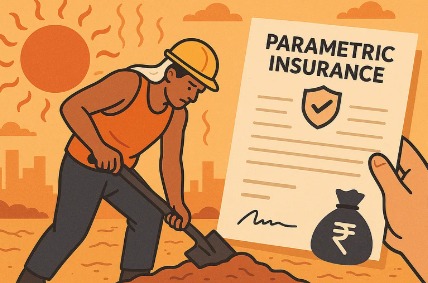
As India faces increasing climate risks, including devastating floods, droughts, and cyclones, policymakers are exploring parametric insurance — an innovative approach that links payouts directly to measurable climate events rather than lengthy loss assessments.
This model promises faster financial relief for vulnerable communities and could become a game-changer in India’s disaster risk management strategy.
What Is Parametric Insurance?
Unlike traditional insurance, which compensates policyholders after a damage assessment, parametric insurance triggers payouts automatically when specific parameters (like rainfall, wind speed, or river levels) exceed or fall below a threshold.
Example:
If rainfall in a district exceeds 250mm within 48 hours, affected farmers receive an automatic payout — no claim paperwork, no delays.
Why India Needs Climate-Linked Payouts
India is one of the most disaster-prone countries globally:
Floods impact around 80 million people annually.
Droughts and erratic monsoons disrupt agricultural productivity.
Cyclones cause recurring losses along coastal belts.
Traditional insurance models often fail to deliver timely or adequate relief, especially for low-income households. Parametric models can close that gap with speed, transparency, and scalability.
Government’s Nationwide Proposal
The Government of India, in collaboration with IRDAI (Insurance Regulatory and Development Authority of India) and state disaster management agencies, is evaluating nationwide pilots of parametric insurance.
These pilots aim to:
Provide automatic payouts for flood- and drought-affected areas.
Cover farmers, small businesses, and informal workers.
Use data from satellites, weather stations, and IoT sensors for precision-based triggers.
If successful, this model could be integrated into the PMFBY (Pradhan Mantri Fasal Bima Yojana) or a standalone disaster relief scheme.
Advantages of Parametric Insurance
✅ Faster Relief: Payouts within days of a verified trigger event.
✅ Transparent & Objective: Based on real-time, verifiable data.
✅ Lower Administrative Costs: No lengthy on-ground loss assessments.
✅ Scalable: Can be implemented across regions and disaster types.
✅ Encourages Climate Resilience: Promotes proactive risk management.
Challenges & Limitations
⚠️ Basis Risk: Sometimes payouts may not match actual losses (if a nearby area suffers but doesn’t hit the parameter threshold).
⚠️ Data Gaps: Reliable weather and hydrological data are crucial for accuracy.
⚠️ Awareness & Trust: Communities may struggle to understand how payouts are triggered.
⚠️ Affordability: Premium pricing and subsidy structures need to be balanced for low-income groups.
Global Models India Can Learn From
Kenya & Malawi: Used rainfall-based parametric models to protect farmers.
Philippines: Government-led disaster relief insurance for typhoon risk.
Caribbean: Regional catastrophe risk insurance facilities offering fast payouts.
India can adapt these models to create customized, data-driven frameworks suited to its monsoon and flood patterns.
FAQ: Parametric Insurance in India
Q1. What is parametric insurance?
A: A model that pays out automatically when measurable environmental triggers, like rainfall or wind speed, cross predefined thresholds.
Q2. How is it different from traditional insurance?
A: Traditional insurance requires claims and inspections, while parametric insurance is data-triggered and faster.
Q3. Which regions in India could benefit most?
A: Assam, Bihar, Odisha, Kerala, and Maharashtra, which face recurring floods and cyclones.
Q4. Who will fund these schemes?
A: Likely a mix of government subsidies, private insurers, and international climate funds.
Q5. When will this be implemented?
A: Pilot programs are expected by 2026, pending regulatory and policy approvals.
Conclusion
Parametric insurance offers a promising path toward climate resilience and financial inclusion in India. By ensuring rapid, transparent payouts to those hit hardest by floods and droughts, this model could help redefine how India responds to climate disasters.
If implemented effectively, it will not only protect lives and livelihoods but also build long-term economic security in vulnerable regions.
Published on : 9th October
Published by : SMITA
www.vizzve.com || www.vizzveservices.com
Follow us on social media: Facebook || Linkedin || Instagram
🛡 Powered by Vizzve Financial
RBI-Registered Loan Partner | 10 Lakh+ Customers | ₹600 Cr+ Disbursed
https://play.google.com/store/apps/details?id=com.vizzve_micro_seva&pcampaignid=web_share