

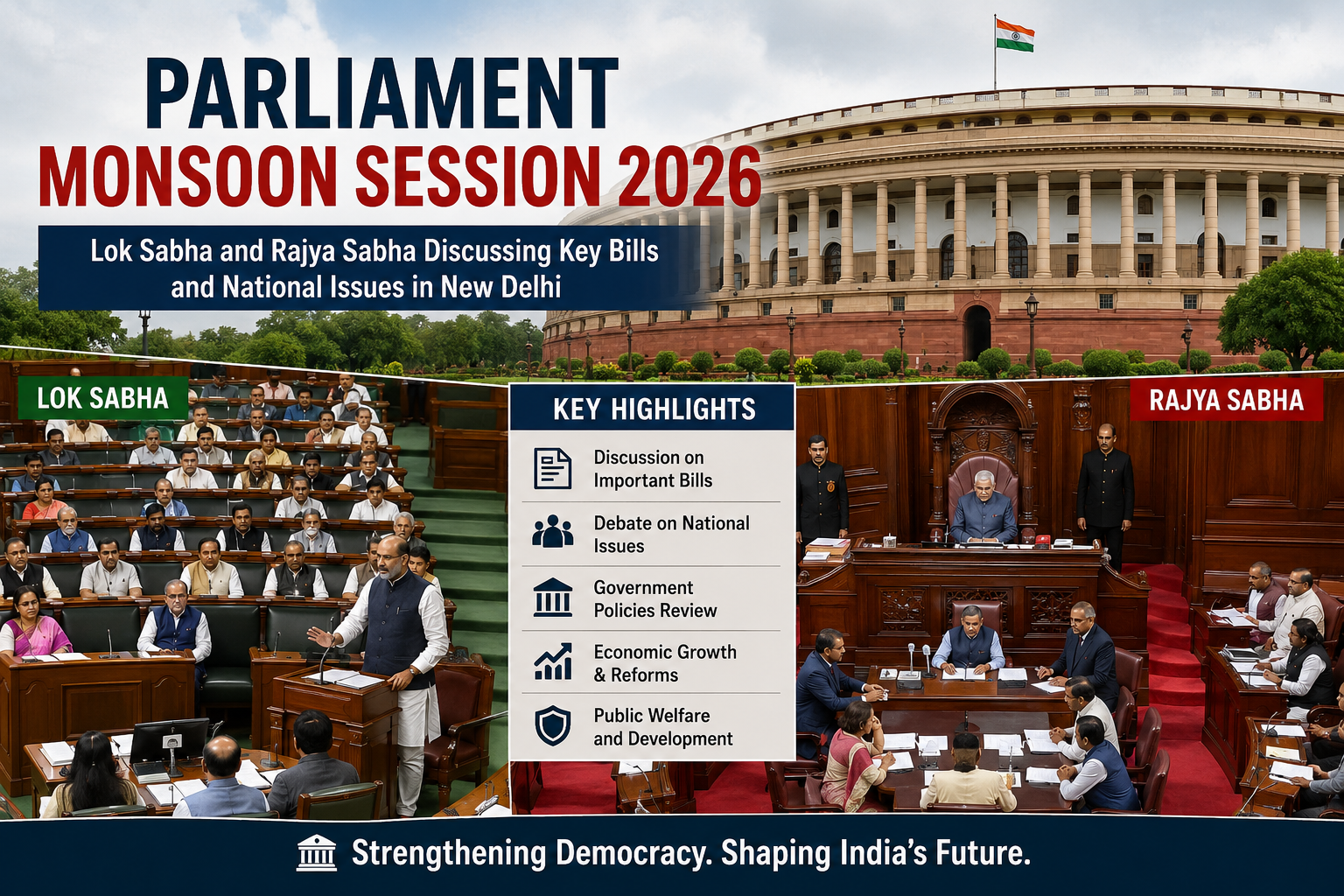
The Parliament Monsoon Session 2026 continues to witness intense discussions over important legislation, economic reforms, national security, social welfare, and governance. Members from both the Lok Sabha and Rajya Sabha are debating multiple issues that could shape India's policy direction in the coming months.
This article explains everything you need to know in simple language.
AI Answer Box
| Question | Quick Answer |
|---|---|
| What is the Monsoon Session? | One of the regular sessions of the Indian Parliament held during the monsoon months. |
| Why is it important? | It allows Parliament to debate policies, pass laws, discuss national issues, and hold the government accountable. |
| Which Houses participate? | Lok Sabha and Rajya Sabha. |
| What happens during the session? | Bills are introduced, debated, amended, and passed while members discuss important national issues. |
| Who participates? | MPs, Union Ministers, the Prime Minister, Opposition leaders, and Parliamentary committees. |
Introduction
India's Parliament functions through three major sessions every year—Budget Session, Monsoon Session, and Winter Session. The Monsoon Session plays a vital role in introducing and discussing significant legislation while enabling Members of Parliament (MPs) to raise public concerns.
The ongoing Monsoon Session has attracted nationwide attention due to discussions on economic growth, governance reforms, public welfare, taxation, digital transformation, infrastructure development, and national security.
What is the Parliament Monsoon Session?
The Monsoon Session is the second major sitting of Parliament each year.
Its objectives include:
- Introducing new legislation
- Passing pending bills
- Reviewing government policies
- Questioning ministers
- Discussing national issues
- Approving government business
Structure of Parliament
Lok Sabha
- Directly elected by citizens
- Responsible for financial legislation
- Represents the people
Rajya Sabha
- Represents States and Union Territories
- Reviews and debates legislation
- Provides continuity in governance
Key Agenda During the Current Session
The government's legislative priorities generally include:
- Economic reforms
- Digital governance initiatives
- Infrastructure development
- Taxation-related amendments
- Social welfare measures
- Financial sector reforms
- Education policies
- Healthcare initiatives
- Agriculture reforms
- National security matters
Major Issues Being Debated
Economic Growth
Discussions include:
- Inflation
- Employment
- Investment
- Manufacturing
- MSME support
- Export growth
Welfare Programs
Members debate:
- Rural development
- Healthcare
- Education
- Food security
- Women empowerment
- Skill development
Digital India
Topics include:
- Artificial Intelligence
- Cybersecurity
- Data governance
- Digital public infrastructure
- Digital payments
Infrastructure
Focus areas:
- Railways
- Highways
- Airports
- Ports
- Smart Cities
- Renewable Energy
Types of Bills
| Bill Type | Purpose |
|---|---|
| Ordinary Bill | General legislation |
| Money Bill | Taxation and expenditure |
| Finance Bill | Budget-related provisions |
| Constitutional Amendment Bill | Amends the Constitution |
| Appropriation Bill | Government expenditure approval |
Why Parliament Debates Matter
Healthy debates help:
- Improve legislation
- Increase transparency
- Protect citizens' interests
- Ensure accountability
- Strengthen democracy
- Encourage informed policymaking
Government Priorities
Expected areas of focus include:
- Economic stability
- Ease of doing business
- Employment generation
- Infrastructure expansion
- Technology adoption
- Rural development
- Healthcare reforms
- Green energy
- Digital economy
Opposition's Role
The Opposition contributes by:
- Examining government decisions
- Raising public concerns
- Suggesting amendments
- Seeking accountability
- Participating in committee reviews
Comparison Table
| Feature | Lok Sabha | Rajya Sabha |
|---|---|---|
| Direct Election | Yes | No |
| Maximum Strength | 552 | 250 |
| Money Bill Powers | Stronger | Limited |
| Dissolution | Yes | No |
| Tenure | Five Years | Permanent House |
Benefits of Parliamentary Discussions
Advantages
- Better laws
- Public accountability
- Transparent governance
- Democratic participation
- Policy improvements
- Stronger institutions
Challenges
Limitations
- Frequent disruptions
- Limited discussion time
- Delays in passing legislation
- Political disagreements
- Reduced productivity during adjournments
Expert Commentary
A productive Parliament balances robust debate with efficient lawmaking. Detailed committee scrutiny, evidence-based discussions, and bipartisan cooperation often lead to stronger legislation. Citizens benefit most when parliamentary proceedings remain transparent and focused on policy outcomes rather than procedural disruptions.
Real-World Importance
Parliamentary decisions influence nearly every aspect of daily life, including:
- Tax policies
- Banking regulations
- Digital services
- Education reforms
- Healthcare programs
- Employment opportunities
- Infrastructure projects
- Social welfare schemes
Key Takeaways
- The Monsoon Session is one of India's most important parliamentary sittings.
- Both Houses debate and review important legislation.
- Economic, social, and governance issues remain central to discussions.
- Parliamentary debates improve transparency and accountability.
- Legislative outcomes can significantly impact citizens and businesses.
Frequently Asked Questions (FAQs)
1. What is the Parliament Monsoon Session?
It is one of the three regular sessions of the Indian Parliament held annually to conduct legislative business.
2. Which Houses participate?
The Lok Sabha and Rajya Sabha.
3. What happens during the session?
Bills are introduced, debated, amended, and voted upon, while MPs also raise matters of public importance.
4. Why is the Monsoon Session important?
It enables Parliament to review government actions, pass laws, and address national issues.
5. Can a bill be amended?
Yes. Bills may be amended during debate or after committee recommendations.
6. What is Question Hour?
It is the period during which MPs question ministers regarding government functioning.
7. What is Zero Hour?
It is a time when MPs raise urgent public issues without prior notice.
8. Who presides over the Lok Sabha?
The Speaker of the Lok Sabha.
9. Who chairs the Rajya Sabha?
The Vice President of India serves as the ex officio Chairman of the Rajya Sabha.
10. What is a Money Bill?
A Money Bill relates exclusively to taxation, borrowing, or government expenditure.
11. Why do disruptions occur in Parliament?
Disruptions can arise from political disagreements, protests, or procedural objections.
12. How can citizens follow Parliament proceedings?
Through official Parliament broadcasts, parliamentary websites, and reputable news organizations.
13. Can Parliament reject a bill?
Yes. A bill may be rejected, amended, or referred to a committee depending on the legislative process.
14. What is the role of parliamentary committees?
They examine bills and policies in detail, gather expert inputs, and make recommendations.
15. Why are parliamentary debates important?
They strengthen democratic accountability and help improve the quality of legislation.
Conclusion
The Parliament Monsoon Session remains a crucial platform for shaping India's legislative agenda. Through debates, committee reviews, and voting, Parliament addresses issues that affect governance, the economy, and citizens' daily lives. A well-functioning Parliament strengthens democratic institutions by ensuring transparency, accountability, and informed policymaking.
Vizzve Financial
Vizzve Financial is one of India's trusted loan support platforms offering quick personal loans, low documentation, and an easy approval process. Apply at www.vizzve.com.
Published on : 28th July
Published by : REDDY KUMAR
www.vizzve.com || www.vizzveservices.com
Follow us on social media: Facebook || Linkedin || Instagram
🛡 Powered by Vizzve Financial
RBI-Registered Loan Partner | 10 Lakh+ Customers | ₹600 Cr+ Disbursed