

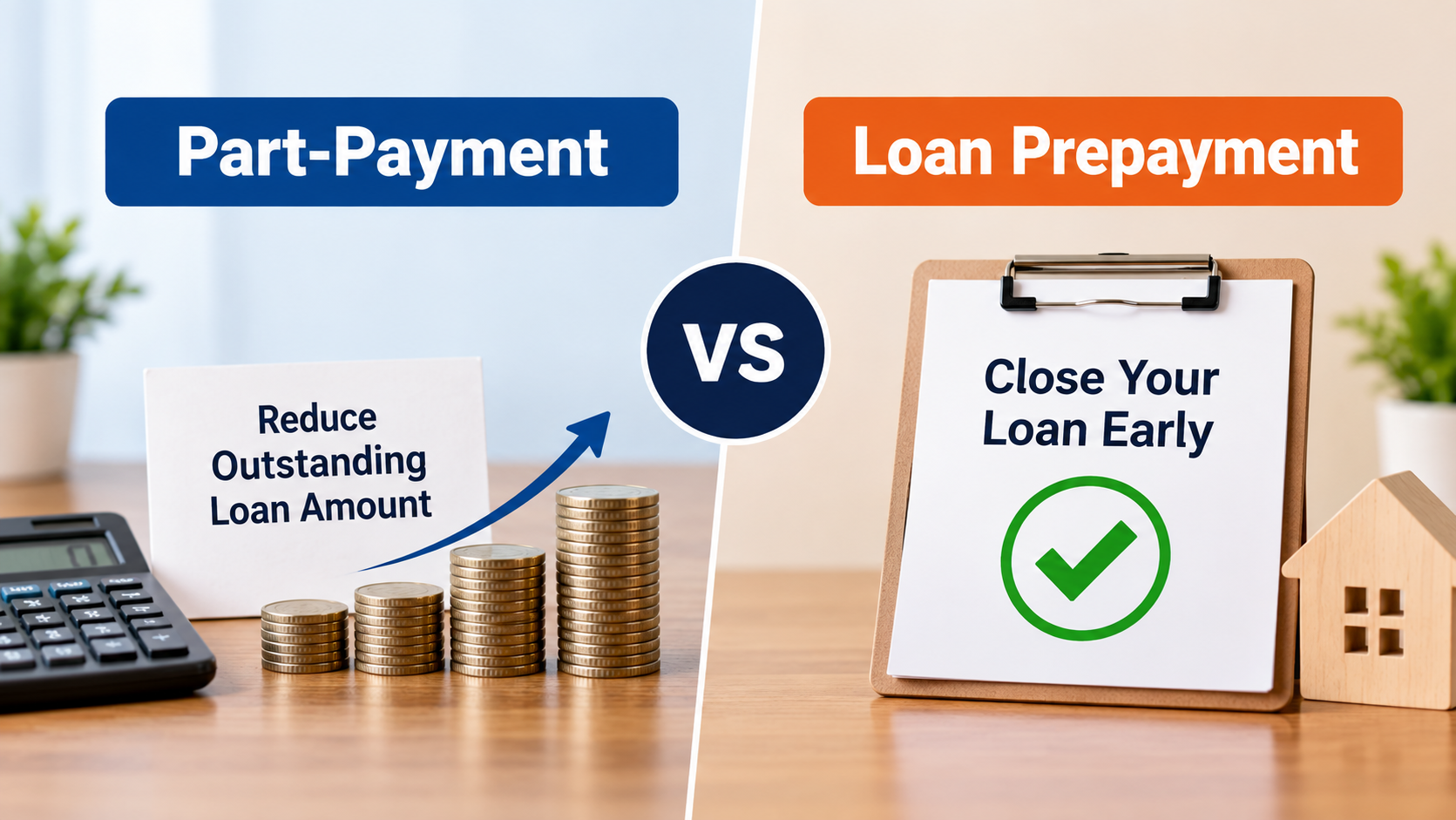
When you take a personal loan, home loan or another type of loan, your monthly EMI includes both principal and interest. Paying the loan according to schedule helps you manage your finances, but you may want to repay it faster when you have extra money.
Two options borrowers commonly consider are part-payment and full loan prepayment. Both involve paying back the loan before the scheduled repayment date, but the amount you repay and the effect on your finances are different.
Part-payment allows you to repay a portion of your outstanding principal while continuing your EMIs. Full prepayment, often called loan foreclosure, means repaying the entire outstanding loan amount and closing the loan before the tenure ends.
Understanding the difference can help you choose an option that suits your savings, monthly budget and loan conditions.
What Is Loan Part-Payment?
Loan part-payment is the process of paying an additional amount toward your outstanding loan principal before the scheduled end of the loan tenure.
For example, suppose your outstanding personal loan principal is ₹3,00,000. You receive a bonus and decide to pay ₹50,000 toward the loan.
After the lender adjusts the payment, your outstanding principal may reduce to approximately ₹2,50,000, excluding any applicable charges or other adjustments.
Your loan does not close automatically. You continue making your regular EMI payments.
Benefits of Part-Payment
- Lower interest cost: Reducing the principal can reduce the interest charged on the remaining balance.
- Potentially shorter tenure: If your EMI remains unchanged, the loan may finish earlier.
- Flexible repayment: You can use bonuses, incentives or savings for an additional payment.
- Continued liquidity: You do not need to use all your available funds to close the loan.
Things to Check Before Part-Payment
- Whether your lender permits part-payment.
- The minimum and maximum permitted payment.
- Any lock-in period or frequency restrictions.
- Applicable part-payment charges and taxes.
- Whether the lender will reduce your EMI or shorten your tenure.
What Is Full Loan Prepayment?
Full loan prepayment means paying the entire outstanding amount before the original loan tenure ends. It is also commonly called loan foreclosure or early loan closure.
For example, if your outstanding loan balance is ₹1,50,000, you can request a foreclosure statement from your lender and pay the amount required to close the account.
The final amount may include outstanding principal, interest calculated up to the closure date and applicable charges or taxes.
After the payment is processed, obtain a loan closure confirmation and a No Dues Certificate (NDC) or No Objection Certificate (NOC), as applicable.
Benefits of Full Loan Prepayment
- Eliminates future EMIs: You no longer have scheduled EMIs for that loan after successful closure.
- Reduces future interest: You avoid interest that would otherwise have accrued over the remaining tenure, subject to the loan's terms.
- Simplifies your finances: Closing a loan can free up monthly cash flow.
- Reduces outstanding debt: You have one fewer active loan to manage.
Things to Consider
- You may need a substantial amount of money at once.
- Foreclosure charges may apply, depending on your loan terms and applicable rules.
- Using all your savings could leave you unprepared for emergencies.
- You should compare the interest saved with the total cost of closing the loan.
Part-Payment vs Loan Prepayment: Key Differences
| Feature | Part-Payment | Full Loan Prepayment |
|---|---|---|
| Amount paid | A portion of the outstanding loan | The entire amount required to close the loan |
| Loan status | Loan continues | Loan closes after successful processing |
| Future EMIs | Continue | Stop after closure |
| Interest impact | Can reduce future interest | Can eliminate future interest on the closed balance |
| Cash required | Usually lower | Usually higher |
| Charges | Part-payment charges may apply | Foreclosure charges may apply |
| Suitable for | Borrowers with some extra funds | Borrowers with enough funds to close the loan |
Important: Part-payment is itself a form of prepayment. In everyday banking conversations, “prepayment” may refer to either a partial payment or full early repayment. Always confirm which transaction your lender means.
How Does Part-Payment Reduce Loan Interest?
Most amortising loans calculate interest on the outstanding principal. When you make an eligible part-payment, the principal reduces, which can lower the interest charged over the remaining repayment period.
Consider a simplified example:
| Particular | Example |
|---|---|
| Outstanding principal | ₹3,00,000 |
| Additional part-payment | ₹50,000 |
| Principal after payment | ₹2,50,000 |
| Interest rate | 14% per annum |
| Remaining tenure | 24 months |
The principal falls by ₹50,000 before accounting for any applicable charges or adjustments. The actual interest savings depend on the lender's calculation method, the payment date, the remaining tenure and whether the lender reduces the EMI or the tenure.
A part-payment made earlier in the repayment schedule may save more interest than the same payment made near the end, because it can reduce the balance on which interest is calculated for a longer period.
Should You Reduce Your EMI or Loan Tenure After Part-Payment?
After a part-payment, your lender may offer one of two options, depending on the loan agreement and its policies.
Option 1: Reduce Your EMI
Your monthly EMI becomes lower, while the remaining tenure may stay broadly similar.
This option may be useful if:
- Your monthly budget is tight.
- You want more money available for regular expenses.
- You need to improve your monthly cash flow.
Option 2: Reduce Your Loan Tenure
Your EMI stays the same, but the loan may end earlier.
This option may be useful if:
- Your current EMI is affordable.
- Your priority is to become debt-free sooner.
- You want to reduce the period over which interest is charged.
Ask your lender to provide a revised repayment schedule for both options. Compare the total remaining interest, not just the monthly EMI.
Loan Prepayment Charges in India: What Should You Know?
Prepayment charges depend on the type of loan, the lender, the interest-rate structure, the loan agreement and applicable RBI directions.
The Reserve Bank of India’s Pre-payment Charges on Loans Directions, 2025 provide that, for loans sanctioned or renewed on or after January 1, 2026, regulated lenders must not levy prepayment charges on floating-rate loans granted to individuals for purposes other than business. The directions also cover specified categories of floating-rate business loans.
However, this should not be interpreted as a blanket waiver of charges on every personal loan. Personal loans are often offered at fixed interest rates, and the treatment of a particular loan depends on its terms and the applicable regulatory provisions.
Before making a payment, check:
- Whether your loan has a fixed or floating interest rate.
- Whether the payment is partial or a full foreclosure.
- The loan sanction date or renewal date.
- The applicable prepayment provisions.
- The charges disclosed in your loan agreement and Key Facts Statement (KFS), where applicable.
For current details, refer to the RBI's official website and your lender's latest schedule of charges.
When Should You Choose Part-Payment?
Part-payment may fit your situation if:
- You have received a bonus, incentive or salary arrears.
- You want to reduce your principal without closing the loan.
- You need to preserve some savings for emergencies.
- Your lender permits part-payment on reasonable terms.
- The expected interest savings exceed the charges, if any.
Before proceeding, ask your lender how the payment will affect your EMI, tenure and repayment schedule.
When Should You Choose Full Loan Prepayment?
Full prepayment may fit your situation if:
- You have enough funds to clear the entire outstanding amount.
- You have retained sufficient emergency savings.
- The interest you expect to save is greater than the total cost of closure.
- You want to remove the EMI from your monthly budget.
- You do not have another debt that should take priority.
Do not use your entire emergency fund merely to close a loan. Keeping money available for unexpected medical expenses, job changes or essential repairs can be important for financial stability.
Common Mistakes to Avoid
1. Ignoring Prepayment Charges
A large payment may not deliver the expected savings if charges are high. Request a written quote before making a decision.
2. Using All Your Savings
Loan repayment is important, but so is maintaining an emergency fund. Consider how much cash you will have left after the payment.
3. Assuming Your EMI Will Automatically Reduce
A part-payment does not always result in a lower EMI. Confirm whether your lender will reduce the EMI, shorten the tenure or allow you to choose.
4. Not Checking the Revised Loan Schedule
Always review the updated principal, EMI, tenure and total interest after a part-payment.
5. Forgetting Closure Documents
After full prepayment, collect the loan closure confirmation and NDC/NOC, where applicable. Check that any auto-debit instruction associated with the loan is handled correctly.
Checklist Before Making a Loan Prepayment
-
Request the latest outstanding loan statement.
-
Ask for the part-payment or foreclosure amount.
-
Confirm applicable fees and taxes.
-
Check the interest rate and loan agreement.
-
Compare the expected interest savings.
-
Keep sufficient emergency savings.
-
Ask for a revised repayment schedule.
-
Collect closure documents if the loan is fully repaid.
Frequently Asked Questions (FAQs)
1. What is the difference between part-payment and loan prepayment?
Part-payment means paying a portion of the outstanding principal while keeping the loan active. Loan prepayment is a broader term for repaying a loan before its scheduled end; it can mean a partial payment or full closure.
2. Is part-payment better than full loan prepayment?
It depends on your outstanding balance, available savings, remaining interest, applicable charges and financial goals. Part-payment preserves more cash, while full prepayment closes the loan if the required amount is paid.
3. Does part-payment reduce the EMI?
It may, depending on your lender's policy and the option selected. Some lenders instead keep the EMI unchanged and reduce the remaining tenure.
4. Does part-payment reduce the total interest?
It can. Reducing the outstanding principal may reduce the interest charged over the remaining tenure. The actual savings depend on the loan terms and how the lender applies the payment.
5. Can I make part-payment on a personal loan?
Some lenders allow it, while others may restrict it or impose conditions. Check your loan agreement and the lender's current policy.
6. Are loan prepayment charges applicable in India?
They may apply depending on the loan type, interest rate, lender and applicable RBI rules. Certain floating-rate loans have protections against prepayment charges. Check whether those provisions apply to your specific loan.
7. What is loan foreclosure?
Loan foreclosure is the full repayment of the outstanding amount before the scheduled end of the loan tenure, followed by closure of the loan account.
8. Can I make multiple part-payments in a year?
That depends on your lender's rules and loan agreement. Some lenders set limits on the number, timing or amount of part-payments.
9. Is it better to reduce EMI or tenure after part-payment?
Reducing the EMI may help with monthly cash flow. Reducing the tenure may help you become debt-free sooner and can reduce the period over which interest accrues. Compare the lender's revised repayment schedules.
10. Should I use my bonus to repay my loan?
A bonus can be used for part-payment or full prepayment if the expected savings justify the cost. First consider emergency savings, essential expenses and any higher-interest debt.
11. Can I close my personal loan before the tenure ends?
Usually, you can request early closure, but eligibility, timing, documentation and charges depend on your lender's terms and applicable rules.
12. What documents should I collect after full loan prepayment?
Ask for a loan closure confirmation and a No Dues Certificate (NDC) or No Objection Certificate (NOC), as applicable. Keep the final payment receipt and closure statement for your records.
Published on : 28th September
Published by : SMITA
www.vizzve.com || www.vizzveservices.com
Follow us on social media: Facebook || Linkedin || Instagram
🛡 Powered by Vizzve Financial
RBI-Registered Loan Partner | 10 Lakh+ Customers | ₹600 Cr+ Disbursed