

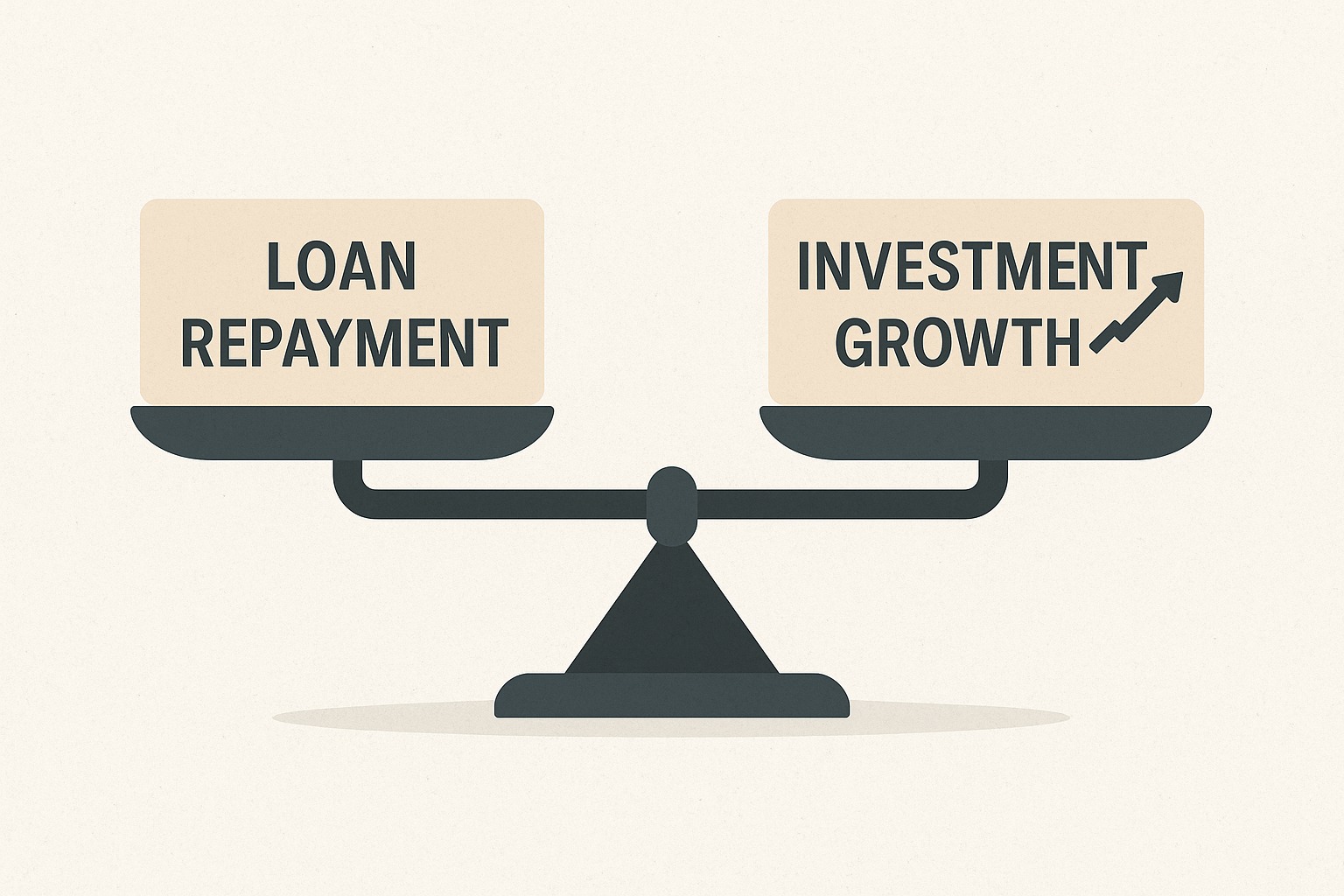
One of the most common financial dilemmas is whether to use surplus money to pay off existing loans faster or invest that money for future growth. There is no universal answer because the right choice depends on a combination of mathematics, behaviour, cash flow stability, risk appetite, and life goals. The smartest decision blends logic with personal comfort.
To make an informed choice, let’s break down the analysis into key components.
Understanding the Core Trade-Off
When you prepay loans, you save guaranteed interest cost.
When you invest, you earn potential returns that are not guaranteed.
So, the battle is between:
Guaranteed savings vs Probable gains
Key Factors to Consider
1️⃣ Interest Rate on the Loan vs Expected Return on Investment
This is the most crucial financial comparison.
If loan interest is higher than expected investment return, repay loan earlier.
If investment return is higher than loan interest, consider investing.
Example comparison logic:
| Loan Type | Typical Rate | Action |
|---|---|---|
| Credit Card Dues | Very High | Pay off immediately |
| Personal Loan | Medium to High | Pay off faster |
| Car/Consumer Loan | Medium | Consider repayment |
| Home Loan | Lower (often) | Compare with investment return |
2️⃣ Your Cash-Flow Comfort & Emergency Fund
If paying off debt leaves you with no safety cushion, you become financially vulnerable.
Always maintain 3–6 months of essential expenses before aggressive prepayment.
3️⃣ Tax Benefits & Loan Structure
Some loans (like home loans or education loans) may provide tax deductions, reducing effective interest.
If tax benefit makes the final interest lower than expected market returns, investing may be smarter.
4️⃣ Risk Tolerance & Emotional Comfort
Money decisions aren’t only mathematical — mindset matters.
Ask yourself:
Does the existence of debt cause stress, even if manageable?
Do you sleep better debt-free, or do you love market growth opportunities?
5️⃣ Tenure Remaining
Early repayments save more interest, while late-stage payments save less.
Prepaying within the first half of the loan tenure provides biggest savings.
Decision Framework (Simple Rule)
| Condition | Better Choice |
|---|---|
| Loan interest > Expected return | Pay off loan |
| Loan interest < Expected return and risk tolerance high | Invest |
| No emergency fund | Build emergency fund first |
| Unsecured loans outstanding | Close loans first |
| High stress due to debt | Pay off loans faster |
| Stable income + long-term horizon | Invest strategically |
Hybrid Strategy (Best of Both Worlds)
You don’t have to choose only one — many experts recommend a balanced dual approach:
✔ Build emergency savings
✔ Prepay high-interest loans
✔ Invest surplus systematically
✔ Continue minimal EMI on low-rate loans
This gives growth + safety + discipline.
❓ FAQs
Q1: Is it always better to prepay loans first?
Not always. It depends on loan type, interest rate, emotional comfort, and investment return expectations.
Q2: Should I stop investing until all loans are closed?
Not necessary. You may continue basic investments (like retirement funds) while paying off debt.
Q3: Should emergency funds come before loan prepayment?
Yes — financial safety should come first.
Q4: Are lump-sum prepayments better than increasing EMI?
Both work, but lump-sums save more if paid early. A hybrid approach is ideal.
Q5: What’s the thumb-rule interest cutoff?
If your loan interest rate is above ~10–12%, early repayment usually makes stronger financial sense.
Published on : 17th November
Published by : SMITA
www.vizzve.com || www.vizzveservices.com
Follow us on social media: Facebook || Linkedin || Instagram
🛡 Powered by Vizzve Financial
RBI-Registered Loan Partner | 10 Lakh+ Customers | ₹600 Cr+ Disbursed