

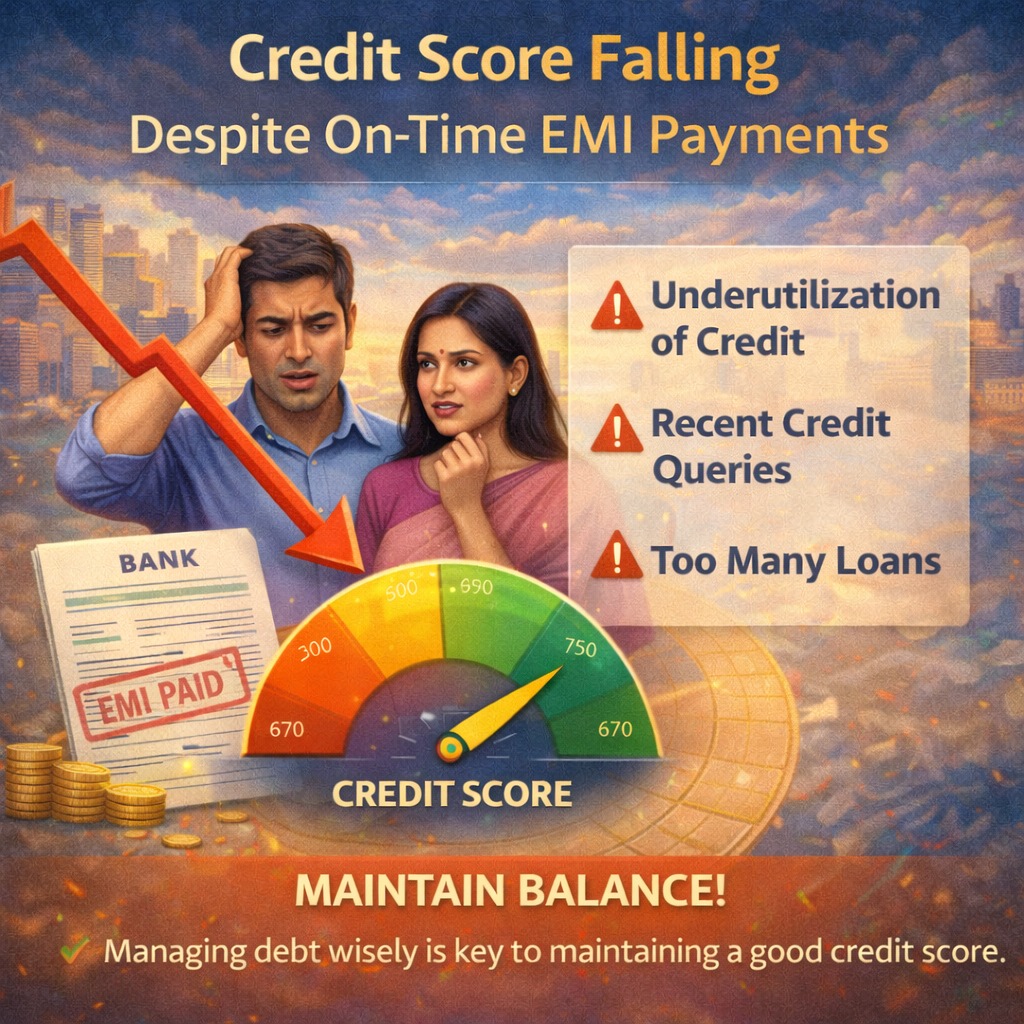
You pay your EMIs on time.
You don’t default.
You’re careful with money.
Yet one day, you check your credit score—and it has fallen.
This is one of the most confusing and frustrating experiences for borrowers. The truth is: credit scores don’t only react to “big mistakes.” They also respond to small, often invisible behaviours that most people overlook.
Let’s break down why credit scores fall even when you think you’re doing everything right—and what to fix in 2026.
AI Answer Box
Credit scores can fall even when EMIs are paid on time due to high credit card utilization, multiple loan enquiries, changes in credit mix, account closures, or errors in credit reports. Credit scores reflect overall behaviour, not just payment punctuality.
Quick Summary Box
On-time payments alone aren’t enough
Credit card usage matters a lot
Multiple enquiries quietly hurt scores
Credit report errors are common
Small actions can cause big drops
The Biggest Myth About Credit Scores
❌ Myth: “If I pay EMIs on time, my credit score will always improve.”
✅ Reality:
Payment history is crucial—but it’s only one part of the credit score formula.
Credit scores also measure:
How much credit you use
How often you apply
How stable your credit profile is
How recent your activity looks
Real Reasons Your Credit Score Falls (Even with Good Behaviour)
1. High Credit Card Utilization (The Silent Killer)
Even if you pay your card bills fully, using too much of your limit hurts your score.
Why?
Lenders see high usage as financial stress
Safe rule:
Below 30% = healthy
Above 50% = risky
👉 Paying later doesn’t erase the risk signal.
2. Multiple Loan or Credit Card Enquiries
Applying “just to check eligibility” creates hard enquiries.
Impact:
Each enquiry slightly reduces score
Multiple enquiries signal desperation
Common mistake:
Applying to several apps in a short time.
3. Closing Old Credit Cards or Loans
This feels responsible—but can backfire.
Why closing accounts hurts:
Shortens credit history
Increases utilization ratio
Reduces credit depth
Older accounts actually support your score.
4. Change in Credit Mix
Credit scores prefer balance.
Example:
Only credit cards → risky
Only loans → limited profile
A sudden shift (like closing a loan) can temporarily reduce your score.
5. Credit Report Errors (More Common Than You Think)
Many borrowers lose points due to:
Incorrect late payments
Loans shown as active after closure
Wrong personal details
Reality:
You may be punished for a mistake that isn’t yours.
6. Paying Only the Minimum Due
Minimum payment avoids default—but:
Interest piles up
Utilization stays high
Score suffers gradually
This is a slow credit leak.
7. No Recent Credit Activity
Yes—doing nothing can also hurt.
Long periods of inactivity may signal:
Dormant credit profile
Low engagement
Occasional, responsible usage keeps the profile “alive.”
Credit Habits vs Score Impact
| Habit | Feels Right | Actual Impact |
|---|---|---|
| Paying EMIs on time | ✅ | Positive |
| Using full card limit | ❌ | Negative |
| Closing unused cards | ❌ | Negative |
| Multiple loan checks | ❌ | Negative |
| Checking credit report | ✅ | Neutral |
| Paying minimum dues | ❌ | Negative |
Expert Commentary: Credit Scores Measure Risk, Not Effort
“Credit scores don’t reward intention. They measure risk patterns. Many ‘good’ habits look risky when viewed through data models.”
— Credit Risk Analyst
How to Stop Unexplained Credit Score Drops
Step-by-Step Fix:
Keep card usage below 30%
Avoid frequent loan enquiries
Don’t close old accounts unnecessarily
Pay credit cards in full
Check credit report once a quarter
Dispute errors immediately
Credit Health Checklist for 2026
| Area | Ideal Practice |
|---|---|
| EMI payments | On time |
| Card utilization | <30% |
| Loan enquiries | Minimal |
| Old accounts | Keep active |
| Credit report | Review quarterly |
Key Takeaways
Credit scores react to patterns, not intentions
On-time payment is necessary—but not sufficient
Credit cards influence scores heavily
Small actions create silent damage
Awareness is the best protection
❓ Frequently Asked Questions (FAQs)
1. Can my credit score fall even if I pay on time?
Yes, due to utilization, enquiries, or profile changes.
2. Does checking my credit score reduce it?
No, self-checks never affect your score.
3. Why did my score drop after closing a credit card?
It reduces credit history length and raises utilization.
4. Is high spending bad if I repay fully?
Yes, if usage crosses safe limits.
5. How often should I check my credit report?
At least once every 3–6 months.
6. How long does a credit score drop last?
Minor drops recover in 1–3 months with discipline.
7. Are credit score drops permanent?
No, most are temporary and reversible.
8. What’s the fastest way to stabilize my score?
Reduce utilization and avoid new enquiries.
Conclusion: Credit Scores Reward Awareness, Not Assumptions
If your credit score fell despite “doing everything right,” you’re not careless—you’re uninformed about hidden credit rules.
Once you understand how credit systems think, you stop fighting your score—and start guiding it.
📌 In 2026, smart borrowers don’t guess—they monitor, adjust, and stay consistent.
Published on : 1st January
Published by : SMITA
www.vizzve.com || www.vizzveservices.com
Follow us on social media: Facebook || Linkedin || Instagram
🛡 Powered by Vizzve Financial
RBI-Registered Loan Partner | 10 Lakh+ Customers | ₹600 Cr+ Disbursed