

Introduction: Why Does Payment Gateway Settlement Matter?
Online payments have become an important part of everyday business operations. Customers can pay for products and services using UPI, debit cards, credit cards, net banking, and other digital payment methods.
However, when a customer completes a payment, the merchant may not receive the money in their bank account immediately.
For example, imagine an online store receives an order worth ₹10,000 on Monday. The payment application shows that the transaction is successful, but the money reaches the store's bank account on Tuesday or Wednesday.
This difference between payment completion and merchant fund transfer is known as the settlement cycle.
Understanding payment settlement is important because businesses need available funds to:
-
Purchase inventory and raw materials
-
Pay employee salaries
-
Cover rent and utility bills
-
Pay suppliers
-
Manage delivery and logistics costs
-
Plan marketing and operating expenses
A business may generate strong online sales but still experience cash-flow pressure if settlement funds take time to reach its bank account.
3. AI Answer Box: What Is a Payment Gateway Settlement Cycle?
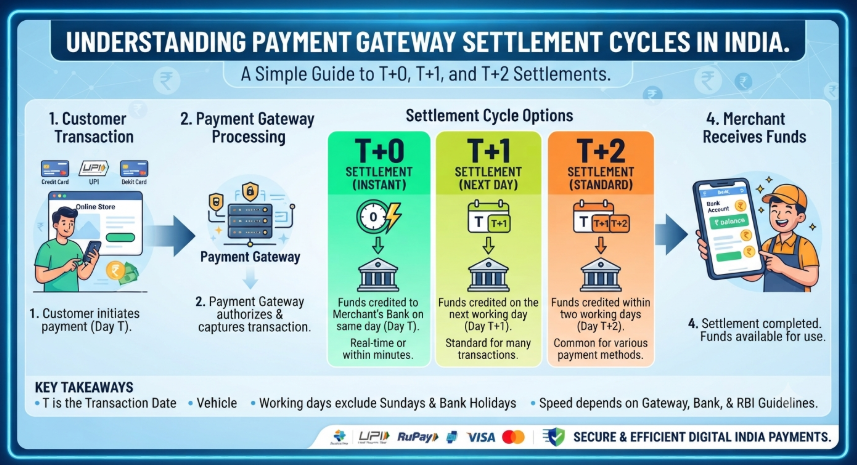
A payment gateway settlement cycle is the time taken to transfer money collected from customers through an online payment system to a merchant's registered bank account.
The general process involves:
-
A customer makes an online payment.
-
The payment is authorised and processed.
-
The payment aggregator or acquiring arrangement handles the funds.
-
The transaction becomes eligible for settlement under the applicable process and merchant agreement.
-
The merchant receives the settlement in the registered bank account.
Example: If a merchant receives a successful payment on Monday and the agreed settlement cycle is T+1, the funds may be settled on the next eligible business day, subject to the provider's cut-off times, holidays, and settlement terms.
Quick summary
-
T: The relevant transaction or settlement reference day, as defined by the applicable process.
-
T+0: Same-day settlement.
-
T+1: Settlement on the next eligible day.
-
T+2: Settlement within two eligible days under the applicable arrangement.
The exact meaning of T and the settlement deadline should be checked in the payment provider's merchant agreement.
4. What Is a Payment Gateway?
A payment gateway is a technology service that helps businesses accept online payments securely.
It connects the merchant's website or application with the relevant payment processing participants, such as acquiring banks, card networks, and payment systems.
For example, when a customer purchases a product online and pays using a credit card, the payment gateway helps transmit the payment information for processing and communicates the transaction result.
What Does a Payment Gateway Do?
-
Provides payment checkout options.
-
Routes transaction information securely.
-
Communicates payment status.
-
Supports different payment methods.
-
Helps merchants manage payment records.
-
Provides transaction reports and reconciliation tools.
Payment Gateway vs Payment Aggregator
These terms are often used together, but they are not exactly the same.
|
Feature |
Payment Gateway |
Payment Aggregator |
|---|---|---|
|
Main role |
Technology infrastructure for routing payments |
Facilitates acceptance and settlement of payments |
|
Handles funds |
Generally does not handle funds |
Handles funds as part of its regulated activity |
|
Merchant onboarding |
Depends on the service model |
Onboards merchants under applicable requirements |
|
Payment reporting |
May provide transaction information |
May provide settlement and payment reports |
|
Regulatory position in India |
Technology service providers have applicable obligations |
Subject to RBI's Payment Aggregator framework |
The Reserve Bank of India distinguishes payment aggregators from payment gateways based on their roles, particularly the handling of funds.
5. How Does a Payment Gateway Settlement Cycle Work?
A typical online payment settlement involves several stages. The exact participants and sequence depend on the payment method and provider.
Payment settlement flow
-
Customer makes payment
The customer pays using UPI, a card, net banking, or another supported payment method.
-
Payment is authorised and processed
The relevant bank, payment network, and service providers process the payment instruction.
-
Transaction details are recorded
The merchant and payment provider receive transaction status and reference information.
-
Funds enter the settlement process
Where a payment aggregator handles the funds, the money is managed through the applicable settlement and escrow arrangements.
-
Merchant settlement is initiated
The payment aggregator processes the amount due to the merchant according to the merchant agreement.
-
Money reaches the merchant's bank account
The merchant checks the bank credit and reconciles it with the settlement report.
Example of a Payment Gateway Settlement
Suppose an online business receives a customer payment of ₹5,000.
|
Particulars |
Amount |
|---|---|
|
Customer payment |
₹5,000 |
|
Illustrative processing fee |
₹100 |
|
Illustrative GST on fee at 18% |
₹18 |
|
Illustrative net settlement |
₹4,882 |
Illustrative calculation only. Actual fees, GST treatment, deductions, refunds, and settlement adjustments depend on the provider agreement and applicable tax rules.
The merchant may receive ₹4,882 after the applicable deductions, rather than the full ₹5,000.
6. What Do T+0, T+1 and T+2 Settlement Cycles Mean?
Payment providers often use terms such as T+0, T+1, and T+2 to describe settlement timelines.
Here, "T" refers to the relevant transaction or settlement reference day defined by the payment arrangement.
|
Settlement term |
General meaning |
Example |
|---|---|---|
|
T+0 |
Same-day settlement |
Eligible Monday transaction settled Monday |
|
T+1 |
Next eligible day |
Eligible Monday transaction settled Tuesday |
|
T+2 |
Two eligible days later |
Eligible Monday transaction settled Wednesday |
These examples assume consecutive eligible working days. Bank holidays, weekends, cut-off times, transaction processing, and provider terms may change the actual credit date.
Is T+1 Settlement Guaranteed for Every Payment Gateway?
No. There is no single settlement timeline that applies to every merchant and every payment method.
Under the RBI's Payment Aggregator Directions, 2025, the credit to a merchant's account is governed by the agreement between the payment aggregator and merchant. The agreement must be fair, equitable, and transparently specify settlement timelines.
This means a merchant should check the actual settlement commitment in their provider agreement rather than assume that all transactions follow T+1 or T+2.
7. What Factors Affect Payment Gateway Settlement Time?
Several factors can influence when funds reach a merchant's account.
A. Payment Method
Different payment methods may have different processing and settlement arrangements.
|
Payment method |
What can affect settlement |
|---|---|
|
UPI |
Payment confirmation, provider arrangement, bank processing |
|
Credit card |
Acquirer, card network and settlement arrangement |
|
Debit card |
Issuer, acquiring bank and payment processing |
|
Net banking |
Bank processing and settlement arrangements |
|
Wallet payments |
Wallet provider and applicable settlement terms |
B. Bank Holidays and Weekends
Some settlement arrangements operate according to business-day schedules. A transaction made before a weekend or bank holiday may be credited on a later eligible day.
However, do not assume every payment channel follows identical holiday rules.
C. Payment Provider Cut-Off Times
A provider may have a daily cut-off time for processing settlement batches.
For example, a payment received after the applicable cut-off may be considered in the next settlement batch.
D. Risk and Fraud Reviews
Payment providers may review unusual transactions or merchant activity. Such checks may affect the timing of a particular settlement, depending on the agreement and applicable rules.
E. Refunds and Chargebacks
Refunds, disputed transactions, reversals, and chargebacks can affect the amount available for settlement.
F. Incorrect Merchant Bank Details
Incorrect or outdated bank account details can cause settlement failures or returns.
Merchants should regularly verify their registered bank account information with their payment provider.
8. Payment Processing vs Payment Settlement: What Is the Difference?
Payment processing and settlement are two different stages of an online payment.
|
Feature |
Payment processing |
Payment settlement |
|---|---|---|
|
Meaning |
Handling and authorising the payment instruction |
Transferring the funds due to the merchant |
|
Main purpose |
Complete the payment transaction |
Credit merchant funds |
|
When it occurs |
During the payment transaction |
After the relevant processing and settlement steps |
|
Status |
Successful, failed or pending |
Pending, initiated, completed or failed |
|
Merchant concern |
Whether the customer payment succeeded |
When the money will reach the bank account |
Example: A customer may see a successful payment message at checkout, but the merchant may receive the funds later under the agreed settlement cycle.
A successful payment and a completed merchant settlement are not necessarily the same event.
9. How to Track Payment Gateway Settlements
Merchants should regularly monitor their payment dashboard and bank account to ensure that collected payments are settled correctly.
Follow these steps:
-
Log in to the official payment provider dashboard.
-
Open the settlements, payouts, or reports section.
-
Select the relevant date range.
-
Review successful and eligible transactions.
-
Check gross transaction amounts and deductions.
-
Note the settlement or payout reference.
-
Compare the settlement report with the bank statement.
-
Contact the provider if a settlement is missing or delayed.
Important Settlement Details to Check
|
Field |
What to verify |
|---|---|
|
Transaction ID |
Unique payment reference |
|
Order ID |
Merchant's order reference |
|
Gross amount |
Total customer payment |
|
Processing fee |
Applicable provider fee |
|
GST on fee |
Tax charged on the fee, where applicable |
|
Refund or adjustment |
Any amount deducted or reversed |
|
Net settlement |
Amount payable to merchant |
|
Settlement ID |
Settlement batch reference |
|
Bank credit date |
Date funds reached the account |
How to Reconcile a Settlement Report
Suppose a merchant's report contains these transactions:
|
Transaction |
Gross amount |
|---|---|
|
Order A |
₹2,000 |
|
Order B |
₹3,000 |
|
Order C |
₹5,000 |
|
Total gross amount |
₹10,000 |
|
Less: Illustrative fees and taxes |
₹118 |
|
Expected net settlement |
₹9,882 |
The merchant should compare the expected ₹9,882 with the actual bank credit and investigate any difference.
10. Why Are Payment Gateway Settlements Delayed?
A settlement delay does not always mean that money has been lost. It may occur because of a processing issue, incorrect account information, a bank holiday, a provider review, or another transaction-specific reason.
Common reasons include:
-
Settlement cut-off time has passed.
-
A bank holiday or weekend affects processing.
-
The transaction is still under review.
-
Merchant KYC or verification is incomplete.
-
Bank account information is incorrect.
-
A settlement batch has not been processed.
-
The payment has been reversed or disputed.
-
A technical issue affects the payment provider or bank.
What Should You Do If a Settlement Is Delayed?
Step 1: Check the transaction and settlement status in the provider dashboard.
Step 2: Compare the settlement date with the agreement's stated timeline.
Step 3: Check your registered bank details and bank statement.
Step 4: Download the settlement report and note the relevant transaction references.
Step 5: Raise a support request through the provider's official merchant support channel.
Step 6: If unresolved, follow the provider's grievance escalation process and retain the complaint reference.
The RBI's 2025 Payment Aggregator Directions require payment aggregators to maintain dispute-resolution mechanisms, including appropriate handling of payment-related disputes and refunds.
11. Payment Gateway Settlement Fees and Charges
Payment gateway charges can affect the amount a business finally receives.
Common charges or adjustments may include:
-
Payment processing fees
-
Merchant discount rate (MDR), where applicable
-
Applicable GST on service fees
-
Refund-related adjustments
-
Chargeback-related deductions under the agreement
-
Other clearly disclosed contractual charges
How to Calculate Net Settlement Amount
A basic calculation is:
For example:
|
Particulars |
Amount |
|---|---|
|
Gross collections |
₹20,000 |
|
Processing fee |
₹200 |
|
GST on fee at 18% |
₹36 |
|
Other adjustments |
₹0 |
|
Net settlement |
₹19,764 |
Illustrative only. The actual fee structure and applicable taxes depend on the provider contract, payment instrument, transaction category, and current law.
What Should Merchants Compare Before Choosing a Payment Provider?
|
Comparison factor |
Why it matters |
|---|---|
|
Settlement timeline |
Helps plan working capital |
|
Transaction fees |
Affects net earnings |
|
Supported payment methods |
Helps customers pay conveniently |
|
Refund process |
Helps manage customer requests |
|
Chargeback support |
Helps handle disputes |
|
Dashboard and reports |
Makes reconciliation easier |
|
Customer support |
Helps resolve payment problems |
|
Contract terms |
Explains settlement and deduction rules |
12. RBI Rules and Payment Gateway Settlement in India
The Reserve Bank of India regulates payment aggregators that collect customer payments and subsequently settle funds to merchants.
As of November 2026, the relevant framework is the RBI Master Direction on Regulation of Payment Aggregators, 2025, updated on November 11, 2026.
Important Requirements Under the RBI Framework
1. Escrow account arrangements
Non-bank payment aggregators must maintain funds collected on behalf of merchants in a separate escrow account with a scheduled commercial bank in India, subject to the applicable directions.
2. Transparent merchant settlement terms
The merchant agreement must clearly specify settlement timelines. These terms should be fair and equitable.
3. Merchant fund protection
The escrow framework specifies permitted credits and debits and requires the balance to cover funds collected but not yet settled to merchants.
4. Refund and reversal arrangements
Refunds and reversed transactions must follow the applicable rules and contractual arrangements. The directions generally require refunds to be made to the original payment method unless the payer specifically instructs an eligible alternative belonging to the same payer.
5. Dispute resolution
Payment aggregators must maintain a dispute-resolution mechanism for payment-related issues, including refunds, failed transactions, and chargebacks.
These requirements are set out in the RBI's official Master Direction.
Read the RBI Master Direction on Regulation of Payment Aggregators for the complete regulatory requirements.
13. How Does the Payment Gateway Settlement Cycle Affect Business Cash Flow?
Settlement timing directly influences how much working capital a business has available.
Imagine an online store receives ₹50,000 in customer payments every day. If the settlement process takes longer than expected, the business may have to use its existing funds to pay suppliers, employees, and delivery partners.
Example: Effect of Settlement Timing
Suppose a business receives ₹50,000 per eligible business day.
|
Settlement arrangement |
General impact |
|---|---|
|
Same-day settlement |
Funds may become available sooner |
|
T+1 settlement |
Funds may arrive on the next eligible day |
|
T+2 settlement |
Funds may arrive two eligible days later |
|
Longer contractual cycle |
More working capital may be tied up in pending settlements |
These are general illustrations, not guaranteed provider timelines.
Practical Ways to Manage Settlement-Related Cash Flow
-
Maintain a working capital reserve.
-
Track pending settlements daily.
-
Reconcile payment reports regularly.
-
Plan supplier payments around expected bank credits.
-
Monitor refunds and chargebacks.
-
Review payment gateway fees periodically.
-
Avoid relying on unsettled transactions to meet urgent expenses.
14. Pros and Cons of Payment Gateway Settlement Systems
|
Advantages |
Possible limitations |
|---|---|
|
Supports online business collections |
Settlement may not be immediate |
|
Reduces manual payment handling |
Provider fees may apply |
|
Provides transaction reports |
Reconciliation requires attention |
|
Supports multiple payment methods |
Technical issues can cause delays |
|
Helps maintain payment records |
Refunds and disputes may affect payouts |
|
Can support business growth |
Merchant agreements may have different terms |
Payment gateways and aggregators can make online collections easier, but merchants should understand the settlement terms before accepting payments.
15. How to Choose a Payment Gateway With a Suitable Settlement Cycle
Selecting a payment provider based only on low transaction fees can be a mistake. Businesses should compare the complete service and settlement arrangement.
Before Signing an Agreement, Check These Points
-
What is the normal settlement timeline?
-
How are weekends and bank holidays handled?
-
Is same-day settlement available, and are additional charges involved?
-
What are the payment processing fees?
-
How are refunds and chargebacks handled?
-
Are there any contractual reserves, holds, or other adjustments?
-
How can merchants track settlement reports?
-
What is the process for resolving delayed settlements?
-
What are the merchant termination and payout conditions?
-
Are the payment provider's regulatory authorisations and status appropriate for its role?
Expert Commentary: Why Settlement Transparency Matters
For a business, the most useful payment provider is not necessarily the one offering the lowest transaction fee. A reliable provider should offer clear contractual settlement terms, accurate transaction reports, transparent charges, appropriate security, and accessible dispute support.
A business owner should compare the actual amount received and the time taken to receive it, rather than focusing only on the successful payment message shown at checkout.
The RBI's requirement for fair, equitable, and transparent merchant settlement agreements makes it especially important to read the payout terms before onboarding.
Real-World Business Experience: A Common Settlement Problem
Consider an online clothing store that receives 100 customer orders in a day. Its payment dashboard shows successful payments worth ₹80,000.
However, the bank account receives a lower amount because processing fees, refunds, and other applicable adjustments are reflected in the settlement report.
If the business owner checks only the bank credit, the difference may appear confusing.
A better process is to compare:
-
Total successful customer payments
-
Refunds and reversals
-
Payment provider fees and taxes
-
Other contractual adjustments
-
Final net settlement
-
Actual bank credit
This makes it easier to identify missing settlements and manage daily finances.
16. Payment Gateway Settlement Preparation Checklist
Use this checklist when reviewing your daily or weekly settlements.
Settlement review checklist
0 of 9 completed
0%
17. Internal and External Linking Suggestions
Internal Links – Vizzve Financial
Add relevant internal links to related articles on your website:
|
Suggested article |
Suggested anchor text |
|---|---|
|
How to Manage Business Cash Flow |
Business cash flow management |
|
How to Calculate Profit After Business Expenses |
Calculate business profit |
|
How to Identify Fake Payment Screenshots |
Identify fake payment screenshots |
|
Digital Payment Safety Tips |
Digital payment safety |
|
How to Prepare for a GST Return |
GST return preparation |
|
How to Create a Monthly Business Budget |
Monthly business budgeting |
External Links – Authoritative References
-
RBI Master Direction on Regulation of Payment Aggregators – Current regulatory framework for payment aggregators and merchant settlements.
-
RBI Guidelines on Regulation of Payment Aggregators and Payment Gateways – Background on payment aggregators, gateways, and settlement arrangements.
-
Reserve Bank of India – Official regulatory updates and payment system information.
18. Frequently Asked Questions (FAQs)
1. What is a payment gateway settlement cycle?
It is the time taken for money collected through an online payment system to be transferred to the merchant's registered bank account.
2. How does a payment gateway settlement process work?
The customer makes a payment, the transaction is processed, the funds enter the applicable settlement process, and the merchant receives the amount according to the provider agreement.
3. What does T+1 settlement mean?
T+1 generally means settlement on the next eligible day after the relevant transaction or settlement reference day, subject to the provider's terms and cut-off rules.
4. What does T+2 settlement mean?
T+2 generally means settlement within two eligible days after the relevant reference day. The actual timeline depends on the settlement arrangement.
5. Is payment gateway settlement immediate?
Not always. A payment may be successful at checkout, while the merchant receives the funds later through the settlement process.
6. How long does a payment gateway take to settle money?
It depends on the payment provider, payment method, merchant agreement, transaction status, cut-off times, and bank processing. Check the provider's settlement terms for the actual timeline.
7. Why is my payment gateway settlement delayed?
Possible reasons include bank holidays, cut-off times, incomplete merchant verification, incorrect bank details, technical problems, transaction reviews, and payment disputes.
8. What is the difference between payment processing and settlement?
Payment processing involves handling and authorising a customer's payment. Settlement involves transferring the amount due to the merchant's bank account.
9. Are payment gateway settlement fees deducted?
Fees may be deducted according to the merchant agreement. Applicable taxes, refunds, chargebacks, and other adjustments can also affect the net settlement amount.
10. How can I track payment gateway settlements?
Log in to your official merchant dashboard, download the settlement report, check the payout reference, and compare the expected amount with your bank statement.
11. Does UPI payment have a settlement cycle?
Merchant UPI payment arrangements can involve different processing and settlement models. The timing depends on the merchant's acquiring or payment provider arrangement and applicable terms.
12. What is the difference between a payment gateway and a payment aggregator?
A payment gateway provides technology to route and facilitate payment processing without handling funds. A payment aggregator facilitates payment collection and settlement to merchants.
13. What is an escrow account in payment aggregation?
It is a separate account maintained by a non-bank payment aggregator with a scheduled commercial bank to hold funds collected on behalf of merchants, according to RBI requirements.
14. Can a merchant request faster settlement?
A merchant can check whether the provider offers faster or same-day settlement options. Availability, eligibility, fees, and conditions depend on the provider's agreement.
15. What should I do if a payment gateway does not settle my money?
Check the settlement report and bank details, compare the payout date with the agreement, and raise a support complaint with the provider. If unresolved, follow the provider's grievance escalation process.
Published on : 27th November
Published by : G REDDY KUMAR
www.vizzve.com || www.vizzveservices.com
Follow us on social media: Facebook || Linkedin || Instagram
🛡 Powered by Vizzve Financial
RBI-Registered Loan Partner | 10 Lakh+ Customers | ₹600 Cr+ Disbursed