

Introduction
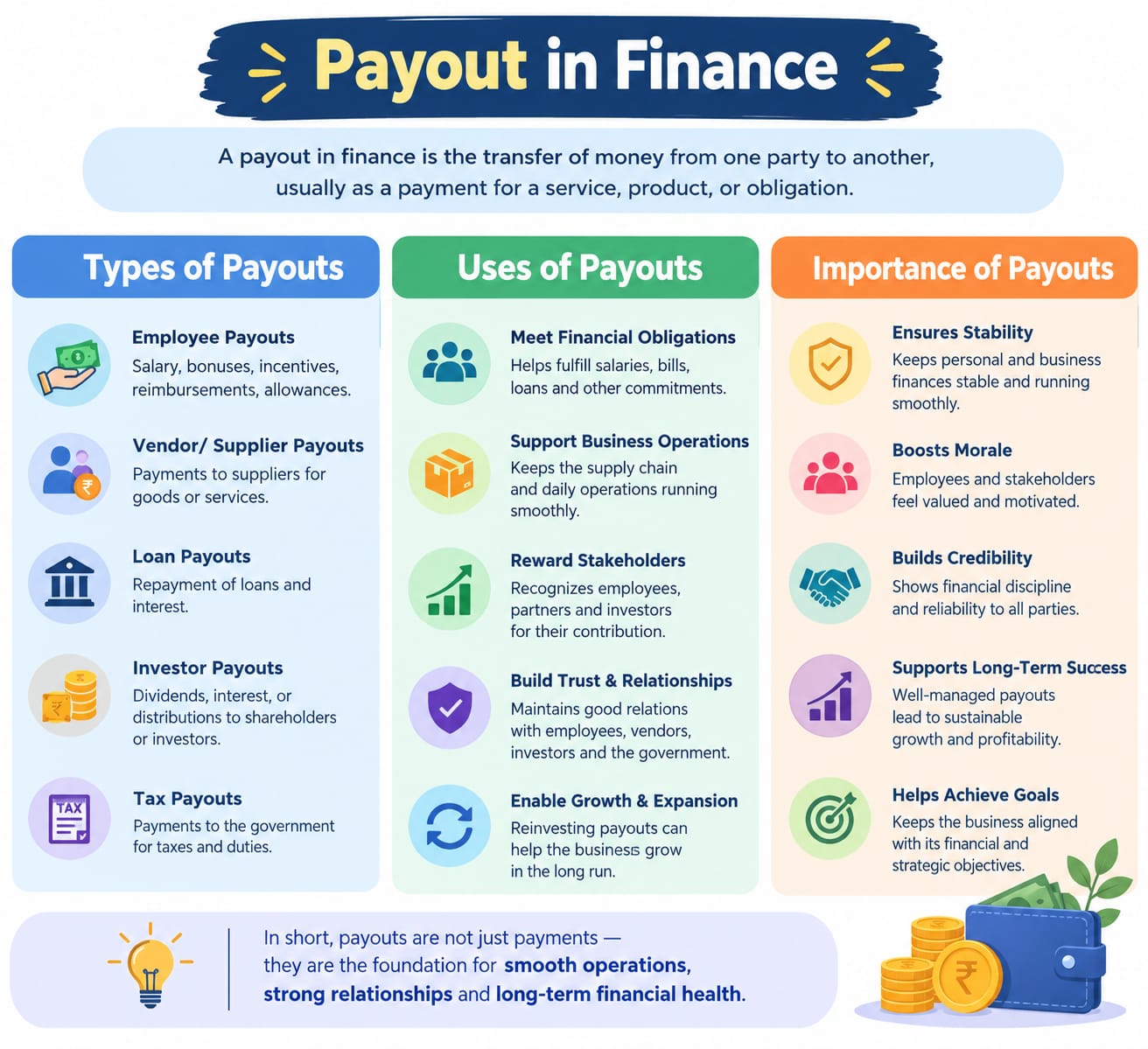
A payout in finance refers to the distribution or transfer of money from a company, financial institution, insurer, investment platform, or other organisation to a recipient. Payouts can occur in many situations, including insurance claim settlements, employee payments, vendor payments, investment distributions, dividends and marketplace settlements.
Understanding payouts is important because they directly affect cash flow, investment income, financial planning and business operations. The amount, timing and method of a payout generally depend on the underlying agreement, financial product or transaction.
What Is a Payout in Finance?
A payout is the outflow of money or financial assets to an individual or organisation.
For example:
- An insurance company pays an approved claim to a policyholder.
- A company distributes dividends to shareholders.
- A marketplace transfers money to a seller after a sale.
- A business pays a supplier for goods or services.
- An employer transfers salary to an employee.
In simple terms, a payout is money being paid out to an eligible recipient.
A payout is different from a customer payment or pay-in. A payment may represent money coming into a business, while a payout generally describes money being disbursed from the business or platform to another party.
How Does a Payout Work?
The payout process can vary depending on the type of transaction, but it generally follows these steps:
1. A payout becomes due
A triggering event occurs. This could be an approved insurance claim, completed sale, salary date or declared dividend.
2. Eligibility is verified
The payer checks the recipient's details and confirms that the conditions for payment have been met.
3. The payout amount is calculated
The amount may be fixed or calculated according to a contract, claim, sales transaction, investment holding or other financial terms.
4. Payment is processed
The payer initiates the transfer through a suitable payment channel.
5. Funds reach the recipient
The money is credited to the recipient's bank account, wallet or another approved payment method.
The exact processing time can vary according to the payment method and financial institution.
Types of Payouts in Finance
Payouts can take several forms depending on their purpose.
1. Insurance Payout
An insurance payout is money paid by an insurer after an eligible claim is approved. It may apply to life, health, motor, property and other types of insurance.
The amount depends on the policy terms, coverage, exclusions and claim assessment.
2. Dividend Payout
A dividend payout is a distribution made by a company to eligible shareholders. Dividends may be paid in cash or, in some cases, through additional shares.
For example, if an investor owns 100 shares and receives a ₹5 dividend per share, the gross dividend payout would be ₹500.
3. Salary and Employee Payouts
Businesses make employee payouts in the form of salaries, wages, bonuses, commissions and eligible reimbursements.
These payments form an important part of a company's regular cash-flow management.
4. Vendor Payouts
Vendor payouts are payments made to suppliers or service providers for products or services supplied to a business.
Timely vendor payouts can help businesses maintain supplier relationships and support uninterrupted operations.
5. Marketplace Payouts
E-commerce and digital platforms may collect money from customers and subsequently transfer the applicable amount to sellers, creators, contractors or other participants.
The platform may deduct applicable fees, refunds or adjustments before releasing the payout.
6. Investment Payouts
Investment-related payouts can include distributions such as dividends, interest income or other amounts generated by an investment product.
The payment structure depends on the specific investment and its terms.
7. Customer Refund Payouts
Businesses may issue payouts when customers are entitled to refunds following cancellations, returns or other qualifying circumstances.
Payout vs Payment
Although the terms are sometimes used interchangeably, they can describe different stages or directions of a financial transaction.
| Feature | Payout | Payment |
|---|---|---|
| Meaning | Money distributed to a recipient | Transfer of money for a transaction or obligation |
| Direction | Generally an outgoing disbursement | Can be incoming or outgoing |
| Example | Insurer paying a claim | Customer paying for a product |
| Common users | Businesses, insurers, platforms, investment firms | Individuals and businesses |
| Main purpose | Distribute or release funds | Complete a financial transaction |
A payout therefore focuses on the disbursement of funds to the recipient.
What Is a Payout Ratio?
In investment and corporate finance, payout ratio has a more specific meaning. It measures the proportion of a company's earnings distributed to shareholders as dividends.
Payout Ratio Formula
Payout Ratio = (Dividends ÷ Net Income) × 100
For example, if a company earns ₹100 crore and distributes ₹40 crore as dividends:
Payout Ratio = (₹40 crore ÷ ₹100 crore) × 100 = 40%
A company retains the remaining earnings for purposes such as business expansion, debt reduction or other corporate needs.
The payout ratio should be interpreted alongside profitability, cash flow, debt levels, business requirements and dividend policy rather than viewed in isolation.
Importance of Payouts in Finance
Payouts are important for both individuals and businesses.
1. Supports Cash Flow Management
Businesses need to plan outgoing payments carefully to maintain adequate liquidity.
2. Provides Income to Recipients
Dividends, insurance settlements, salaries and investment distributions can provide recipients with funds for their financial needs.
3. Helps Fulfil Financial Obligations
Payouts allow organisations to meet contractual and operational commitments to employees, vendors, investors and customers.
4. Improves Financial Transparency
Properly recorded payouts create a clear trail of money moving out of an organisation.
5. Supports Investment Planning
Investors may consider expected distributions when assessing investments and planning future cash flows.
6. Enables Digital Financial Operations
Modern payment infrastructure allows businesses to automate and track many payout processes, including bulk and recurring transfers.
Examples of Payouts
| Situation | Payout Recipient | Example |
|---|---|---|
| Insurance claim | Policyholder | ₹2 lakh claim settlement |
| Dividend | Shareholder | ₹5 per share |
| Salary | Employee | Monthly salary |
| Vendor payment | Supplier | Payment for inventory |
| Marketplace settlement | Seller | Sale proceeds after deductions |
| Refund | Customer | Amount returned after cancellation |
Factors That Can Affect a Payout
Several factors may influence the amount and timing of a payout:
- Terms and conditions of the agreement
- Eligibility requirements
- Available funds
- Verification and compliance checks
- Payment method
- Transaction processing time
- Applicable fees
- Taxes and statutory deductions
- Refunds, adjustments or reversals
- Banking or payment-network issues
For international payouts, currency conversion, local regulations and cross-border payment requirements may also affect the final amount or timing.
Benefits of Efficient Payout Management
Efficient payout management can help organisations:
- Reduce manual payment errors
- Improve cash-flow visibility
- Process payments faster
- Maintain accurate financial records
- Improve vendor and employee relationships
- Track transactions more effectively
- Support reconciliation and reporting
- Strengthen financial controls
Businesses increasingly use automated payout systems to manage large numbers of transactions and reduce administrative work.
Payout in Finance: Key Takeaways
- A payout is generally the distribution or disbursement of money to a recipient.
- Payouts are used in insurance, investments, payroll, marketplaces and business operations.
- Dividend payouts provide shareholders with distributions from a company's profits or eligible reserves.
- Insurance payouts are generally made after eligible claims are processed and approved.
- A payout ratio measures the proportion of net income distributed as dividends.
- Payout timing depends on the transaction type, payment method and applicable conditions.
- Effective payout management can improve cash-flow control and operational efficiency.
Frequently Asked Questions
What does payout mean in finance?
Payout means the distribution or disbursement of money or financial assets from a payer to an eligible recipient.
What is an example of a payout?
An insurance claim settlement, dividend paid to a shareholder, salary paid to an employee or money transferred to an online seller can all be examples of payouts.
What is a payout ratio?
Payout ratio measures the percentage of a company's net income distributed to shareholders as dividends.
Is a payout the same as a payment?
Not always. A payout generally refers to money being disbursed to a recipient, while payment is a broader term for transferring money to settle a transaction or obligation.
What are common types of payouts?
Common types include insurance payouts, dividend payouts, salary payouts, vendor payouts, marketplace payouts, investment distributions and customer refunds.
How is a dividend payout calculated?
A simple dividend payout can be calculated as the dividend per share multiplied by the number of eligible shares held.
Are payouts taxable?
Tax treatment depends on the type of payout, applicable laws, the recipient and the jurisdiction. Different rules may apply to dividends, salary, insurance proceeds and investment distributions.
How long does a payout take?
The timing depends on the payout type, payment method, verification requirements and financial institution or platform involved.
What is an insurance payout?
An insurance payout is the amount an insurer pays to a policyholder or eligible beneficiary after an approved covered claim.
Why are payouts important for businesses?
Payouts allow businesses to fulfil financial obligations, manage cash flow, pay employees and suppliers, distribute funds and process refunds or settlements.
What is a marketplace payout?
A marketplace payout is the transfer of funds from an online platform to a seller, creator or other eligible participant after applicable deductions or adjustments.
What is a vendor payout?
A vendor payout is a payment made by a business to a supplier or service provider for goods or services received.
Can payouts be recurring?
Yes. Salaries, dividends, interest distributions and some platform or investment payments can be recurring, depending on their terms.
What is the difference between payout and disbursement?
Both terms refer to money being paid out. "Disbursement" often emphasizes the release of funds, while "payout" commonly describes the amount or transfer received by the recipient.
What affects the final payout amount?
The final amount can depend on the underlying agreement, applicable fees, taxes, deductions, claim terms, transaction adjustments and other conditions.
Conclusion
Payouts are a fundamental part of financial transactions, connecting businesses and financial institutions with employees, customers, investors, policyholders, vendors and other recipients. From insurance claim settlements and salary payments to dividends and marketplace transfers, payouts help move money to the people or organisations entitled to receive it.
Understanding the meaning, types, calculation and importance of payouts can make financial concepts easier to understand and support better cash-flow and investment planning.
Published on : 28th September
Published by : MONISHA
www.vizzve.com || www.vizzveservices.com
Follow us on social media: Facebook || Linkedin || Instagram
🛡 Powered by Vizzve Financial
RBI-Registered Loan Partner | 10 Lakh+ Customers | ₹600 Cr+ Disbursed